• Skip to main content
  • Skip to footer

Stepping Out Of Babylon

Travel & Photography

  • About me
    • Contact
  • Destinations
    • Africa and Middle East
      • Iran
      • Lebanon
      • Morocco
      • Turkey
    • East Asia
      • China
      • Japan
      • Taiwan (Formosa)
    • South Asia
      • Bangladesh
      • India
      • Nepal
      • Sri Lanka
    • Southeast Asia
      • Cambodia
      • Indonesia
      • Lao
      • Malaysia
      • Myanmar
      • Singapore
      • Thailand
      • Vietnam
  • Itineraries
  • Travel tips
    • Border crossing
    • Hiking and Natural parks
    • Food Journey
    • Visa
  • Photography

Bali

From Bali to Lombok… by public ferry

It takes time… an enjoyable time to do nothing, a thing that we are not much used to do, and sometimes is not so easy.

Just watch the landscape, and let your mind get empty from thoughts and allow your body to relax with the trembling of the boat, while the muffed sound of the engine mix with the clash of the small waves on the ferry-boat.

The arrival to Lombok coincided with the sunset, that paint magic colors on the green hills that from this volcanic island… where the vegetation breaks through the black volcanic rocks.

Pandangbai, Bali
Pandangbai, Bali
Public ferry Bali-Lombok (Pandangbai to Lembar)

How to go from Ubud to Kuta-Lombok by public ferry?

  • First, you need to go from Ubud to Pandangbai (sometimes written as Pandang Bai). For me, the best option was the Perama bus (a kind of tourist bus), because couldn’t find any bemo in Ubud. There are 3 Perama buses a day fromUbud to Pandangbai (see photo below), I took the one at 11.30 and arrive in Lombok (Lembar pier) by ferry around the sunset.
  • The bus from Ubud to Pandangbai takes 1.5 hours and cost 75.000 Rp.
  • The Perama bus drops you very close from the pier. Just walk straight in the direction of the sea, and ignore all the guys trying to push you away from the ferryboat, offering you faster, but more expensive options.
  • As you get inside the port area, you must buy your ticket inside the building on your left side. If you need orientation try to find someone with a uniform otherwise can be one of the many touts hanging around there.
  • The ferry ticket costs 40.000 Rp. The trip took me 4.5 hours.
  • When you arrive at Lembar (Lombok) you just need to walk straight to leave the port area.
  • When I arrive I didn’t saw any public transportation, no bemo or buses, but it was already 6.30 p.m. Grab, Uber, GoJek are NOT available in Lombok. So the only way is to use the services of one of the drivers hanging around the port gate. You can walk straight until you reach the main road (nearby a supermarket) and try to get a taxi. If you are traveling alone, the best it to talk with the other travelers while you are in the boat, to see if anyone is going to the same destination as you, so you can share the ride.
  • I was going to Kuta Lombok, a less popular destination, but found other travelers going on the same way. So we walk until we reach that supermarket (Indomart I think) and there I found some drivers with a kind of old mini-vans. We were three to go to Kuta and we bargain the price to 60.000 Rp per person.
  • The road to Kuta is good and the trip took about 30 minutes in the evening.

[columns] [span6]

Schedules of the Perama buses that departure from Ubud. Perama offer a service direct to Kuta Lombok, that cost 300.000 Rp, .... but choose to take the public ferry.
Schedules of the Perama buses that departure from Ubud. Perama offer a service direct to Kuta Lombok, that cost 300.000 Rp, …. but choose to take the public ferry.

[/span6][span6]

Perama office at Ubud, where you can buy the ticket and catch the bus to Pandangbai

[/span6][/columns]

Practical information about the ferryboat from Pandangbai to Lembar:


  • Ferry Ticket: 40.000 Rp. By the ticket at the ticket counter inside the building. In Pandangbai the building is located inside the harbor area, on the left side.
  • The ferry works 24 hours.
  • It doesn’t have a departure fix schedule, but usually the ferries departure every hour, but it can take more time depending on the number of vehicles waiting for getting inside the boat… and no one seems to be in a hurry!!!
  • My trip on the ferry took, 4.5 hours but can be more if the sea conditions were rough… but I needed to wait 45 minutes until the boat were ready to departure.
  • Inside the boat there a few drinks and snacks, but if you want to avoid processed food, you can get one of the pack that some ladies are selling at the entrance of the boat, usually with fried-rice (nasi-goreng).
  • The ferry goes full of cars, but doesn’t transport many people, so you have a lot of space if you want to sleep.
  • For me is better to do the trip outside on the deck nearby the pilot cabin… if the fence is closed you can open without a problem and travel there.

For more detailed and update information:

http://www.lombok-network.com/ferry_tarrif.htm

How to go from Ubud to Kuta Lombok… costs and time

Perama bus: 7:00, 11:30, 15:00, 75.000 Rp (1.5 hours)

Ferry boat: 4.30h, 40.000 Rp

Shared Bemo: 60.000 Rp/person (minimum 2 people)

Perama Bus has a direct service from Ubud to Kuta Lombok for 300.000 Rp, including boat and bus, but for a minimum of 2 persons.

NOTE: there aren’t Uber, Grab or GoJek in Lombok!

Ticket of the public ferry Bali-Lombok (Pandangbai to Lembar)

Ubud… temples and rice fields

Rice fields, spirituality, yoga, organic and raw food, meditation… all this is part of the Ubud cliché! But despite being overwhelmed by the tourism the place is beautiful! And for sure that Ubud still has the magic touch that attracts so many visitors, that transform this rural area in one of the most popular destinations in Bali Island!

But at the first look, is hard to believe that this was a rural area less than 20 years ago, due to the concentration of shops, restaurants, cafes, hotels and guesthouses… a sequence of shops, with western orientated products, sophisticated and with high quality.

But behind this commercial activity, a bit away from the main roads of Ubud, everything is green, from the rice to the coconut trees!

Being a rural area a walk along the rice fields is a must, with the vivid green landscape creating a bright contrast with the blue sky, where the white cotton clouds aren’t enough to hide the strong sun, that makes these hikes a very sweaty experience, intensified by the strong humidity of the air at the rice fields area.

On the opposite side of the cosmopolitan and westernized lifestyle, the temples, spread a bit everywhere in Ubud, keeping a proud serenity, with their guardians watching and protecting the sacred place keep hidden behind the red brick walls.

Being Bali the only Hindu island in all Indonesia, that is the country with the biggest Muslim population, the religion here has a constant presence in everyday life, with rituals and offerings being made at home and on the temples, in order to pacify the gods and the spirits, special the evil spirits responsible for diseases and disasters. Having a strong connection with the Hinduism practiced in India, the traditions in Bali have many differences, looking almost like a different religion to a foreigner’s eyes.

Ubud_temples_DSC_3645
Pura Padang Kerta. Ubud
Ubud_temples_DSC_3315
Guardians of the temple to protect from the evil spirits. Pura Padang Kerta. Ubud

Ubud_temples_DSC_3356
Balinese temples with the rooftop made in coconut leaf fibers. Ubud
Ubud_temples_DSC_3616
Decoration of an altar in Ubud during the ceremonies that procedure the Nyepi day.
Ubud_temples_DSC_3359
Gunung Lebah Temple. Bali
Ubud_temples_DSC_3447
offerings nearby an altar. Ubud


About Ubud, many things were written and there’s a lot of information about lodging and food, but here I mention a proper budget places… not budget for two-weeks-holidays-tourists but for long term travellers, where each cents has significance 😉 So here is a simple suggestion about cheap local food, budget accommodation in a homestay.

Where to sleep in Ubud (budget option):

If you want to run away from villa, resorts and luxurious places, the best options are the homestays. There are many of this type of accommodation in Ubud, and the best is just walk around and find a sign that looks less catchy to the eyes, as this are usually the unpretentious and cheap places.

Walking down Jalan Hanoman I found this pearl between many posh options in the area: Dewi Ayu 2… don’t have any idea if exist a number 1, but this place suited me. This is a proper family homestay, very well located in the center of Ubud, with different types of rooms.

The cheapest ones (100.000 Rp) are very spacious, fan, basic furniture, cold shower and a terrace in front, where the breakfast is served, facing a garden. The place is very clean but showing the effect of the time. The breakfast include coffee, a generous portion of fruit and the “usual” banana pancakes… a standard of Indonesia tourist breakfast, don’t really know why!

The family is very friendly, and during the Nyepi day, where all the restaurants are closed, all the guests were treated with two homemade meals, cooked and offered by the grandmother… delicious and super kind!

Address: Dewi Ayu 2, Jalan Hanoman, 41, Ubud, Bali

The quiet streets of Jalan Sugriwa and Jalan Jembawan, streets parallel to Jalan Hanoman are also a good place to look for budget homestays in Ubud.

[columns] [span6]

Ubud_Dewi Ayu 2 Homestay_DSC_3295
Dewi Ayu 2 Homestay. Ubud. Bali

[/span6][span6]

Dewi Ayu Homestay. Ubud. Bali
Dewi Ayu 2 Homestay. Ubud. Bali

[/span6][/columns]

Where to eat local food for a cheap price:

Padang food: this is the budget option in terms of food in Bali. The “padang” or “masakan padang” are eateries, with a big range of food, from meat, fish, tofu, tempeh, eggs… and rice, of course! The meals can be eaten inside the restaurant or packed for take-away. The portions are generous and a meal cost around 20.000 Rp, less than 1.5 €. The base of padang food is the rice, and each person chooses what to add from a big variety that is show off at the window of the eatery… from meat, fish, tofu, vegetables, curry, tempeh, etc…

They open around 11 a.m. and close around 8 p.m… others close after lunch, specially in small towns and villages.

  • Rumah Makan Sari Minang (Jalan Ray Pengosekan, nearby the junction with Jalan Raya Nyuh Kuning, opp to Alfamart)… my favorite!!!
  • Sanak (Jalan Hanoman, 7)
  • Puteeri Minang (Jalan Raya, 77)

[columns] [span6]

_Ubud PAdang food_IMG_2610
Padang food restaurant… my favourite in Ubud

[/span6][span6]

_Padang Food_IMG_2619
Padang food

[/span6][/columns]

Warungs: These are local restaurants, usually simple and informal. They have a menu, sometimes posted on the wall with the usual range of Indonesian foods: nasi goreng, gado-gado, nasi campur, etc… the prices are between 20.000 to 40.000 Rp.

  • Warung Lokal (Jalan Gootama, 7)

Street food: there are a few options of street-food away from the main touristic streets. Usually, these stalls start around the sunset… you can find satay, bakso, martabak (a roti filled with vegetables or egg), goregan (deep fry stuff), injin (pancake stuffed with rice).

  • Junction between Raya Pengosekan and Jaan Made Lebah, in front of a supermarket
  • On Jalan Raya Ubud, between Jalan Jembawan and the Anjuna Statue (Jalan Raya Andong)
  • Around lunch time, you can spot same ladies nearby the market area, with a tray on the top of the head that usually have nasi goreng, deep-fry tofu, meat…

[columns] [span6]

_Ubud_street food_DSC_3451
Nasi goreng and fry tofu from a street-food seller, Ubud

[/span6][span6]

Martabak... cooking rotis with different filling and a lot of oil... only show up arounf sunset
Martabak… rotis with different filling and a lot of oil… only show up around sunset

[/span6][/columns]

Exchange money in Ubud:

There are a lot of money exchangers in Ubud… and there are also many stories about scams with exchanging money.

I didn’t have any problem the three times that I exchange my money in this two places, the process is easy and you don’t need to show the passport:

  • PT Bali Maspint Jinra, located at Jalang Pengosekan… nearby Bening Bungalow s
  • PT Bali Hastie Indomalaya, located on the west side of the Jalan Raya Ubud

Move around Ubud:

Move around is not an easy task in Ubud, as the Uber, GoJek, Grab…. and others transport companies are banned from town and cannot operate there due to the pressure of the local taxi and moto-taxi corporation, who’s drivers stay on every street and every corner offering their services.

Bemos apparently also don’t operate in Ubud, at least during the time I stay there I couldn’t see any.

To visit the rice fields and hike to Campuan ridge you can do all on foot. But if you want to go further than three kilometers you must hire a taxi or a moto-taxi that, if you are alone, is the cheapest option.

There isn’t a fixed rate, and the price must be negotiated before the ride… usually, the minimum that they ask is 50.000 Rp, but you must bargain. A 3 km moto-taxi ride shouldn’t cost you more that 20.000 Rp, even on a rainy day!!!!

.... only taxis or moto-taxis
…. only taxis or moto-taxis

What to do in Ubud for free:

  • Walk along the Campuhan ridge: very popular and a bit crowded at the sunset. It starts on the west side of Jalan Raya Ubud, before the bridge.
Ubud_Campung ridge_DSC_3333
Walk along the Campuhan ridge, Ubud
Ubud_Campuang ridge walk_DSC_3335
Walk along the Campuhan ridge, Ubud
  • Walk in the rice fields: easy and pleasant walk but without much shade. It starts on Jalan Raya Ubud, just before Museum Puri Lukisan, and ends nearby Desa Temple, also in Jalan Raya Ubud.
Ubud_rice fields_DSC_3434
rice fields walk. Ubud
Ubud_rice fields_DSC_3437
rice fields walk. Ubud
  • Walk to the river: pass by some rice fields, if you want you can go to the river and on the way back it passes by a more shady area. This walk starts on Jalan Raya Ubud, nearby Eden House, where you need to turn left after a few meters. When you reach the sign that points the river (doesn’t worth the effort to go down), you can turn right and follow the water ditch along the rice field and join the path that ends nearby Desa Temple.
Ubud_rice fields_river walk_DSC_3444
walk to the river. Ubud
  • Petulu and the herons:To reach the trees where the herons gather you need to pay 20.000 Rp, to help the development of the local community.This small village about 6 km north Ubud is famous for being the gathering of the herons, that around sunset return to the village filling the trees of white dots and the air with their chirp.The show of the herons doesn’t really worth the money, but the road that leads to the village of Petulu, that start somewhere on Raya Petulu, is quite nice, as you can have an idea of how Ubud look like before the tourism arrive here. It’s a long walk, and the part along Raya Petulu is uncharacteristic and with some traffic.
Petulu
Petulu
Petulu
Petulu

How many stars have the sky on the Nyepi night?

As the first stars show up in the sky, the sound of the cicadas become clearer but is the frog’s choir that stands up in the night orchestra. The quietest night of the year, in all Bali island.

On the last day of the year 1939 according to the Saka calendar, the evil spirits are evoked during the Ogoh-ogoh parade that culminates with the purification ritual of the burning of the statues representing demons and Hindu mythological creatures. But just after the ceremony that reduces most of the Ogoh-ogoh to ashes, starts the Nyepi, the day of silence. During the next 24 hours, the activity in the island is reduced to the basic needs, all the inhabitants stay at home, the streets are empty, there’s no music, the lights are turned off or kept dim, the voices are kept in a low tone… not to wake up the evil spirits!

During the day the sounds that come from the kitchen where different from usual… as the task of preparing the food, dealing the pan and pot, was being done with gentleness and care. Not much more was done during the Nyepi day, with all the family gather at home, preparing the traditional complex offerings for the next days.

All the quietness on the street and the stillness of the people give, on Nyepi day space to many sounds that in this day become more clear that ever… the birds during the day that are more audacious to show off with their colorful feathers… the gentle sound of fall of the frangipani flowers… the bats during the night, moving in the thick darkness, invisible to our eyes but felt by our senses, that become sharper due to the lack of light.

The quietness of the night, without human sounds, creates an unusual feeling… a strange silence that seems not to match with an urban place… a silence heavier that usual… a thick silence that occupies all the spaces of the Universe.

But all this silence with the light turn off brings with him a sky full of stars, looking like the sky decide to light up to celebrate the beginning of a new year.

How many stars have the sky on Nyepi night?


On the end of the Ogoh-Ogoh parade the statues are burned, symbolising the end of the evil

See also: Ogoh ogoh and the Nyepi day

Ogoh-ogoh… the parade of the evil spirits

What a rest!!!!… after the busyness and the excitement of the Ogoh–Ogoh parade the Nyepi day start quietly with a beautiful blue sky decorated with fluffy white clouds, surrounding the laidback village of Ubud, in the heart of Bali island, the only that follows the Hindu religion in all Indonesia.

According to the Saka calendar, the new year is commemorated with a day of silence, the Nyepi day, when all the inhabitants of the island stay at home, all shops and restaurants are closed, no one is allowed to walk or drive on the streets, the activity at home is reduced to the minimum and the lights are turned off or keep dim, there is no music, TV or radio, and even Bali’s airport is closed during 24 hours. These rules are applied to everyone that stays on the island during this day, no matter religion or nationality, and the Pecalang, a kind of civil police, patrols the streets to guarantee that these rules are respected.

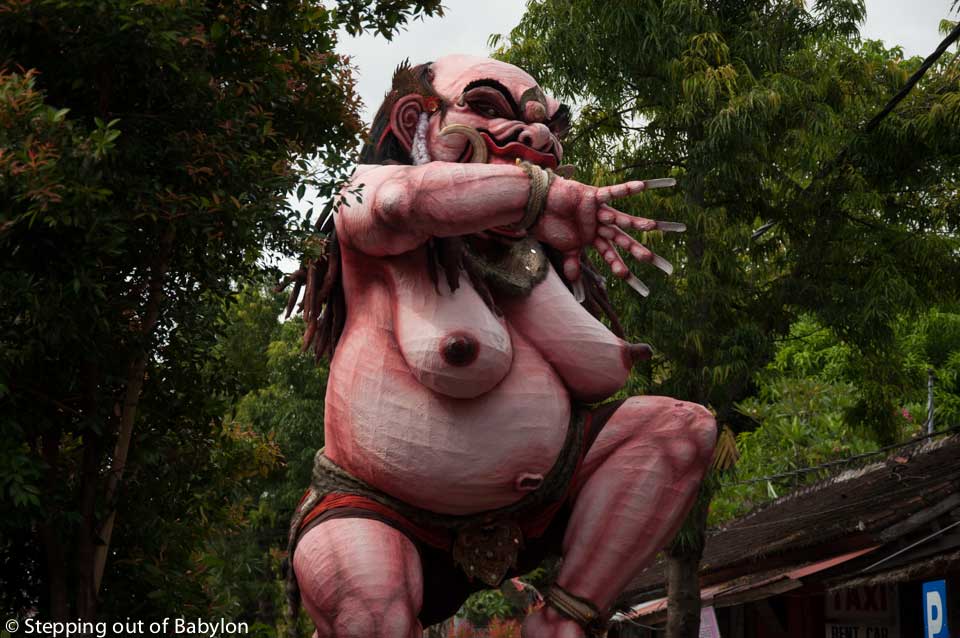
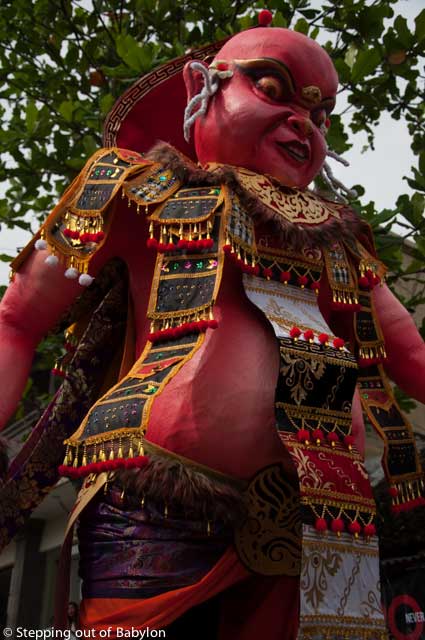
But the day before Nyepi is busy and noisy with the Ogoh-ogoh parade. Statues representing demons are building by different groups in all the villages by the local population, symbolizing the evil and the bad spirits responsible for disease and misery.

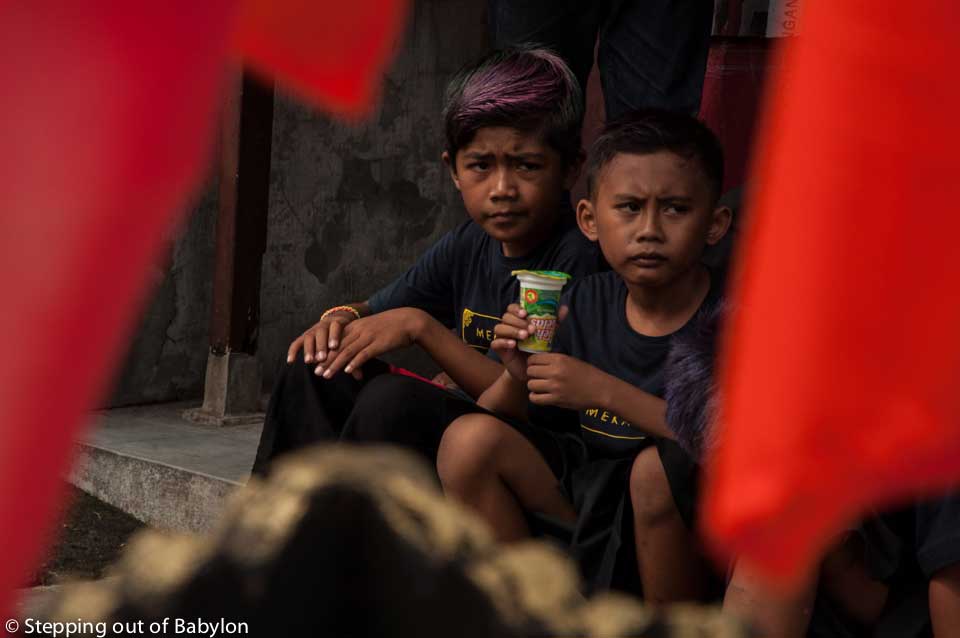
The Ogoh-Ogoh are carried on a bamboo structure the streets, usually by boys and young men, parading in front of the temples, where they execute a kind of dance at the sound of the drums of the Gamelan orchestra. Between voices and shouts, the streets are filled with excitement, every time that the Ogoh-ogohs, made with foam, resin and styrofoam are lifted and carry on the shoulders.

Ogoh-Ogoh Parede, Bali

In the end of the day, before 12 o’clock they are burned, as a ritual of purification. After this everyones return home, and start the 24 hours of silence in all Bali Island.

At home, before the Ogoh-ogoh parade, the family walk around the house shouting and making noise with metal plates, to pushing away the evil spirits, leaving behind a trace burning bamboo sticks.

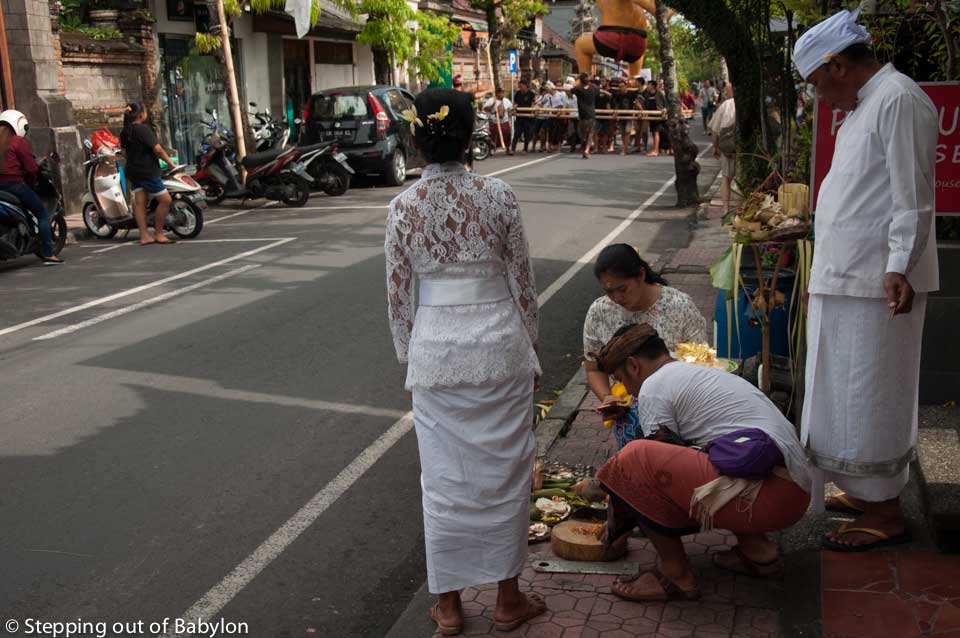
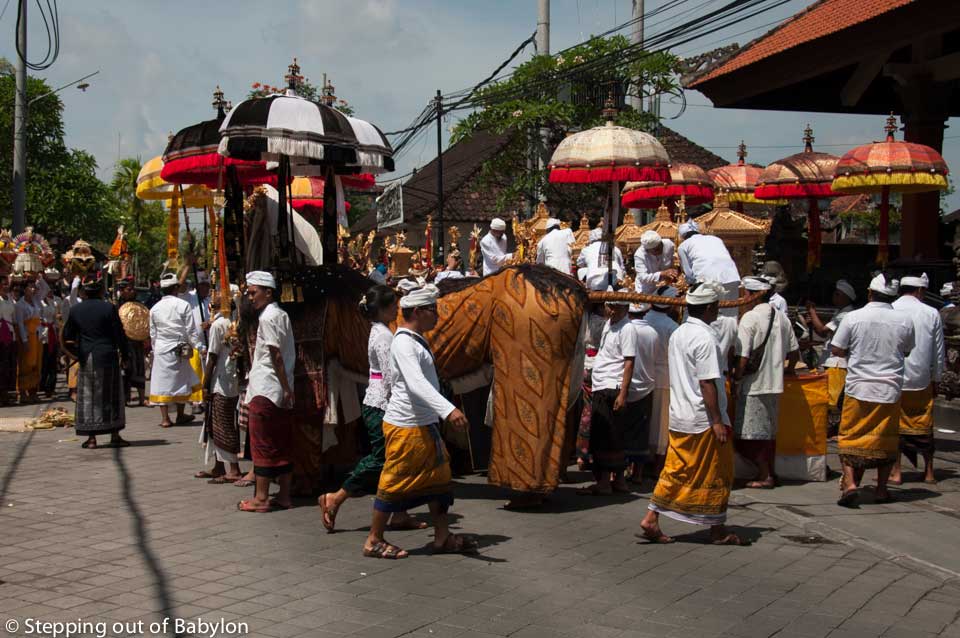
The day before the Nyepi, is busy also around the temples, with the population gathering with offerings made from fruits and flowers, participating in a long and complex ceremony where the foreigners are not allowed but where the music of gamelan, traditional from Bali, is present.

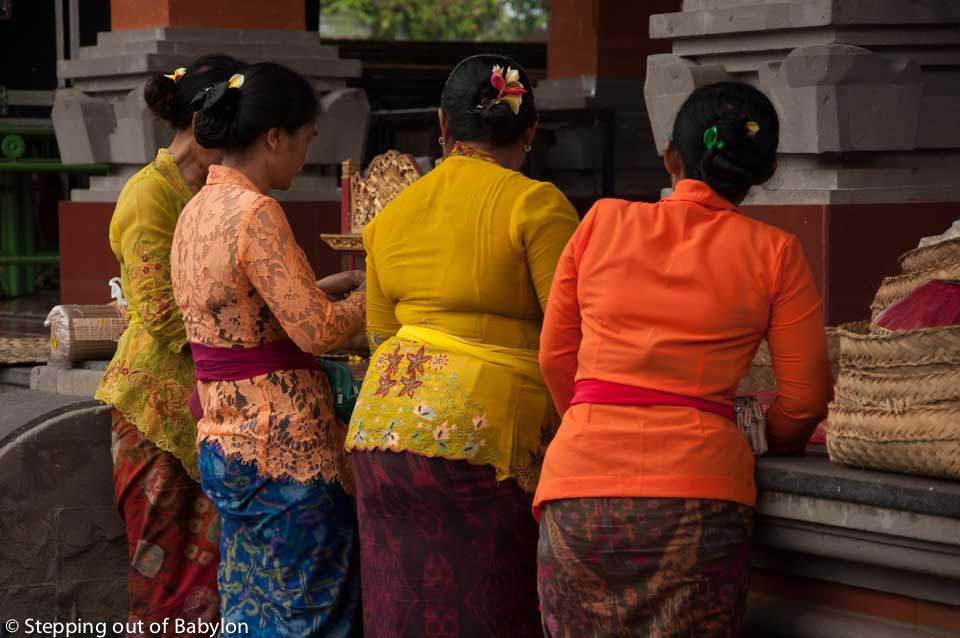
The festive sarongs of the women with shiny color tops (the kebaya) and the hair decorated with flowers, the frangipani flowers that are everywhere around the island, contrast with the more sober outfit of the men, with batik dark color sarongs, white shirt and the udeng, a headband traditional in Bali.

[columns] [span6]

Offerings that can be find every where, streets and houses
Offerings that can be find every where, streets and houses. Ubud, Bali

[/span6][span6]

Special offerings for festivals
Special offerings for festivals, that include flowers, food, coconut and delicate decorations made from bambu. Ubud, Bali

[/span6][/columns]

Bali_Nyepi_ogoh-ogoh_DSC_3376
Rituals in front of the temples on the last day of the Sasak calendar. Ubud, Bali
Bali_Nyepi_ogoh-ogoh_DSC_3384
Ubud, Bali
Special offerings during the festival
Special offerings during the festival. Ubud, Bali
Rituals in front of the temples
Rituals in front of the temples. Ubud, Bali
Bali_Nyepi_ogoh-ogoh_DSC_3496
traditional outfit for festive days. Ubud, Bali
Bali_Nyepi_ogoh-ogoh_DSC_3524
boxes made form bambu with offerings for the rituals on the last day of the year. Ubud, Bali
Bali_Nyepi_ogoh-ogoh_DSC_3400
rituals at the temples before the Nyepi day. Ubud, Bali

Practical information about the Ogoh-ogoh parade in Ubud:

The Ogoh-ogoh parade and the Nyepi festival is celebrated all over Bali island.

The Ogoh-ogoh parade start around 5 p.m. but two hours before you can see the different groups (usually men and boys but also some girls) caring the demons to the ground in front of the temples. And it ends around 9 p.m. with the entire Ogoh-ogoh gathering at the ground near Monkey Forest Temple

The parade move around a few streets in Ubud, but the center of everything is the Jalan Hanoman nearby the Pura Padang Kerta, where the Ogoh-ogoh start to gather around 3 p.m.

But the festival that starts a three or four days before, with ceremonies at the temples, and more elaborated offers in front of the houses.

The foreigners are not allowed at the temples during this period, even if dressed with the traditional ceremony Balinese outfit.

  • « Go to Previous Page
  • Page 1
  • Page 2

Footer

search

Tags

Arugam Bay Assam Bali Border Crossing Borneo Cappadocia Colombo Dambulla Esfahan Fes Food Gilis Hiking Hikkaduwa hokkaido Istanbul Itinerary Jakarta Java Kandy Kashan Kataragama Kumano Kodo Lombok Meghalaya Meknes Mekong Nagaland Natural Park Nongriat Northeast States Ouarzazate Sarawak Shiraz Sichuan Province Sumatra Tabriz Tehran transportation Varanasi Visa Yangon Yazd Yogyakarta Yunnan Province

I’m Catarina, a wanderer from Lisbon, Portugal… or a backpack traveller with a camera!

Every word and photo here comes from my own journey — the places I’ve stayed, the meals I’ve enjoyed, and the routes I’ve taken. I travel independently and share it all without sponsors or ads, so what you read is real and unfiltered.

If you’ve found my blog helpful or inspiring, consider supporting it with a small contribution. Every donation helps me keep this project alive and free for everyone who loves exploring the world.

Thank you for helping me keep the journey going!

BUY ME A COFFEE

Categories

Recent Posts:

  • How to go from Hualien to Dulan Beach
  • Taroko Gorge: between marble cliffs and emerald rivers
  • Hualien: a dull gateway to Taroko Gorge
  • Taiwan: Itinerary for an 16 day trip
  • Vietnam: Itinerary
  • 3 months in India: Kolkata, Tamil Nadu, Karnataka, Goa and Kerala
  • Backpacking Turkey in 24 Days: itinerary & costs
  • English
  • Português

Copyright © 2026 · Stepping Out Of Babylon on Genesis Framework · WordPress · Log in