• Skip to main content
  • Skip to footer

Stepping Out Of Babylon

Travel & Photography

  • About me
    • Contact
  • Destinations
    • Africa and Middle East
      • Iran
      • Lebanon
      • Morocco
      • Turkey
    • East Asia
      • China
      • Japan
      • Taiwan (Formosa)
    • South Asia
      • Bangladesh
      • India
      • Nepal
      • Sri Lanka
    • Southeast Asia
      • Cambodia
      • Indonesia
      • Lao
      • Malaysia
      • Myanmar
      • Singapore
      • Thailand
      • Vietnam
  • Itineraries
  • Travel tips
    • Border crossing
    • Hiking and Natural parks
    • Food Journey
    • Visa
  • Photography

Search Results for: China

Yilan… back to the hot springs

The plan was to make a round trip through Taiwan—heading south along the east coast to Kenting, then looping back up to Taipei via the west side of the island. So before hitting the popular Hualien, I made a stop in Yilan County, hoping to catch a glimpse of a more authentic slice of Taiwanese life.

Since Taiwan is a volcanic island, it’s shaped by massive mountain ranges. The west is less rugged and home to most of the population, as well as agriculture, fisheries, and industry. But along the east coast, you’ll still find towns and cities tucked into the flatter stretches between the green, forest-covered mountains and the blue waters of the Pacific.
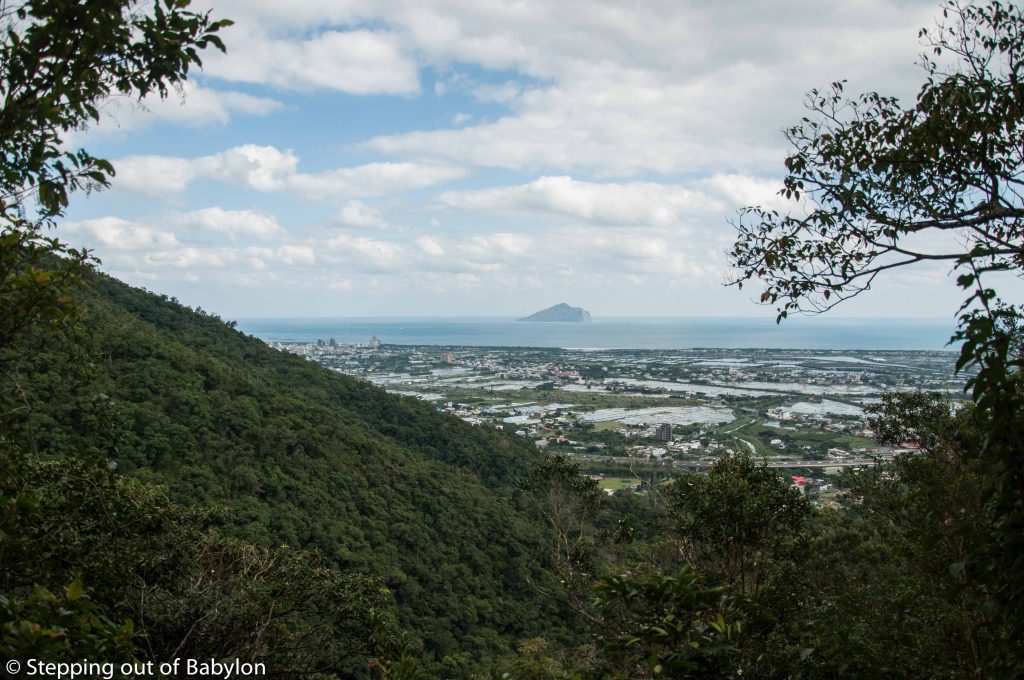
Yilan and the ocean

Yilan City, right in the center of the county, turned out to be a great base to explore the surrounding area. The main attractions around here? Beaches, mountain hikes, hot springs, and the night markets. The city itself doesn’t have a ton to offer, but it’s well connected by train, which makes easy-going day trips a breeze.
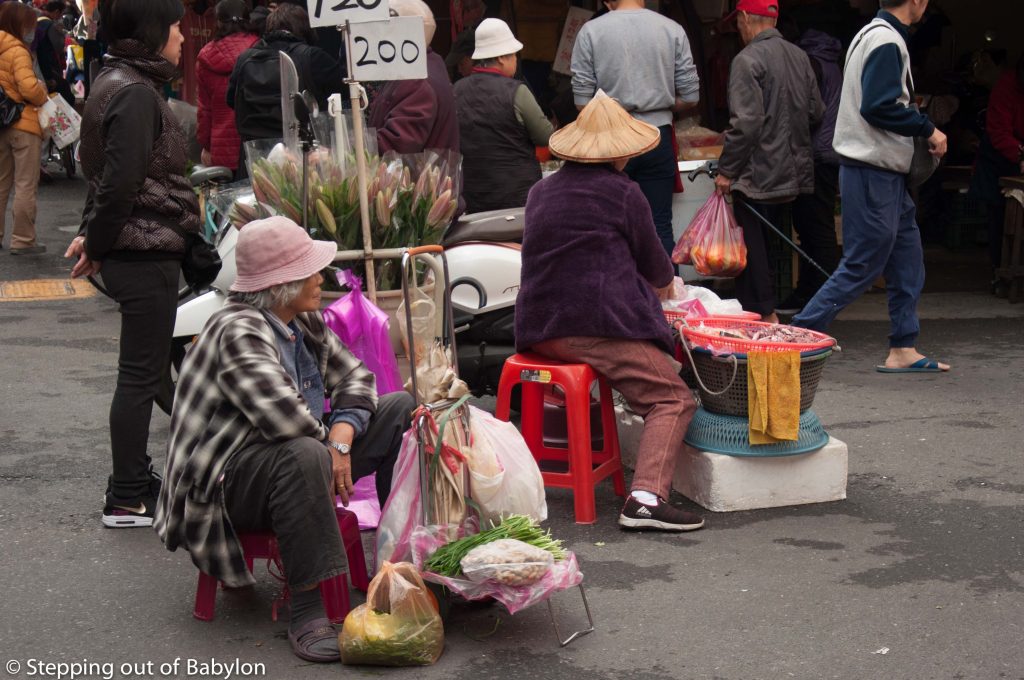
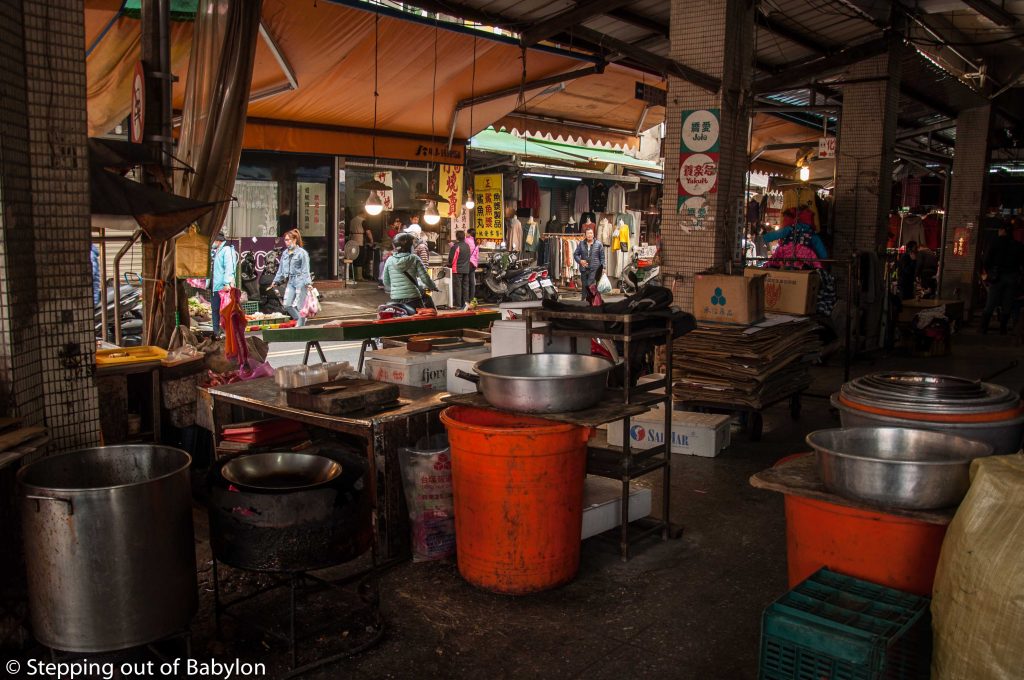
Yilan streets
market area in Yilan City

Paoma Historic Trail

Less than 10 kilometers to the north is Jiaoxi Town (also written as Jiaosi), nestled at the foot of the mountains. It’s famous for its hiking trails—often called “Historic Trails” in Taiwan—along with waterfalls and, of course, the hot springs.

One of the trails, the Paoma Historic Trail, is an old timber route through the mountains, stretching just over 6 kilometers. It’s an easy walk through a lush, humid forest, and on a clear day, you can even catch glimpses of the sea. I only hiked part of it—just up to where the trail meets a paved road—then headed back to Yilan. The full route goes a bit too far, making it tricky to get back if you’re relying on public transport.

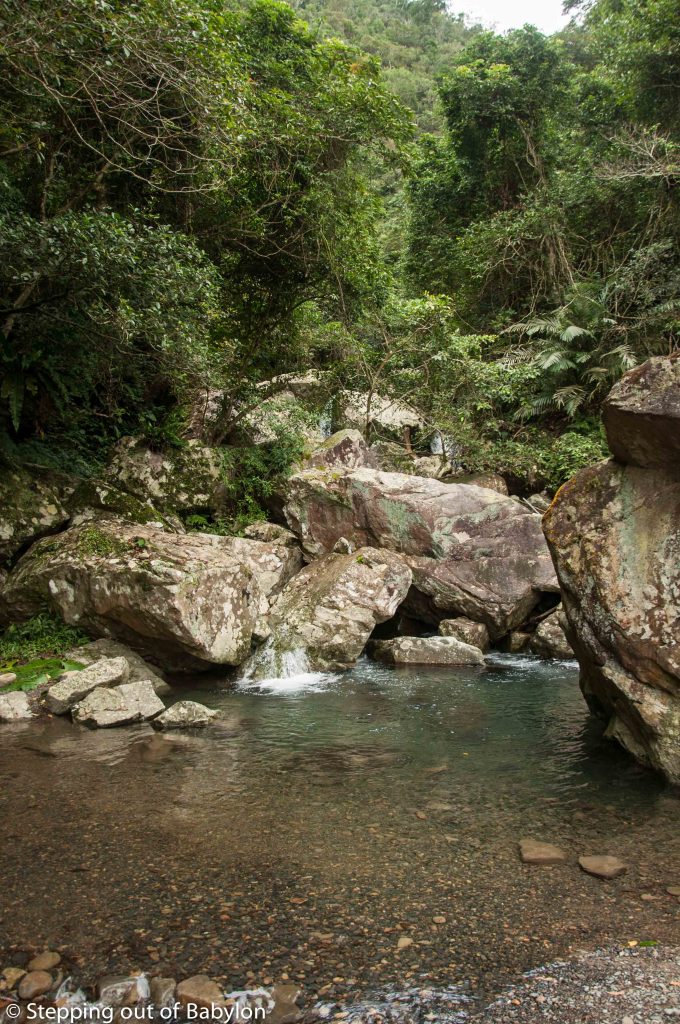
Paoma Historic Trail

Jiaoxi Hot Springs Park Onsen

After that little hike, the perfect spot to unwind is the Jiaoxi Hot Springs Park Onsen, the area’s top attraction. Taiwan has hot springs all over the island thanks to its volcanic geology, but it was during the Japanese era (when “onsen” culture was introduced) that these natural sites were adapted for public bathing—often for their therapeutic benefits, as the water tends to be rich in minerals like sulfur and emerges at high temperatures.

Hot springs in Taiwan are usually open-air pools where people bathe together in swimsuits. But Jiaoxi sticks to the traditional Japanese style, with gender-separated pools of varying temperatures.

It’s a beautiful and relaxing experience… though maybe not quite as peaceful as in Japan, since Taiwanese bathers are a bit more talkative and lively. (Entrance fee is 120 NT$. Don’t forget your towel and shower cap—or you can buy them at the counter.)

Jiaoxi Hot Springs Park Onsen

Though Luodong isn’t a major city, its night market is way more lively than Yilan’s Dongmen Night Market. It draws bigger crowds thanks to its huge variety of food stalls. That said, if you’re a foreigner, don’t expect much from the merchandise—it’s mostly low-quality clothes and cheap “made in China” items. Still, night markets are a fun way to spend an evening and watch local life unfold. They’re a big social scene, and some food specialties are unique to each one. Getting to Luodong from Yilan is easy—just a 15-minute train ride (15 NT$).

Dongmen Night Market

Waiao Beach, not far from Jiaoxi, was a bit tricky to reach without your own wheels. The local trains are slow and infrequent (they stop at every station), so a simple beach trip can easily eat up the whole day. Plus, with winter in full swing, the cold weather wasn’t exactly inviting for a swim.


Even though Yilan City isn’t packed with tourist sights, I still found myself enjoying quiet evening walks, despite the chill. Winter nights start early—around 5 p.m.—and the dim fluorescent lights give the streets a nostalgic vibe. There’s a kind of quiet charm in the old eateries, where the lack of fancy decor feels oddly stylish. Some of the shops have that same slightly faded elegance that gives the city an old-school personality that’s hard to fake

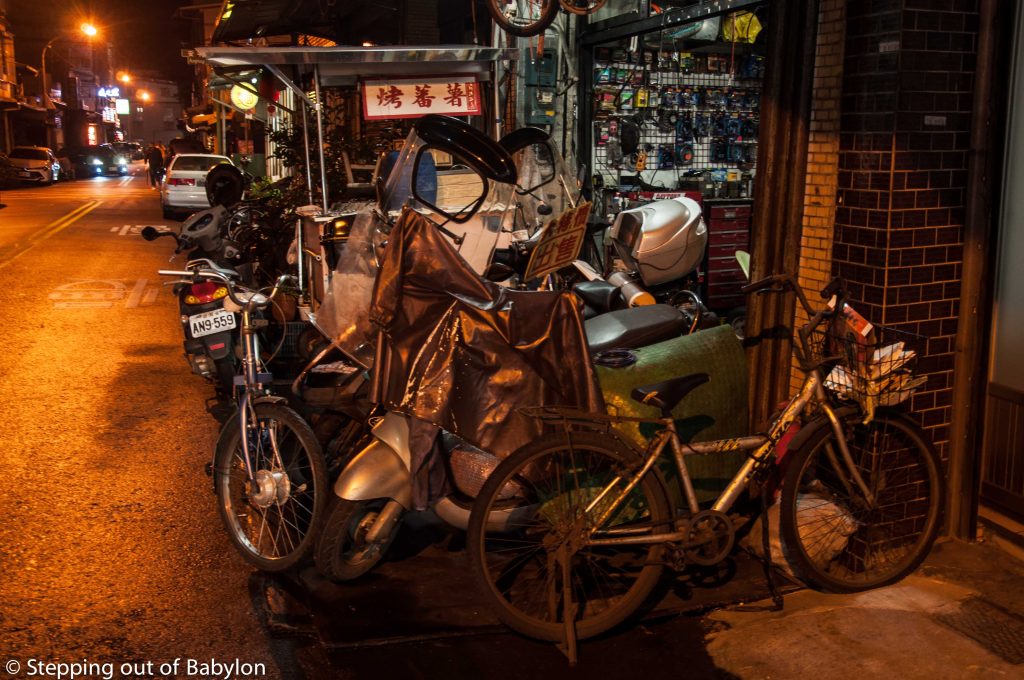
Yilan
Yilan

Where to Sleep in Yilan City

There aren’t many budget options in Yilan—it’s definitely a bit off the typical backpacker trail. I stayed at Shen Nong Village, which has a super stylish and incredibly comfy dorm in a renovated building. It’s part of a cool concept space that also includes a restaurant, cafés, and boutique shops, mostly selling design and vintage stuff.

Even though it’s a bit pricey, it’s still the cheapest decent option within walking distance from the train station. Honestly, the peaceful vibe and comfort totally justify the cost.

Right next to Shen Nong Village, there’s a small buffet-style restaurant with lots of vegetarian options. The space is modern and clean, though a little lacking in personality. Still, the food is tasty—and super cheap!

The best breakfast in Yilan City

On the corner of Kangle Road and Guangfu Road, just next to Urisabakisho Restaurant, there’s a little breakfast spot that serves up a really tasty traditional Taiwanese breakfast.

The name and menu are all in Chinese, but with a bit of help from other guests—or just pointing at whatever’s being cooked in the open kitchen—you can easily order a chilled sweet rice milk and a vegetarian Fan Tuan (a sticky rice roll). It’s made with red sticky rice and stuffed with You Tiao (fried dough sticks) and pickled cabbage.

A bit of an unusual combo for breakfast, but it was great to try a veggie version of Fan Tuan!
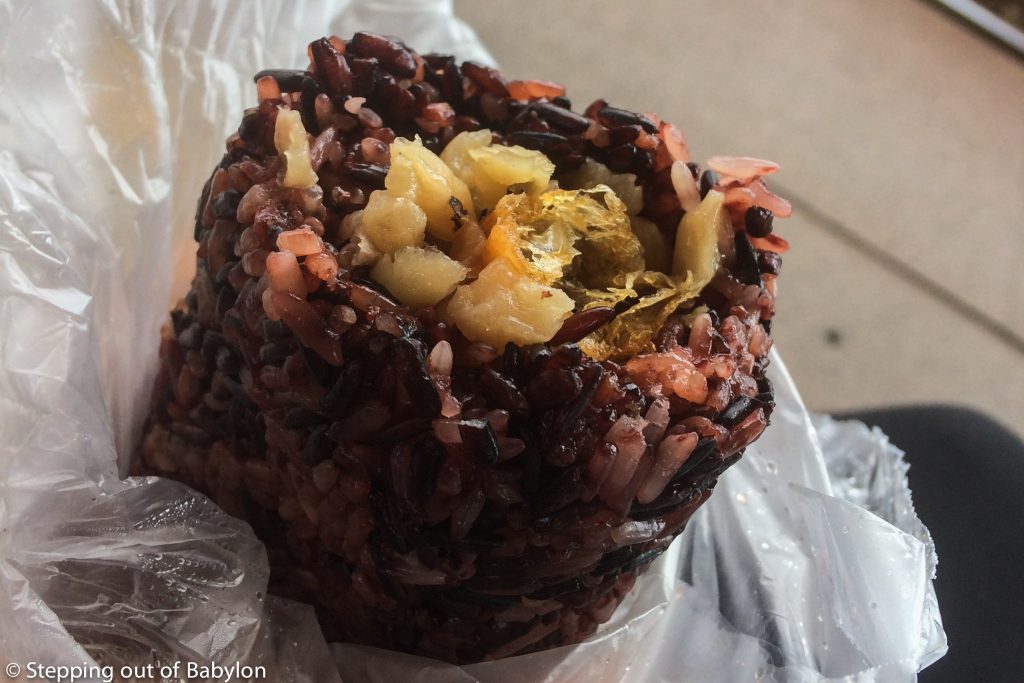
vegetarian Fan Tuan

Eating at Yilan County Night Markets

Taiwanese food is heavily influenced by Chinese cuisine, but there are plenty of local specialties and regional twists worth trying. One of Yilan’s famous snacks is the scallion pancake—which is popular all over Taiwan—but here it comes in a unique spiral shape that makes it stand out. It’s fried in lots of oil, making it softer and more like bread than the crispier versions elsewhere.
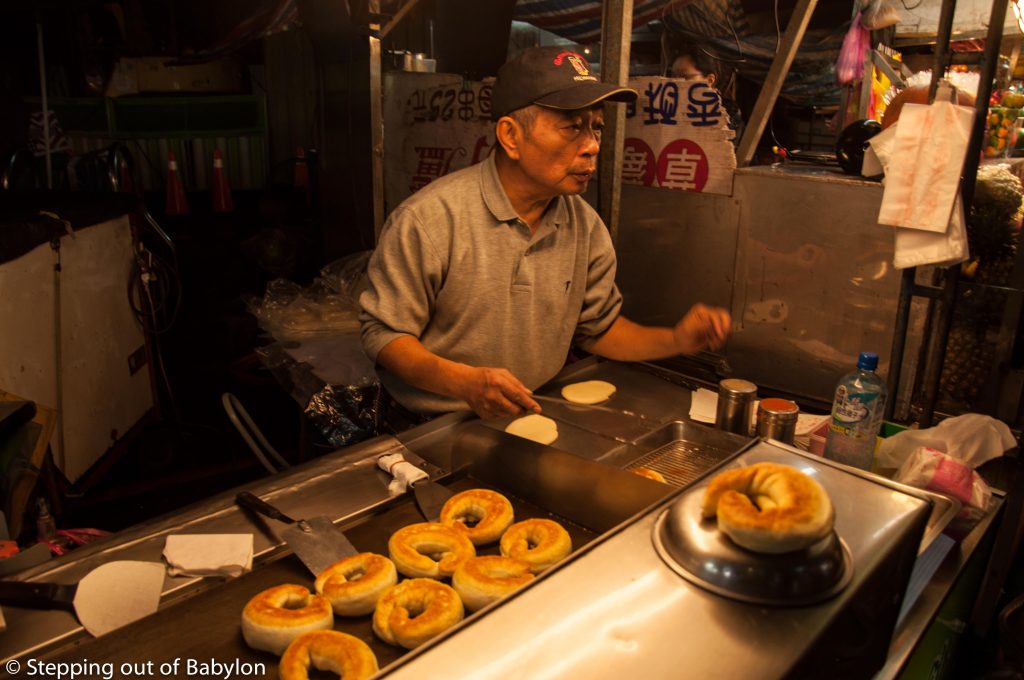
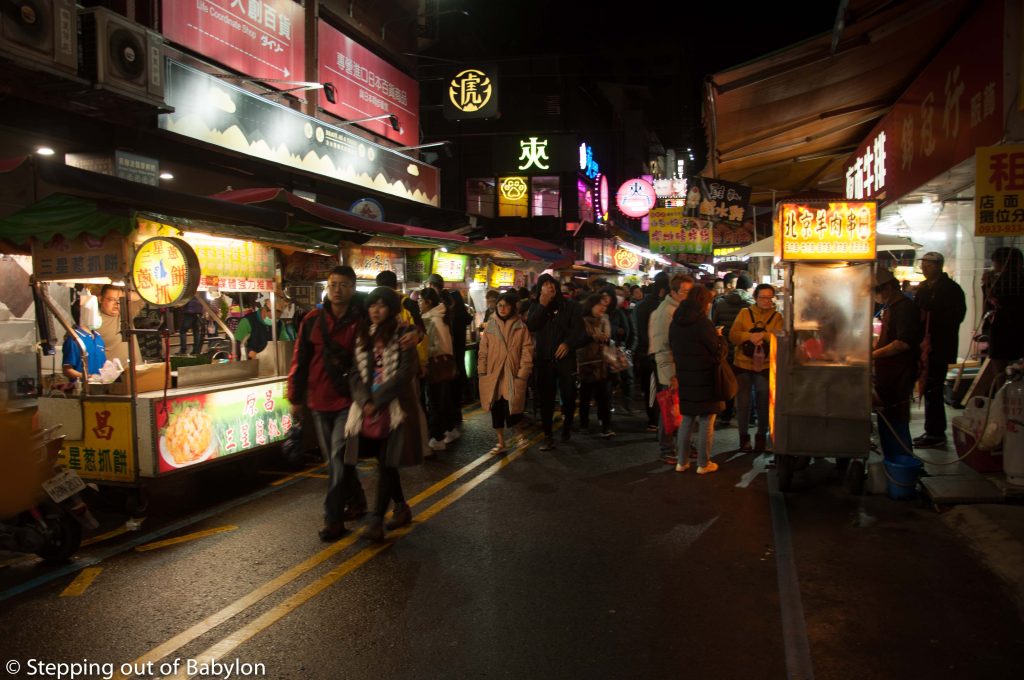
street food in one of the Yilan’s night markets

The best one I had was at Luodong Night Market, at a tiny stall near Yilan Zhongshan Park where there’s always a line. Totally worth the wait—these pancakes are super crispy, flavorful, and seriously addictive when eaten hot!
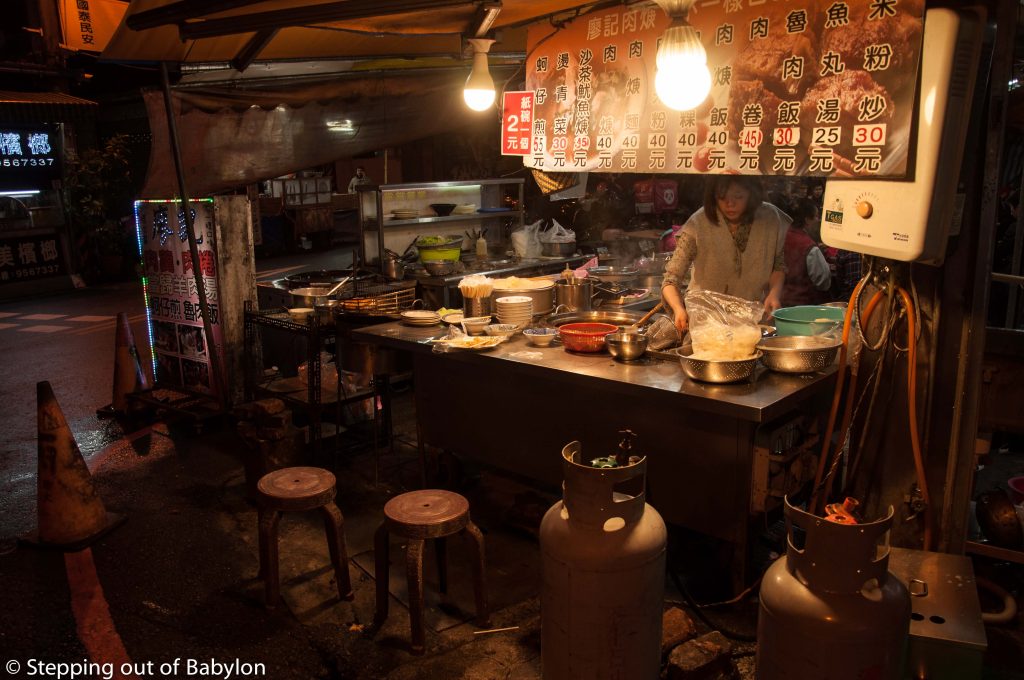
Luodong Night Market

How to Get from Yilan to Hualien

The train is hands down the best way to get to Hualien. The ride is short and scenic, following the coastline with nice sea views.

No need to book in advance—just show up at the station a few minutes before departure and grab your ticket at the counter. Trains in Taiwan run frequently, are comfortable, and rarely packed.

  • Time: About 1 hour trip
  • Price: 225 NT$

Taipei… the gateway

Arriving in Taipei

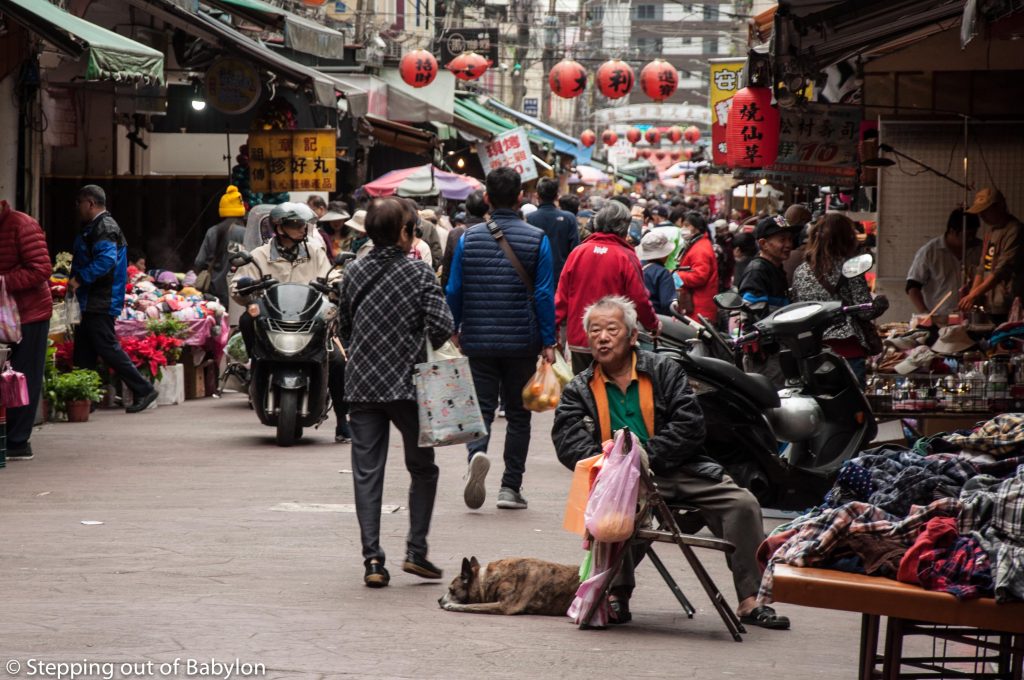
Arriving in Taipei after six weeks in Japan, I had the unexpected feeling that I had finally arrived in Asia: scooters everywhere, food being cooked and sold on the streets, foot massages being announced as we passed by, the ladyboys… the smells, the sounds, the turmoil that more or less characterise Southeast Asian countries — but without the chaotic traffic, the annoying horns, or the tuk-tuk cliché!

However, Taipei greeted me with a grey, cloudy sky that soon turned into a light but persistent rain, which lasted throughout my stay, making walks around the city — especially those further from the central area — less enjoyable.

Even the markets seemed to lose their usual color. The exotic nature of some foods and products wasn’t enough to leave a vivid memory. The winter weather, which made long walks unpleasant, pushed me instead into indoor spaces like coffee shops and malls, where you can feel a modern, cosmopolitan Taiwan, heavily influenced by Western habits and standards.

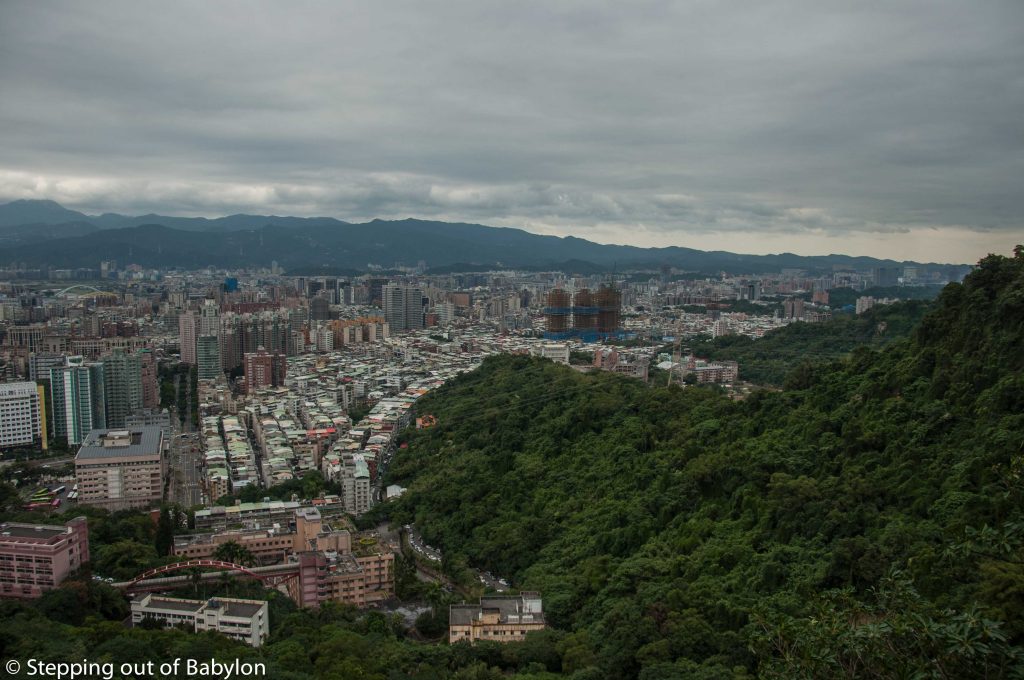
The cold and rainy climate painted the city in shades of grey, leaving a somewhat underwhelming impression of the capital, where there seems to be a disconnection between the run-down concrete buildings from the 1960s and the massive modern office towers and luxury apartments competing with the tallest in the world (Taipei 101, the city’s icon, is ranked 5th). Somewhere in between is an effort to rehabilitate old industrial zones from the 1930s and 1940s, where characteristic brick buildings were transformed into shops, studios, and ateliers — part of an attempt to create heritage and a sense of the past in a relatively new country with little history.

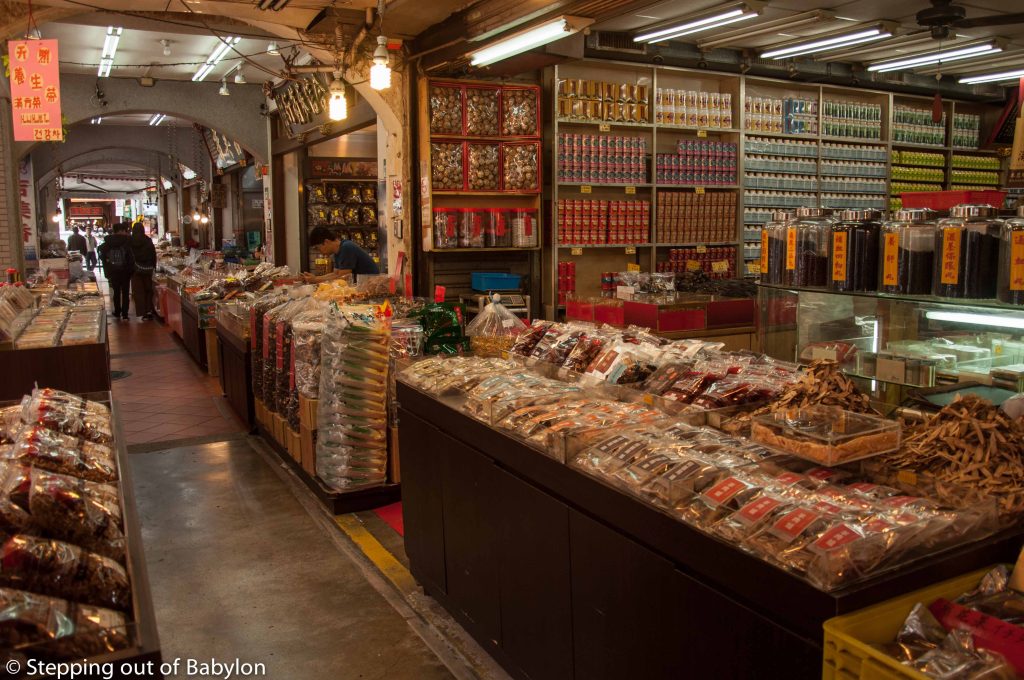
Despite being a recent city (it only became the capital in 1949) with little tradition or historical depth, Taipei still manages to offer some charm. Chinese goods stores selling decorations, food, and traditional medicinal products that give the city a colourful and exotic touch dominate the older neighbourhoods.

A bit about Taiwan… aka R.O.C.

Taiwan, officially called the Republic of China or R.O.C. (not to be confused with the People’s Republic of China — commonly just called China), is a relatively new country compared to its neighbours. It became an independent territory when Japanese troops withdrew from the island at the end of World War II in 1945. Despite their relatively short occupation (less than five decades), Japan contributed significantly to Taiwan’s economic and industrial development.

Originally called Formosa by the Portuguese when they arrived in the 16th century, Taiwan was under Chinese rule for centuries. This is reflected in its population, which is almost entirely ethnic Chinese, with indigenous groups and other minorities making up less than 5%Despite its economic development — Taiwan ranks among the world’s developed countries — it remains unrecognized as an independent nation by most of the international community. It is the most populous country and the largest economy that is not a member of the UN. This is due to Chinese foreign policy, which threatens to cut off trade and diplomatic relations with countries that recognize Taiwan. As a result, only 14 nations and the Holy See officially acknowledge it.

Regardless China’s efforts to maintain dominance over Taiwan, a growing number of young Taiwanese are distancing themselves from Chinese influence, instead embracing their own identity — a unique blend of Chinese and Japanese cultural elements.

A Temple Visit to Remember

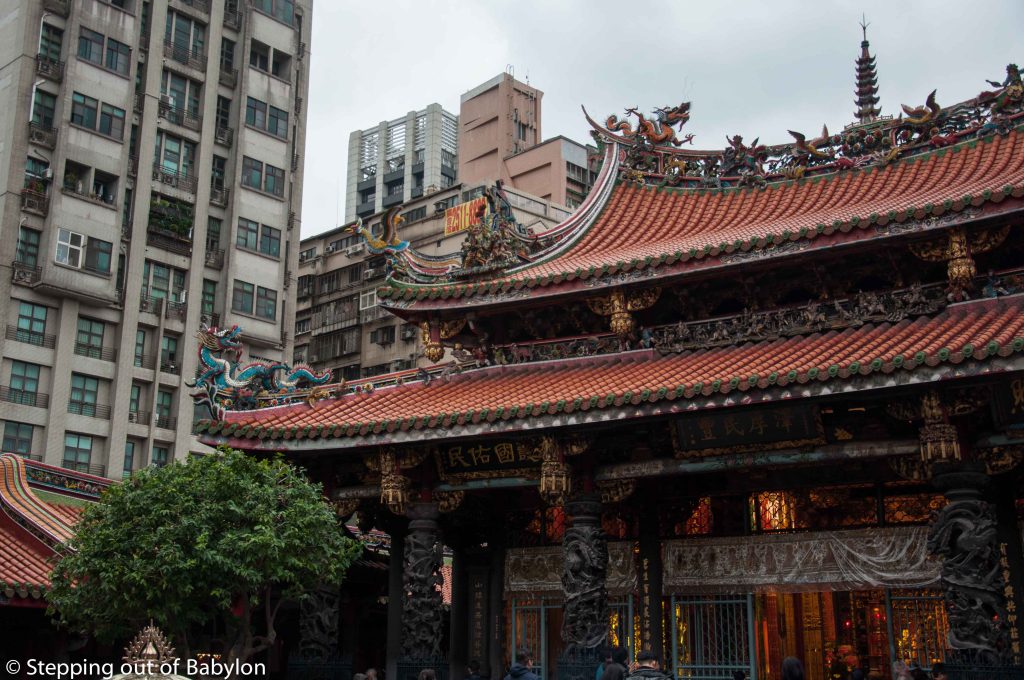
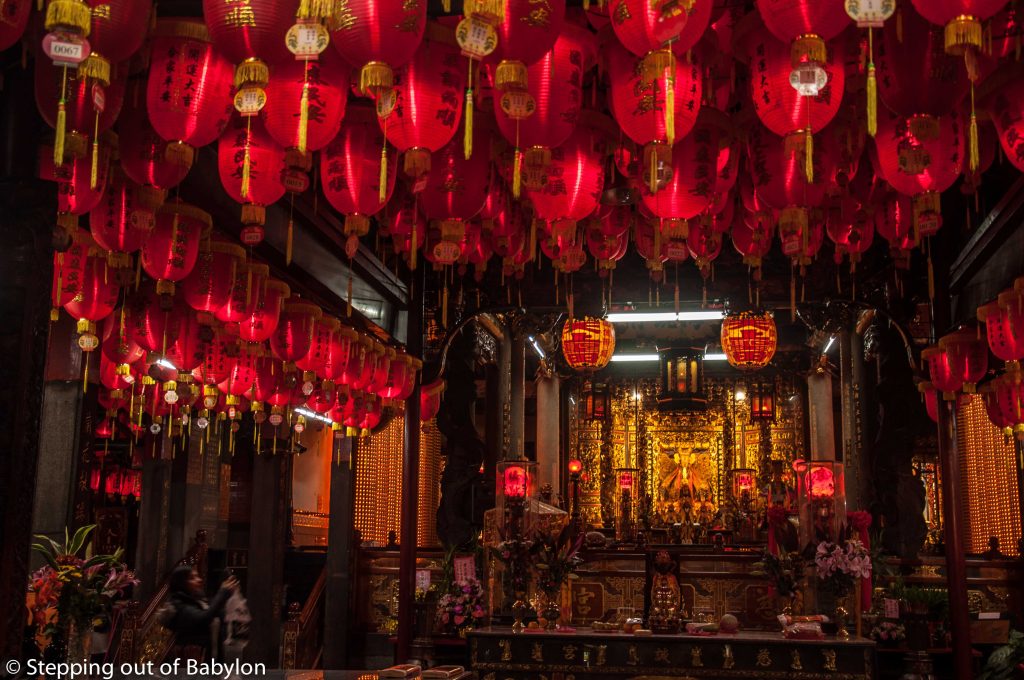
Maybe it was the rainy, grey weather, or maybe it was the city itself, but Taipei didn’t leave a particularly strong or memorable impression on me — with one exception: my visit to Longshan Temple, one of the oldest Buddhist temples in Taipei. Built in traditional Chinese religious style, it has a long history marked by fires, earthquakes, wars, and numerous reconstructions.

I arrived at the temple late in the day. The sky had been thick with clouds, and the early darkness added to the mood. Despite the dim light, I could still see the intricate carvings of dragons and other mythological figures, decorated with floral motifs and enhanced by the vivid colors of the carefully maintained paintwork.

It was clearly a special day, as it’s not every day that so many people gather at the temple, singing or chanting prayers alongside the monks inside. The smoke from the incense filled the room, blending with the scent of flowers and food offerings. The result was a unique and vibrant atmosphere — a moment of magic that made my visit to Longshan Temple truly memorable.

The square in front of the temple is also an interesting spot, serving as a meeting place for the Chinese community. Many elderly people gather there to play chess or cards. It’s also a place where beggars and homeless people congregate, creating a stark contrast to the sleek modern image of Taipei, symbolized by the gleaming Taipei 101 tower.

Longshan Temple


Longshan Temple

Where to sleep in Taipei:

As the main entry point to Taiwan, Taipei offers plenty of accommodation options for all budgets — including lots of hostels with dorm beds.

The Pillow Hostel
A great location, about 400m from MRT Taipei Station (exit Z6), which connects to several metro lines. It’s a quiet and comfortable place with very friendly and helpful staff. There’s a well-equipped kitchen available for guests, and free coffee in the morning (surprisingly good!), which might make up for the not-so-cozy common area. Good Wi-Fi too.

The area around the hostel is full of restaurants and street food stalls, and it’s within walking distance of the Ximending shopping district (also known as Shi-men Ting), which really comes alive in the evenings with shops and food stands staying open late.

Duckstay Hostel
On my second visit to Taipei, I stayed at Duckstay Hostel, near Longshan Temple. The hostel was probably better for meeting other travelers, but it wasn’t very comfortable — and the location was less convenient.

The best Taiwanese breakfast in Taipei:

Yong He Soy Milk – Wanhua District (Hankou Street)
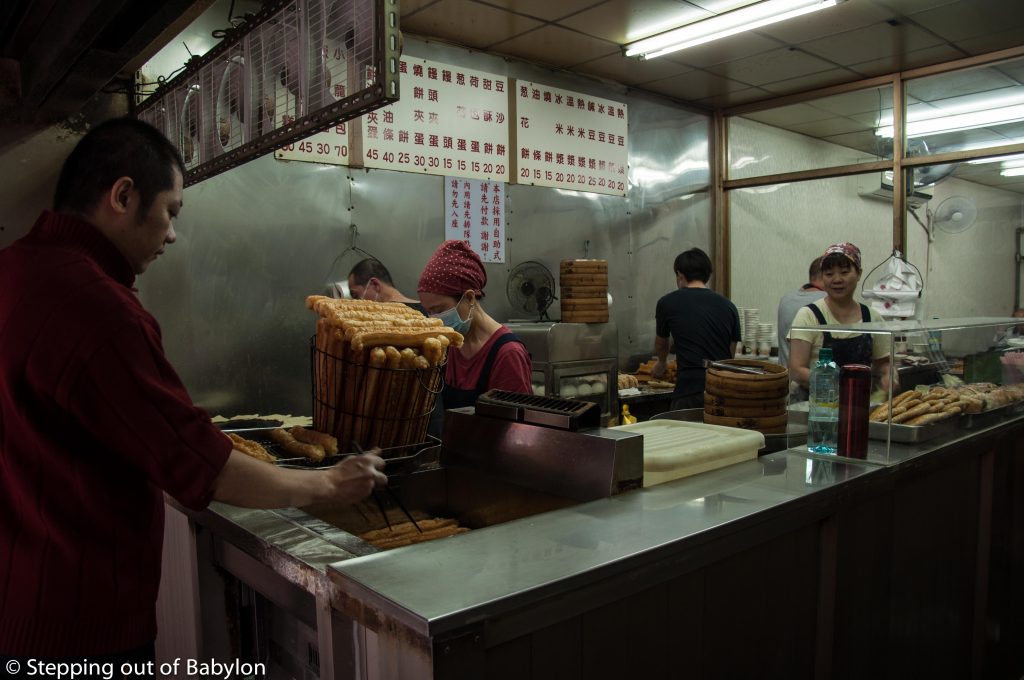
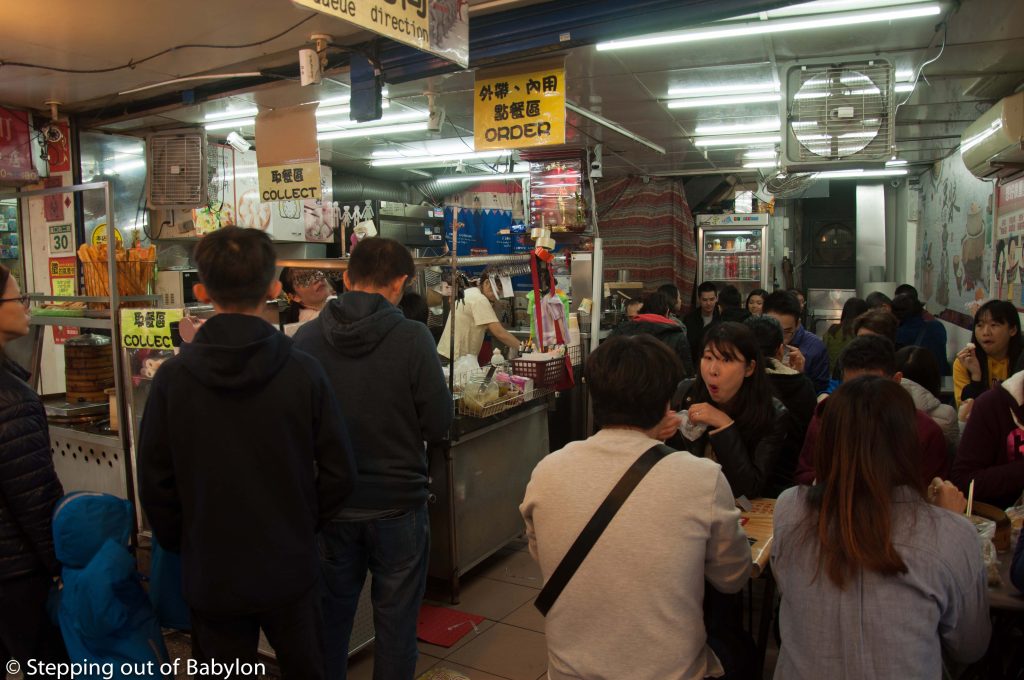
This place is a local institution when it comes to traditional Taiwanese breakfast! It opens around 5 a.m. and stays open until 3 p.m., but no matter when you go, there’s almost always a line. The service is quick and efficient — though a bit rough — and the place is noisy, not very clean, and far from comfortable. Still, it’s a great chance to experience local life and eat with the locals.

Yong He Soy Milk – Zhongzheng District (Hengyang Road)
If the Wanhua location is too crowded, there’s another spot with the same name on Hengyang Road. It serves the same kind of food in a quieter environment — but it’s poorly ventilated, with dirty white walls and aluminum tables. The flickering fluorescent lights give the place a slightly depressing vibe. Personally, I prefer ordering the food to go — as most locals do — and eating it back at the hostel, where there’s usually a common area set up for this.

Yong He Soy Milk
Yong He Soy Milk

About the food in Cambodia

In summary, it can be said that Cambodia is not an easy country for vegetarians, as this is a strange concept in this country where meat consumption dominates. But there are always options like noodle soups, curries and some snacks that help to get around the situation!

As in Lao, the noodle soups continued to be present but the quality decreased: not only are the broths less aromatic, but sometimes the noodles are made from dry pasta or even instant noodles. The usual dish of aromatic herbs and vegetables that accompanied these soups in the neighbouring country, is often absent here.

In Cambodian food, there is a strong influence of Chinese and Vietnamese cuisine, which is visible in the many restaurants serving “phò”, the traditional vietnamese noodle soup.

Another influence of China is the hot pots, which are very popular among Cambodians (as in many other Southwest Asian countries), especially in cities and particularly on weekends, where these restaurants are filled with families and groups of friends who share this meal, consisting of a pan with a boiling broth, where pieces of meat are floating, which remain hot on the table with the use of a mini gas stove, and where the various side dishes, such as cabbage, fresh herbs, pasta, pieces of meat and also viscera…

These noodle soups, prepared at the moment, can be made in the vegetarian version, however, although meat is not added, there is no increase in the amount of vegetables that usually come down to a handful of soy sprouts and a few cabbage leaves. As for the broth that serves as the base for these soups, almost transparent and with a light flavour, it is likely to contain products of animal origin in its preparation.

The so-called rice soups, popular as a morning meal, although a little boring, are also an option for vegetarians, since you can always order without meat, alternatively adding soy sprouts.

More advisable in terms of a vegetarian diet are fry-noodles, where the rice noodles are stir fry with some vegetables and egg and seasoned with mysterious sauces.

Coffee is usually served with ice and is almost always sweetened with condensed milk. The preparation is in everything similar to that found in Vietnam, with the boiling water being poured over the coffee in a kind of metallic filter, placed on the top of the glass. Often the coffee is already made, in a very concentrated dose, which is then diluted in hot water when the coffee is served. The flavour is smooth but with a particular flavour, but it is necessary to use a certain communication skill to avoid the popular condensed milk, which totally crushes the original flavour of the coffee.

The curries continue to be strongly present, much less spicy than in neighbouring Thailand, served with the usual dose of rice. The most popular of these curries is amok, which can be seafood, fish, meat or just vegetables, highlighting the mild aroma of spices from which lemongrass, turmeric and ginger stand out. Traditionally this dish is made very slowly, in steam, on a banana leaf. Not as easy to find as a noodle soup, amok served with rice is a delicious option for vegetarians and is more likely to be found in restaurants than in markets.

In Cambodia, vegetarian options are scarcer than in other countries in Southeast Asia, dominating meat, whether fresh or processed in the form of small meatballs whose appearance is far from attractive but which is extremely popular in Cambodia. In the south of the country, given the proximity to the sea, fish and seafood are strongly present, with markets offering a wide variety of products, which is reflected in the dishes and even street snacks.

And as in any Asian country, street food has a strong presence, due to its variety, both in sweets and in snacks, appearing at specific times of the day, often next to markets, schools, or in the busiest streets of cities. They can be small stalls transported on bicycles or compact kitchens coupled to motorcycles.

As in many Southwest Asian countries, it is not difficult to find exotic foods by European standards, and Cambodia seems to offer even more opportunities to find frogs for sale in the markets or grasshoppers fried at a street stall.

Sopa de arroz, servida somente de manhã, como primeira refeição do dia, e que muitas vezes é acompanhada de uma especie de pão frito
Rice soup, served only in the morning, as the first meal of the day, which is often accompanied by a kind of fried bread
stree food em Siem Reap
street food in Siem Reap
pasteis de massa de arroz recheados com legumes e mergulhados numa mistura de molhos doces, salgados e picantes
rice noodles stuffed with vegetables and dipped in a mixture of sweet, savoury and spicy sauces
banca que todas as noite surge nas ruas de Siem Reap servindo a sopa de noodles tradicional do Vietnam
every night several small stands appear on the streets of Siem Reap serving Vietnamese traditional noodle soup
muitas vezes é possivel encontrar fruta já descascada e cortada que se vende nas ruas, em especial nas zonas mais frequentadas por turistas.
it is often possible to find already peeled and cut fruit that is sold on the streets, especially in the areas most frequented by tourists
fritos de banana e massa
fried banana
phô
Vietnamese phô soup
bancas de venda de comida em Siem reap, em frente ao local de partidas dos autocarros... depois da hora de ponta mudan-se para outras paragens.
food stalls in Siem reap, in front of the bus departure point … but after the rush hour it moves to other stops
nooodlles
dry noodles
chá que está semptre disponivel nas mesas
tea that is always available on the tables
sops de noodles com legumes
noodle soup with vegetables
molhos e mais molhos... mas poucos picantes, em comparação com o que era oferecido na Tailândia ou mesmo no Laos
sauces and more sauces … but few spicy, compared to what was offered in Thailand or even Laos
café confeccionado de forma semelhante à que se encontra no Vietnam
ice coffee made by the filter process
street-food em Phnom Penh
street-food in Phnom Penh
fruta de uma especie de palmeira, servida com leite de coco, gelo e muito, muito açucar
toddy fruit, from a kind of palm tree, translucent and gelatinous, served with coconut milk and ice…. very sugary
fruta de uma especie de palmeira
toddy palm fruit
mercado de Phnom Penh
Phnom Penh market
bolos cozinhados ao vapor, em folha de bananeira
steamed cakes in banana leaf
noodles fritos com legumes e ovo estrelado... sempre frito dos dois lados!
fried noodles with vegetables and a fried egg … always fried on both sides!
banca de rua
street stall
street food em Phnom Penh
street food in Phnom Penh: pancake served hot, stuffed with sticky rice and sweetened with a mixture of coconut and sugar
street food em Phnom Penh
street food in Phnom Penh with fry dough, also called oily sticks
um dos muitos snacks de rua: massa doce frita e salpicada de sésamo
one of the many street snacks: fried sweet dough, sprinkled with sesame seads
restaurante de phô em Phnom Penh
“phô” restaurant in Phnom Penh
DSC_3399

Vegetable “amok“… the famous Cambodian curry that most of the times is made with fish, but that can also be ordered in a vegetarian version only with legumes.

Uma especie de custard, mas cozinhada dentro de uma pequena abóbora que depois de cozida se pode comer a casca; é servida às fatias, regadas com leite de côco, calda de açucar, gelo e leite condensado. Muito popular na Tailândia, pode-se também encontrar nos mercados do Camboja

A kind of custard, but cooked inside a small pumpkin that after being cooked you can eat the peel; it is served sliced, drizzled with coconut milk, sugar syrup, ice and condensed milk. Very popular in Thailand, it can also be found in Cambodian markets

banca no mercado de Sihanouk Ville dedicada à venda de doces, onde domina o leite de côco e o leite condensado
stall in the Sihanouk Ville market dedicated to the sale of sweets, where coconut milk and condensed milk dominate

Food in Thailand for vegetarians

The fame of Thai gastronomy is entirely deserved, with a great diversity of dishes with a predominance of curries, aromatic and mildly spicy, and noodles, a smooth and soft pasta made with rice flour, present in many of the Thai dishes, like soups and stir-fry.

Generally speaking, rice is always present in any home, and it is common to walk the streets of the neighbourhoods to feel the hot smell of cooked rice at any time of the day, which is almost always made in electric cookers, both at home and in restaurants.

Near the markets, or even on the streets of the city, small stalls are selling cooked rice, both glutinous and normal, in small plastic bags, serving as side dishes for curries, stews or fried fish or meat, and sold in the form of small kebabs.

Sticky rice, or glutinous rice, serves as an accompaniment to many Thai dishes, also serving as a dessert, where it is eaten together with pieces of mango, and often drizzled with sweetened coconut milk, making a good combination. In some markets it is still possible to find this type of rice, which after being cooked is introduced into a bamboo trunk which is then grilled over charcoal; it can be just plain rice or mixed with beans, alfalfa seeds, bananas, meat… the choice is always risky because most sellers don’t speak English and even the sounds I try to pronounce to express my choice for vegetarian food are not understood, most of the time.

This type of long grain rice with a sweet taste, originally from the Issan region (northeastern Thailand), where it adapts well to poorly fertile soils, after being cooked it maintains its firm consistency but is easily added which allows it to be dipped in sauces, it is left to soak in water overnight, so that in the morning it is ready to be cooked.

Very popular, especially among foreigners, is the so-called “fried rice” which is nothing more than previously cooked rice that is stir-fry in the wok, with some pieces of vegetables and flavoured with soy sauce and fish sauce. Far from being my favourite dish, I consider the fried rice as “last resort” option, as the vegetarian option don’t show much nutritional value apart from a lot of carbohydrates and fat!!

It can be considered that the curry paste is the basis of almost all traditional dishes of Thai gastronomy, and can be made with different ingredients, but it usually has ginger, garlic, salt, chili, curry leaf, lemongrass… finely crushed and crushed to form a paste to which salt and spices are added that can be kept for several weeks. According to the dish to be prepared there are several types of curry pastes: green, red, massaman, panang… which are sold in the food markets all around the country.

Another constant is the noodle soup, prepared in less than a minute and very popular as street food, where small stalls only need a large pot with a steaming broth, which when uncovered fills the air with soft aromas, which pieces of green leafy vegetables, meat, or tofu are added to the dish, with the addition of fresh rice noodles, which are instantly ready to eat.

MSG, Monosodium Glutamate. This is the true plague of Thai food that competes strongly with sugar, and is present in almost all dishes, both in restaurants and in street food, which consists of a chemical used to enhance the flavour of food, but controversial use as it is not well tolerated by everyone and can cause gastric problems.

The “pad thai” is undoubtedly the most popular, perhaps because it has become popular with tourists and because it is cheap and easy to make, which makes it present in all restaurants, markets or street stalls. based on sautéed noodles with soy sprouts and a few vegetables, and sprinkled with crushed peanuts. Despite having an egg, it is a good option for vegetarians, but small dried shrimps often appear that ruin this option.

In general, Thai cuisine is not very “friendly” for vegetarians, as many of the dishes often have pork, chicken or shrimp, including noodle soups that are often made with meat broths; even more difficult is for vegan, where the presence of egg is almost mandatory when ordering something vegetarian.

But in the bigger urban areas, the vegetarian diet is getting popular and with a bit of internet research is not difficult to spot a vegetarian or even vegan restaurant. However, the prices are certainly higher than what you can find in street-food.

Tofu is also a presence in Thai cuisine, certainly an influence from neighbouring China, and is seen as one more ingredient in the local dishes, and not necessarily an alternative to meat or fish.

As most of the food is cooked at the moment it’s not difficult to order a vegetarian version of a dish, yet nothing is a guarantee about the use of some “mysterious” sauces that most of the time contain animal products.

There is no strict timetable for meals, nor a specific type of food for each meal, and a soup of noodles or a piece of fried chicken with rice can be served for breakfast, lunch, or dinner.

restaurante de rua em Bangkok que surge diáriamente ao fim do dia dedicada exclusivamente à preparação de um prato feito à base de legumes e de carne ou marisco, que são cozinhados numa chapa aquecida sobre lume forte, enquanto são vigorosamente mexidos e regados com caldos e molhos
street restaurant in Bangkok that appears daily at the end of the day dedicated exclusively to the preparation of a dish made with vegetables and meat or seafood, which are cooked on a heated plate over high heat, while being vigorously stirred and drizzled with broths and sauces
restaurante junto à estação de comboios de Ayutaya, que logo pela manhã, ainda antes do nascer do dia já serve refeições simples, como sopa e noddles e pad thai
A restaurant next to Ayutaya train station, which in the morning, even before dawn, already serves simple meals, such as soup and noddles and pad thai
uma das muitas sopas de noodles que podem ser encontradas pelos restaurantes tailandeses; esta é uma variante vegetariana com tofu, mas a base é a mesma das tradicionais sopas à base de carne: caldo que está sempre fumegante numa panela ao lume, que é deitado sobre os legumes e onde são colocados os noodles (massa de arroz) que é cozinhada pouco mais de trinta segundos numa outra panela com água a ferver. Tudo isto é feito em menos de um minuto.
one of the many noodle soups that can be found in Thai restaurants; this is a vegetarian variant with tofu, but the base is the same as the traditional meat-based soups: broth that is always steaming in a pan over the heat, which is laid over the vegetables and where the noodles (rice noodles) are placed it is cooked just over thirty seconds in another pan with boiling water. All of this is done in less than a minute.
Uma das bancas de venda de salsichas, e outros derivados de carne ou de peixe, apresentado uma consistência estranha, de textura compacta e cor artificial, mas que, a avaliar pelo numero destas bancas, são bastante apreciadas pelos tailandeses, que as consomem enquanto andam pela rua ou levam para casa juntamente com sacos de arroz, já cozinhado
One of the stalls selling sausages, and other meat or fish products, presented a strange consistency, of compact texture and artificial color, but which, judging by the number of these stalls, are highly appreciated by the Thais, who consume them while walking down the street or take home with bags of rice, already cooked
Em alguns mercados é ainda possivel encontrar leite de coco feito na hora, que é vendido juntamente com o coco ralado resultante do processo de obtebção do liquido
In some markets, it is even possible to find freshly made coconut milk, which is sold together with the grated coconut resulting from the process of obtaining the liquid
Sopa de arroz acompanhada de massa frita, que é um dos tradicionais pratos consumidos pela manhã, mas que tb se pode encontrar em algusn restaurantes ao longo do dia. A base é muito semelhante à sopa de noodles, sendo feita à base de um caldo de legumes, onde é colocado o arroz muito coziso e por vezes ligeiramente triturado, e que pode ser servido com ovo que lentamente cozinha no caldo que é serviso a escaldar
Rice soup accompanied by fried pasta, which is one of the traditional dishes consumed in the morning, but which can also be found in some restaurants throughout the day. The base is very similar to noodle soup, made from a vegetable broth, where the rice is placed very cooked and sometimes lightly crushed, and which can be served with an egg that slowly cooks in the broth that is served to scald
Sticky-rice em bambu; esta é a variante com alfafa
Bamboo sticky-rice; this is the alfalfa variant

Although it is not too cold, this time of year is corresponding to winter, and temperatures drop significantly during the night; and how could it be that chestnuts appear to remember winter in Portugal … but these are smaller and steamed!

pad thai, numa variante feita por mim, nos dias que passei na Giant Gouse, em Chiang Mai; esta tem mais legumes para além dos habituais rebentos de soja, e não tem ovo
pad thai, in a variant made by me, in the days I spent at Giant Gouse, in Chiang Mai; this one has more vegetables than the usual soy sprouts and has no egg
tiras de carne a secar ao sol
strips of meat drying in the sun
Bananas, bananas, bananas.... estão por todo o lado, de diversas variedades, e vendidas frescas, verdes, secas, fritas, assadas....
Bananas, bananas, bananas… they are everywhere, of various varieties, and sold fresh, green, dried, fried, roasted..
Uma das bancas de venda de "papaia salad" no mercado de Sompet, em Chiang Mai
One of the stalls selling “papaya salad” at Sompet market in Chiang Mai
DSC_7652
as the end of the day approaches, many stalls that prepare meals or simple snacks start to appear in the streets
DSC_7664
rotee… a kind of crepe, but with a very thin dough based on rice flour, which is stuffed with banana and can be drizzled with chocolate or condensed milk; You can also opt for the vegetarian option. Despite the similarities with the French crepe, this snack comes from Malaysia and most of the sellers who are in Thailand, of Muslim origin
Papaia Salad, feita com papaia verde, cortada em tiras finas, juntamente com cenoura e pepino, e que é envolvida num molho picante feito à base de chili, alho e algusn molhos
Papaya Salad, made with green papaya, cut into thin strips, together with carrot and cucumber, which is wrapped in a hot sauce made from chili, garlic, and some sauces
Um dos muitos caris que a dá fama à gastronomia tailandesa, sempre acompanhados de arroz. Podem ser servidos numa espécia de sopa, em taças e que aos poucos se deita sobre o arroz ou nesta versão, menos liquida
One of the many curries that make Thai cuisine famous, always accompanied by rice. They can be served in a kind of soup, in bowls and gradually poured over rice or in this version, less liquid
Sopa de noodles vegetariana
Vegetarian noodle soup
Caril de marisco, vendido nos mercados para ser consumido em casa ou no trabalho, juntamente com o arroz vendido em doses individuais e embrulhado em sacos de plastico
Seafood curry, sold in markets to be eaten at home or at work, along with rice sold in individual doses and wrapped in plastic bags

Koyasan… the holy mountain

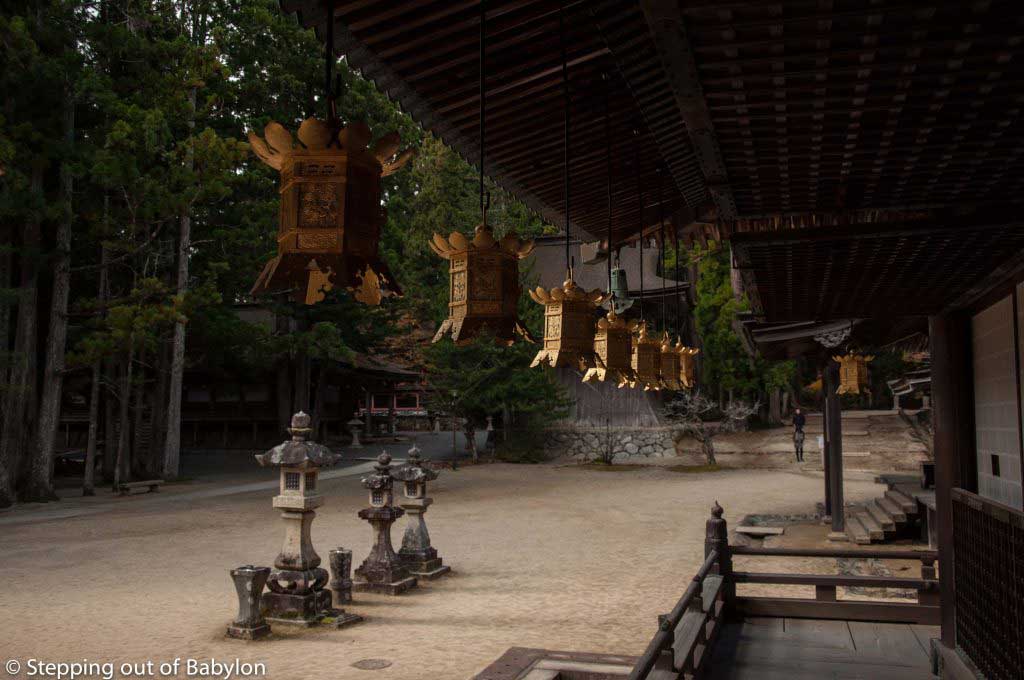
Kobo-Daishi (also called as Kukai) it’s a name to definitively you will hear (and read) if you come to visit Koyasan. He was the one that created Koyasan (that means mount Koya) after traveling through China to learn more about Buddhism. Located around in the mountains about 900m of altitude, Koyasan was chosen for being surrounded by eight peaks, that represent the eight petals of the lotus flowers on the top of what Buddha is represented.

In Koyasan we can find the Shingon-shu Buddhism, that more or less means “Esoteric Mantra Buddhism”, that is one sect from the Shingon Buddhism, whose mentor was Kobo-Daishi, that dedicates his life not only to religion but was also with credits as poet, artist, calligrapher and was responsible for the construction of may temples.

In the center of Koyasan, it’s the Danjo Garan, a complex that includes 20 temples. One of them is the Fudo-du Hall, which is not the most impressive but it’s the oldest, and the only one that survived to multiple fires and catastrophes that during centuries destroyed the original constructions. Some of the present buildings are already the fifth reconstruction!!!…

Daito Pagoda
Danjo Garan
Danjo Garan
Danjo Garan

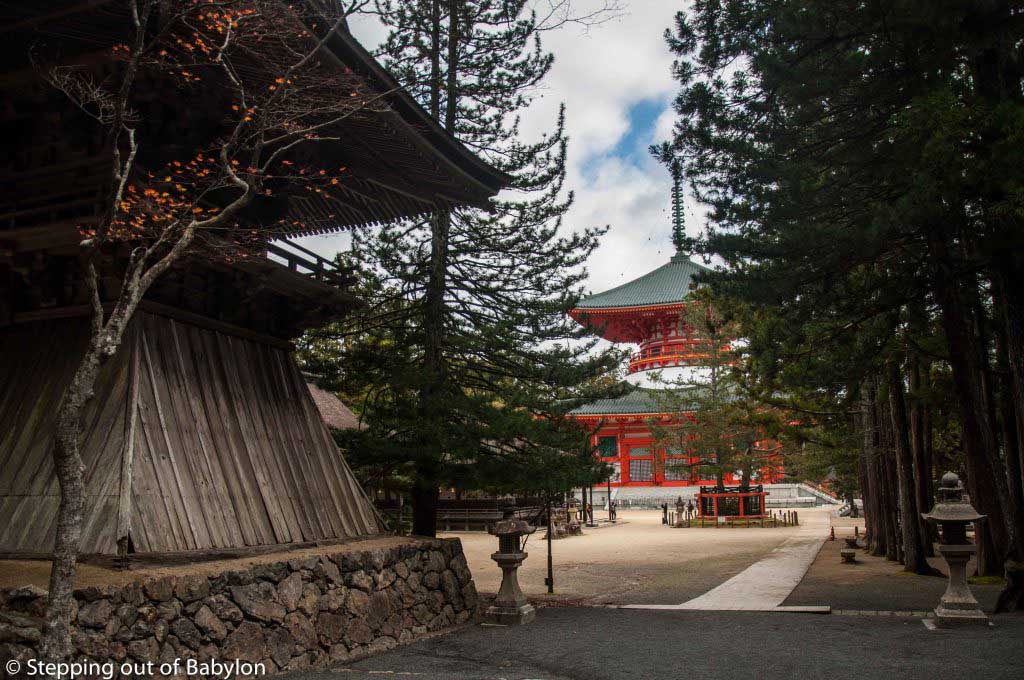
But inside the Danjo Garam, what stands up is the Daito Pagoda (the great Pagoda design by Kobo-Daishi), with its original pagoda shape and the Mie-do Hall with the impressive Buddha statues. But the place itself, with many other temples and buildings all made in wood, surrounded by big cedar trees and umbrella-pine tree offer a pleasant walk.

The massive but mot so elegant Daimon Gate, is the official entrance of the Koyasan temple area, located in the extreme West side of the village. If you walk along the Women Pilgrimage course (Nyonin-michi), which corresponds to the way that the women used to reach Kobo-Daishi Mausoleum, as during many years Koyasan was a place exclusive for monks and access was forbidden to women, you’ll find Daimon Gate along the way. This hiking course can easily be done in 3 hours, and offer a pleasant stroll in the forest, taking ridge of some of the mountains that surround the sacred place of Koyasan.

Women Pilgrimage course (Nyonin-michi)

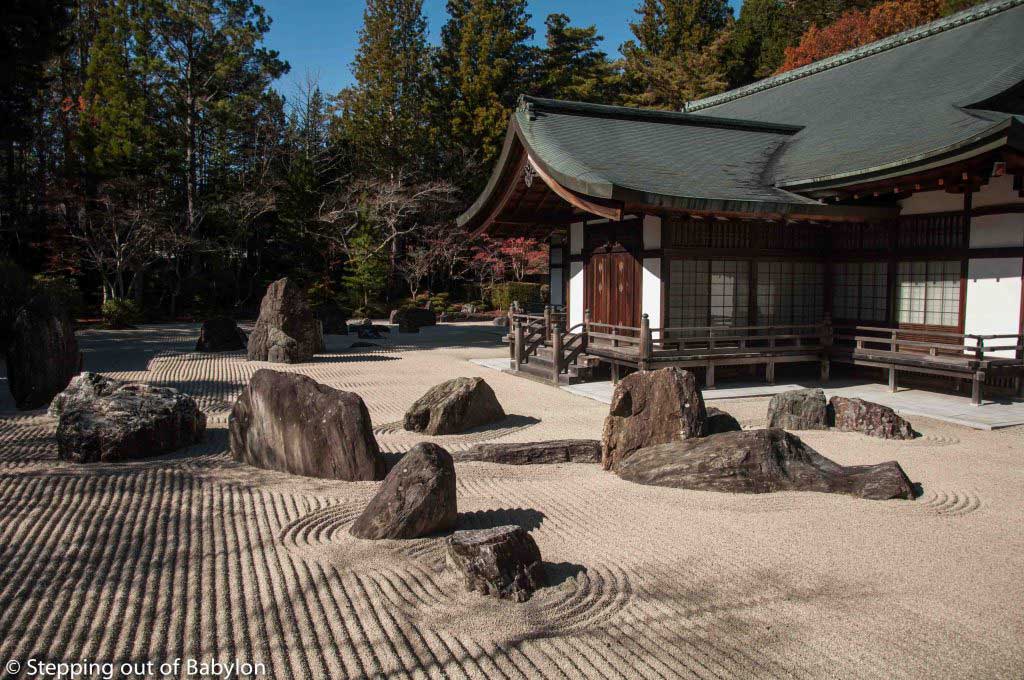
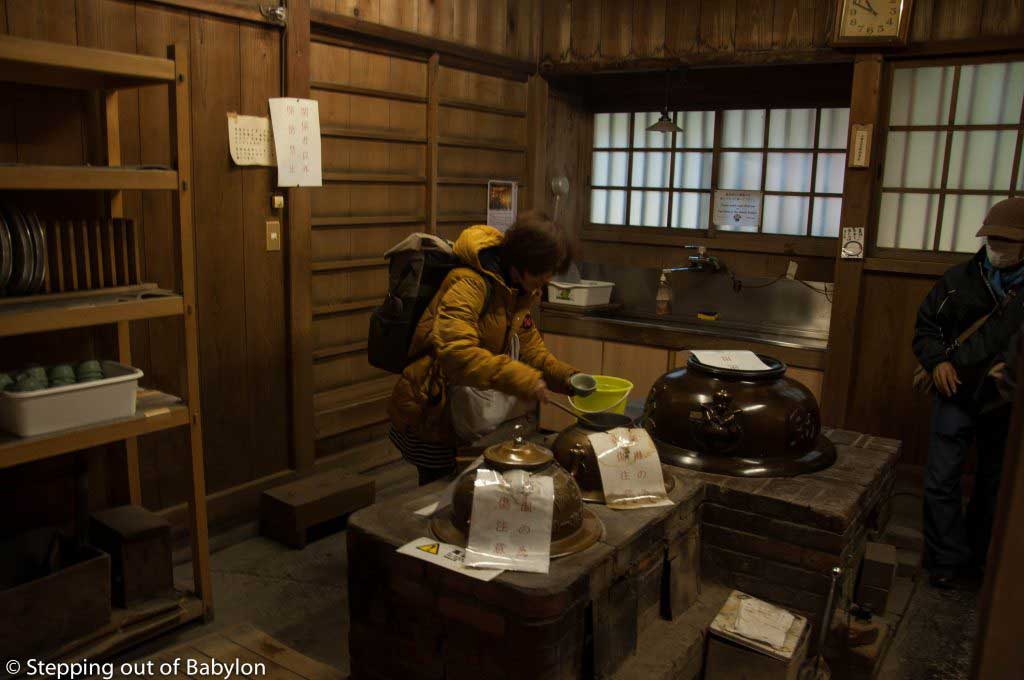
The Kongobu-ji, the headquarters of all the monasteries in Koyasan, isn’t used anymore by monks but only for special ceremonies. Although you can visit the interior, including the kitchen area, as well the different rooms where the walls are decorated with delicate paintings related to Kobo-Daishi’s life and also nature scenes. But the most impressive is the rock garden (Banryutei), where blocks of granite that mimic a dragon coming out from the water waves.

rock garden (Banryutei) at Kongobu-ji

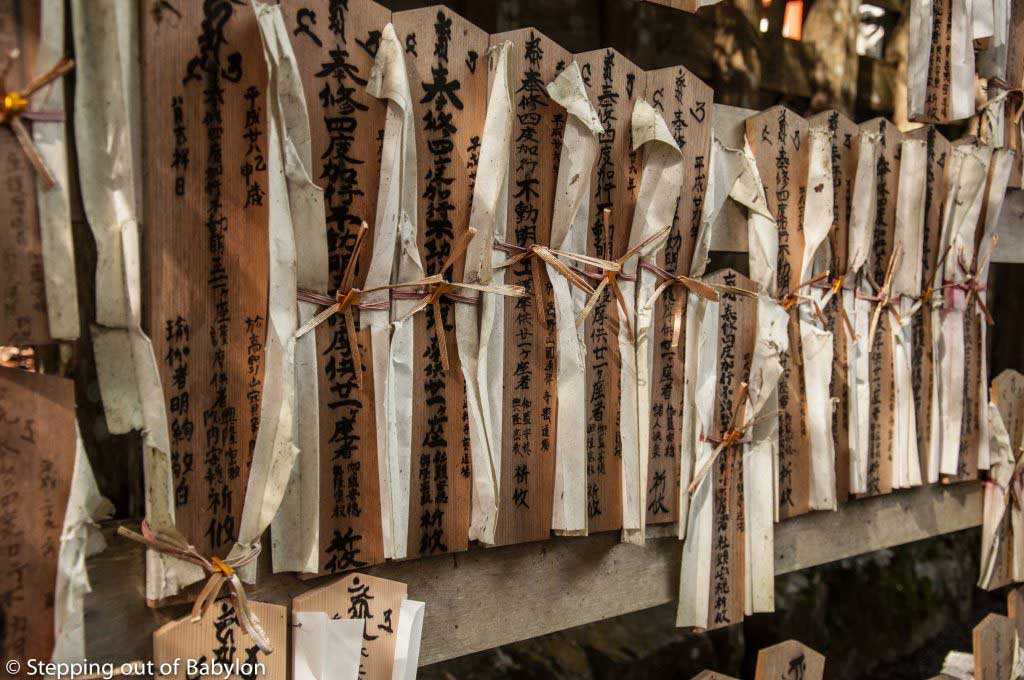
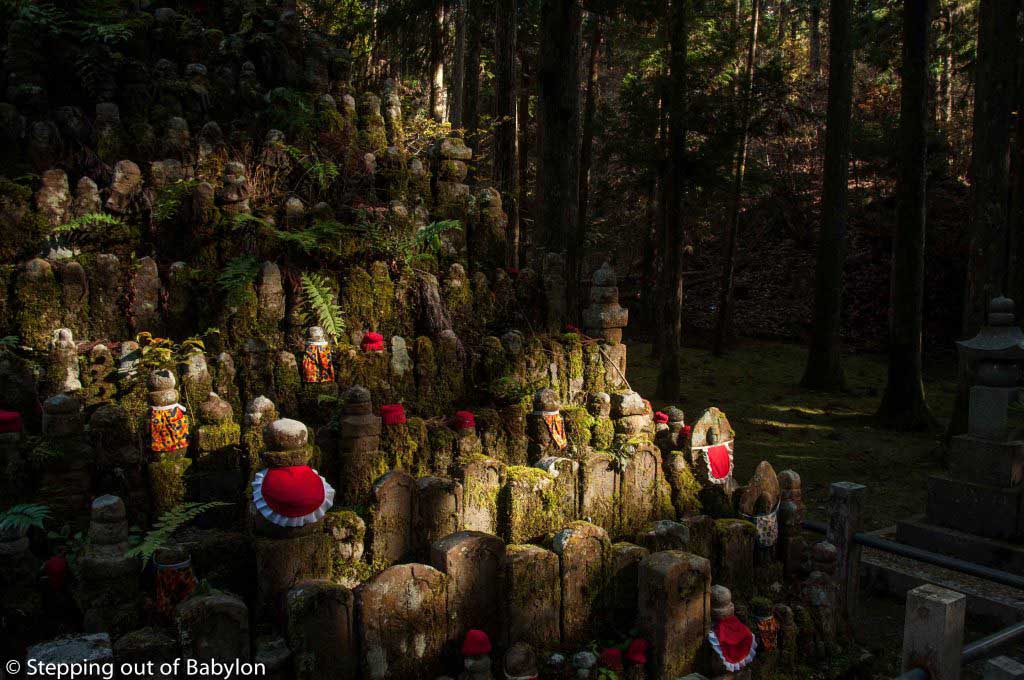
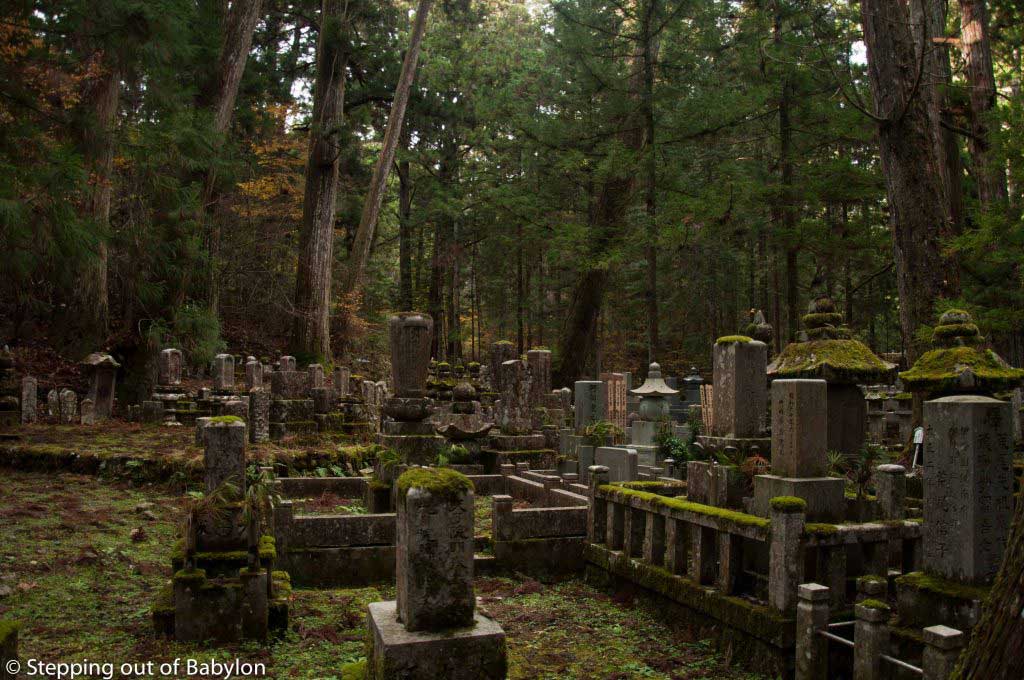
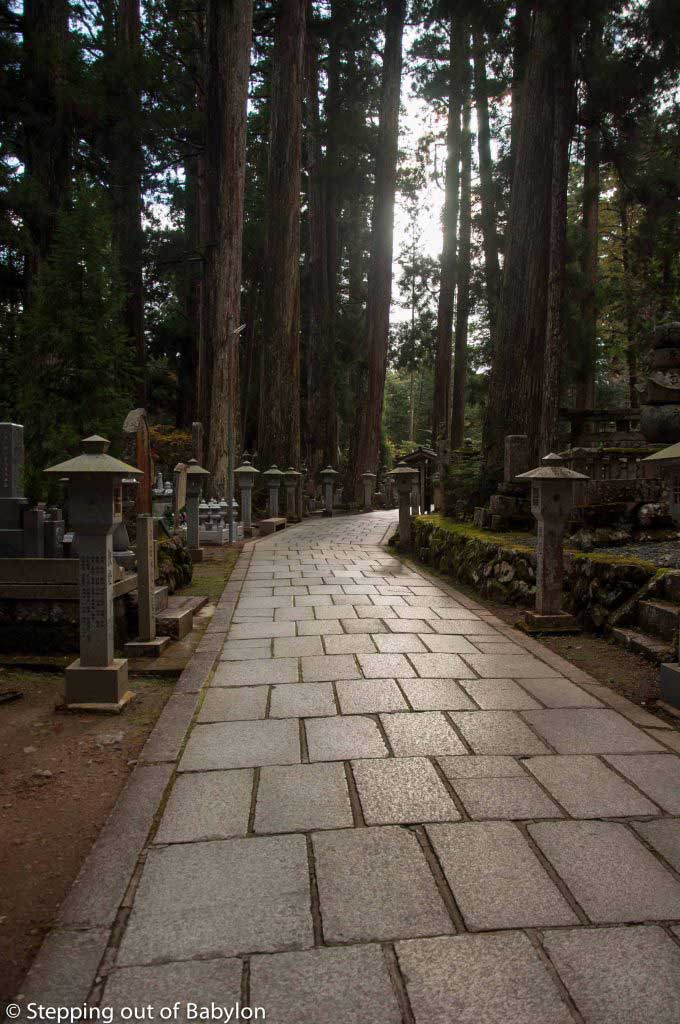
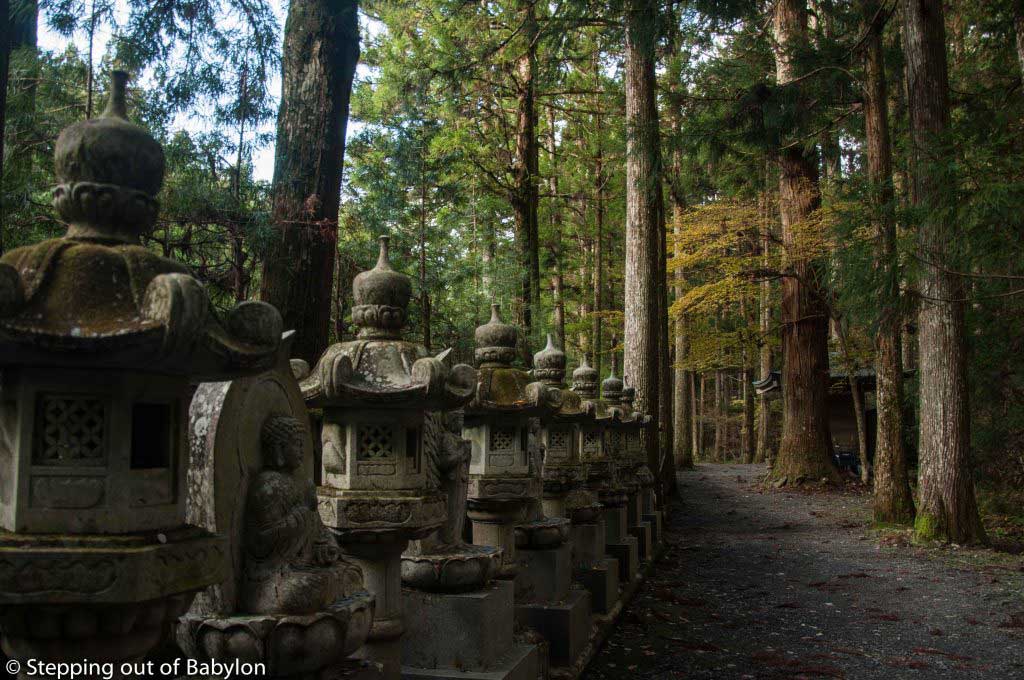
But from all that Koyasan as to offer, for a visitor, the place that I visit more times was surprisingly the Okuno-in cemetery. Apart from being a nice place to walk, in the middle of the cedar and pine forest, where the stones that mark the graves are covered with moss it’s also the only way to reach the Kodo-Daishi Mausoleum. It’s a kind of magic place, where you easily can spend one hour, exploring the different stone paths, crossing bridges, going up and down gentle steps, observing the thin rays if sun crosses the dense canopy.

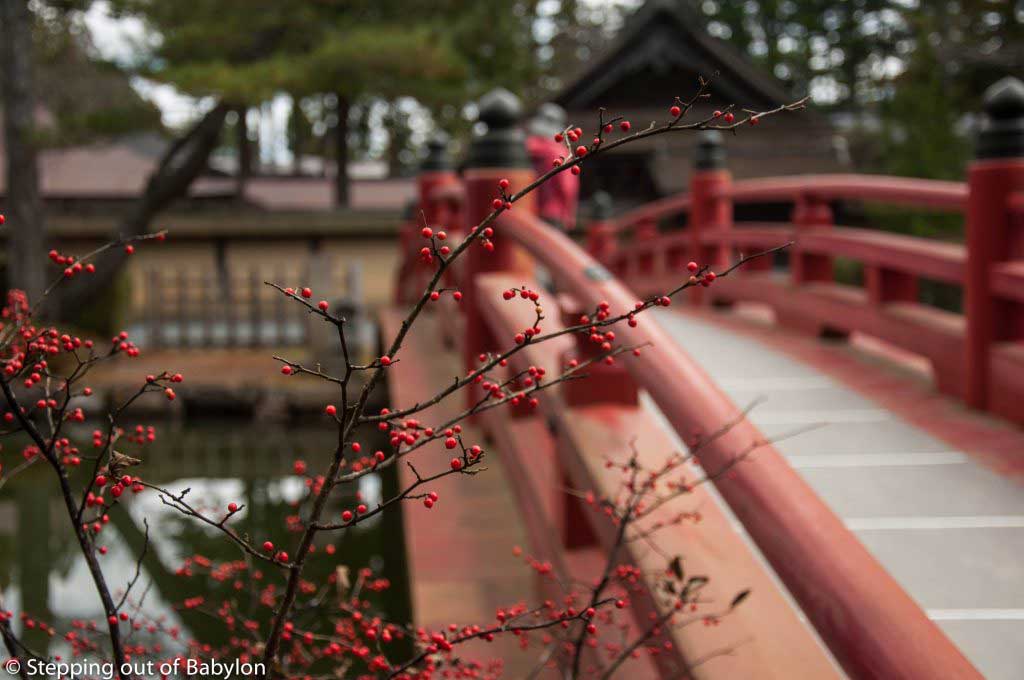
After cross the Gobyo-no-hashi Bridge you enter the sacred place, as according to the followers of the Shingon-shu Buddhism, Kobo-Daishi, born in the year 774, is still seated in deep meditation since the retired from the world with the of 62. This makes Koyasan a mandatory point for Buddhist pilgrims, which come here all year round, making this place part of the Kumano Kodo Pilgrimage route.

Okuno-in cemetery
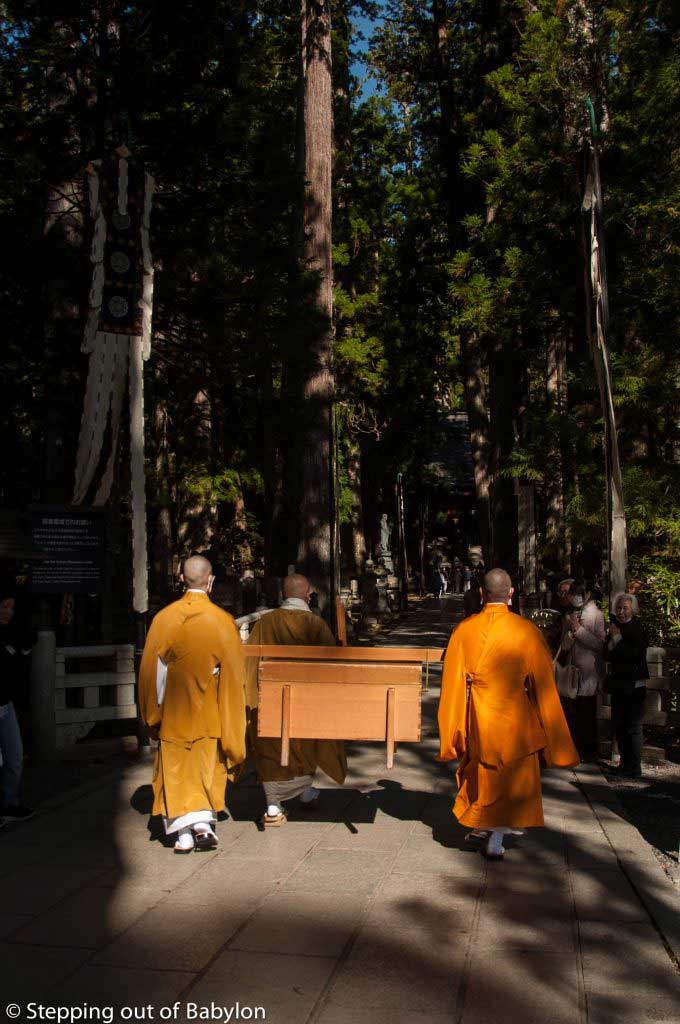
Entrance of the Kodo-Daishi Mausoleum, where the monks repeat every morning the ritual of bring food for Kobo-Daishi
Okuno-in cemetery
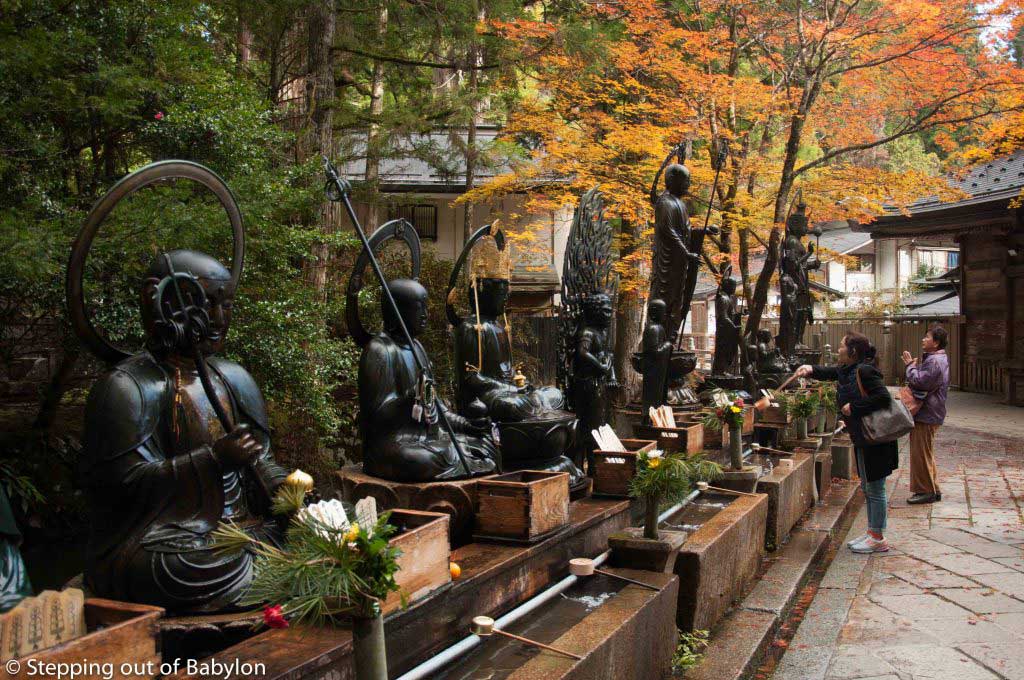
Buddha statues at the entrance located before the Gobyo-no-hashi Bridge, where the visitors sprinkle the statues with water symbolising the river crossing that was necessary to do before the construction of the bridge
Okuno-in cemetery

Koyasan has enough to see and to do if you have curiosity or if you feel the connection with Buddhism, and it’s a nice place to stay for three days or more, enjoying the nice vegetarian food, the temple ceremonies, and hikes in nature.

Okuno-in cemetery
Okuno-in cemetery

And Koyasan is also the starting point for the one of the Kumano Kodo Kohechi, one of the routes that crosses the Kii Peninsula, in the southern Kansai region, to reach Kumano Hongu Taisha. Kumano Kodo, an ancient pilgrimage route is now a World Heritage site classified as “Sacred Sites and Pilgrimage Routes” in parallel with Camino de Santiago.

Koyasan visitors ticket pass:

It costs 1500 ¥ that can be used in several days… it worth it if you want to see all the temples as also join the Jukai Ceremony (accepting the 10 Buddhist precepts that cost 500 ¥, ask at the Daish Kyokai).

  • Kobo-Daishi Mausoleum, Okuno-in cemetery and Lantern Hall: free
  • Danjo Garan: free, but to get inside the Daito
    Pagoda or Mie-do Hall is 200 ¥ each.
  • Kongobu-ji: 500 ¥

Everyday you can hear the morning chants in the shukubo, but you can also experience this magic and hypnotic moment in Kododaisho Mausoleum, everyday from 6 until 7 in the morning, for free.

In the evenings, there a Cemetery Walking Tour (2000 ¥) guides by monks that can tell you the myths and superstitions of the cemetery as well to understand a bit more about Kodo-Daishi and the Shingon-shu Buddhism. This tour is organized by Eko-in, and departure from there.

Each 21st day of each month, it’s considered a special day as it’s the day of the
anniversary of the death of Kobo-Daishi, and Koyasan receives more visitors to assist to the special changings that include particular rituals way more rich and complex that the usual morning chants. So if you can manage to be in Koyasan in this day you can attend the
chants that start at 9 o’clock in the morning. In the evening before (20th) there is also a special ceremony at Kododaisho
Mausoleum
around 7:30/8:00.

Koyasan Bus pass:

The trip from the cable car until Okuninmae (basically until the end of the village) costs 420 ¥ (one way).

There are passes (3 days = 3000 ¥) but the Kaoyasan as about 3 km from the Dai-mon Gate to Okuninmae, where is the entrance Okuno-in cemetery, and that can be made easily on foot.

Where to sleep in Koyasan:

But most of the visitors stay in Koyasan only one night and choose to stay in the traditional pilgrim accommodation, the shukubo. It’s for sure a remarkable option but a bit pricy, so I choose to stay in a guesthouse, that in fact is very rare in Koyasan.

Koyasan Guesthouse Kokuu, it’s located in Okuninmae (very close by the Okunomi cemetery and from a bus stop), 200 meters from the bus stop, and offer rooms and dorms in capsule style. The building is super cool, design by the Japanese Alphaville Architects. They offer also an amount of detail infromation about Koyasan, religious activities, mediation, hiking trails, etc…

Where to eat in Koyasan:

As many people (almost everyone) stay in one of the 52 shukubo (temples lodging) that include breakfast and dinner, there are not many options for dinner in town. But the convenience stores (there are at least 3) provide quite good options for food.

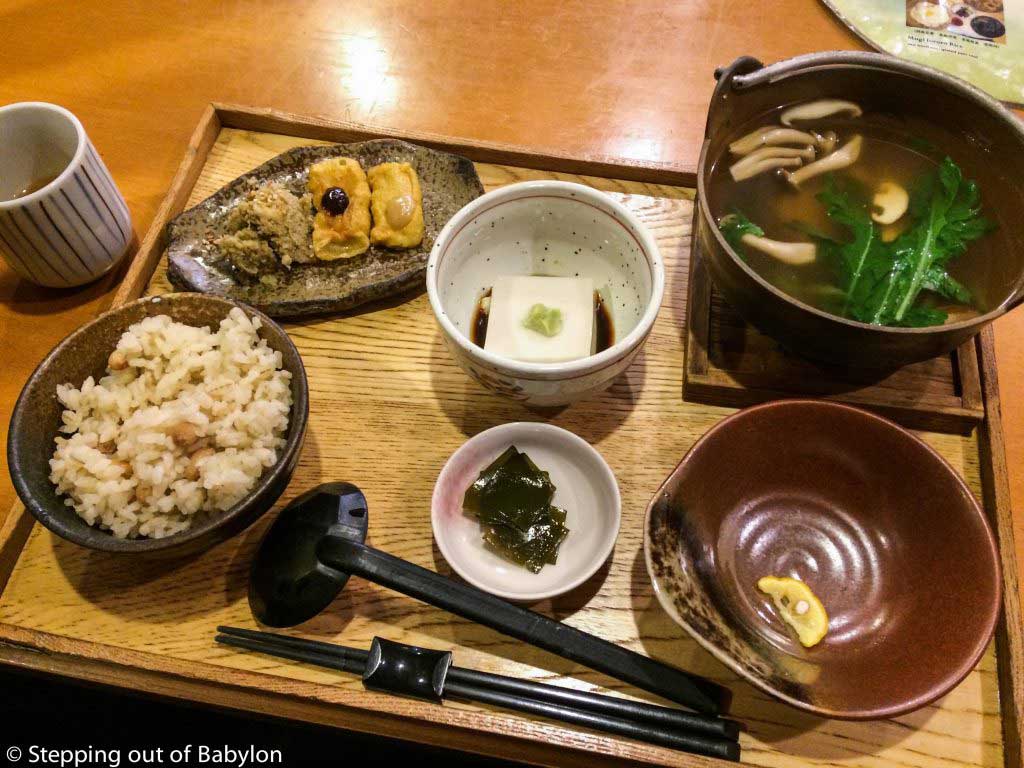
But for lunch, if you want to try the monasteries food, shojin-ryori, a totally vegan meal compost by several small dishes matching the five cooking methods (raw, stewed, boiled, roasted, and pickling) five flavors (sweet, sour, salty, bitter, and umami), and five colors (green, yellow, red, black, and white). A work of art!!

The Sanbou Restaurant offers delicious shojin-ryori meals. At first glance, the meal set available look a bit small but it a perfect portion and provides the chance to taste a wide variety of flavors as well the different kinds of tofu. The prices range between 1250 ¥ to 4000 ¥. The Sanbou Restaurant doesn’t have a sign in Latin characters but is located very close by the Ichijo-in Shukubo (check the image below). It’s only open for lunch (from 11:00 until 14:00). Try the famous goma-tofu, very silky tofu made from ground sesame paste!!! Something new!

shojin-ryori meal at Sanbou Restaurant
Sanbou Restaurant

Koyasan for the sweet tooth:

There aren’t many shops in Koyasan but the ones that exist, apart from restaurants are dedicated mostly to sell religious souvenirs (some of them a bit cheesy) as well as sweets, that apparently are the most popular souvenirs from Koyasan. There are several options, but my favorites were the yaki-imo made from sweet potato and cinnamon and the amazake manjyu, filled with sweet bean paste.

Some of these sweet shops are also factories, so try to find one of them (you can see people work inside, as here everything is fresh. Try Mirokuishi, a traditional Japanese confectionary, located on the main road, more to the East part of Koyasan…. and there you can also get a tea if you chose to eat the sweets inside!!

yaki-imo on the left andamazake manjyu in the center where my favourite sweet from this confectionary, where you can drink tea for free while taste the sweets

Mirokuishi, a traditional Japanese confectionary
Koyasan Curry… a vegetarian version of the traditional Japanese curry, that is sold packaged and just needs to be heated and accompanied with rice. A good souvenir form Koyasan!!

How to go from reach to Koyasan:

There are two options to arrive to Koyasan by public transportation:

  • Taking the Nakai Line, direct from Namba to Koyasan… this is the best option if you want to stay more than one night in Koyasan, or if you plan to move forward,
    instead of getting back to Osaka. It cost 1390 ¥ and includes the cable-car to
    Koyasan. The trip takes in total 2h.

At Koyasan station you need to take a bus to your accommodation… it’s a 2.5 km distance to reach the center of Koyasan, and 5 km to reach the easternmost point of Koyasan.

The bus from Koyasan station (the terminus of the cable car) to Okunoin (cemetery) cost 420 ¥, one way.

  • Buy the Koyasan World Heritage Ticket, which is the best option if you just want to stay one night is Koyasan. 2900 ¥ and includes the return train trip, the cable car
    and the bus pass to move around Koyasan for two days.

Note: The Nakai Line trains to Koyasan departure from Namba Station, but don’t mistake with JR Namba. Nakai is a private company and has it’s own station (the JP rail pass ins not valid here) that is linked with JR Namba by the Namba Walk, a long-long tunnel that takes around 15 minutes to walk, where you can find shops and restaurants along the way.

How to apply for Chinese visa in Laos

Definitely getting the Chinese visa, even for tourism, isn’t a simple task, requiring more documents than it’s normal for most of the South East Asia countries.

China doesn’t have the visa upon arrival.

The tourist visa, type “L”, is 30 days and is valid for three months from the date of issue. Staying longer than the thirty days entitles you to a heavy fine and a formal apology request based on a good justification (according to information collected on the net the fine is 500 yuan), running the risk of being banned from entry in China forever.

My first attempt to obtain the visa was at the Chinese embassy in Bangkok, which is a time-consuming and demanding task. It’s advisable to arrive early, as visa services only work in the morning, and yet there is no shortage of a wait of more than four hours, in a crowded room, which can be extended in the afternoon.

Even though I had arrived a little more than half an hour after the opening of the doors, I came upon a veritable throng which filled the vast hall with more than two hundred people.

According to information gathered from other tourists who are more accustomed to this process, it is practically impossible to apply for an entry visa in China if there is no copy of a return plane ticket, which I did not have because my objective was to enter China along the border with Laos. It is also necessary to provide proof of accommodation reservations during your stay in China.

I gave up! Following some advice, I chose to apply for a visa elsewhere, which in Thailand may be in Chiang Mai, or in Vientiane, capital of Laos, which in my case was more favorable.

I choose Laos because it was on the way to China…. the process in Vientiane proved to be simple and easy, taking no longer than 10 minutes, including the time for completing the application form, for a total of four pages.


Documents required for visa application to China:

  1. Passport valid for 6 months;
  2. Visa application form: it’s available in the embassy, duly filled in, which in addition to identification data, company name and contact details of the employer (may be fake data because this information is not verified by consular services) , should also include the planned itinerary and the number of days and should be excluded allusions to a visit to Tibet ;
  3. Photograph with light background;
  4. Copy of passport
  5. Copy of flight ticket: it is enough to one-way ticket; if you choose to enter China by crossing land border, the best is to forge a ticket based on any another, changing dates and names using Photoshop or other image editing software;
  6. Copy of bank statement proving financial means to bear the expenses of the stay;
  7. Proof of booking of accommodation: just send a few emails to various hotels or hostels to book room for the dates outlined in the application form for a visa; is then re-contact these entities to cancel the reservation; if they not accept reservations without payment of a percentage (the case of many lodges associated with Hostelworld), just take the email reply and edit the text confirming the booking.
  8. Cost

Single Entry                                          $ 30

Double Entry                                        $ 45

Multiple Entry valid for 6 months      $ 60

Multiple Entry valid for 12 months    $ 90

Multiple Entry valid for 24 months    $ 90

This amount can be paid in dollars or in local currency. In Bangkok payment is made in the embassy services, but in Vientiane is necessary to go to the Bank of China to make the payment, which adds a payment of 1,000 kip for bank charges.

For citizens with American passports the visa fee is $130.

  1. Visa is ready in 4 days.

Embaixada Chinesa em Vientiane, Laos (Chinese embassy in Vientiane, Laos)

Website: http://la.china-embassy.org/eng/

Email: chinaemb_la@mfa.gov.com

Ambassador: Mr. Bu Jianguo

Address: Wat Nak Road, Sisattanak, Vientiane, Lao P.D.R (P.O.Box 898)

Office Hours: 8:00-11:30, 14:00-17:00 Monday-Friday

Tel: +856-21-315100

Fax: +856-21-315104

Email: chinaemb_la@mfa.gov.com

Consular Office

Office Hours: 9:00-11:30 Monday-Friday

Tel: +856-21-315105

Embaixada Chinesa em Bangkok, Tailândia (Chinese embassy in Bangkok Thailand)

Website: http://www.chinaembassy.or.th

Email: chinaemb_th@mfa.gov.cn

Ambassador: Mr. Guan Mu

Address: 57, Ratchadapisek Road, Bangkok, 10310, Thailand

Tel: +66-2-2450088, 2457043, 2457044 (direct)

Fax: +66-2-2468247

Consular Office

Office Hours: 09:00-11:30, Monday-Friday

Tel: +66-2-2457033, 2457036 (24 hour Auto Answer), 2478970 (14:00-17:00 Working Day)

Fax: +66-2-2472214

China Visa
China Visa


Larung Gar… looks like a dream

(English version from the text posted in Jun/2014)

Larung Gar, located in the Sertar district in the western region of Sichuan province, is the largest Tibetan Buddhist school, housing about 40,000 monks, forming almost a town in the Larung Valley.

Through the hills surrounding the main building are thousands of small houses, which evenly cover the slopes, forming a pattern similar to small squares painted with maroon color, the same color adopted by the Tibetan monks who follow the Mahayana current of Buddhism.

The gray of the sky with its heavy clouds contributes to the mystical atmosphere that surrounds the place, intensified by the morning mist that comes out from the slopes covered with a mantle of fine green grass.
From the fireplaces of the small wooden houses comes out a thin column of smoke that slowly mix with the heavy clouds.
The houses, located very close from each other, create an intricate labyrinthine of narrow streets and uneven steps.

It was a special day, with the celebration of a ceremony attended by the founder of the institute, Lama Jigme Phuntsok, whose image can be seen in houses, cars, restaurants, and shops, in the neighbouring villages such as Sertar and Lughuo, as well as hanging around the neck of many Tibetans.

The vision and atmosphere of Larung Gar, which until recently was barred to foreigners, is too impressive to be recorded in pictures and even less in words, having been one of the most remarkable places of trip in China.

Larung Gar
Larung Gar

Boleia para ir de Sertar a Larung Gar, num mini-tractor
Hitchhiking in a tractor to Larung Gar

Larung Gar
Larung Gar

Larung Gar
Larung Gar

Estrada de acesso a Larung Gar
Road to Larung Gar

Larung Gar
Larung Gar

Larung Gar
Larung Gar

Larung Gar
Larung Gar

Larung Gar
Larung Gar

Larung Gar
Larung Gar

Larung Gar
Larung Gar

Larung Gar
Larung Gar

Larung Gar
Larung Gar

Larung Gar
Larung Gar

Larung Gar
Larung Gar

Larung Gar
Larung Gar

Larung Gar
Larung Gar

Larung Gar
Larung Gar

Larung Gar
Larung Gar

Larung Gar
Larung Gar

Larung Gar
Larung Gar

Larung Gar
Larung Gar

Larung Gar
Larung Gar

Larung Gar
Larung Gar

… hitchhiking by Kangding, Tagong and Sertar

(English version from the text posted in Jun/2014)

Because of a misunderstanding between me and the Litang taxi drivers, as a result of my poor Chinese pronunciation and the limited knowledge shown by the Tibetans about Mandarin, I ended up going to Kanding, near Garzé instead of Ganzi… instead of going North, I was on my way to Chengdu, East, forcing me to spend a night in the uninteresting city of Kanding.

But everything happens for a reason and the disappointment brought a succession of events that become positive: in the hostel where I slept in Kanding, I met two Chinese on school vacations that were planning to travel in the western region of Sichuan.

So, it began a pleasant three-day adventure hitchhiking through the Kangding region, which took us to the green hills of Tagong, to a sky burial near Luhuó and the incredible monastery town of Sertar.

The Chinese generosity was evident during these days, with countless vehicles stopping to offer us a ride (with the exception of the trucks that are forbidden to carry foreigners) being available to arrange space even when the car was apparently full, offering us water and food. Along the way, our drivers stop at temples, monasteries, and viewpoints to appreciate the wide landscapes of this region, where the Tibetan presence is evident and the Buddhist religion has a strong presence, visible by the numerous stupas and prayer flags that stand out at the top of the hills.

Easy, easy hitchhike in China, but it’s necessary to speak the language or travel in the company of Chinese!

OLYMPUS DIGITAL CAMERA
Kangding district

OLYMPUS DIGITAL CAMERA
Monastry at Kangding disrict

OLYMPUS DIGITAL CAMERA
Luhuó

Luhuó
Tagong

Luhuó
Tagong

Luhuó
Sertar

Luhuó
Sertar

Luhuó
Sertar

Luhuó
Sertar

Luhuó
Sertar

Luhuó
Sertar

Luhuó
Sertar

Tibetan High-way: Estrada G318 que liga Chengdu a Lhasa e que é a rota mais popular para quem visita o Tibete, em especial entre os muitos chineses que efectuam este percurso mais de 2000 quilómetros, de carro, de bicicleta e por vezes a pé.
Tibetan High-way: Estrada G318 from Chengdu to Lhasa

Kangding
Kangding

Xinduqiao
Xinduqiao

Xinduqiao
Xinduqiao

Paragem na estrada perto de Xinduqiao, enquanto se espera por nova boleia...
Hitchhiking near Xinduqiao

Tagong Grasslands
Sertar

Itinerário dos possíveis percurso para chegar a Lhasa; este género de autocolantes que decoram muitos dos veículos da região fazem com que a viagem pelo Tibete se pareça com um rali, sobressaindo o espírito de aventura com que os Chineses encaram esta viagem... um pouco como a descoberta da "ultima fronteira"!
map of the tibet region with the different roads that reach Tibet

Tagong Grasslands
Tagong Grasslands

Muito mais que uma boleia, este ex-monge tibetano durante 17 anos, levou-nos a conhecer a região, mostrando paisagens, mosteiros, levando-nos a assistir a um sky burial, pagando refeições e alojando-nos no seu hotel... uma incrível generosidade!!
More than just a hitchhike, this tibetan, that was a monk for 17 years, took us to visit the region during two days… an amazing generosity!!

  • « Go to Previous Page
  • Page 1
  • Page 2
  • Page 3
  • Page 4
  • Interim pages omitted …
  • Page 6
  • Go to Next Page »

Footer

search

Tags

Arugam Bay Assam Bali Border Crossing Borneo Cappadocia Colombo Dambulla Esfahan Fes Food Gilis Hiking Hikkaduwa hokkaido Istanbul Itinerary Jakarta Java Kandy Kashan Kataragama Kumano Kodo Lombok Meghalaya Meknes Mekong Nagaland Natural Park Nongriat Northeast States Ouarzazate Sarawak Shiraz Sichuan Province Sumatra Tabriz Tehran transportation Varanasi Visa Yangon Yazd Yogyakarta Yunnan Province

I’m Catarina, a wanderer from Lisbon, Portugal… or a backpack traveller with a camera!

Every word and photo here comes from my own journey — the places I’ve stayed, the meals I’ve enjoyed, and the routes I’ve taken. I travel independently and share it all without sponsors or ads, so what you read is real and unfiltered.

If you’ve found my blog helpful or inspiring, consider supporting it with a small contribution. Every donation helps me keep this project alive and free for everyone who loves exploring the world.

Thank you for helping me keep the journey going!

BUY ME A COFFEE

Categories

Recent Posts:

  • How to go from Hualien to Dulan Beach
  • Taroko Gorge: between marble cliffs and emerald rivers
  • Hualien: a dull gateway to Taroko Gorge
  • Taiwan: Itinerary for an 16 day trip
  • Vietnam: Itinerary
  • 3 months in India: Kolkata, Tamil Nadu, Karnataka, Goa and Kerala
  • Backpacking Turkey in 24 Days: itinerary & costs
  • English
  • Português

Copyright © 2025 · Stepping Out Of Babylon on Genesis Framework · WordPress · Log in