• Skip to main content
  • Skip to footer

Stepping Out Of Babylon

Travel & Photography

  • About me
    • Contact
  • Destinations
    • Africa and Middle East
      • Iran
      • Lebanon
      • Morocco
      • Turkey
    • East Asia
      • China
      • Japan
      • Taiwan (ROC)
    • South Asia
      • Bangladesh
      • India
      • Nepal
      • Sri Lanka
    • Southeast Asia
      • Cambodia
      • Indonesia
      • Lao
      • Malaysia
      • Myanmar
      • Singapore
      • Thailand
      • Vietnam
  • Itineraries
  • Travel tips
    • Border crossing
    • Hiking and Natural parks
    • Food Journey
    • Visa
  • Photography

Search Results for: China

Hikking through Palaung Villages

Strange feeling to be in a remote village where the hills and the winding and steep dirty roads create a barrier with the modern world.

This sense of isolation is intensified with the nightfall, where a cloak of darkness surrounds the village, with the blackness of the moonless night enters through the windows, creating a thick obstacle between us and the inhabitants of the house where we will spend the night, where the cultural and language differences do not allow us to break.

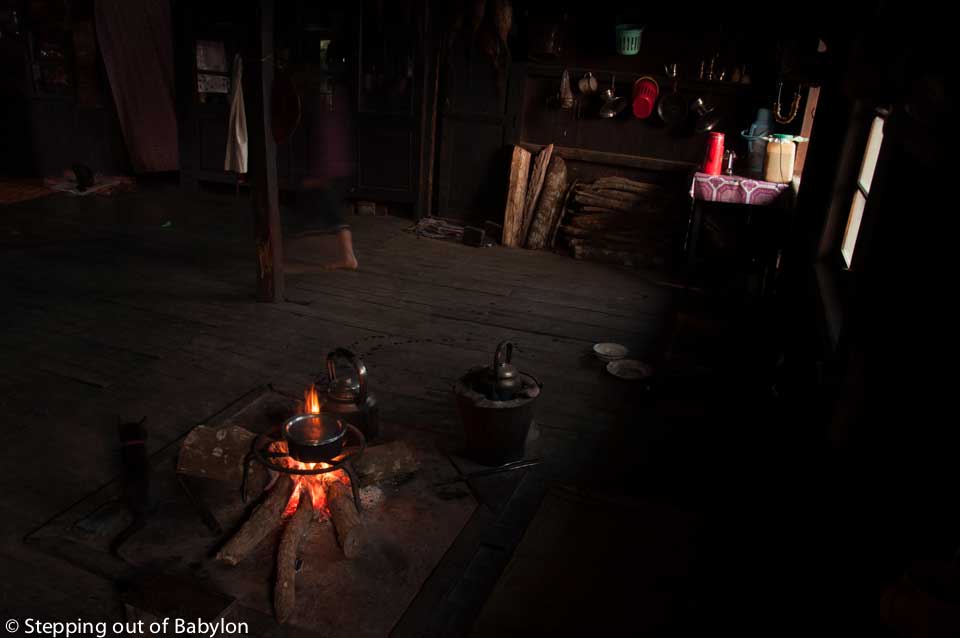
Large rooms made of wood and bamboo, simple, comfortable and above all functional, where the fire is the center of the house, being kept lit throughout all day, from the first rays of the sun until bedtime… that here is around nine o’clock. A fine and discreet smoke that burns the eyes and leaves an fragrant trace on the clothes, reminding us how different the way of life in the countryside.

Shortly after sundown, as soon as the sky darkens, the movements in the streets of the Palaung village cease, the ballads of the donkeys, the clucking of the chickens, the tweeting of the birds and the laughter of the children suddenly ceases. The families gather to the houses, wrapped in the rituals of preparation of food. Rituals where everyone, including the children, seems to know their role by heart, making the daily life resemble a silent play.

A thin layer of smoke remains in the main room of the house, a large area almost empty of furniture that is at the same time the living room and the kitchen. The few belongings wait for special days in lockers embedded in the wooden walls, almost becoming invisible in the penumbra that permanently fills the space, despite the various windows that look to the succession of woody hills.

From this first stop in a village on the outskirts of Kyaukme, a further two days’ hike through the western region of Shan State, dominated by the Palaung tribe, whose population shares the ethnic heritage with China, but along many centuries developed its own characteristics of language, clothing and gastronomy.

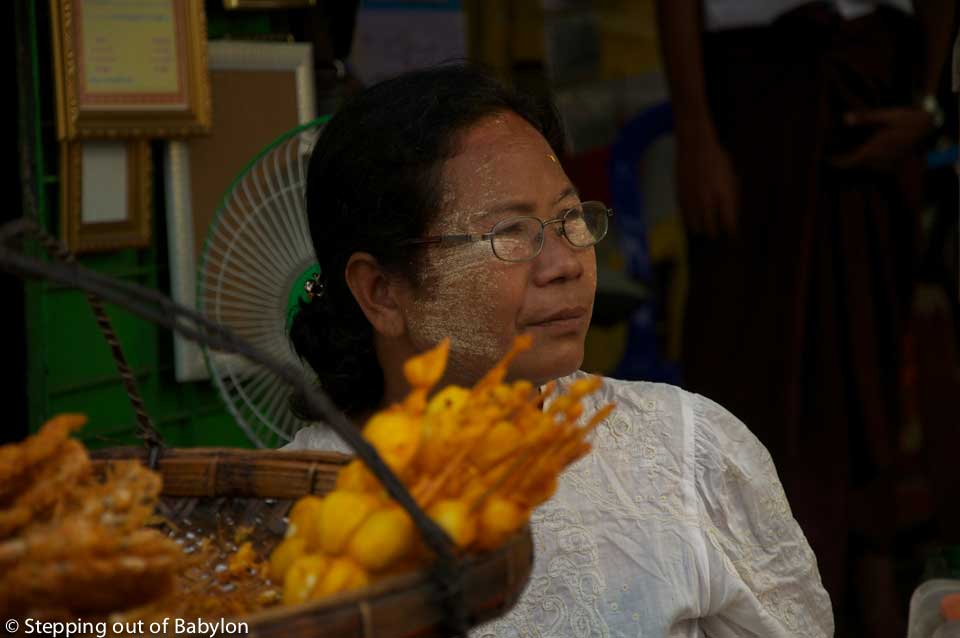
The Palaung, whose features are more Asian than the Bamar ethnic group (dominant in Myanmar) are easily recognizable by the way women dress, with sarongs of gaudy colors in purple, blue and green, and by the white handkerchiefs that cover carelessly the Heads, whose hair is kept shaven, following an unknown tradition.
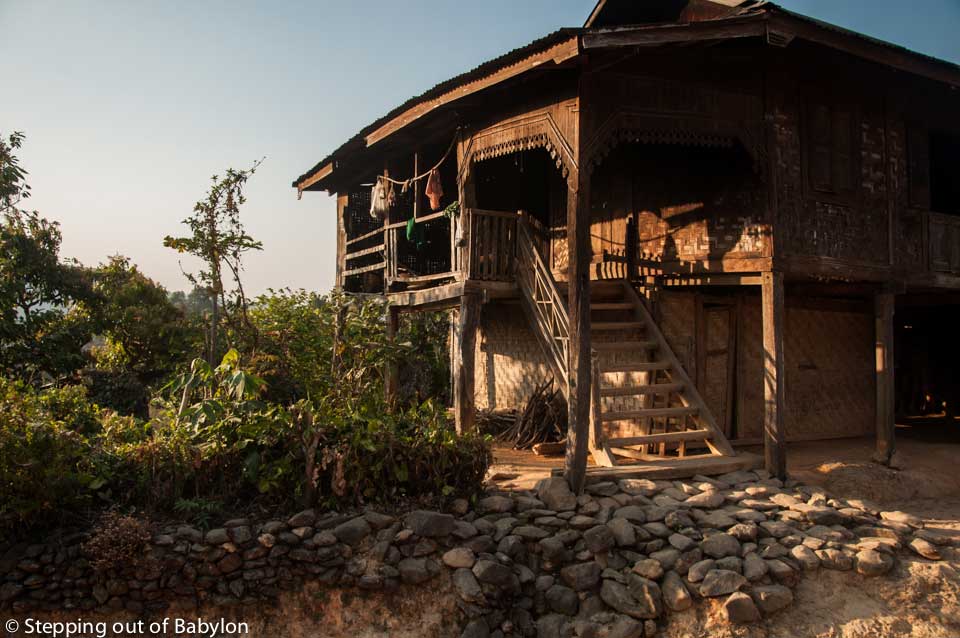
Palaung village. Kyaukme region. Shan State
Woody hills that little by little have been replaced by tea plantations, the main commercial activity in the region
Palaung village. Kyaukme region. Shan State
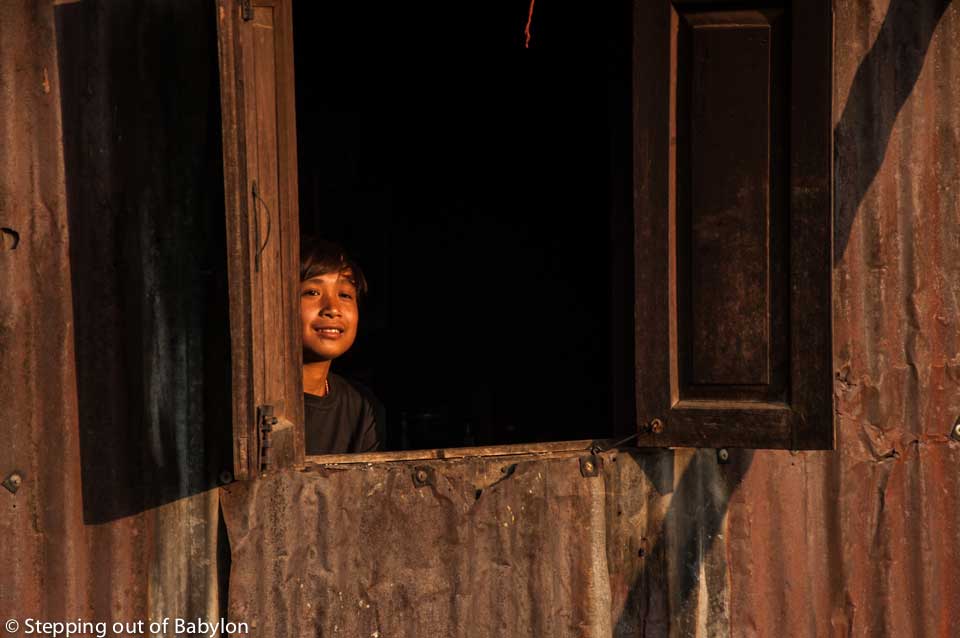
shy but curious smiles wait for us everywhere
Palaung village. Kyaukme region. Shan State
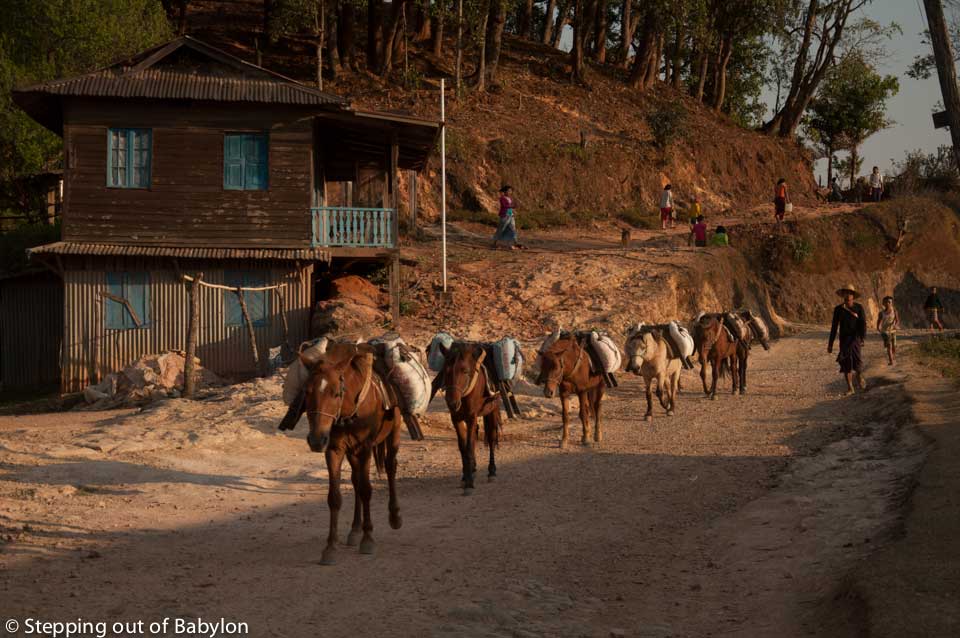
Despite the recently made roads the donkeys are still commun as a way to transport cargo between villages
A tecelagem é parte do quotidiano das mulheres da tribo Palaung
Weaving is part of the everyday life of women of the Palaung tribe, whose sarongs are made by themselfs
Palaung_Kyaukme_Shan State_Myanmar_DSC_2934
Inside one of the houses where we spend the night during the three days of walking through Palaung villages… the fire is the main source of light of the house
Palaung village. Kyaukme region. Shan State
Easy going life at the villages, where even the population that work in the tea plantation keep the slow pace
Palaung village. Kyaukme region. Shan State
In the main villages there is always a small monastery attached to the pagoda, so it is common to find children in monastic costumes
Palaung village. Kyaukme region. Shan State
altar decorado com motivos birmaneses numa das aldeias
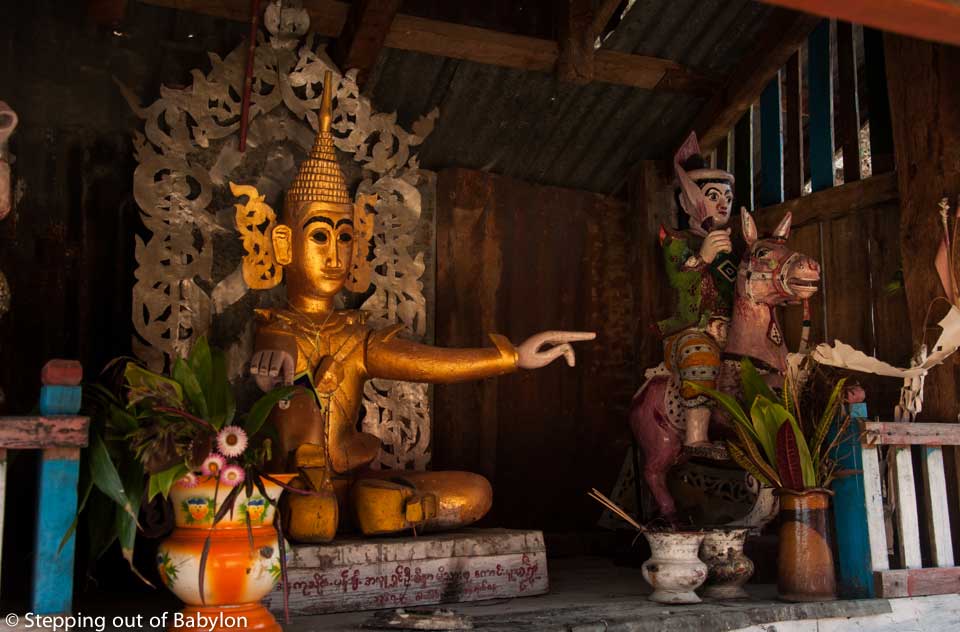
Buddhist altar decorated with Burmese motifs in one of the villages
mulheres da tribo Palaung, com o tradicional lenço que cobre a cabeça rapada
Women of the Palaung tribe, with the traditional scarf covering the shaved head… a tradition with blur contours
Palaung village. Kyaukme region. Shan State
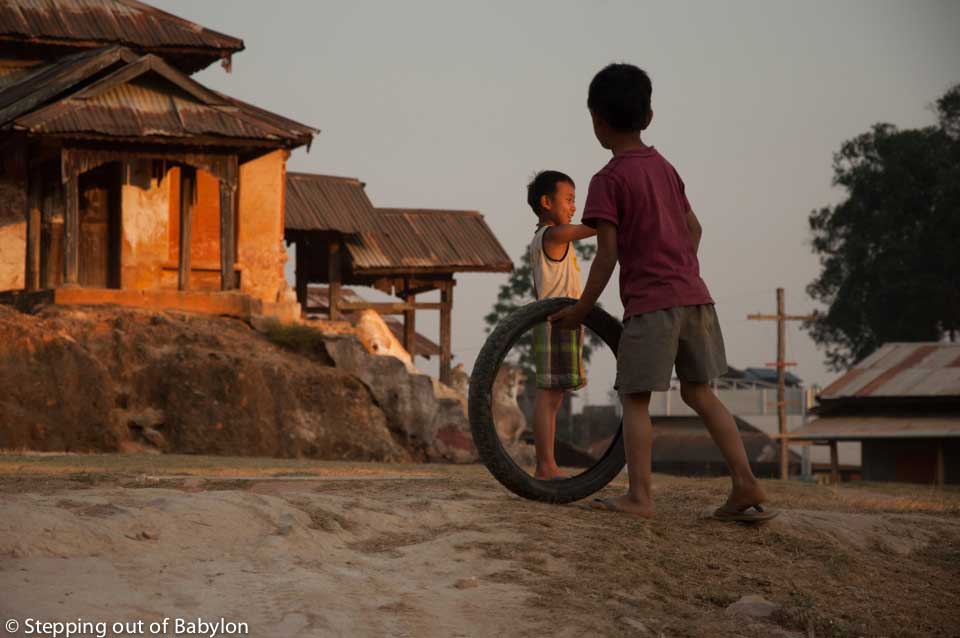
During the day children play leisurely on the streets of villages, practically without traffic

But here also the religion acquires its own contours. Despite the domination of Buddhism that arrived in the eleventh century, there are still traces of rituals and beliefs related to animism. A small group of people gathers in one of the village houses bringing offerings, where a woman in trance communicates with the spirits … practical questions about the whereabouts of a lost cow or the crops are answered by spirits by the voice of a possessed woman, who’s tone change from female to male tone according to each spirit evoked.

Sessão espírita numa das aldeias, mostrando que o Budismo não esmagou totalmente as práticas animistas
Spiritist session in one of the villages, showing that Buddhism did not completely crush animistic practices

In all villages that we visited always seem to be full of children running freely in the streets, waving and smiling, curious and excited by the unusual presence of strangers.

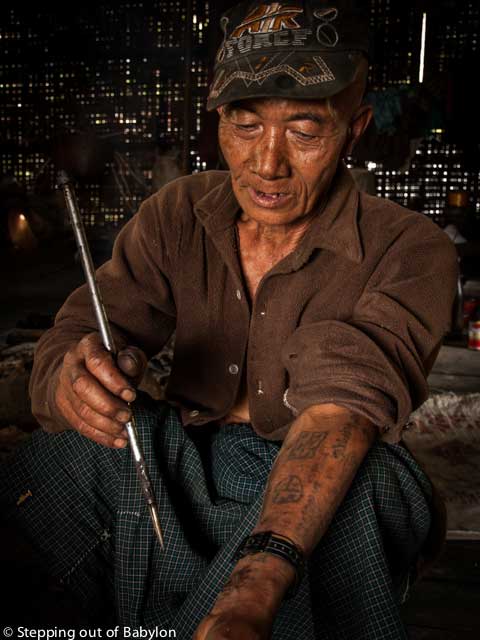
But it is not only the children who show their curiosity, as the adults cannot disguise the pride with which they pose for the photographs, hiding damage teeth under a closed-lipped smile. But are the men who, despite language differences, show more communicative, exposing the tattoos that cover the body, with symbols and inscriptions, that work as protection against all kind of bad things, a practice common among the male population and also among the Buddhist monks, both in Myanmar as in Thailand.

 

Palaung village. Kyaukme region. Shan State
Men rom the Palaung tribe with protection symbols tattooed on his chest
as tattoos para proteção com símbolos e inscrições Budistas são comuns entre os habitantes mais velhos
Tattoos for protection with Buddhist symbols and inscriptions are common among older people

How to visit the Palaung villages around Kyaukme

These three days of hiking were organized by Thura, a Burmese from the Shan ethnic group, whose mother was from the Palaung tribe. He’s friendliness, the very good english and the contacts with local people allows him to travel around this region, which is probably impossible to visit without a guide who speaks the local language.

The route is done on foot and by motorcycle. The hike is easy and made with many breaks but sometimes the path can be in a less shady area.

The nights are spent in local families houses, on improvised beds on the living room floor, with blankets and blankets. The bathrooms are basic (a small hut outside the house) and the washing is made on the back of the house without much privacy or hot water.

Meals (can be vegetarian or not) are either in a family home or in local restaurants. This is a good opportunity to try the local food and have the taste of a homemade meal.

Everything is included (motorbike, gas, meals, water) and this tour costs 25€ per person, a day… that is not much more than you spend on food and accommodation when you travel in Myanmar

Thura Tours contact: http://thuratrips.page.tl/
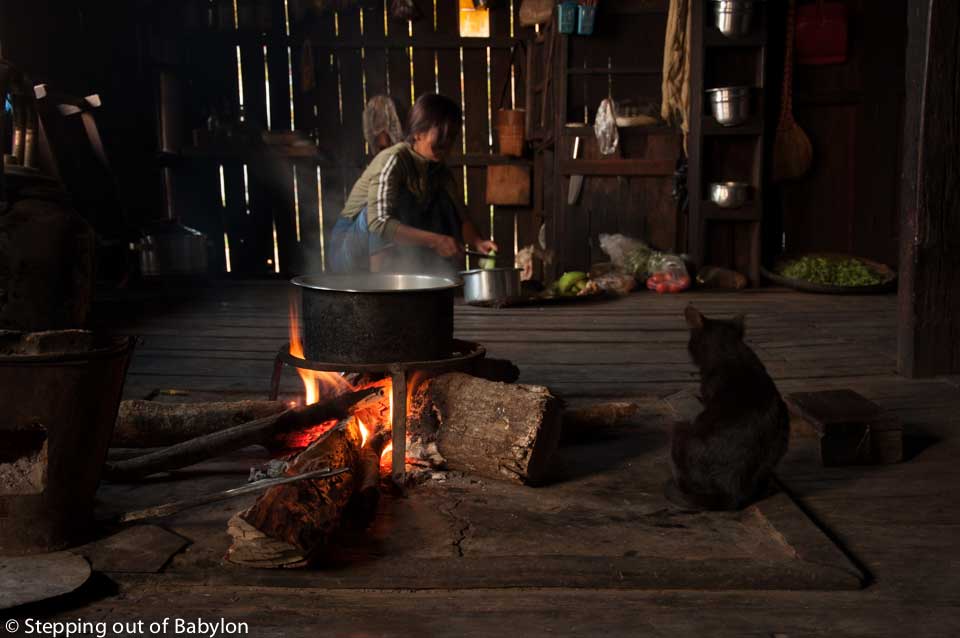


casa de aldeia onde o fogo é o centro da casa seja para aquecimento seja para cozinhar
one of the village house where we stay overnight; the fire is the center of the house whether for heating or for cooking
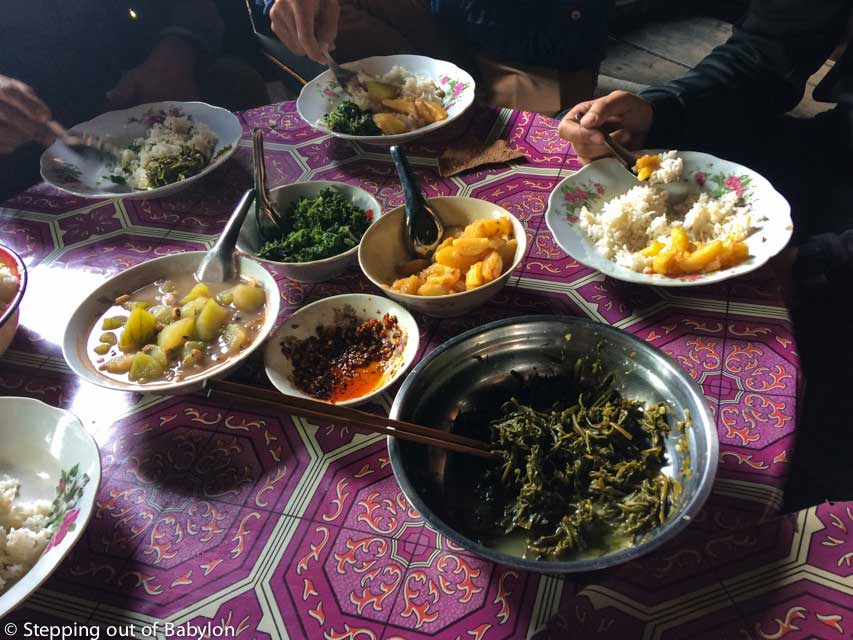
Refeição preparada por uma das famílias que nos acolheu durante os três dias de caminhada
Meal prepared by one of the families who welcomed us during the three days of walking… delicious vegetarian meals where the bowls never stop to be refilled

Yangon… eat, sleep and move around

A short guide to help the ones that are visiting Yangon for the first time.

Where to sleep in Yangon


After checking a few places, including some new western-style hostel with dorms, the choice was to the White House Hotel… an old school accommodation, basic, cheap and very-very clean. The staff is friendly and helpful. Good location at Yangon downtown, between Sule Pagoda and the Chinatown area…. so plenty of food around at a walking distance.

There are rooms for many prices… but the cheapest ones are without window and with shared toilet. Basic, small and quiet, but is better get one with air-con as the fan maybe is not enough to provide freshness and dryness during the hottest months… but all depends on how long you plan to stay! Hot water shower, with good pressure, clean toilets with toilet paper.

Cheaper than White House Hotel I think there’s only Mahabandoola Guest house, with the same style but not so clean, particularly the bathrooms and toilets.

[columns] [span6]

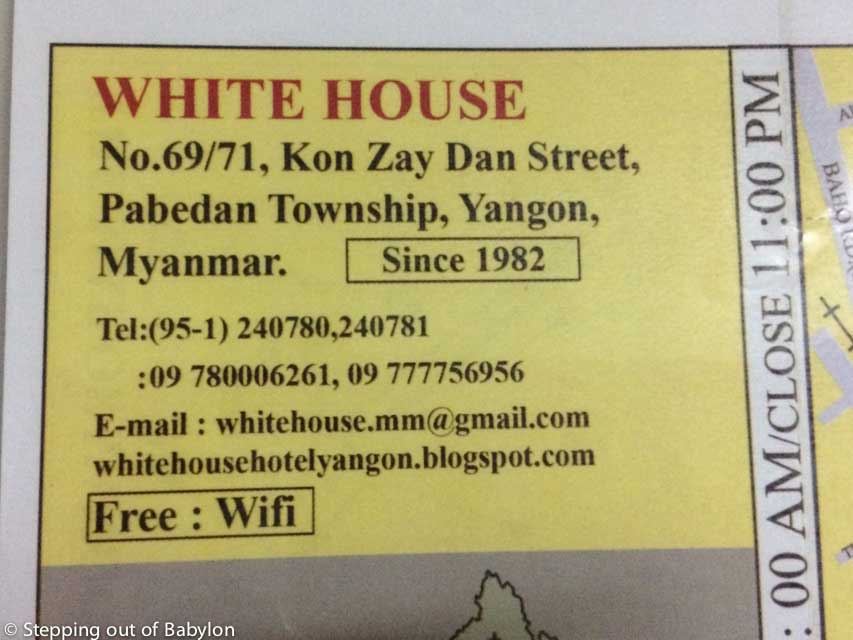
White House Hotel Yangon. Address and contact

[/span6][span6]

IMG_2115

[/span6][/columns]

Moving around Yangon


All downtown of Yangon can be visited on foot… maybe is a too big area to do it in one day, but in three days you can see a lot, and even have time to take a short nap during the warmest part of the day. It worth to wake up early one time to see the early city vibe, that starts really early with market and food stalls start just as the sunrise.

Walk randomly along the streets grid and enjoy the Friday fuss at the Muslim neighbourhood, the groups of monks line by height begging for alms, drink a cold lassi at the Indian area of the city or enjoy a sweet milk tea in one of the Chinese style tea shops.

To visit the Shwedagon Pagoda you can take the bus at Sule Pagoda bus stand (Sule Pagoda Road). The ticket is 200 Kyat, in a air- conditioned bus.

DSC_1950

Where to eat in Yangon


At each corner of Yangon downtown you can find some food: fruits, deep-fry snacks, sweets and puddings, sticky rice, noodles soups, mohinga, parathas, noodle salads, juices, stir fry rice and noodles… it looks that each time you find something new to try!!!

But it all depends on the time of the day… so don’t expect to find parathas after 9 a.m. or mohinga after 5 p.m… just walk random and grab what look more attractive, without thinking about hygiene conditions. Choose a place to seat along the street and have your food or tea, surrounded by friendly smiles, and enjoy the contact with local people! They will be happy to have you around and that you appreciate the local food.

Any of this street-food should cost you less than 1.000 kyats.

A mohinga bowl without meat is around 500 kyats.

  • Ingyin New South Indian Food Center is a good option.

The famous Nilar Biryani Restaurant suffers a strong upgrade and has a new look and new prices, not anymore the casual biryani place from before, but worth a try.

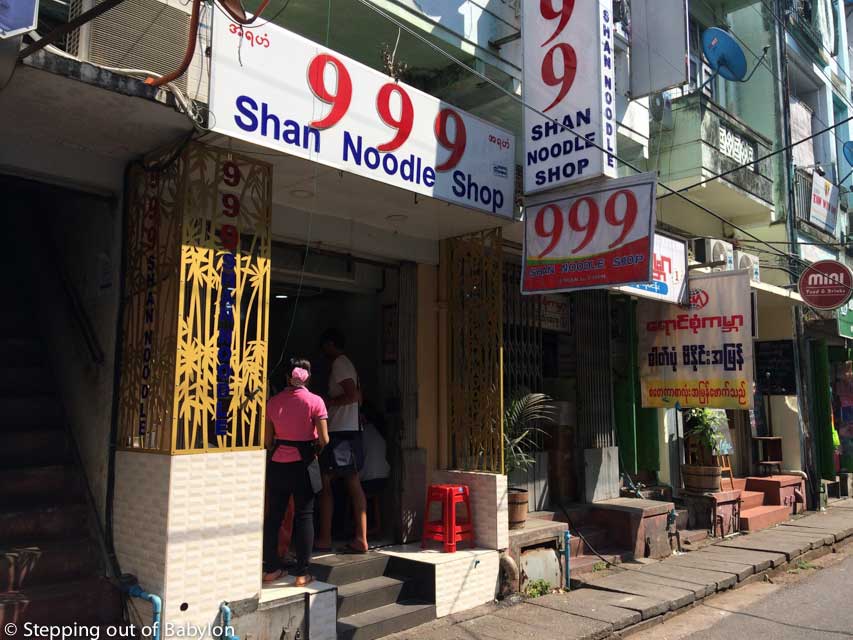
  • Shan food: basically noodle soup cooked in Shan State style, serving also the traditional Burmese food, like tea leaf salad. A bit touristic and busy but with good food.
  • Strand Road food market: For an evening meal the place with the more options is the street food market along Strand Road... it starts more or less close to the 30th street and goes on for more than ten blocks… I could never walk until the last stall.

It’s open every day from 4 p.m until 11 p.m. and there you can find every kind of Burmese food, from grill fish to hot pot soups, from fry noodles to noodle soups, from smoothies to lassi, from sweet sticky rice to the delicious rice pancakes!

Despite many stalls serve meat, there’s also a lot’s of vegetarian options.

Food market that every evening occupy the sidewalk between the Strand Road and the port area

Shan noodles... very popular between foreigners but a good way to try the food from Shan State
Shan noodles… very popular between foreigners but a good way to try the food from Shan State

How to go from Yangon to Aung Mingalar Highway Bus Terminal


This bus terminal is located 20 km north of the city center, on the right side of the Nº 3 Main Road, the highway that connects Yangon to Mandalay.

Note: Most of the buses departure from Aung Mingalar Bus Terminal, but if your destination is the west coast, like Ngwe Saung or Ngapali for example, your bus probably will depart from Dagon Ayeyar Highway bus station.

Dagon Ayeyar Highway Bus Station is located about 22 km far from Yangon city center, on the side of the Yangon-Pathein Highway (west from Yangon, after crossing the Yangon river). A taxi from Yangon to Dagon Ayeyar Bus Station costs about 8.000 kyats.

  • By mini-van (shared-taxi):

Nearby Sule Pagoda, on the corner of Sule Pagoda Road and Maha Bandoola Road (northeast corner of the square) you’ll find a group of mini-vans that work like a shuttle between the terminal and the city.

They are identified by the sign “Aung Mahar Taxi Cab” and the ride cost 1.000 kyats. The trip can take almost one hour because of the traffic jam that are frequent in Yangon.

  • By taxi:

The taxi drivers will ask you 10.000 kyats but you can get it for 7.000 kyats. In evening time or very early in the morning maybe you need to pay 8.000 kyats.

IMG_2326

Aung Mingalar Highway Bus Terminal

The Aung Mingalar Highway Bus Terminal is huge, and the way it is organized has nothing to do with what we used to call a terminal. Is more like a grid of streets, with yards where each company has their office. There are thousands of bus companies and each bus departure from the parking area in front of the office/ticket counter. In between you have restaurants and others shops, storage areas, a lot of people, hawkers… too big and too confuse for you to manage if you are in a rush or if you have heavy luggage. So is better to ask your taxi driver to drop you at the bus company office from where you have the ticket. You need to pay extra 200 Kyat for the taxi get inside the terminal.

At the entrance of the terminal, there is dozen of hawkers asking you where you go, to try to push you to a certain company. If you already have a ticket you are “safe” otherwise to need to know where to go, or trust in one of this guys.

IMG_2182
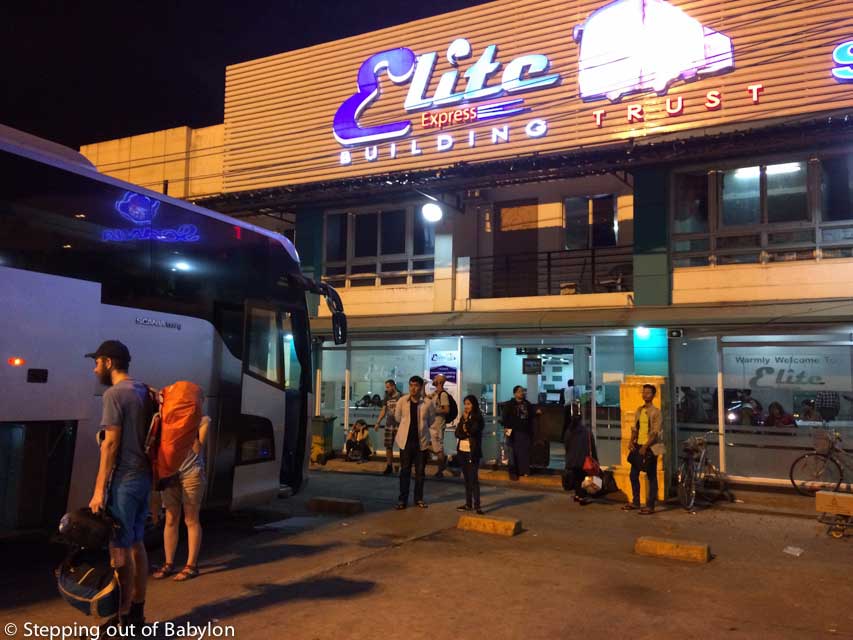
One of the bus companies that departure from Aung Mingalar Highway Bus Terminal, Yangon

Where to buy bus tickets in Yangon

  • At Hotels, hotels, guesthouse and travel agents that charge a small fee.
  • By the internet (http://www.go-myanmar.com/by-bus)
  • Directly at the bus company offices at the terminal… if you have time and energy.
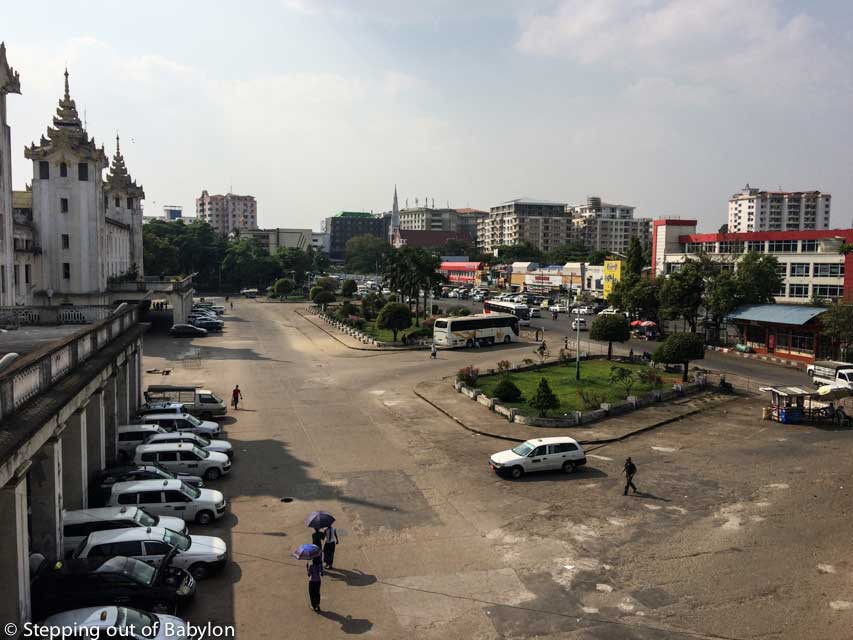
  • But if you want to check different option in terms of costs and schedules you can go to the small offices of ticket sellers in front of the Train Station. You can reach there by crossing the Pansodan Bridge and turn right when you see a staircase, after crossing over the rail lines. You’ll be at a wide ground, with the station building on your left and the offices on the right side. From here there are also some private shuttles to the Aung Mingalar Bus Terminal, which service can be arranged by the same company where you buy the ticket.

To buy bus ticket in Yangon: on the ledt side is the train station and on the right side are located the offices from ticket agents and bus companies
To buy bus ticket in Yangon: on the left side is the train station and on the right side are located the offices from ticket agents and bus companies

How to go from Yangon to the Airport

  • By bus:

There’s a local bus (city bus) that take you close to the airport, and that departure from the bus stops on Sule Pagoda Road (in front of Sule Shangri-La Hotel). Is hard to know the number of the bus, but just ask the people that are waiting and they will point you the bus when it shows up. The ride takes almost 1 hour but can be more because of the traffic, and at rush hours is almost guarantee that you find a jam along most of the way. The ticket should cost around 200 kyats.

Any bus stops at the airport; the nearby bus stop (called Sal Mile Kone at Pyay Road) is about 2 km walking.

  • By taxi:

If you ask in your hotel you can get a taxi to the airport for 8.000 kyats.

At the streets the taxi driver’s start by 10.000 kyats, but you can negotiate and get it for 6.000 kyats. Take into consideration that if you need a taxi very early in the morning (live 5 a.m. or so) you’ll maybe need to pay a bit more because you’ll not find many taxis in the streets at that time. The same applies to evening rides.

ATMs in Myanmar

The maximum amount of cash you can withdraw at the ATM is 300.000 kyats and is charged a commission of 5.000 kyats.

Not all the ATM accepts foreigner cards but KBZ is a good and reliable option and can be found a bit everywhere.

The ATMs are available in every cities and town.

If you prefer to exchange money, the banks offer a very good rate (sometimes better that the exchange shops) with no commission. But some have a maximum amount of money that each person can change a day (100 euros for example) and your bills must be in good condition, no wrinkles, not dirty or damage and no marks of pen, pencil or stamps.

Guwahati… the gateway to Northeast States

Guwahati, not being the capital of the state of Assam, is the city that works as a gateway to the so-called Northeastern States, mainly due to its geographical position in a lowland area, between Bhutan and the mountains of the state of Meghalaya.

Under the generic name of Northeastern States, gathering seven states also called Seven Sisters, located in the extreme north-east of India, delimited by Bhutan, Bangladesh, Burma (Myanmar) and Tibet (China). These states along with Sikkim are “linked” to the rest of the India by a narrow strip of territory, part of the state of West Bengal. This strip of Indian territory between Nepal and Bangladesh is called “chicken’s neck,” that at some point only 23 km wide.

These Seven Sisters are Arunachal Pradesh, Assam, Meghalaya, Tripura, Mizoram, Manipur and Nagaland. Until recently these states had some restrictions being necessary permits to visit, but currently, only the state of Arunachal Pradesh requires permits, both foreign and Indian nationality, given the sensitive border with China.

Guwahati
Guwahati

After a 30 hours train trip, the usual bustle of Indian big cities waits for us, with noise, traffic and the hurried movements of people. But Guwahati has the advantage of having the train station right in the center of the city, which avoids the usual stress of negotiating rates with tuk-tuks drivers.

And being the gateway to the northeastern states, it is noted upon arrival, a big ethnic diversity.

Leaving the train station we are faced with the Paltan Bazaar located on the left side of the busy national highway running through the town, the GS Road (Guwahati-Shillong Road). In Paltan Bazaar, within five minutes from the station and the bus terminal, there’re plenty of accommodations, dominating the hotels with a big range of prices and quality. But this is here where the difficulties begin. Many of the hotels don’t have the special license need to accept foreigners, given the small number of non-Indians visitors that come so far. Therefore, the most modest lodgings don’t accept foreigners, arguing that they are full when are obvious the room keys hanging patiently at the reception.

This way we are pushed to more expensive hotels, some taking advantage of the few alternatives, charging high prices for a room in miserable conditions… 600 rupees that don’t guarantee clean sheets!

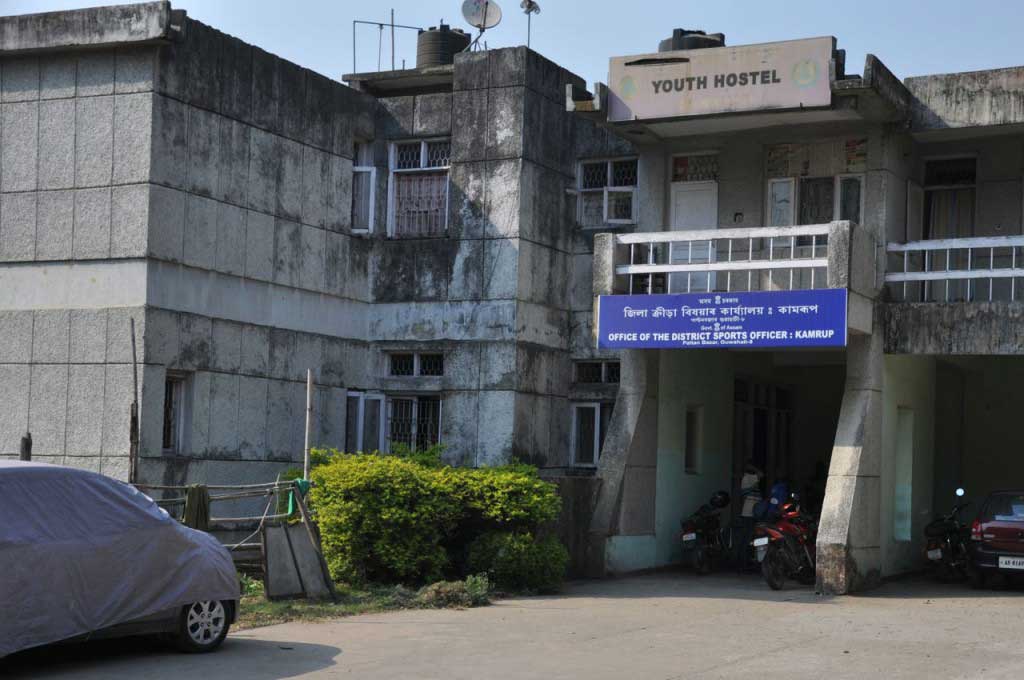
In this search for a place to sleep came on my way the Youth Hostel, an institution that I was unaware of existing in India. In a building that has seen better days, reigns an atmosphere of abandonment and emptiness, where the room show an urgent need of repairs and the toilet is decrepit, but cheap price, the clean sheets and the friendly staff made this place look like a warming shelter to spend a night, before traveling to the mountains of Meghalaya.

Fancy Bazzar
Fancy Bazaar


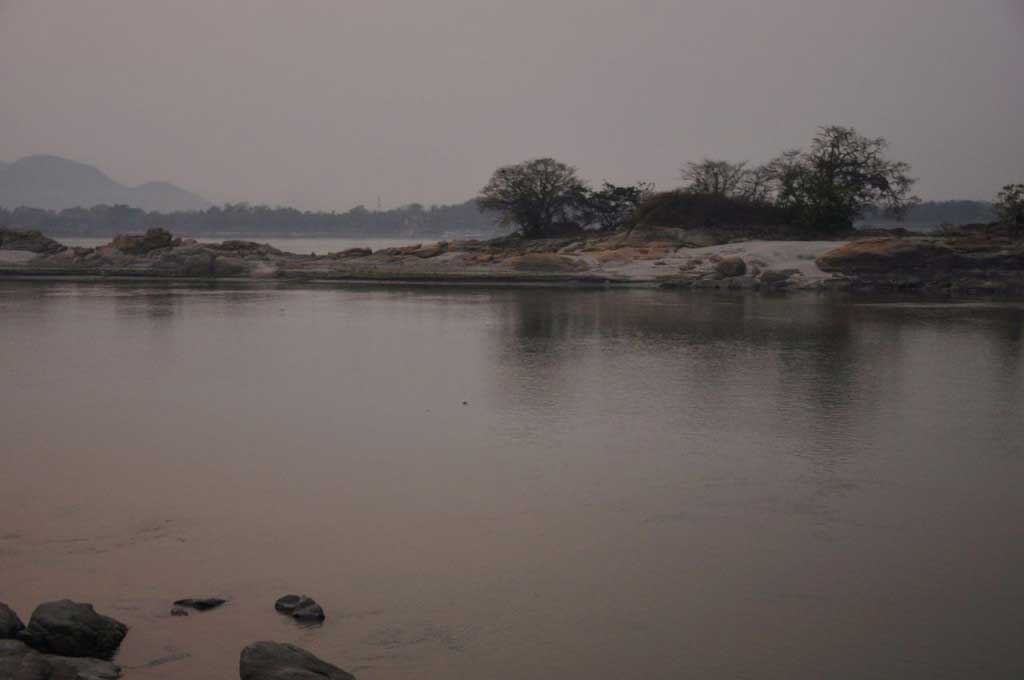
The last afternoon spent in the Guwahati there wasn’t the opportunity to get away from restless city center, away from the confusing Paltan Bazaar and Fancy Bazaar, which despite the names are quite similar. But there was time to walk to the banks of Brahmaputra, which the brownish waters offers a serene landscape that contrasts with the movement of the city streets. The Brahmaputra, one of the largest Asian rivers, runs through the state of Assam, heading south until the Bay of Bengal, crossing the plains of Bangladesh.

Brahmaputra
Brahmaputra

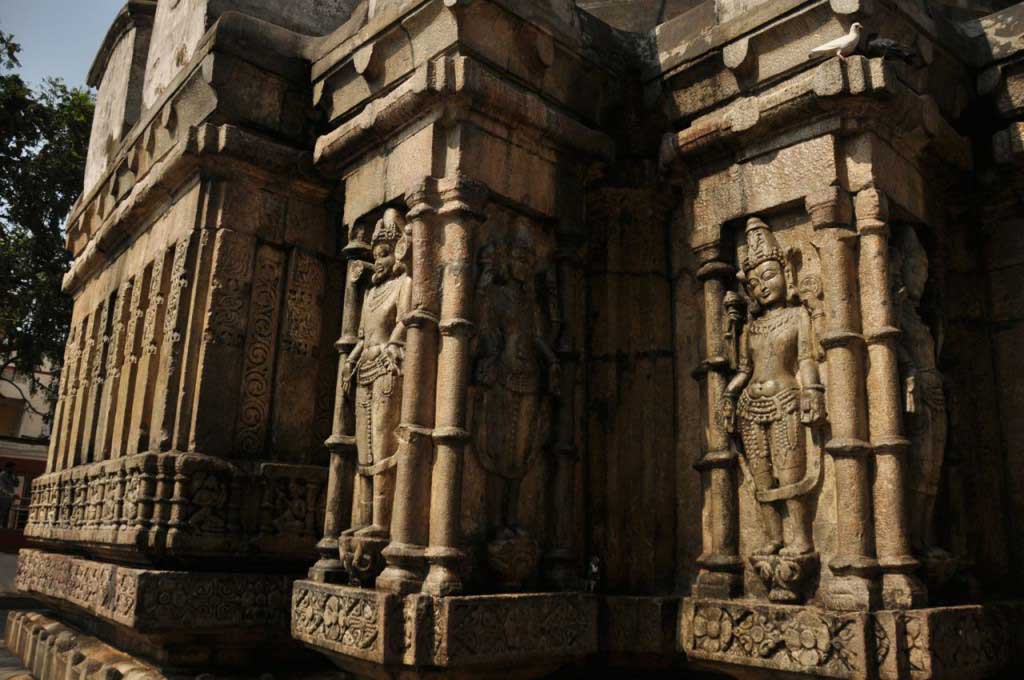
In Hindu religion, it is common the representation of the yoni with the lingam, which corresponds to the female and male elements of cosmic creation, according to the Shiva followers. But in India, there are few temples dedicated exclusively to the female side of this energy: Shakti (also referred as Devi), the goddess representing the energy of creation and change, also associated with fertility and creativity.

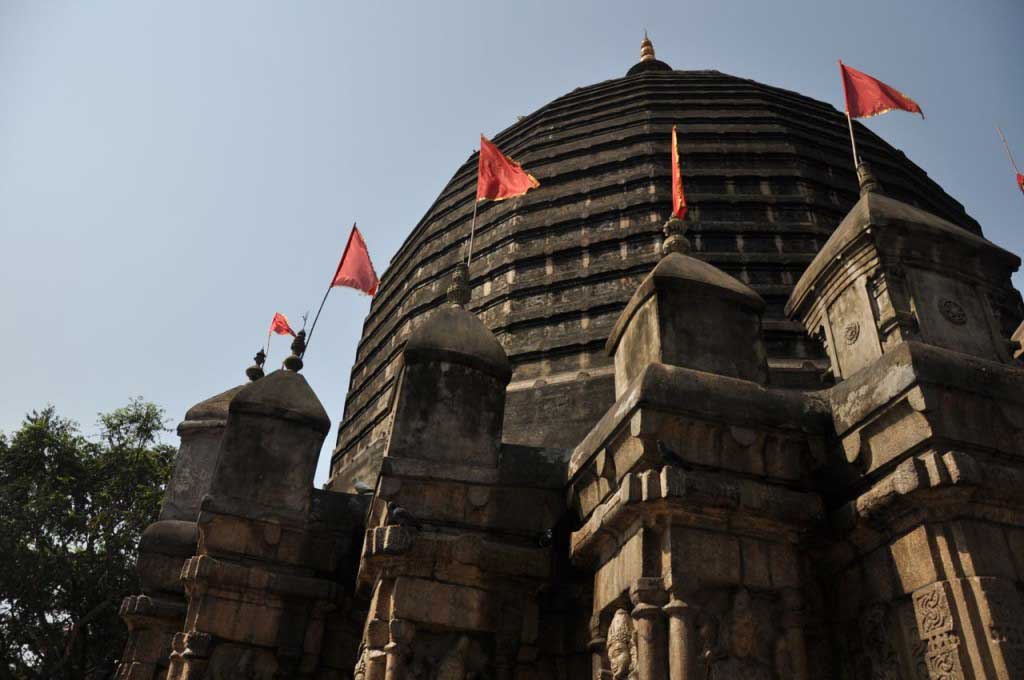
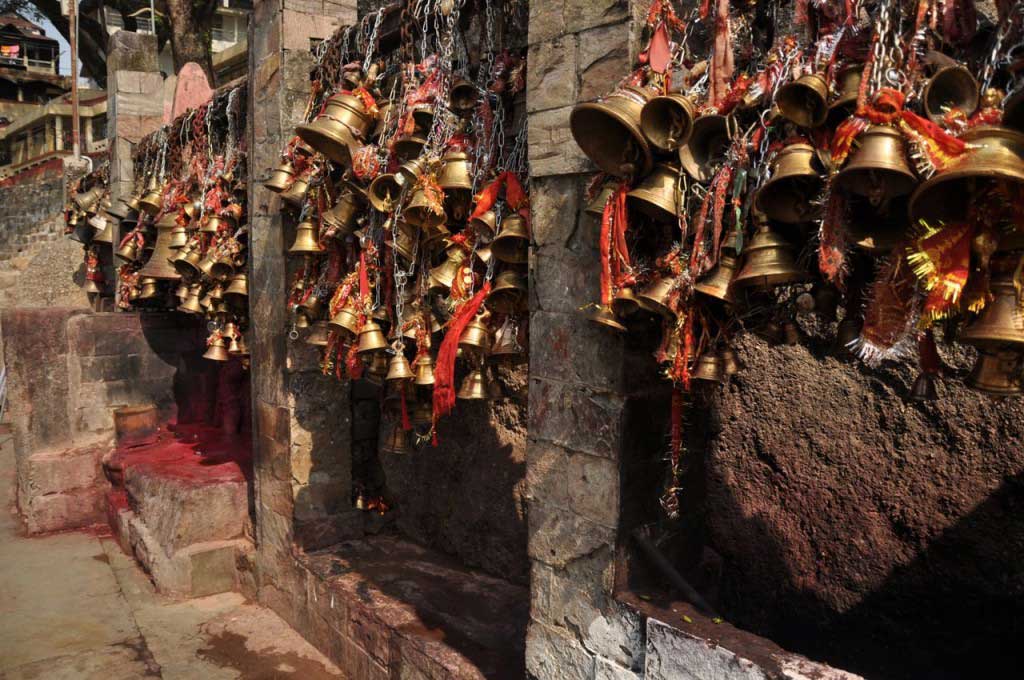
Guwahati is one of the most important temples dedicated to mother goddess: the Kamakhya Temple, where during Ambubachi Mela animals are sacrificed, according to Tantric tradition, with the blood of goats symbolizing the annual period of goddess Kamakhya.

Kamakhya Temple. Guwahati


Kamakhya Temple. Guwahati


Kamakhya Temple. Guwahati


Kamakhya Temple. Guwahati


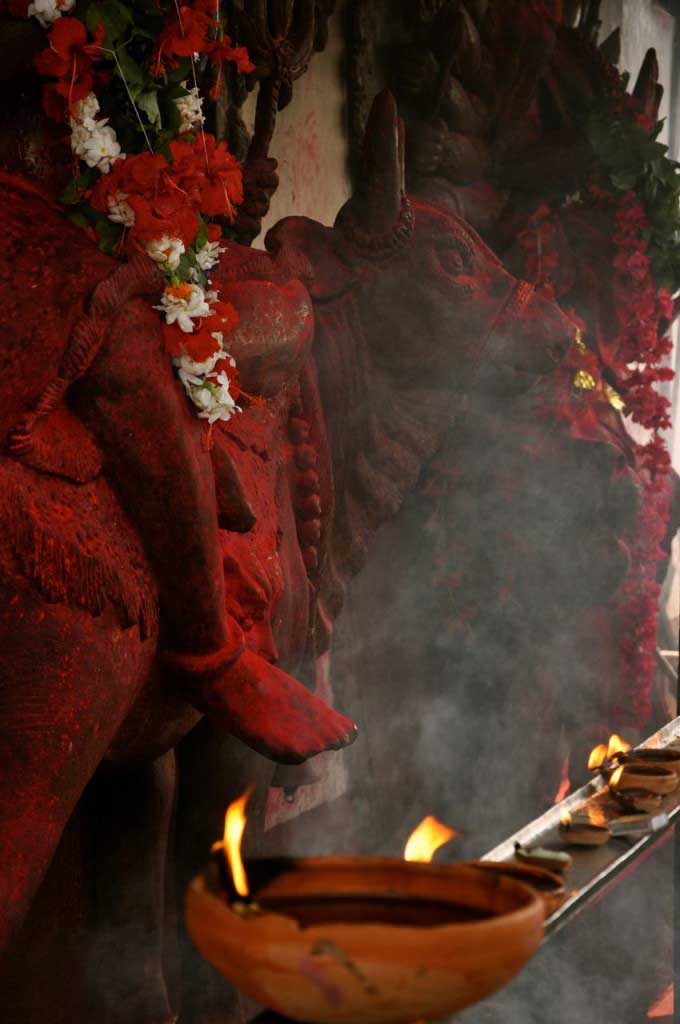
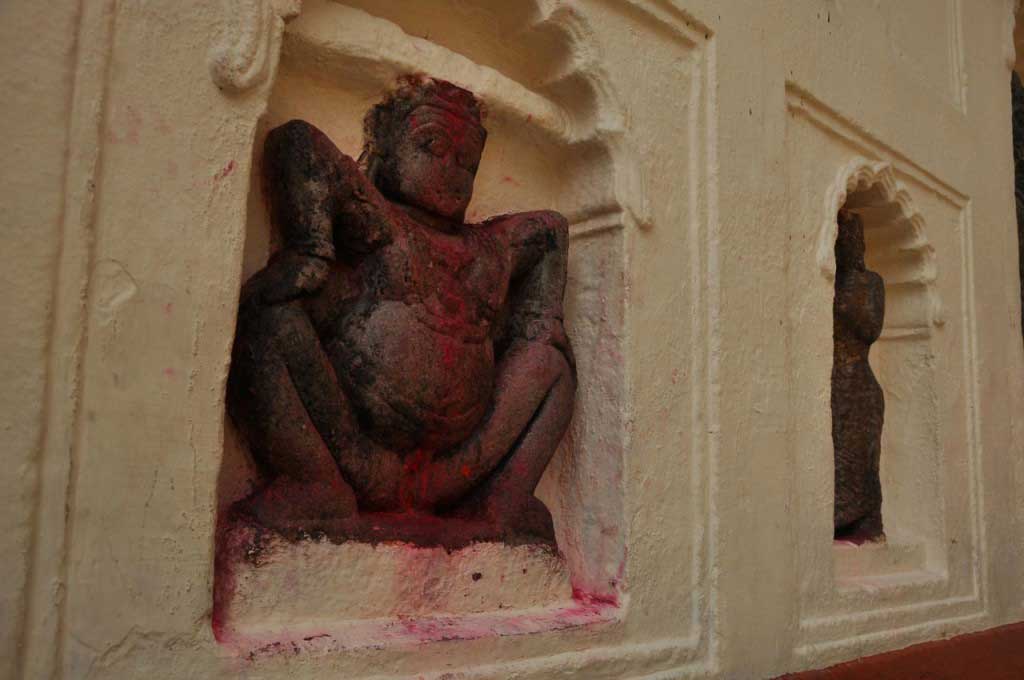
For those who visit the place, where the red color stands out, symbolizing the menstruation, the female reproductive cycle and fertility… in the red robes of the pujari (followers of goddess Kamakhya), in the red flowers that adorn statues, in the red pigment covering the statues of Kamakhya, from whom are lit incense and candles, and the red that seems to come out from vaginas of women statues associated with fertility.

Kamakhya Temple. Guwahati


Kamakhya Temple. Guwahati


How to go to the Kamakhya Temple:


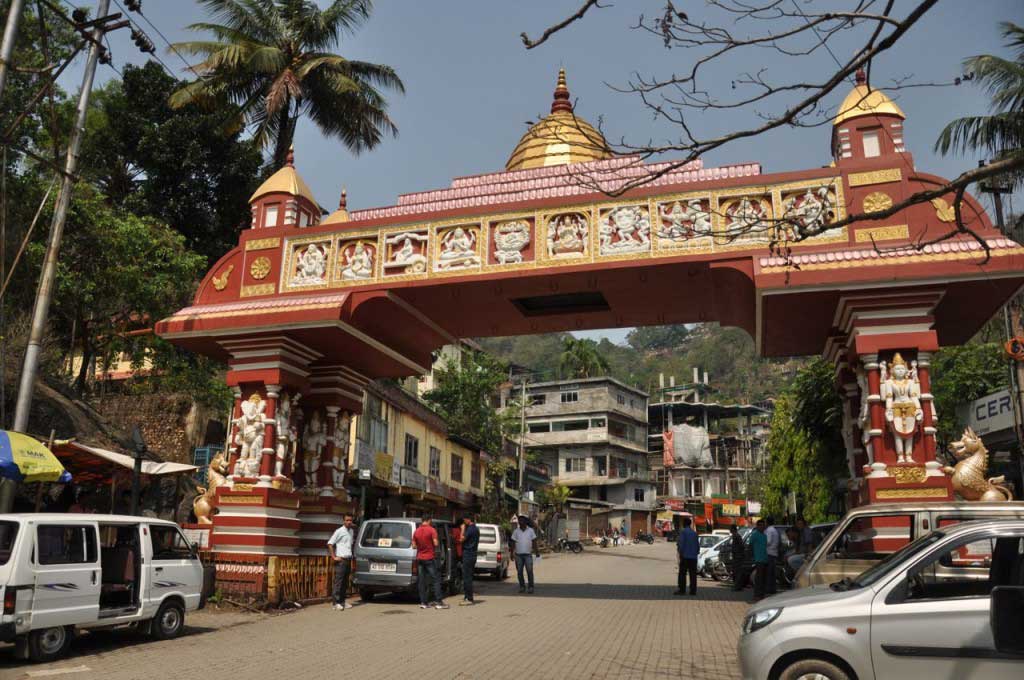
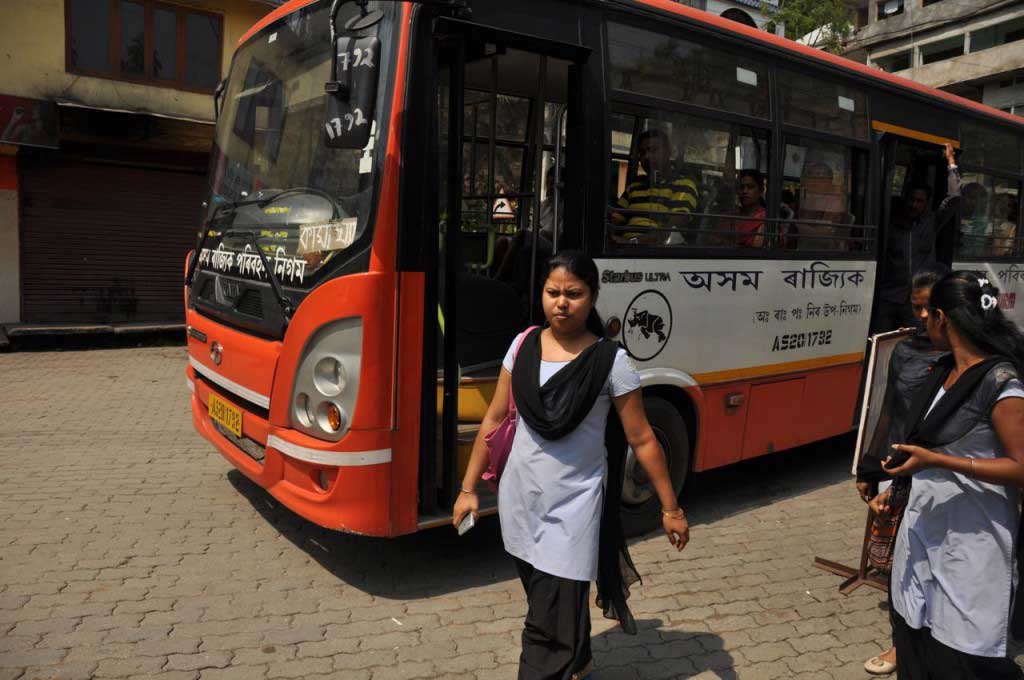
To go to Kamakhya, you can catch one of the buses that pass on GS Road. Just ask for “Kamakhya” and stop on the main road (AT Road). The bus ticket costs 8 rupees. After crossing a gate, there are the ASTC buses that make the journey to the top of the hill, for 7 rupees; these buses depart when are full and the journey takes about 10 minutes. There is a pedestrian access, a staircase you access to the temple but that seems to be little used, with the pilgrims prefer the comfort and the speed of the bus.

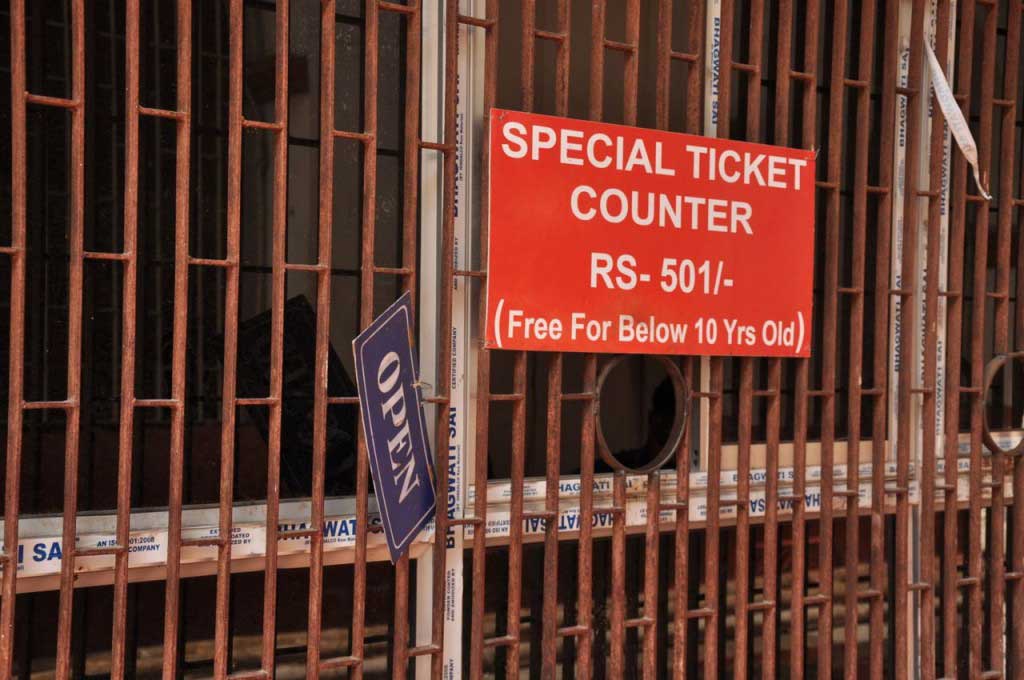
To visit the interior of the temple is required to join the dozens of pilgrims waiting patiently in a long queue, holding offerings to Kamakhya altar. But as often happens in India, where is strong the distinction between social classes, there is a VIP access which saves the pilgrims and visitors from a long wait, by paying 501 rupees… yes, five hundred and one… why this modest rupee among other 500!?!!


Portico junto à estrada principal onde estacionam os bus que vão até ao cimo da colina. Kamakhya Temple. Guwahati
Gate that mark the entrance to the road that goes up to Kamakhya Temple, where buses stop. Guwahati


autocarro para o Kamakhya Temple. Guwahati
Bus Kamakhya Temple. Guwahati


Kamakhya Temple. Guwahati

Where to stay in Guwahati:

For those who stay only for one night, the GS Road and the side streets around Paltan Bazaar, offer dozens of options for several prices. From my experience, you can’t get a room with shared toilet for less than 500 rupees, which however don’t guarantee clean sheets.

Unexpectedly I found the Youth Hostel that has a discreet access on the right side of GS Road, on the corner of MD Shah Road. The building looks abandoned, and in fact, almost no one stays here, with some of the rooms being used as offices of Assam tourism department. The available room works in a dormitory system, with 4 beds with a private bathroom, but everything is in a miserable condition, in need of heavy repairs especially the toilet facility. The bed is comfortable and the sheets are clean; it has a mosquito net for each bed.

The Youth Hostel is an option for those who intended to stay only one night in Guwahati and have a very short budget.

Youth Hostel Guwahati: Bed in a dormitory room with toilet: 250 INR (the room, regardless of the number of occupants). Despite being a dorm, as no one else the room was just for me.


Youth Hostel. Guwahati


Youth Hostel. Guwahati


Youth Hostel. Guwahati

Where to eat in Guwahati:

Many restaurants, here called “hotel” line up next to the train station and along the GS Road, as well as the cross streets of Paltan Bazaar, with reasonable vegetarian thalis for 60 rupees. Here rules the typical Indian food, but in a poorer version that usual, with rice, potato based curries and watery dal. Almost all restaurants have vegetarian and non-vegetarian options, which reflects the taste of the Assamese for meat.

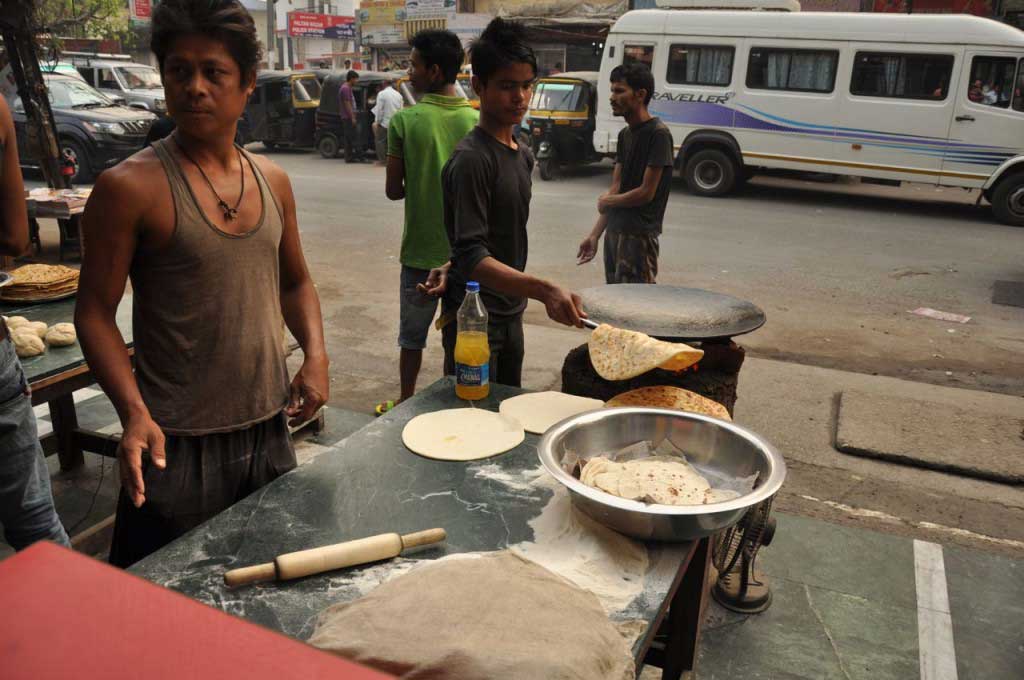
There are great parathas during the morning in two small restaurants at the beginning of GS Road, Greenview and Deepak Restaurant, located on the right side of those coming from the south of the train station exit.


"parathas" no Paltan bazaar. Guwahati.
“parathas” at Paltan bazaar. Guwahati.


restaurante de comida indiana e deliciosas "parathas" no Paltan bazaar. Guwahati.
Indian food restaurant with good “parathas” at Paltan bazaar. Guwahati.


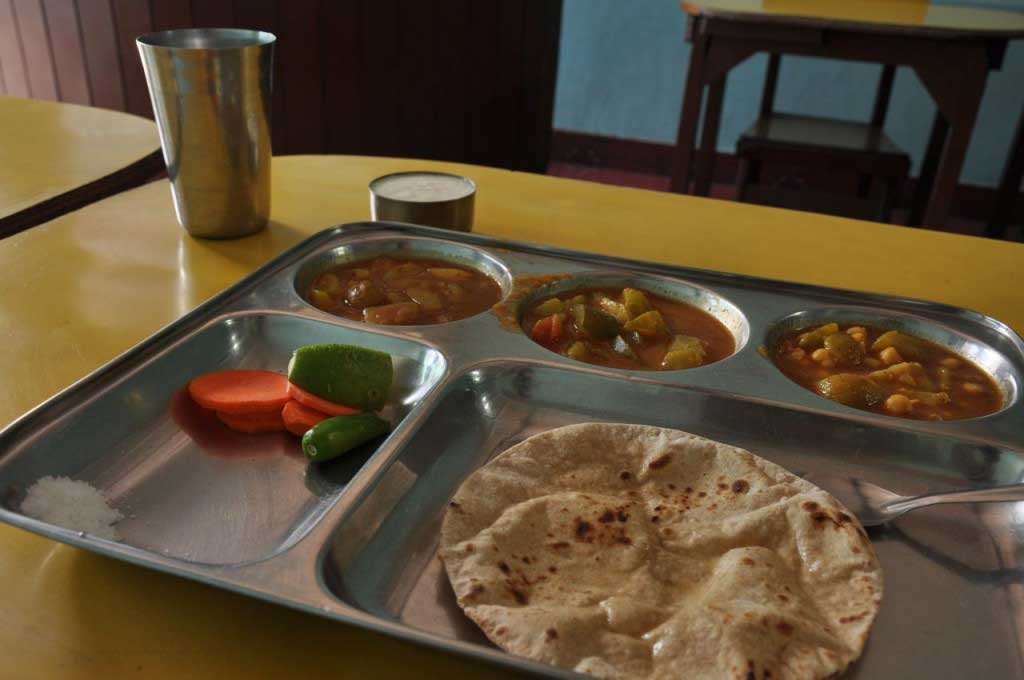
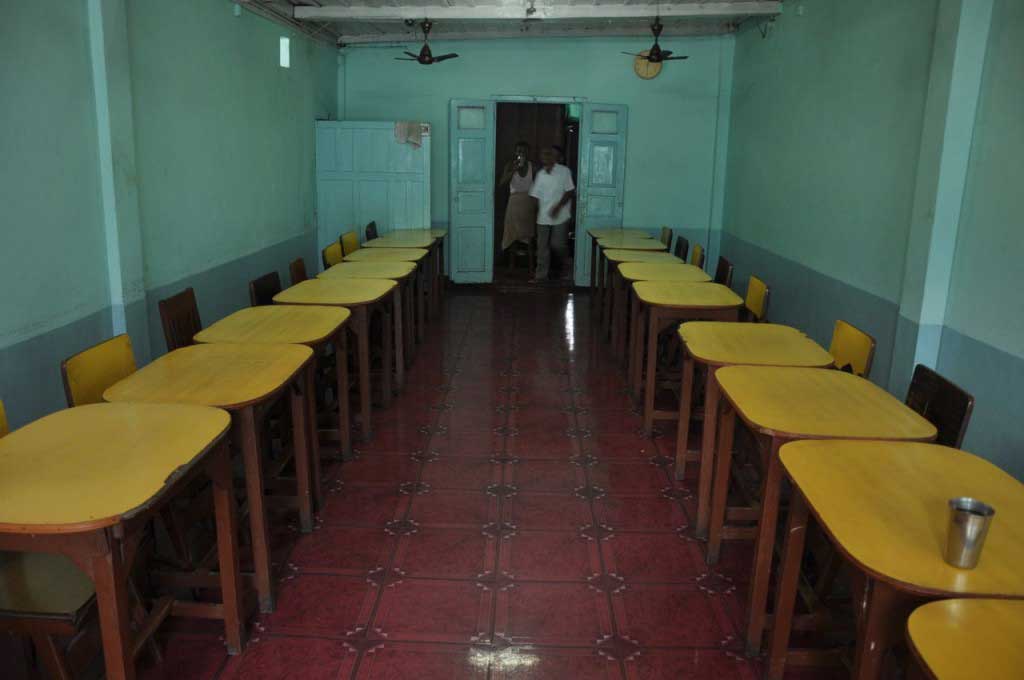
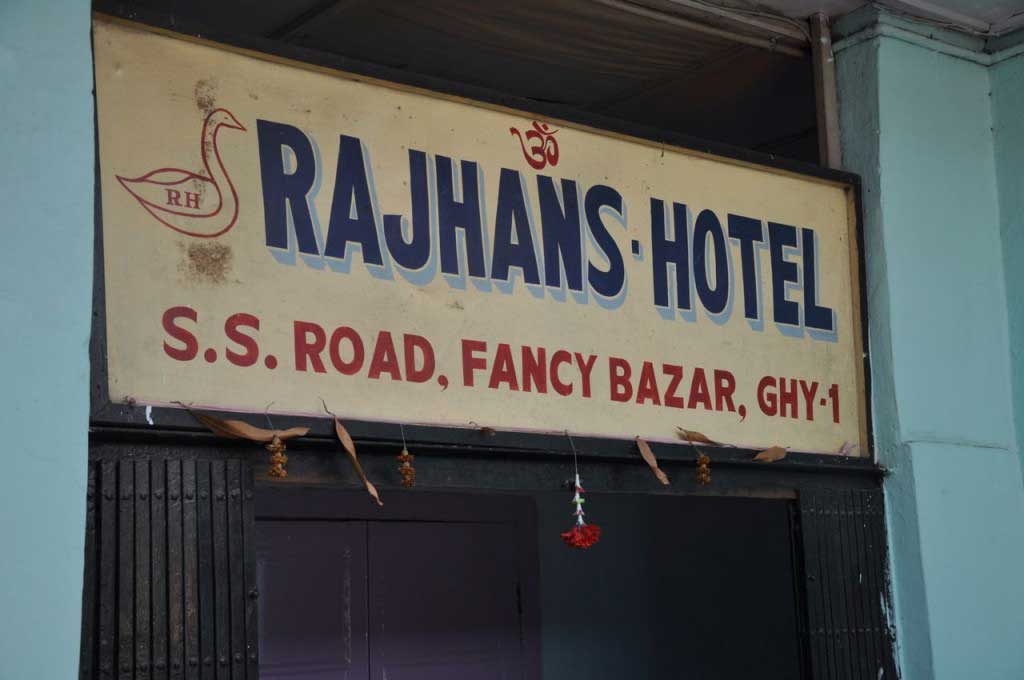
If you are in Fancy Bazaar and feel the call of the stomach, Rajhans Hotel, on the second floor of an anonymous building is a nice option with vegetarian food, friendly service and a decor that takes us to a school canteen, which have certain charisma and a super smiley staff.

Rajhans Hotel: S.S. Road, Fancy Bazaar, Guwahati. Vegetarian thali for 70 rupees.

Rajhans Hotel. Vegetariano. Fancy bazaar. Guwahati.
Kitchen of Rajhans Hotel. Vegetarian restaurant at Fancy bazaar. Guwahati.


tahli no Rajhans Hotel. Vegetariano. Fancy bazaar. Guwahati.
Vegetarian tahli no Rajhans Hotel. Fancy bazaar. Guwahati.


Rajhans Hotel. Vegetariano. Fancy bazaar. Guwahati.
Rajhans Hotel. Vegetarian restaurant at Fancy bazaar. Guwahati.


Rajhans Hotel. Vegetariano. Fancy bazaar. Guwahati.
Rajhans Hotel. Vegetarian restaurant at Fancy bazar. Guwahati.


Transports in Guwahati:

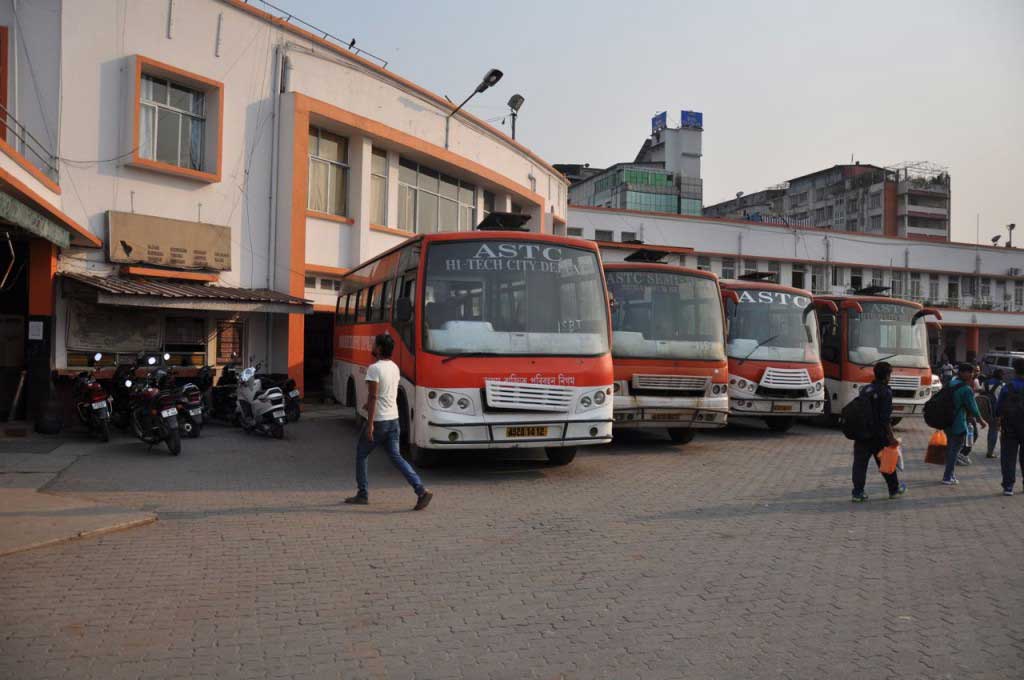
Both the train station and the public bus terminal (ASTC) are conveniently located in the center of Guwahati, close to hotel and restaurants and other commercial activity.

From Guwahati, there are trains that cross Assam stat, towards the North until Dibrugarh, passing through Dimapur.


Note: Guwahati railway station has two entrances: the north side (the same side of the river) and that is the main entrance, and another on the south side that leads directly to the GS Road (Guwahati-Shillong Road). The Reservation Office (for long distance tickets) is in a building a few meters from the north entrance of the station (opposite the Paltan bazaar).


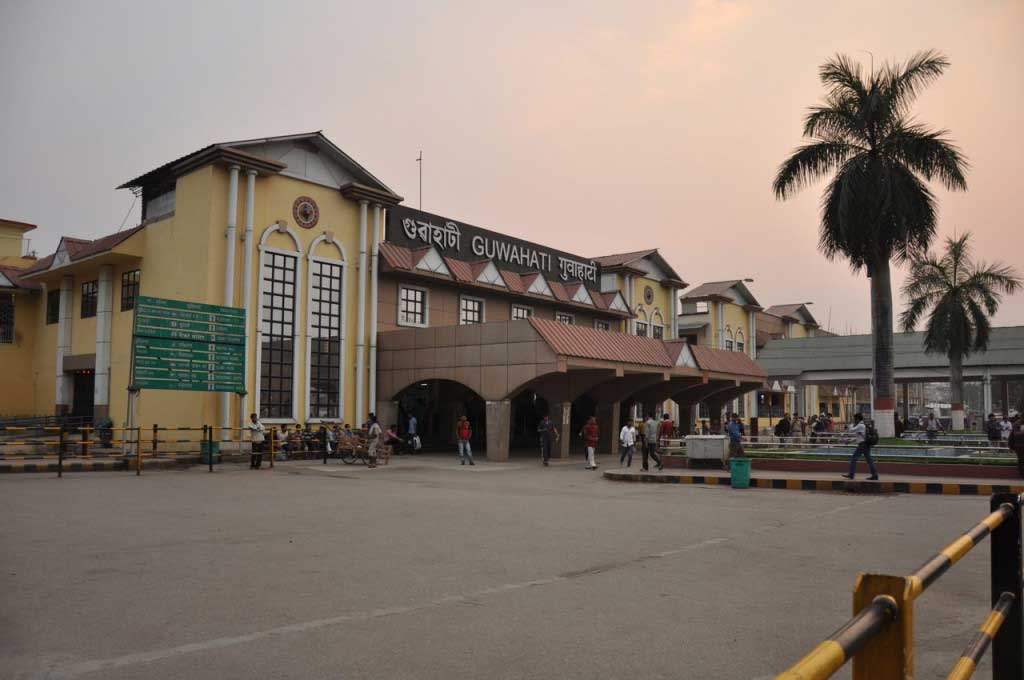
Guwahati Train Station. South entrance. Paltan Bazaar


Guwahati Train Station. North entrance.


The public bus station is just outside the train station (near the Paltan Bazaar). The ticket office ASTC is inside the building, although there are several counters of private companies that also sell tickets for ASTC buses.

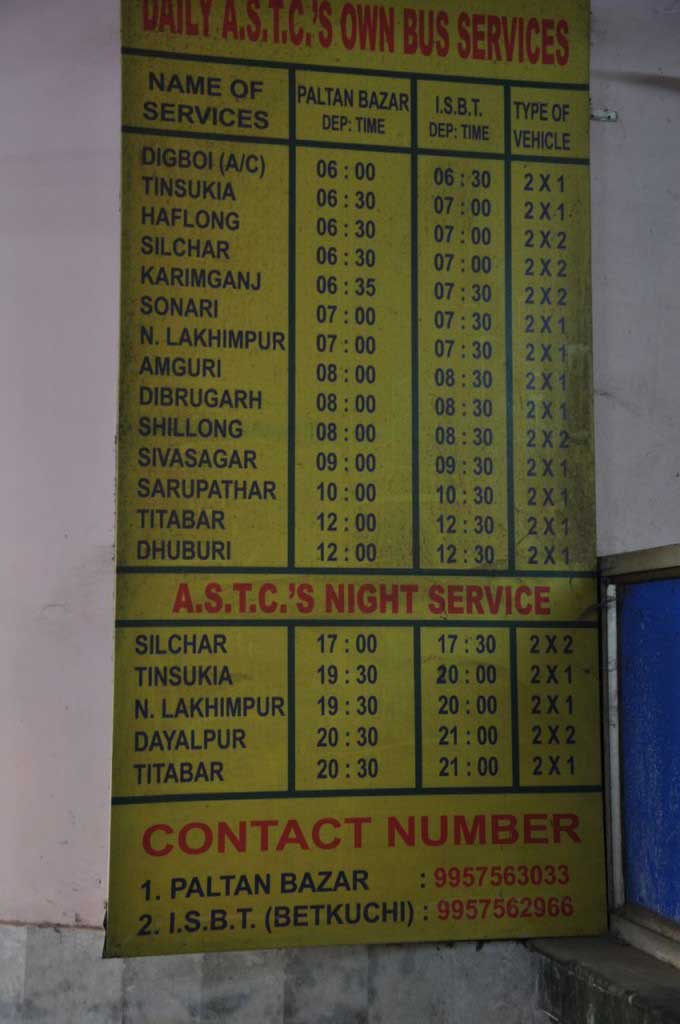
The bus (ASTC) from Guwahati to Shillong leaves at 7:30 am, and the journey takes 4 hours.

  • Bus ticket to Guwahati-Shillong: 135 rupees (a/c)… in fact, the air conditioning doesn’t work, but it is bearable because the bus always runs with the door open, and as we move away from the plains of Assam, the temperature is drop down.


horários. Terminal de autocarros da ASCT em Guwahati
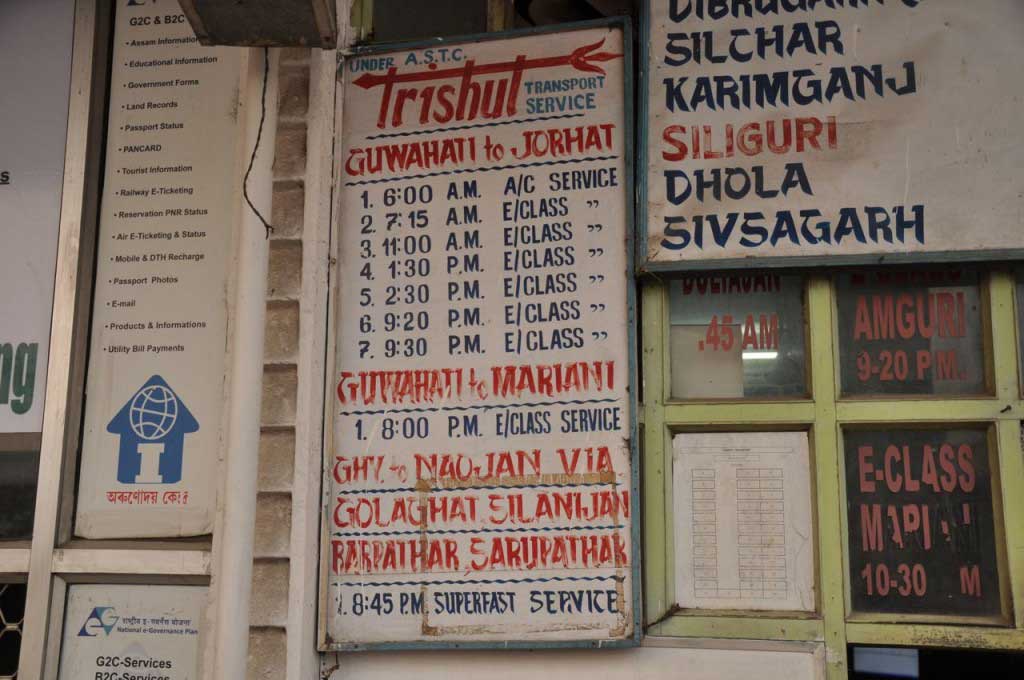
Timetable of private buses from Guwahati


Terminal de bus ASCT em Guwahati
Central buses Terminal. Guwahati


Terminal de autocarros da ASCT em Guwahati
Timetable of private buses from Guwahati


horários. Terminal de autocarros da ASCT em Guwahati
Timetable of ASCT buses from Guwahati


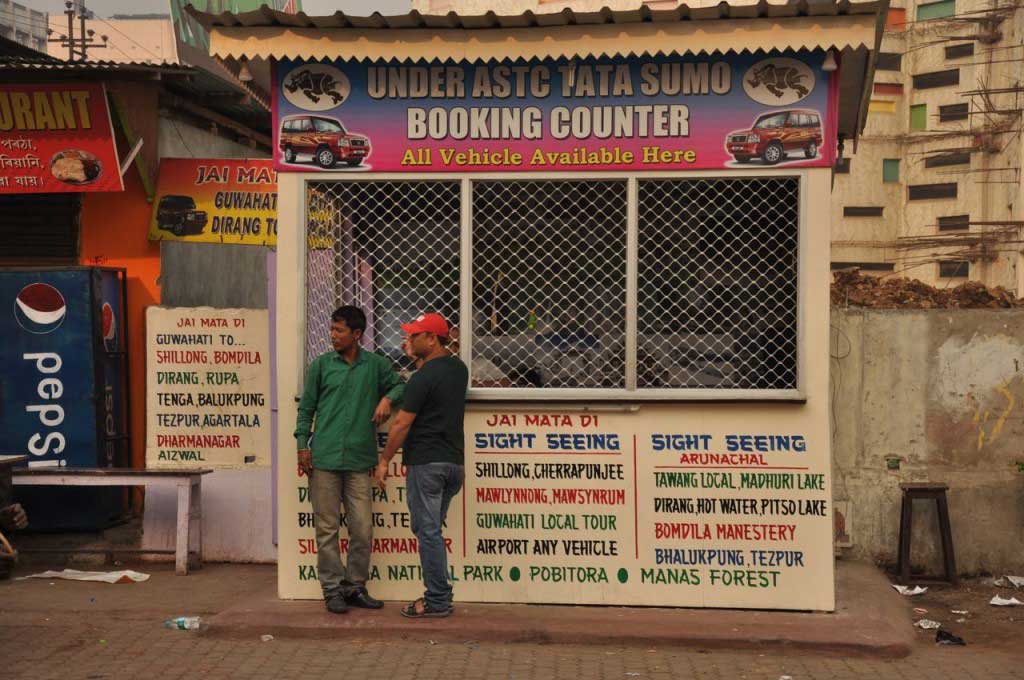
As an alternative to the buses, there are sumos, a shared all-terrain, which are a very popular mode of transport in the Northeast states, and that makes the connection between the main cities. Inside the Guwahati Bus Terminal, in the bus park, there’s a booth where you can buy tickets for the sumos. In general, these vehicles have no set time, circulating during the day, since very early morning, and depart when they are full.

  • sumo Guwahati to Shillong: 170 rupees (the trip takes about 2.45 pm, depending on traffic and number of stops)

bilheteira de "sumo" no Terminal Central de autocarros
“sumo” counter at Guwahati central bus terminal


Internet in Guwahati:

Most hotels don’t have internet and those who have charge sometimes 100 rupees per day. The best option is the cyber-cafes that aren’t easy to find.

In GS Road, on the left side for who comes from the train station, there is a shop “complex”, and on the first floor there’s a cyber-cafe, Virtual Office, with good connection and wi-fi.

  • Wi-fi: 30 rupees per hour.


Elevation: 56 m

Population: 809,895

Laos food… a bit more than noodles soup

With many similarities with the cuisine of Thailand and some influences of China and Vietnam, the traditional Lao food is a modest sample of the neighbouring countries cuisine. Stand out the noodles and soups, but the grilled are also very popular, but despite the meat is a constant presence, the consumption of fish is not unusual, given the proximity to the Mekong and other rivers that cross the country.

For vegetarians, the options are very slim, not much more than noodles soup, which even if you order without meat, the broths are usually made with chicken or pork and probably you’ll notice the flavour of meat, that can be disguised with the spicy sauces and seasonings alway available.

The noodle soup was a constant presence in my diet during my stay in Laos, where I ate noodles soup at least once a day, often as breakfast.

Both in cities as small villages there are always restaurants that serve only serve noodle soup, changing the quality of the broth and the kind of meat served, but especially the type of noodles that can range from very thin and almost transparent to thicker and consistent strips, but always made from rice flour.

The soup is served with a plate full of raw vegetables such as cabbage, lettuce, green beans, leeks, spring onions, mint, spinach and other vegetables popular in Asian markets but absent from western cuisine. The soups aren’t spicy at all, but sauces like fish, soy, oyster, etc… but chilly can be added in powder, as fresh chilies or as an oily paste, which is often generously laid on the soup and can transform a clear broth in a red soup. Limes in slices are always available on the tables of restaurants, which give a twist of freshness to these soups.

To eat this soup in Laos style, you must use bamboo chopsticks to eat the noodles and other solid ingredients, while the spoon in the left hand is used to eat the broth.

As an alternative to the noodle soup, is also possible to find rice soup, a broth made with overcooked rice which are added a bit of spring onions, soy sprouts and small pieces of meat. This option can only be found in the morning as it just eaten as breakfast with a glass of green tea.

Very popular is the lap, a dish that can be with meat or fish, usually very spicy, prepared with lots of mint leaves and chilies, which is generally eaten with hands with the help of stick-rice, a very glutinous type of rice, dominant in Laos.

A melhor sopa de noodles do Laos, experimentada logo no segundo dia de estadia, na povoação fronteiriça de Huay Xai, com o requinte de servir um pequeno prato de pasta de amendoim onde tradicionalmente são mergulhadas as malaguetas ants e serem comidas
The best noodles soup in Laos, ate in the first day, just after crossing the border at Huay Xai, with lots of vegetables peanut sauce and tea

Stiky-rice, servido como é tradicional em potes de bambo
Sticky rice, in the traditional bambu pots

Sticky-rice a acompanhar um prato de vegetais salteados... uma alternativa vegetariana à tradicinal carne grelhada que acompanha este tipo de arroz
Sticky-rice with stir fry vegetables… but usually this kind of rice is served with meat

restaurante em Luang Prabang que somente serve sopa de noodles, aberto desde manhã bem cedo mas que encerra pouco depois da 1 hora da tarde
street restaurant in Luang Prabang that only have noodles, open since early morning, but close around 1 pm; very popular between local people, serving a good food for a very cheap price, in a casual environment

ingredientes para a preparação da sopa de noodles, que para além dos vegetais custuma ter pedaços de carne, por vezes sangue cozido ou visceras, que são também usadas na confecção do caldo
tray with the ingredients for the noodles soup that apart from a wide range of vegetables, also have meat, intestines and cooked blood

ingredientes para a preparação da sopa de noodles
Ingredients for noodles soup

Besides the noodle soup, you can find easily fried rice and fried noodles. Curries are also part of Laos gastronomy but simple and less sophisticated versions of the ones served in Thailand.

Is visible a greater diversity in the food served in the North of the country, a more wet and fertile area, compared to southern regions, where the climate is dryer and supply are more limited, except the rice that dominates the landscape in the south flat areas.

About sweets, there is little to say because the desserts are not part of the menu of typical restaurants in Laos, being very rare to find some pastry out of the tourist areas. However, as also in Thailand, the rotis are very popular, and can be found in street stalls, that show up after the sun set along the city street. The rotis are a kind of pancake, made from a very thin dough, stuffed with banana, chocolate or egg, fried bit a bit of oil, and drizzled with condensed milk in the end, for extra sweetness.

This roti business is very popular and dominated almost exclusively by Indians, many from Chennai, as this area the roti, in a plain style, are usually eaten with the meal. This Indian community provides also restaurants where is possible to find the traditional Indian dishes for those already tired of some monotony of Lao cuisine.

banca de rua em Vientianne que serve dsde manhã bem cedo sopa de arroz e sopa de noodles, assim como o tradicional café
Street stall in Vientianne that since early morning serve rice and noodles soup, as also the traditional Lao coffee, being a very popular place between local people

molhos e picantes que são adicionados à comida, juntamente com sal, e açucar: uma presença constante em todas as mesas dos restaurantes tradicionais do Laos
A big range of condiments and sauces are available in the restaurants tables, as also sugar, that is manny times added to the food

Muitos do condimentos usados na cozinha do Laos são de origem Tailandesa ou, como é o caso, Chineza
Most of the ingredients used in Lao cuisine come from Thailand and China, making it hard to understand what we have on the table to seasoning the food

The so-called Lao Coffee is a constant presence throughout the country, usually served in the morning on the street stalls. But it can also be found in the more sophisticated cafes in touristic and cosmopolitan areas of Luang Prabang and Vientiane, side by side with French bakery.

The Lao coffee is prepared in a very characteristic way: there’s a metal pot, which always keeps in the heat with boiling water, from where the water is removed with a ladle and poured into a jug, passing through a conical filter cloth, containing the coffee powder. From the jug it’s poured into small glasses, passing again through the coffee filter, to make ti stronger. In the end is usually added condensed milk, or sugar with milk powdered. The coffee that remains in the filter is used more than once, serving to prepare several coffees. It can also be drunk plain without dairy or sweeteners, and this is the best way to appreciate the dense and thick texture of this coffee that have an unexpectedly soft taste and somewhat light bitter flavor.

The price of a Lao Coffee is from 4,000 to 5,000 kips, and is often served accompanied by a kind of bread made in the of fried dough, and sometimes is also serve with a glass of tea… yes, the tea is served even with the coffee and is offered for free.

The French presence is visible in the bread, especially the baguettes, which are sold on the streets and bus terminals, consume as a meal or as a snack between meals, stuffed with not-identify paste, spicy sauces, meat (usually pork or processed meat) and vegetables. They are a popular option for a meal in the long and endless bus trips, due to be easy to take away and to the low price around 7,000 10,000 kips, less than 1 euro.

In tourist areas, it is possible to find restaurants with a wide range of Western food, but with much higher prices than traditional food found in the simple and modest restaurants frequented by locals, where you can have a meal for 10,000 kip, about 1 €.

Lao-coffee
Lao-coffee

In terms of snacks the Lao coisine doesn’t offer many choice, being basically rice cakes, that can be sweet or salted. The sweat ones are made from puff rice, and the salted version is made with cooked rice, mix with egg that is grill with the shape of a small pancake.

noodles frescos vendidos nos mercados espalhados por todo o Laos, e que marcam a diferença entre as várias sopas vendidas em restaurnates, muitas das vezes contiguos uns aos outros
fresh noodles, that can be found all over the country, being sold in markets and also made in the restaurants. the quality of the noodles make the difference in the soups, making on place more popular than the one next door

snack muito popular no norte do país, feito á base de arroz cozido que depois de espalmado é mergulhando em ovo batido e grelhado no carvão
snack made with rice and egg.

About me

Hey there!

I’m Catarina, a wanderer from Lisbon, Portugal… or a backpack traveller with a camera!

My journey as a traveller started in 2013 and led me towards the Asian continent, after a few short trips to Vietnam, India, and Peru.

The first six months were spent in India which gave me the experience, knowledge, and strength to explore the diversity of Southeast Asia, including Thailand, Laos, Myanmar (Burma), Cambodia, the southwestern region of China, Malaysia, Singapore, and Indonesia. 

But it was India where I found myself visiting often and sticking around longer, exploring more remote areas like Ladakh, Kashmir, Nagaland, Rann of Kutch, Thar Desert and Cherrapunji.

In North Africa and the Middle East, I travelled through Iran, Morocco and Turkey.

Later, Sri Lanka and Nepal complemented the first four years of my journey.

Japan and Taiwan are the farthest East places that I have been so far.

After a two-year break during the pandemic, I hit the road again. This time, I focused on shorter trips and closer destinations. East Turkey and Lebanon are my recent passions with their rich history, cultural diversity, and delicious food.

But my recent biggest surprise was Bangladesh, a lesser-visited country without flashy sights, but which truly captured my heart through the kindness and friendliness of its people.

This blog is my travel notebook: here I share information and tips about accommodation, border crossings, visa arrangements, local transportation… all to help you travel safer, cheaper, and explore behind the beaten path.

I’m not exactly sure what keeps me travelling, but definitely photography keeps me pushing forward, food keeps me excited, and people keep me inspired.

Thanks for stopping by. I hope something here inspires you and inspires your next adventure!

Catarina

Love and Respect

Mirissa and the whales

Taking advantage of the stay in Narigama Beach and to break the routine made from swimming in the warm sea and walk along the beach, a boat ride for whale watching show up as a good option, as the south coast of Sri Lanka is considered one of the best places to observe the Blue Whale, the largest mammal on the planet.

The best time of year for whale watching, not only blue whale but also of other species is from November to April and July to September when this giant remain in the warm waters of the Indian Ocean for feed. But the months of December to March are the ones that provide a more quiet sea, however, it is still easy to get sick with the ripple that is not so smooth.

The boat ride to the favorable place for watching cetaceans takes over an hour to go, but not that far that you can not see the coast. Along the way, a group of dolphins (Spiner dolphins) crossed the boat’s trajectory always offering a lively show.

When the boat arrived at the place and put the engines in slow rotation waiting for some whales to show up, already about one-third of the passenger was sick, not even giving the chance to eat the breakfast provided at the beginning of the trip along with a tea in an unexpected china cup!

Once that was seen one of the characteristic winches breath of the cetaceans, the various boats waiting on site, over ten, speed the engines trying to get the best position to watch the whales, which even considering that the safety rules are being respected may cause some stress to the animal.

However the creature spotted, a blue whale, returned two more to the surface to breathe, between long intervals, always creating a strange feeling of a shiver for being there before such gigantic animal, able to shows an unreal gentleness, each time it comes out to breath or when the tail emerges from the water.

The return, that always looks faster than the outward journey, there was time and “stomach” for the breakfast and to observe a sea turtle swimming in the same direction of the boat and that briefly remained on the surface before diving into the dark waters of the southern coast of Sri Lanka.

Boat trip to reach observation area

Blue Whale (baleia azul). Mirissa

Sea turtle (tartaruga marinha). Mirissa

Whale watching rules. Mirissa

Whales and dolphins species. Mirissa

The little time spent in Mirissa, once a fishing village and now focuses more on tourism, where the main attraction is the observation of marine animals, whether on boat rides or diving, revealed to be a quiet and laid back place, that keeps the local lifestyle and where people are always willing to receive us with a genuine smile.

Mirissa Fish Harbour

Mirissa Fish Harbour

Mirissa
Mirissa

Where to stay in Mirissa

There are handfuls of options in terms of accommodation in Mirissa, including many guest houses and homestays that rent rooms. Prices are slightly higher than in Narigama but also Mirissa attracts more people because it has a more lively nightlife, that focuses on a small but nice beach along a bay a bit more sheltered from the swell.

Moon Glow Guest is a homestay, where friendly and very willing owner rents rooms on the ground floor while the rest of the family occupies the top floor. The house is new and is spotlessly clean, with the room with mosquito-net (a must) and a clean and modern shared toilet. It is located on a small side street off the main street that connects the Mirissa beach the harbor; is about 5 minutes walk from the harbor where whale watching boats leave.

double room (with shared toilet): 2000 LKR

Address: Kapparamulla, Mirissa

Contact: 077 3955172, 041 2254901

free wi-fi

_Mirissa_Moon Glow Guest house_DSC_6906
Moon Glow Guest House. Mirissa

Moon Glow Guest house. Contacts. Mirissa

Where to eat in Mirissa

Along the beach line up many restaurants as also some hotels serving both Sri Lankan food as international food but where the bet is on grilled fish and seafood.

But along the national highway A2 are many local food restaurants, which usually do not serve dinners, but where you can find rice and curry for lunch. For a later meal or a dinner, the options are rotis and kutus.


How to go to Mirissa by bus:

The most economical way to get to Mirissa is by bus, but many people choose to make the journey in a tuk-tuk, which is more comfortable to do the 35 kilometers that separate the two sites and it takes about 1 hour; expect to pay more than 1000 LKR, depending on each one negotiation skills.

If you choose to do the trip by bus you must change bus in Galle Bus Terminal, but that shouldn’t take more than 5 minutes since the frequency is really high during day time.

Bus Narigama – Galle: 35 LKR; 30 minutes

Bus Galle – Mirissa 50 LKR (or 52 LKR); 1 hour


Whale watching tour:

A bit everywhere, even in Hikkaduwa and Narigama, there are ads for excursions to see the whales along the southern coast of Sri Lanka.

At Hikkaduwa, these tours cost 5000 LKR per person and include tuk-tuk ride to Mirissa and the boat trip. The tour starts at 5 a.m. and ends by 12 p.m.

At Mirissa, you can get a better price, with the boat ride costing 4000 LKR.

However, going directly to the harbour, where dock the boats that make this whale watching trips, easily identifiable by the double-deck filled with chairs and benches, and speaking directly with the boat staff you can easily get at least 2000 LKR per person, including breakfast (a small sandwich, boiled egg, pineapple and bananas) and water, as the mandatory lifejacket. On board are also available pills for sea sickness.

However this option being the cheapest it involves spending a night in Mirissa because the boats depart at 7 am, but you need to arrive early at 6 am, that makes it difficult to arrive on time if you came by bus to Mirissa. After the boat ride that can take longer than just the morning, depending on the distance to where the whales can be watched) one just take any bus that passes on the national road towards Galle and then look for another bus towards Hikkaduwa (150 LKR total per person, both ways).

The boat was the Blue Ocean, that limits the number of passengers to about 10 or 12, which means that there´s plenty of room on board, and don’t risk the stability of the vessel when all passengers rush to one side to see and take pictures to the whales.

Whale watching tour: 2000 LKR… and few rupees more for tipping the crew.

Whale watching. Mirissa

Mirissa Hourbour
Mirissa Hourbour

Whale watching Tickets and Conditions. Mirissa

From the hill to the beach… Kandy to Hikkaduwa by train

Go from Kandy on the hills to the plains of the southwest coast, near Hikkaduwa, by train proved to be a long and arduous trip that lasted over 9 hours, to cover the 250 kilometers that separate the two sites, involving three trains and two short bus journeys trips… but “zero” tuk-tuks!!!!

Kandy is located at the so-called “Hill Country” a mountain area with lakes, forests and tea plantations that dominate the central-south part of the country. Around, in whatever direction is extend the tropical plains ending at the sea. But given the topography of the country, the inefficient road network and the structure of the transport system, to go to Kandy to the beaches located on the southwest coast is inevitable to go to Colombo, either to change trains or bus.

Although looking disorganised and be very slow the buses are a good mean of transport in Sri Lanka, with services covering the entire territory with high frequency, where is not necessary to wait more than 15 minutes for the “next bus”. The bus terminals are continently located in the city center, and never far from the Train Stations. The drawback of the bus is that there aren’t express services, i.e. direct buses, so the trips become long and tiring with multiple stops to pick up passengers, not only in the “official” bus stands but in any place where someone is waiting.

Buses of the state-owned company (SLBT identifiable by the red color of the buses) do not have this problem, but also don’t offer direct connections between major cities.

Roads linking the major cities are in good condition, but having only two lanes show up most often insufficient for the intense traffic, essentially dominated by buses, trucks, motorbikes and tuk-tuks, that constantly takeover each other in risky maneuvers that require quick accelerations and constant braking making any journey tiring and uncomfortable.

The busiest roads, such as Colombo to Kandy are flanked on both sides by houses, workshops, buildings, shops and stalls that cause a constant busyness of people and vehicles that often occupy the road slowing, even more, the traffic flow.

The train is a relic left by British colonialism and kept almost intact, with only a few newer wagons “made in china”. Stations, information boards, tickets took us to charming old times, but worst is the totally archaic operating system, where all lines radiate from Colombo, with trains to start and finish the service in the capital, always being necessary to change to another train if you wish to go to another line.

Keeping the same strategy doesn’t exist an “extra” service in the busiest section of a line, that makes the train arrive at a busy station already totally packed. The same applies to weekends and holidays, when the number of passenger increases, to visit relatives or religious sites, making the train runs always crowded in the 2nd and 3rd class.

Buy train tickets for 1st class, the only ones with reserved seats, have to be done over a month in advance what pushes tourists to travel agencies that book lots of tickets in advance and resell then charging high commissions. This means that for those who travel without an organised tour has no chance to have a reserved seat in Sri Lankan trains, make you strive for a seat or often just to get into the train.

Yet the price of a train ticket is extremely cheap, for a 250 km trip you pay 600 LKR (approximately 3.7 €) and with the train to do more interesting and charming routes than the buses, away from the noisy and polluted roads, and providing nice view especially in mountainous areas.

For train schedule and more detail information: http://www.seat61.com/SriLanka.htm


3rd Class train. Sri Lanka

Train departure time @ Galle Train Station

Hatton Train Station

Train Schedule @ Galle Train Station

Haputale Train Station Staff

Sri Lanka_Train ticket_DSC_7084

How to go from Kandy to Colombo by Train:

For those who are lodged on the southern side of the lake along the Saranankara Road, just go down until reaching the main road that runs along the lake and waits for one of the many buses passing by. The ticket until the Bus Terminal costs 8 LKR, and bus stops within a walking distance from the train station. The alternative is the tuk-tuk, but they don’t charge less than 100 LKR.

Tickets for 2nd and 3rd class start to be sold one hour before the train departure. The early morning trains have always more demand, so if you want to start your trip early you better get prepared to face a big queue at the ticket counter.

Since there are no reserved seats it is convenient to arrive early to get a seat if the train is beginning in Kandy station, otherwise, it is most likely you need to stand most of the trip.

The train trip between Kandy and Colombo is quite nice, with much of the route between mountainous areas full of green, with superb views of valleys, lakes and highest peaks, if you are lucky to get a seat by the window, on the left side of the train, for who is traveling in Colombo direction.

Kandy Train station is small, easy guidance and without significant movement… and have toilets for foreigners?!?!?! Even if you don’t have time for a meal, you’ll find something to eat in one of the many hawkers sealing rotis, steamed corn, fruits and deep fry snacks.

From Kandy to Colombo the train takes close to four hours, arriving a little later than the scheduled.

Train ticket: 600 LKR (include travel to Kandy to Colombo-Fort and from Colombo-Fort to Hikkaduwa).


Kandy Train Station
Kandy Train Station

Kandy Train Station
Kandy Train Station

Kandy Train Station
Kandy Train Station

Kandy Train Station
Kandy Train Station

Train trip from Kandy to Colombo

Train trip from Kandy to Colombo

How to go from Colombo to Hikkaduwa by train:

Arriving at Colombo Fort, the main train station of the capital (and the most central) is necessary to find out which line pass the next train in direction to Matara, that stops in Hikkaduwa, and since there is no proper signals and it is difficult to find the station staff, there is no other option than to ask to other passengers, who will do everything to help.

As the first train that arrived at Matara was completely full, which is usual on weekends, the solution was to rely on the help of one of the passengers that were traveling in the same direction. So we take first a train in the opposite direction to Maradana Station (about 10 minutes away) where the train to Matara begins. There we just wait for the next train that stops in Hikkaduwa.

The journey until Hikkaduwa, after leave Colombo, is quite pleasant with the train making the most of the way along the coast overlooking the sea.

Reaching Hikkaduwa, exiting the small station, you’ll see in the other side of the road a small bus Terminal. To go to the beaches of Narigama or Trianagama, a little south of the busy Hikkaduwa, just catch one of the buses that pass on the main road next to the terminal bound for Galle.

bus Hikkaduwa -Narigama ticket: 8 LKR

Colombo-fort Train Station. Sri Lanka

Hikkaduwa bus terminal, on the road Colombo-Galle

Hikkaduwa bus terminal, on the road Colombo-Galle

Bus from Hikkaduwa to Galle that stops in Narigama

How to apply for Indian Visa in Malaysia and Thailand

At least since December 2015 that is not possible to get an Indian Tourist visa is Malaysia, as also in Thailand.

At the IVS /Indian visa Services) in Kuala Lumpur you can apply for visa, give all the documentation, fill a form as non-resident, make the payment and anyone will tell you that the India Embassy in Malaysia in not longer giving tourist visa to non-Malaysia Resident for more than two years. The only things that they ask is you to sign a paper that you agree to the submission of your application to the High Commission, don’t tell nothing about the meaning of this.

Later you’ll find that there is 99% of chances that you application is refused, and no way to have you money back.

The IVS staff in Kuala Lumpur is extremely impolite and totally incompetent to provide proper and clear information.

The only option if you are in one of this countries (Malaysia or Thailand), is to apply for 1 month e-visa if you are citizen of one of the 133 eligible counties:

Andorra, Anguilla, Antigua & Barbuda, Argentina, Armenia, Aruba, Australia, Bahamas, Barbados, Belgium, Belize, Bolivia, Brazil, Cambodia, Canada, Cayman Island, Chile, China, China- SAR Hongkong, China- SAR Macau, Colombia, Cook Islands, Costa Rica, Cuba, Djibouti, Dominica, Dominican Republic, East Timor, Ecuador, El Salvador, Estonia, Fiji, Finland, France, Georgia, Germany, Grenada, Guatemala, Guyana, Haiti, Honduras, Hungary, Indonesia, Ireland, Israel, Jamaica, Japan, Jordan, Kenya, Kiribati, Laos, Latvia, Liechtenstein, Lithuania, Luxembourg, Malta, Malaysia, Marshall Islands, Mauritius, Mexico, Micronesia, Monaco, Mongolia, Montenegro, Montserrat, Mozambique, Myanmar, Nauru, Netherlands, New Zealand, Nicaragua, Niue Island, Norway, Oman, Palau, Palestine, Panama, Papua New Guinea, Paraguay, Peru, Philippines, Poland, Portugal, Republic of Korea, Republic of Macedonia, Russia, Saint Christopher and Nevis, Saint Lucia, Saint Vincent & the Grenadines, Samoa, Seychelles, Singapore, Slovenia, Solomon Islands, Spain, Sri Lanka, Suriname, Sweden, Taiwan, Tanzania, Thailand, Tonga, Turks & Caicos Island, Tuvalu, UAE, Ukraine, United Kingdom, USA, Uruguay, Vanuatu, Vatican City-Holy See, Venezuela, Vietnam.

https://indianvisaonline.gov.in/visa/tvoa.html


Indian Visa Services (IVS) in Kuala Lumpur


Indian Visa Services (IVS) in Kuala Lumpur

Apply for Indian Visa in Thailand

Since October 2015, it is no longer possible for a non-Thailand residents to get a Indian Tourist visas in Bangkok or any other city.

Indian Tourist Visa is only given to Thai residents.

Check update info at: http://www.travelfish.org/orientation_detail/thailand/bangkok_and_surrounds/bangkok/bangkok/138


The only option is to apply for 1 month e-visa if you are citizen of one of the 133 eligible counties:

Andorra, Anguilla, Antigua & Barbuda, Argentina, Armenia, Aruba, Australia, Bahamas, Barbados, Belgium, Belize, Bolivia, Brazil, Cambodia, Canada, Cayman Island, Chile, China, China- SAR Hongkong, China- SAR Macau, Colombia, Cook Islands, Costa Rica, Cuba, Djibouti, Dominica, Dominican Republic, East Timor, Ecuador, El Salvador, Estonia, Fiji, Finland, France, Georgia, Germany, Grenada, Guatemala, Guyana, Haiti, Honduras, Hungary, Indonesia, Ireland, Israel, Jamaica, Japan, Jordan, Kenya, Kiribati, Laos, Latvia, Liechtenstein, Lithuania, Luxembourg, Malta, Malaysia, Marshall Islands, Mauritius, Mexico, Micronesia, Monaco, Mongolia, Montenegro, Montserrat, Mozambique, Myanmar, Nauru, Netherlands, New Zealand, Nicaragua, Niue Island, Norway, Oman, Palau, Palestine, Panama, Papua New Guinea, Paraguay, Peru, Philippines, Poland, Portugal, Republic of Korea, Republic of Macedonia, Russia, Saint Christopher and Nevis, Saint Lucia, Saint Vincent & the Grenadines, Samoa, Seychelles, Singapore, Slovenia, Solomon Islands, Spain, Sri Lanka, Suriname, Sweden, Taiwan, Tanzania, Thailand, Tonga, Turks & Caicos Island, Tuvalu, UAE, Ukraine, United Kingdom, USA, Uruguay, Vanuatu, Vatican City-Holy See, Venezuela, Vietnam.

https://indianvisaonline.gov.in/visa/tvoa.html


  • « Go to Previous Page
  • Page 1
  • Page 2
  • Page 3
  • Page 4
  • Page 5
  • Page 6
  • Go to Next Page »

Footer

search

Tags

accommodation Assam Bali Border Crossing Borneo Cappadocia Colombo Dalí Dambulla Dao Cheng Esfahan Fes Food Gilis Hiking hokkaido Istanbul Itinerary Jakarta Java Kandy Kashan Kataragama Kumano Kodo Lombok Meghalaya Meknes Mekong Nagaland Natural Park Nongriat Northeast States Ouarzazate Sarawak Shiraz Sichuan Province Sumatra Tabriz Tehran transportation Visa Yangon Yazd Yogyakarta Yunnan Province

I’m Catarina, a wanderer from Lisbon, Portugal… or a backpack traveller with a camera!

Every word and photo here comes from my own journey — the places I’ve stayed, the meals I’ve enjoyed, and the routes I’ve taken. I travel independently and share it all without sponsors or ads, so what you read is real and unfiltered.

If you’ve found my blog helpful or inspiring, consider supporting it with a small contribution. Every donation helps me keep this project alive and free for everyone who loves exploring the world.

Thank you for helping me keep the journey going!

BUY ME A COFFEE

Categories

Recent Posts:

  • How to go from Hualien to Dulan Beach
  • Taroko Gorge: between marble cliffs and emerald rivers
  • Hualien: a dull gateway to Taroko Gorge
  • Taiwan: Itinerary for an 16 day trip
  • Vietnam: Itinerary
  • 3 months in India: Kolkata, Tamil Nadu, Karnataka, Goa and Kerala
  • Backpacking Turkey in 24 Days: itinerary & costs
  • English
  • Português

© Copyright 2026 Stepping out of Babylon · All Rights Reserved · Designed by OnVa Online · Login