• Skip to main content
  • Skip to footer

Stepping Out Of Babylon

Travel & Photography

  • About me
    • Contact
  • Destinations
    • Africa and Middle East
      • Iran
      • Lebanon
      • Morocco
      • Turkey
    • East Asia
      • China
      • Japan
      • Taiwan (Formosa)
    • South Asia
      • Bangladesh
      • India
      • Nepal
      • Sri Lanka
    • Southeast Asia
      • Cambodia
      • Indonesia
      • Lao
      • Malaysia
      • Myanmar
      • Singapore
      • Thailand
      • Vietnam
  • Itineraries
  • Travel tips
    • Border crossing
    • Hiking and Natural parks
    • Food Journey
    • Visa
  • Photography

Search Results for: Malaysia

Yakushima… like a dream!

Looking for a magic place?!?! Japan has a lot of beautiful landscapes, but Yakushima Island exceeded expectations. It’s like a dream, a fairytale…

Shiratani trail

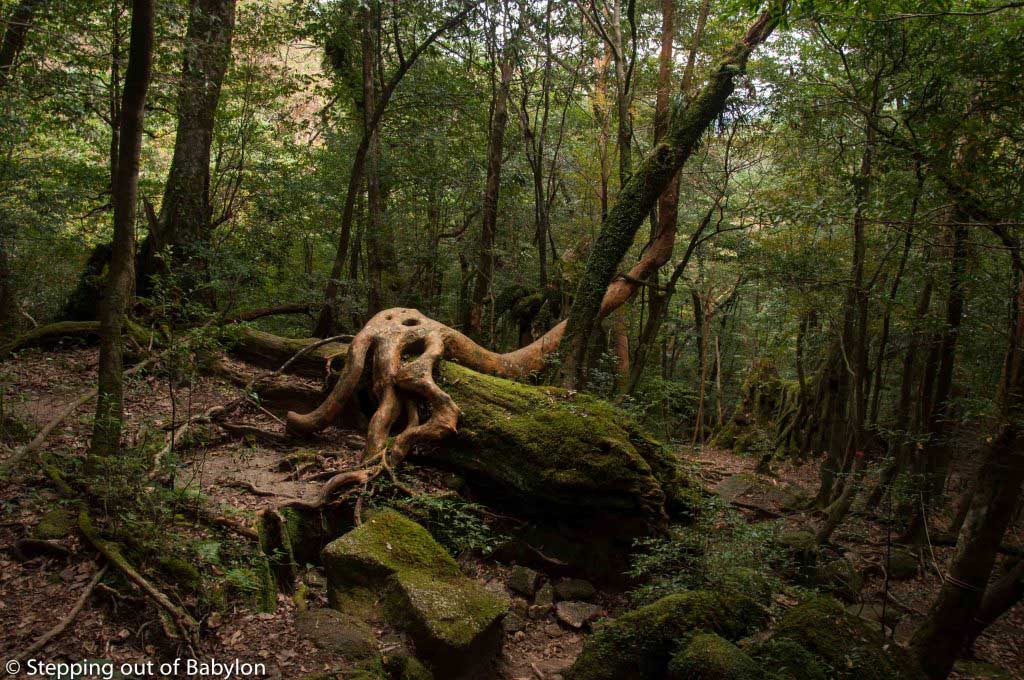
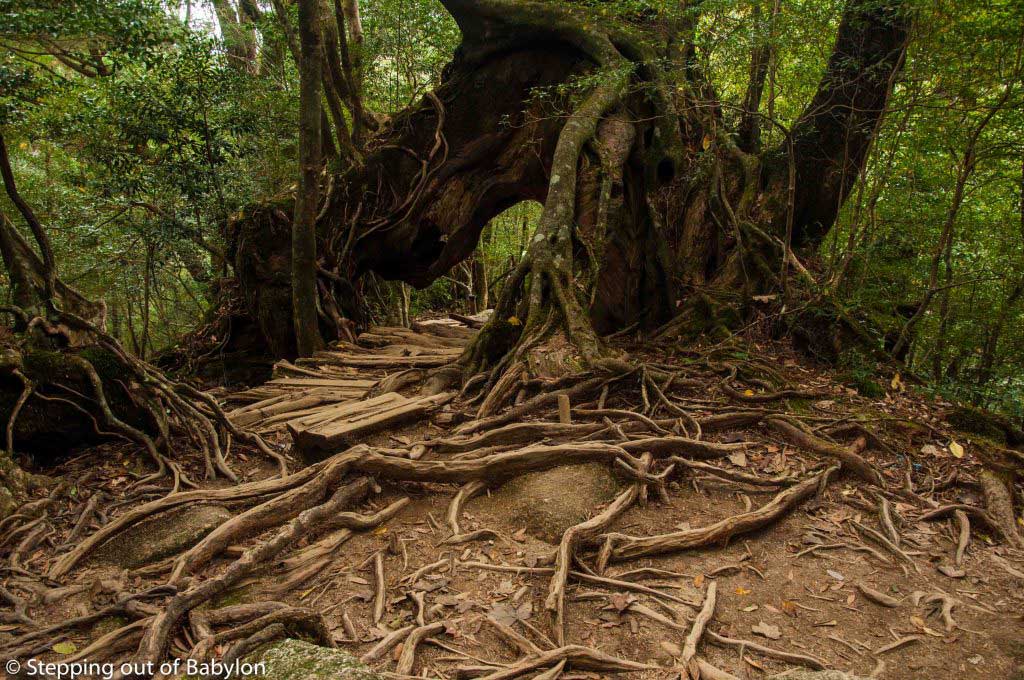
By some mysterious reasons, there are places, located a thousand kilometers away at different latitudes, that look that are connected by a strange bound, sharing the almost the same scenery and offering similar experiences… like the Living Root bridges of Nongriat, in India and the Mossy Forest of Gunung Brinchang, in Malaysia.
Shiratani trail

Yakushima, an island located south from Kagoshima Prefecture don’t have more than 100 km perimeter if you go along the road that goes all around the island, and its basically mountains, covered by a dense green forest, where the populations only occupy some small places along the coast. All the interior of the island remains almost untouched.

Basically there only two roads that go inside the island: one to Shiratani Unsuikyo Ravine and the other one to Yakusugi Land, that also gives access to Arakawa trail, to reach the famous Jomon Sugi (the oldest tree in the island, and one of the oldest in the world) that is also the highest peak on Yakushima, at an elevation of 1,934 m.
Shiratani trail
Shiratani trail

This island is basically all covered with cedars trees and here you can find specimens with more than 1000 years, and the oldest are sign along the trails. One of the most famous, apart from Jomo Sugi, is the Kigensugi Cedar that has an estimated age of 3000 years, or the Buddha Cedar with 1800 years.

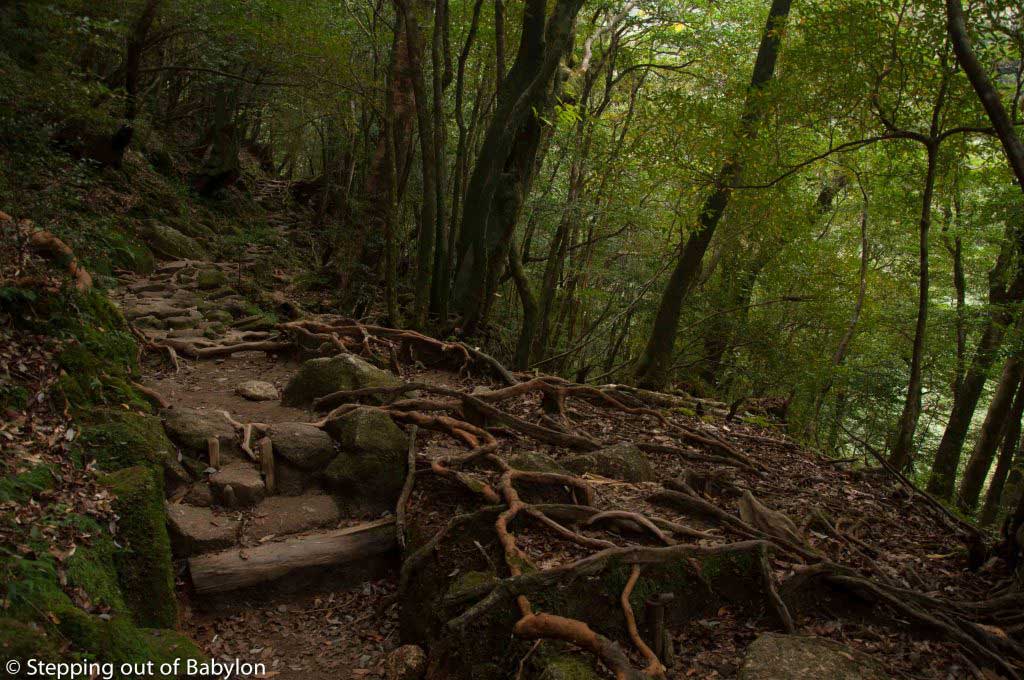
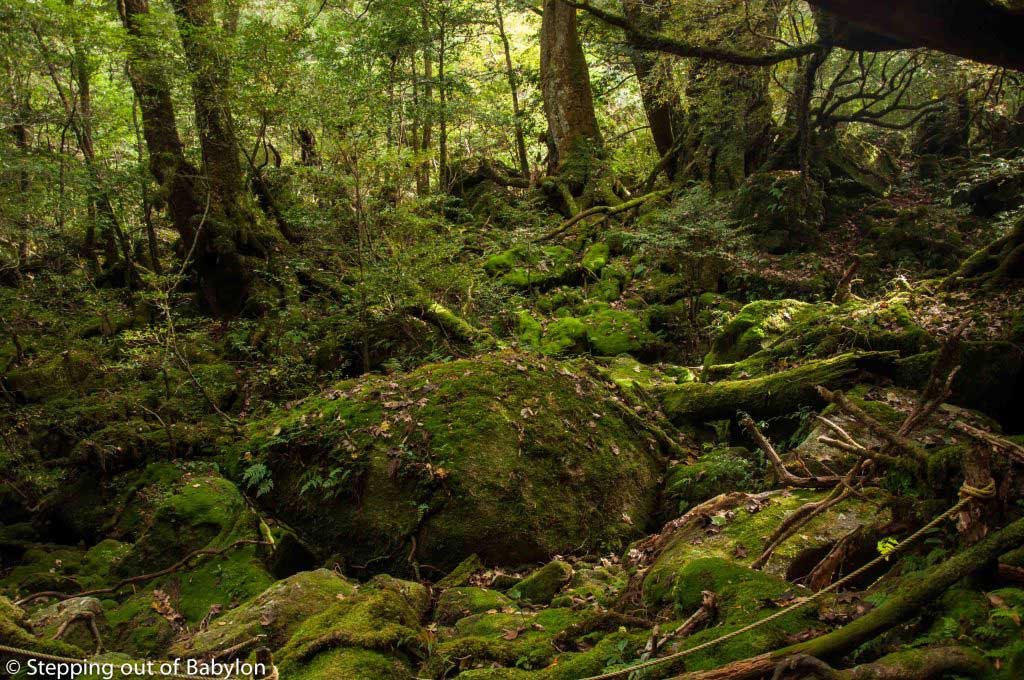
The Shiratani is famous for the moss covered forest, an area with more humidity (even more than the rest of Yakushima), but walking further you can reach a high point the Taikoiwa Rock from where you can have a wide view… and see finally the sunlight (in a clear day) as the forest here is so dense that is hard to see the sun!
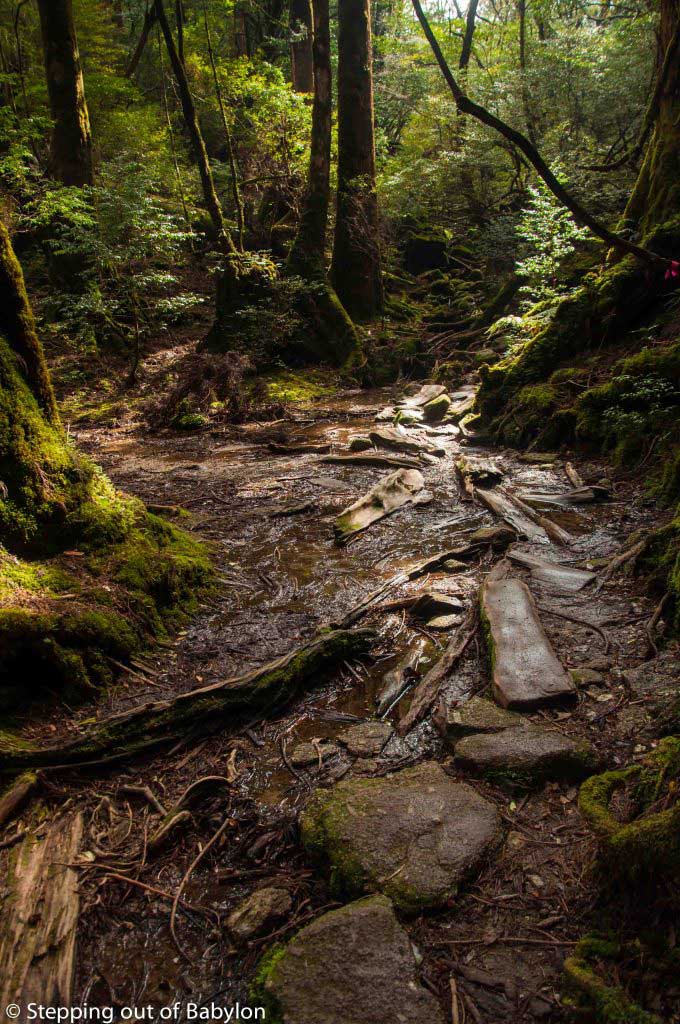
Shiratani trail
Shiratani trail

The main village in Yakushima is Miyanoura and is where you’ll arrive if you choose to come by ferry (the Yakushima 2 or the Hibiscus). Here is also where you can find a bigger concentration of restaurants and supermarkets, as well the tourist information (there also one Tourist office at the exit of the airport as also close by Anbo harbor).

To visit Ohkono-taki waterfall, you only have one bus that goes there. Its departure from Miyanoura at 8:41, arrives at 10:22 and returns from the waterfall at 11:00. So this is the only schedule possible, otherwise, you need to walk from the previous stop Kuriobashi. Is time enough to visit the waterfall.

On the way back I stop at Nakama beach and also check the Nakama Gajumaru Banyan, a group of ficus trees whose roots are connected, forming an arch. It’s nothing impressive especially after you walk along the Yakushima trails, and force you to break the bus trip from Ohkono-taki waterfall, forcing two hours waiting for the next bus.

Shiratani Unsuikyo Ravine trail

  • One way: departure at 8:10 and arrives at Shiratani at 8:45… but you don’t need to start so early and there’s a more convenient bus at 10:45, that allow you to hick all the courses and finish on
    time of the last bus.
  • Return: the bus’s last departure from Shiratani at 16:10 and take about 30, to arrive at Miyanoura.
  • There are 3 trails in Shiratani. The longest takes you to the Taikoiwa Rock, passing by the moss covered forest and is the most interesting of all. The other
    long trail, takes you to the Sanbon-yarisugi cedar, passing by several of very old
    cedar trees. The short course it’s very easy as most of it is steps and paved
    trail to reach the Yayoisugi Cedar.
  • This is a good option if you arrive at Yakushima early in the morning in the Hibiscus ferry, as it gives time to reach the guesthouse, get information in the tourist office (open at 9am) as well the bus pass and still have time to go to the supermarket (also open at 9am, and it’s close from the tourist information building) to buy some food for the hick.
  • Fee for Shiratani Unsuikyo Ravine: 500 ¥
Yakusugi Land

Yakusugi Land trail plus the visit to Kigensugi Cedar, 6 km further

In fact, Yakusugi means trees with more than 1000 years old and in this area there a big concentration of these old cedar trees.

Inside Yakusugi Land you have five different trails, a couple of them with about 1km, that are paved and easy to walk; the longest one as 4.4km, basically going up and down the hills using the tree roots as steps. The longest trail includes almost all the length of the shorter ones. It’s an easy walk that took me 4 hours with several stops for photos and to enjoy the views.

But after doing the long trail I realize that I wouldn’t have time to reach Kigensugi Cedar on time to catch the last bus to return. So hitchhiking and was lucky with one of the few cars that do that road.

If you are in Miyanoura, these are the possible bus schedules to visit Yakusugi:

  • One way: departure at 8:41, and change at Gochome at 9:20 to another bus that reachs at Yakusugi at 10:07.
  • Return: departure at 15:15, arrive at Gochome at 15:58, and then you need to wait until 16:32 for the bus to Miyanoura.
  • This schedule allows you to walk along all the trails without a rush. You can also start later (12:51) or leave from Yakusugi earlier (11:05).
  • Fee for Yakusugi Land: 500 ¥

But the most famous trail is Jomo Sugi, an 11.5 km trail that reaches the 1300m, starting in Arakawa. It takes all day, and in the wintertime the days are short… so I didn’t’ even try… maybe next time. You need to departure from Miyanoura (this bus starts at Sea Side Hotel, stop number 19) around 4:45 to catch the fist bus to Shinenkan, and there change bus at 6:00 to Arakawa Tozanguichi that takes just 35 minutes. To return you must be at the bus stop at Arakawa at 15:30… maybe too short to hike 11 km!??!?

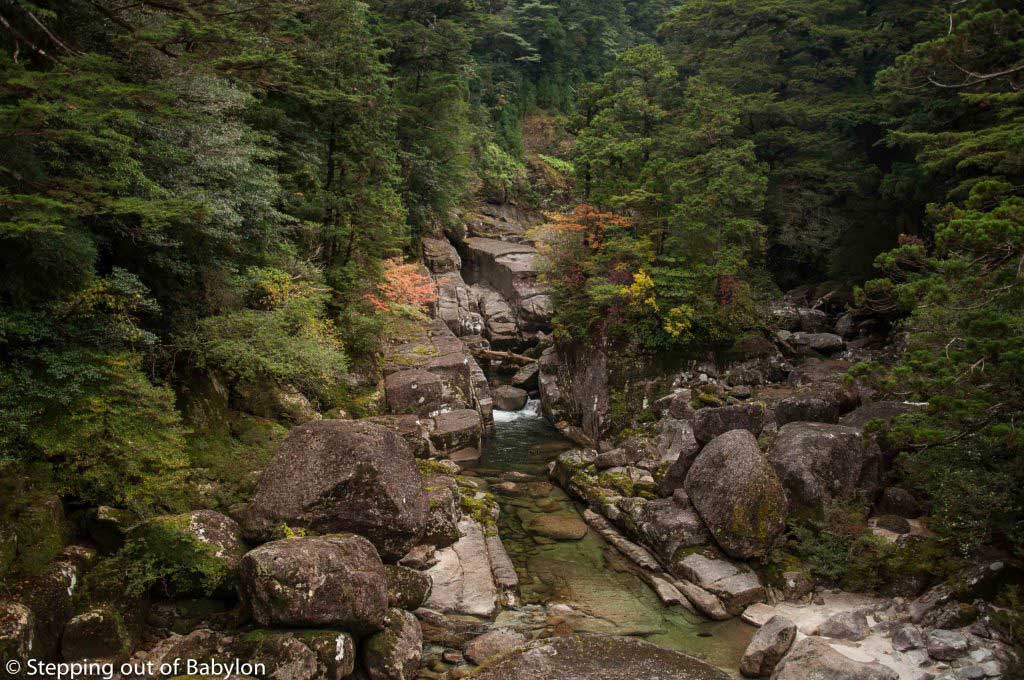
Yakusugi Land
Yakusugi Land

Onoaida Onsen:

There is about 8 onsen (natural hot springs) in Yakushima, most of them are in the sea… as it was November, thes options didn’t show up much pleasant, despite the winter in Yakuhima being more gentle that in other parts of Japan.

But couldn’t resist to visiting twice the Onoaida onsen, located on the south coast of Yakushima, being the most famous of all the onsen between the local population. The poll isn’t that big, but the water is so warm that no one can stay there for more than a couple of minutes. You can see the bubbles from the sulfur hot spring coming from the bottom of the poll between the basalt pebbles.

Here people use more the water from the hot spring to wash rather than using the shower, pouring buckets of water over the body from the pool.

Onoaida onsen is located a bit away from the main road, close by the forest, but doesn’t have any exterior pool. The building, all made in wood with a high ceiling, where the floor and wall are covers by the black volcanic rock, offers a cozy ambiance, where you can try to interact with the local population, and relax from a hiking day!!

I also try the Kusugawa onsen but doesn’t recommend, is it’s more like a public bath with warm tap water, in a dodgy building.

After a hike, there’s nothing better than a very hot bath, and the onsen provides that treat!!!! You end up almost melting on the way back to your guesthouse.

Fee: 200¥ but you need to bring a towel and soap.
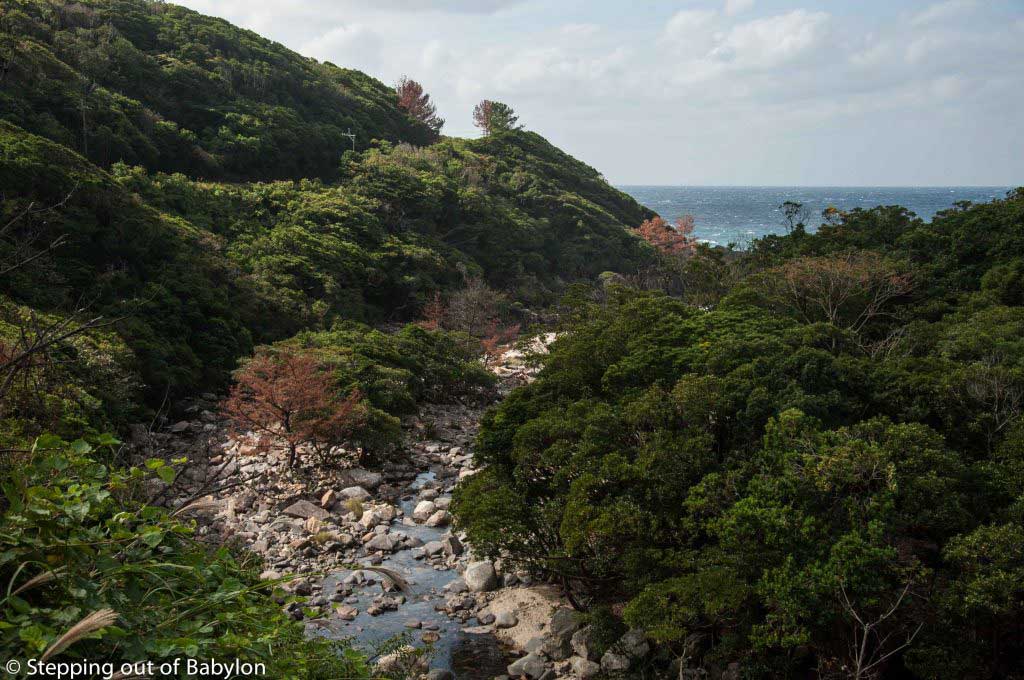
Nakama beach

How to move around Yakushima by bus:

In fact, the main issue that I face in Yakushima was transportation. Some buses go around the island, from Nagata to Ohkono-taki waterfall, but they are not very frequent with sometimes gaps of 2 hours and finish very early.

So this can really be an obstacle to explore the island, making short hikes of 4 hours, like Yakusugi Land and Shiratani-trail, take you all day, as you probably need to wait more than one hour for the bus back. So basically you need one day for each of the trails… and depending on your location, and one extra day more to the visit the Ohkono-taki waterfall.

Here is some info about buses in Yakushima:

  • Kotsu Bus
    Pass
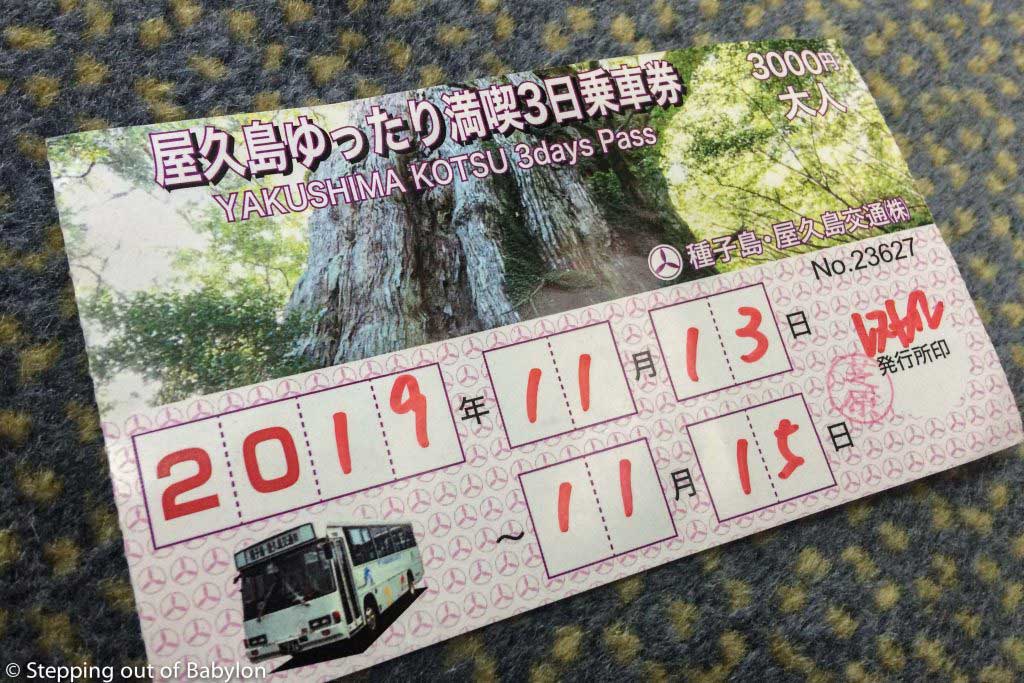
    : the bus is the only way to move around Yakushima, but this service is scarce, with several places having only two buses a day. Apart from that, the bus is expensive, as a trip around the island (from Okonotaki waterfall to Miyanoura) costs 1900 ¥. So it’s better to get the bus Kotsu Pass, that allows an unlimited number of trip, with several options:
    • 1 day: 2000 ¥
    • 3 day: 3000 ¥
    • 4 day: 4000 ¥
  • You can get the Kotsu Bus Pass at the Information office of Miyanoura, Ambo Port and the Airport; at Miyanoura, the Yakushima Visitor Center (a kind of souvenir shop located on the left side of the main road, about 100m further from the Information Center, but this shop opens earlier, at 8 am) and also at the Youth Hostel.
  • It’s easy to navigate by bus as all the stops have a number that is also in the bus schedule.

More information about the bus schedule at: http://yakukan.jp/doc/pdf/2019gw_yakuko_en.pdf

Where to sleep in Yakushima:

I choose to stay at Miyanoura. It’s not a charming place but it very close to the harbor, which reveals convenient when arriving and departures as you don’t need to de dependent on the buses. Miyanoura, wherever you stay, it’s a walking distance from the harbor.

I stayed at Sudomari Minshuku Friend, It’s a local guesthouse, with traditional Japanese shared rooms, some with beds others with tatamis. A quiet place where I felt at home. Laundry is for free and you can use the kitchen. The manager is very friendly but doesn’t speak much English, so you can’t count much on him to get help with how to move around. It’s continentally located just in front of one Kotsu bus stops and it’s about 1.2km from the Hibiscus Ferry port. 3300 ¥ a night.

Where to eat in Yakushima:

As an Island, Yakushima speciality is the fish, and there are several restaurants in Miyanoura, but some of them only open for lunch.

The supermarket (there are two) are a good option if you need to buy food for the hiking. Some places offer bento box but the price is a bit high.

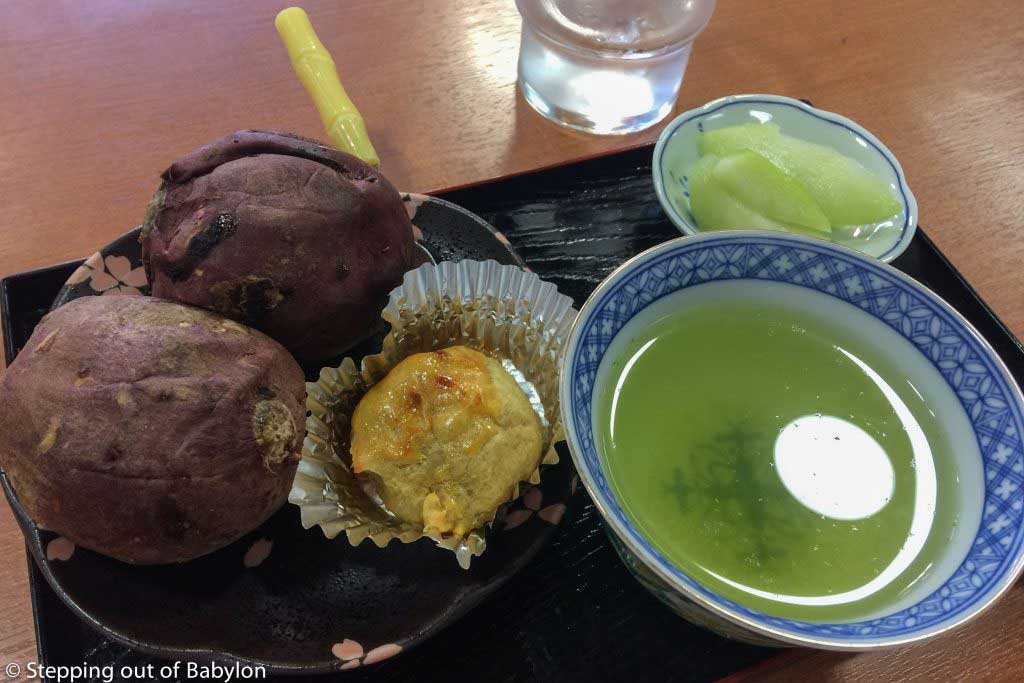
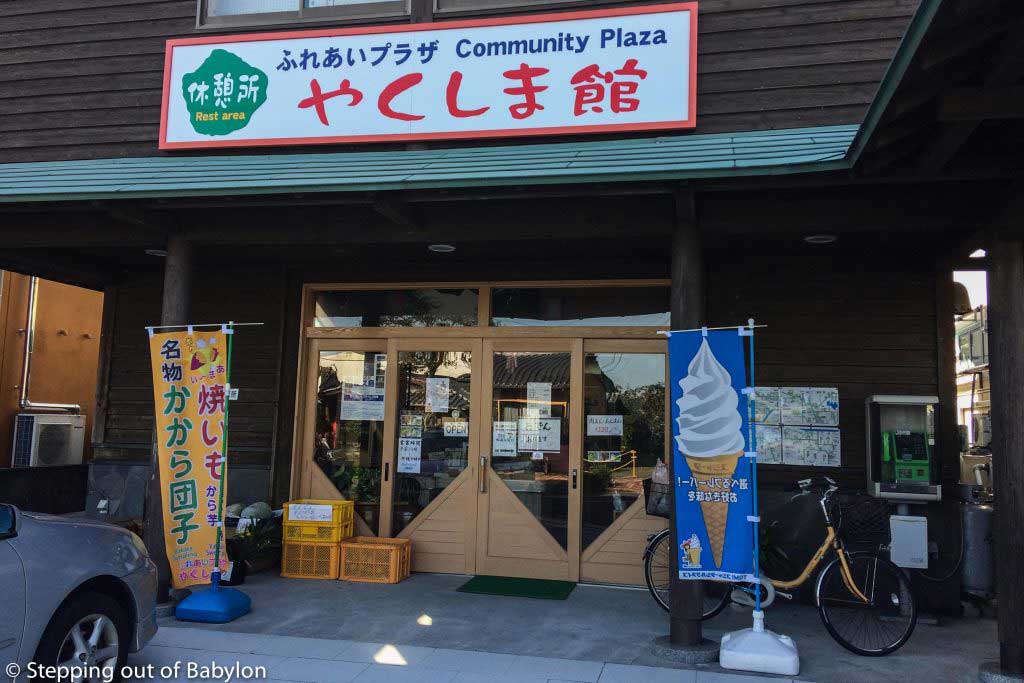
At the Community Plaza, a small shop located a few meters further from Sudomari Minshuku Friend Guest House, they serve also food for a very cheap price. The usual dish is curry (meat) but if you are in the mood for a snack you can try the sweet potato set, that also include a tea and a delicious sweet, also made form sweet potato… only 100 ¥ (it closes around 4pm).
Things to know when you arrive at Yakushima:

  • The tourist information in Miyanoura, that you gonna find on the right side of the road when you leave from the harbor, has the door closed with a sign “closed today”; go around the building (along the left side), as the main door is the opposite side; the Information office is open from 9 am until 5 pm,
    everyday.
    Here you can get the maps of the trails, the bus schedule as also the Kotsu Bus Pass.
  • There are two big supermarkets at Miyanoura, and they are open from 9 am until 10pm; there you can find ready-made meals for take-away.
  • Money: It’s better to get cash before the trip, as in Yakushima the only ATMs are in the post office spread along the
    island, but they charge 220 ¥ commission for each withdraws.
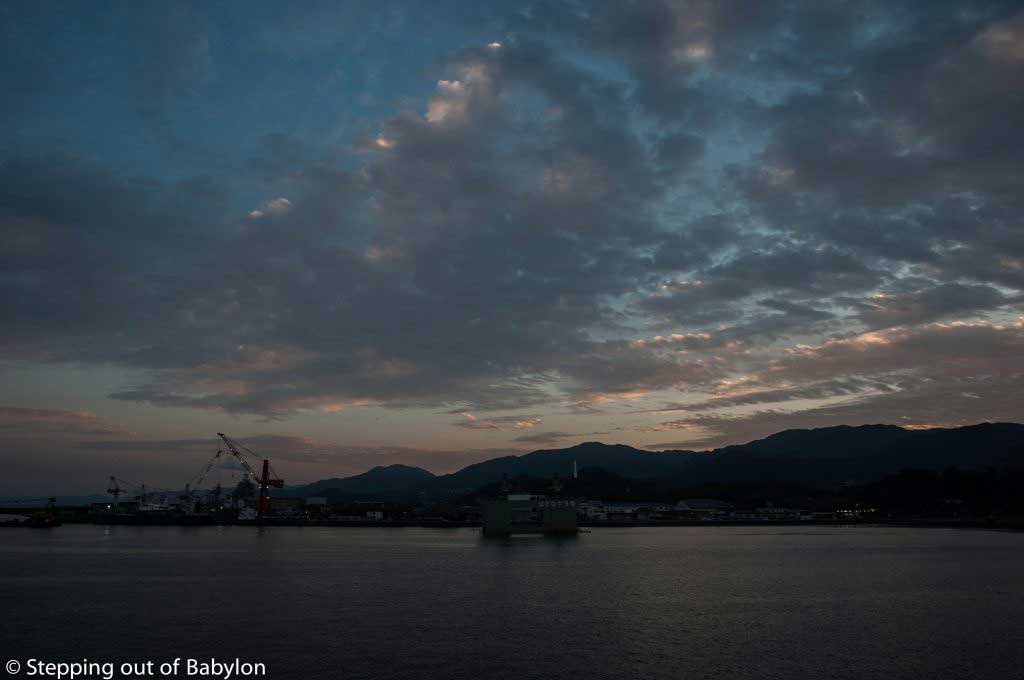
How to reach Yakushima by ferry boat:
click this link:

22 days in Sumatra: itinerary & costs

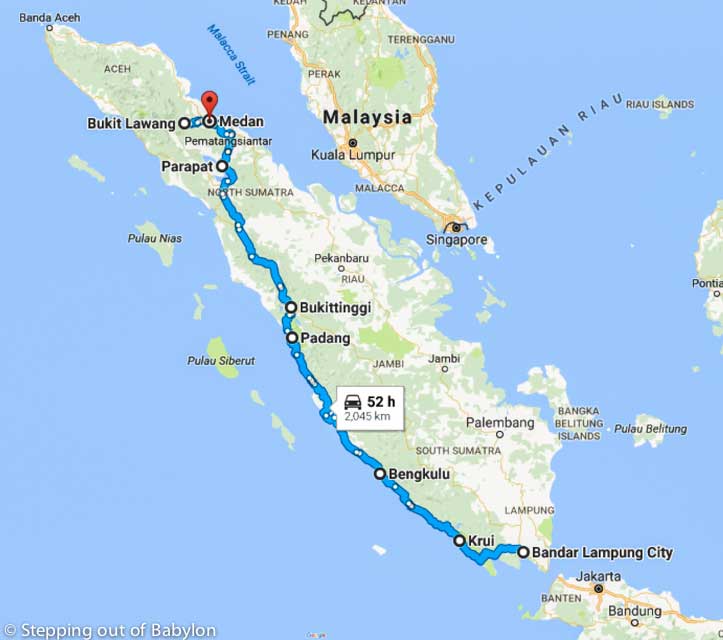
Itinerary:

  • Ferry crossing Merak-Bakauheni (from Java to Sumatra by ferry)
  • Bandar Lampung: 1 day
  • Krui: 5 days
  • Bengkulu: 1 day
  • Padang: 3 days
  • Bukittinggi: 4 days
  • Lake Toba: 3 days
  • Bukit Lawang: 3 days
  • Medan: 2 days

Costs:

13.4 €/day

… considering traveling solo, eating just local (vegetarian) food, no a/c rooms, sometimes dorms, travel by public transport, no alcohol and no soft drinks, making my own laundry and walking a lot on foot… Shopping and souvenirs are also not included, as well health expenses and communications (SIM card, mobile, telephone, internet…).

Costs in Sumatra:

  • room (fan): minimum 60.000 Rp up to 100.000 Rp (one person); in Sumatra the accommodation is usually cheaper that other Indonesian islands. There are many places with dorms in the cities for 60.000 or 80.000 Rp; nearby the beach areas the prices increase reaching 100.000 Rp. Most of the times the breakfast isn’t included.
  • meal: less than 20.000 Rp for a meal (local food, street-food, vegetarian meals). The water is usually free at the guesthouses, as also coffee and tea.
  • rent a scooter: 70.000 Rp/day or 100.000 Rp/day; a litter of petrol: 10.000 Rp in road side shops (at the pump station is 8.500 Rp/l)
  • angkot (small local bus): costs from 2.000 Rp to 10.000 Rp for an urban area trip.
  • ojek (moto-taxi): 10 km cost around 15.000 Rp (but the price of the ojek depends on your bargain skills and the needs of the driver, weather, time of the day…).
    At Medan the GoJek, Uber and Grab companies offer moto-taxi services, that are an easy way to move around.
  • There is only one passenger train service in Sumatra (Bandar Lampung to Palembang), so the bus is the most common option but the distances are big and sometimes the plain is the best option as the prices are not much higher than the bus, and a bus trip of 15 hours can be mande in 1 hour by plane. Still… all this Sumatra trip was done by land!!!!
  • A bus trip of 680 km costs around 200.000 Rp, in a air-con bus.
  • At Sumatra the cost with transportation increase significantly compared with Bali, Lombok or Java) as the distances are bigger. But the accommodation is cheaper than in the other islands that i visit.

Note: this trip was made duriing Jun 2017, which still is still considered the low season, when the prices of the accommodation are lower, that can be significant at beach areas.

MAP_Bandar Lampung City, Lampung, Indonesia to Medan - Google Maps-1-2
Sumatra: itinerary


see also:

Masakan Padang… the most popular Indonesian cuisine

How to get a Thai visa in Vientiane… from Chiang Mai

The so-called “visa run” is a classic for travels that choose to stay for a long time in Thailand. But let’s start with what is a visa run?? Running for a visa? More or less!!! Means go to a nearby country, cross to border and come back to Thailand again, preferentially in the same day!!

Laos, Cambodia, Myanmar and Malaysia are the neighboring countries, but being in the north of Thailand, the easiest way to get a new 60 days tourist visa is going to Vientiane, the capital of the Lao People’s Democratic Republic

Mae Sai, in Myanmar, is also a popular option but crossing by land only give you 15 days visa (NOTE: since 31st December 2016, you can get 30 days tourist visa, on arrival, for free).


Step by step… time and costs:

Day 1: from Chiang Mai to Thai Consulate in Vientiane

  • Bus from Chiang Mai to Udon Thani: 545 baht

The best price is from Phetprasert company (good and comfortable buses), that has several buses leaving during the day, but the best option is the on that departure at 7.30 pm, from Terminal 2 of Arcade Bus Station, otherwise you’ll arrive unnecessarily early to the border.

A VIP bus can cost around 800 bahts and is better to buy the ticket in one of the counters of the Terminal 3.

If you don’t carry much luggage you can go on foot from the old town to the Arcade Bus Station, and it will take you between around 40 minutes walking.

  • The bus departure at 30 pm and arrive to Udon Thani around 6.30 am. The bus drops the passengers in from of the City Plaza, a modern mall. Watch out because this is not the last stop.
  • After the bus leave, you’ll see on the other side of the street a kiosk (with Van Station sign) where you can buy a ticket for the mini-van that take you to the border: Nong Khai

Mini-van kiosk at Udon Thani, in front of Central Plaza

The mini-van ticket from Udon Thani to Nong Khai cost 50 baht. It takes 1.5 hours and drops you at the Immigration area.

  • Thai Immigration at Nong Khai: basically you need to wait on the line and show the passport and the departure card.

If you overstay in Thailand you need to line on the counter on the left and pay the fee (500 baht a day).

  • After you get the stamp you´ll find a desk outside the room that sells the tickets to a bus that cross the Thai-Lao Friendship Bridge over the Mekong. Apparently crossing the bridge on foot is not allowed!

The bus ticket cost 20 baht, and the trip takes about 10 minutes. The bus departure when is full.

The bus will drop you just at the Thanaleng border crossing and you just need to walk a few meters to the Lao Immigration.

Crossing the Thai-Lao friendship bridge

  • Lao Immigration procedures: when you get off the bus you’ll see a counter on your left side, where you can find the immigration form.

For the Lao visa you need:

  • 1 passport photo,
  • Immigration form,
  • 35 USD (you can pay in baht – 1500 baht – but it will be more expensive). The fee depends on from your country but most of the Europeans countries pay the same. The French citizens pay 30 USD. Check your situation on line.

After you present the document and pay the visa fee (everything in the same counter) you need to wait a few minutes. Every now and then the third window of the counter will open and your name will be called and the passport gave back to you, with a 30 days visa, single entry. A transit visa will cost you the same and will give you more trouble.

Note: the Lao Immigration works from 8 am to 4 pm, so if you cross the border out of this schedule, no matter in which way, you need to pay 1 USD extra.

  • As soon you cross the border gate, mini-van drivers that take you to Vientiane or directly to the Thai embassy approach you. You need to wait until there at least 3 passengers.

The mini-van trip cost you 25.000 kip or 100 baht (the driver will be happy to receive baht… so don’t rush to exchange money at the border and just wait to arrive at the Vientiane to get a better rate!!!) the trip takes around 30 minutes.

  • If your trip to Laos is just to get the visa, so is better go directly to the embassy, as it closes at noon.

Consular Section: Monday to Friday

08.30 – 12.00: Application for Visa

13.00 – 15.00: Distribution of Passports with visa

Close on Saturday and Sunday (check also Thai and Lao holidays http://vientiane.thaiembassy.org/en/embassy/calendar.php)

  • Procedures at Thai Embassy in Laos:

For the Thai visa you’ll need:

  • 2 passport photos
  • a copy of the last Thai visa and also the page with the stamp of entry in the country
  • a copy of the Lao visa

At the Consulate the things are a bit chaotic and busy.

As you cross the Consulate Gate you must go first to the building on your left where you can ask for the application form, and where you can also take the copies of your passport: 20 baht each (you can pay baht or kip).

Inside this building there are some desks where a few consular officials can help you to fill the forms and glue the photos… you must pay 4.000 kip for this service, but filing the form has no big issues and you can save time and money doing it by yourself!!!

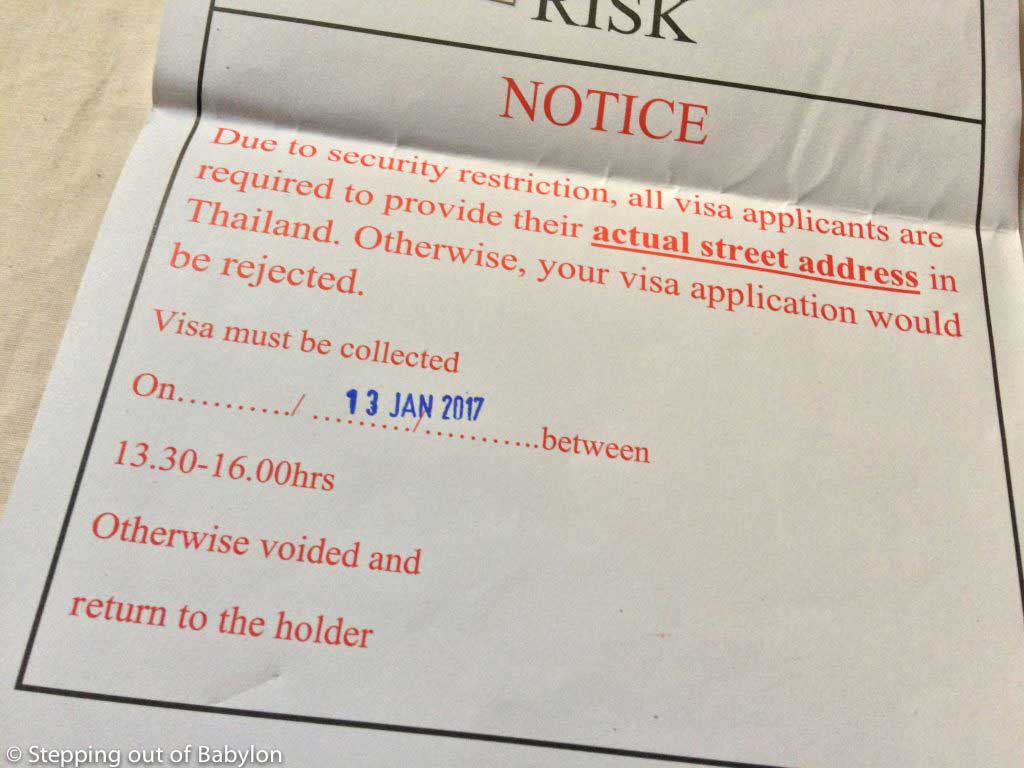
Note: you must write an address of a place or the guest house where you plan to stay in Thailand… don’t need to make proof of any reservation but you must provide a valid name and an address.

Note: you must write an address of a place or the guest house where you plan to stay in Thailand... don’t need to make proof of any reservation but you must provide a valid name and an address.
Note: you must write an address of a place or the guest house where you plan to stay in Thailand… don’t need to make proof of any reservation but you must provide a valid name and an address.

With all this paper stuff ready you need now to join the long queue that zig-zag under the shed, that you see as you come out of the building. This part is fast, as is just the time need to the consular officials check your documents, and give you a number, that you’ll use next day to pick the passport with the new visa stamp, for 60 days with a single entry.


Watch out: when you come off the mini-van, maybe someone forward you to one of the improvised offices where someone fill the form for you, make the copies and arrange everything for you (4.000 kips), even with the promise that paying an extra you can get the visa on the same day… don’t trust in this touts! The consular officials reject the forms that they have… and then you need to do it by yourself inside de consular services.

Watch out: when you come off the mini-van, maybe someone forward you to one of the improvised offices where someone fill the form for you, make the copies and arrange everything for you (4.000 kips), even with the promise that paying an extra you can get the visa on the same day... don’t trust in this touts! The consular officials reject the forms that they have... and then you need to do it by yourself inside de consular services.
Watch out: when you come off the mini-van, maybe someone forward you to one of the improvised offices where someone fill the form for you, make the copies and arrange everything for you (4.000 kips), even with the promise that paying an extra you can get the visa on the same day… don’t trust in this touts! The consular officials reject the forms that they have… and then you need to do it by yourself inside de consular services.


Exceptionally, from 1st of December 2016 until 28th of February 2017, the 60 days tourist visa is free. http://vientiane.thaiembassy.org/en/news/announce/detail.php?ID=362

Now that you have you have the ticket with the number is time to find a guesthouse, have rest and some food in the sleepy Vientiane.

You can reach the center of the city on foot, which that take around 40 minutes walking slowly.

In Vientiane, you can get a bed dorm for 40.000 kips (Garden Hostel, Sihome), get street food for 10.000 kips and watch the time pass by near the Mekong waters.

Day 2: from the Thai Consulate in Vientiane to Chiang Mai

  • On the next day, after 1 pm you can go the embassy to collect your passport. The officer behind the counter will calls people by the ticket number given to you the day before. But don’t worry, is ok if you arrive later (2 pm is a good time), as this way you just need to go to the counter and show your recipe, no matter if it already call your number. This is super fast.
  • Outside de Consulate the mini-van driver will be waiting to take the foreigners back to the Thai border. Again you can pay in baht or kip the mini-van ride: 100 baht.
  • Arriving at the Lao Immigration you must get your passport stamped.
  • Take the bus to cross the Thai-Lao Friendship Bridge: 20 baht
  • Fill the arriving/departure card and get your passport stamped with the day that you must leave the country.
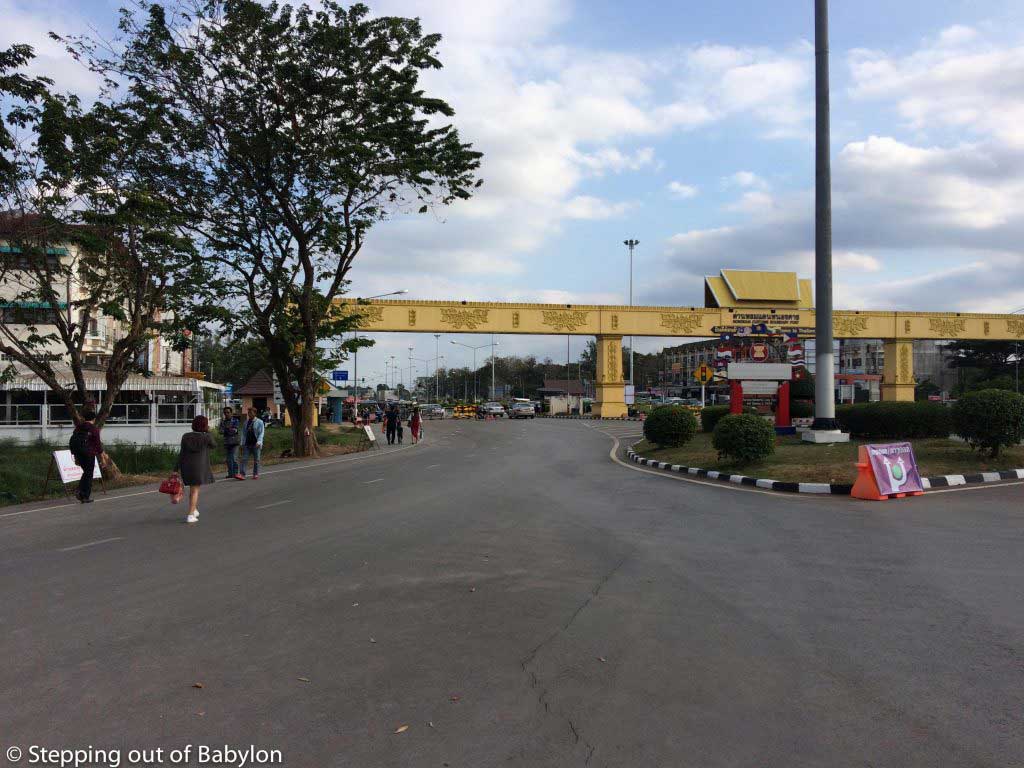
  • After the Thai Immigration procedures, you must walk out the border crossing area, until you pass under a big gate decorated in gold. Many taxi and tuk-tuk drivers will approach you to take you to Nong Khai (if you are going to the south, like Bangkok) or Udon Thani if you are going back to Chiang Mai, for a big amount of money. Ignore them!

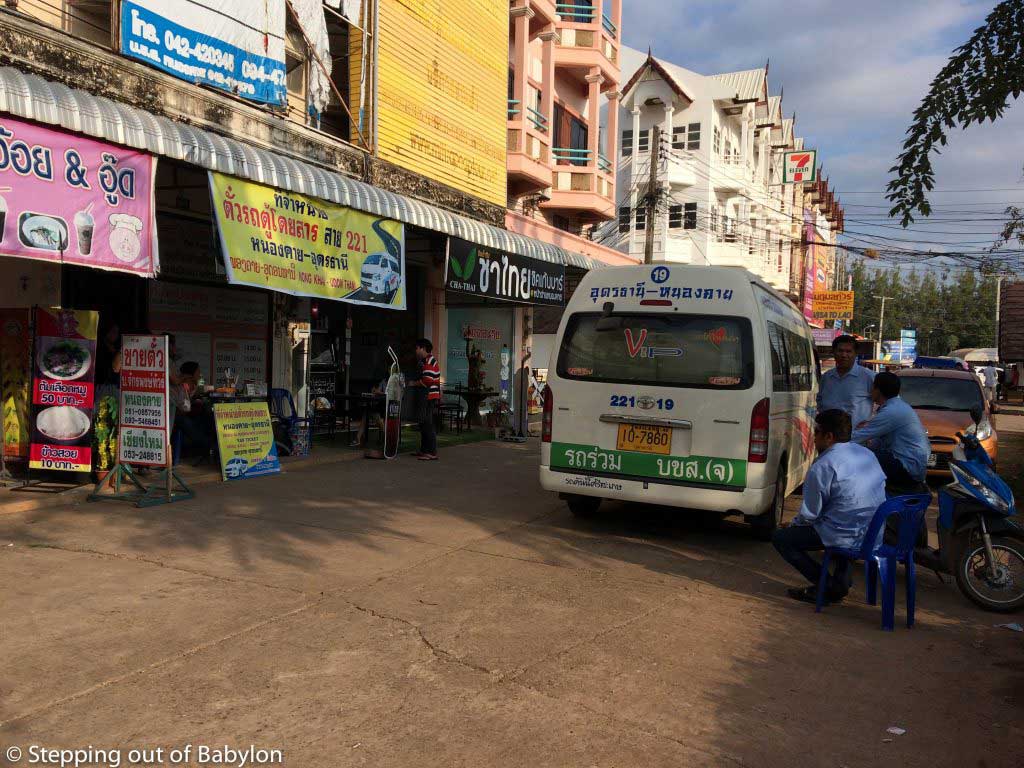
Keep walking a bit further after the gate and you’ll see a few tuk-tuk line up on your left (if you arrive at a 7 eleven, you walk too much), behind them is the office of the mini-van company that takes you to Udon Thani for the just 50 baht! Just need to wait a bit, as the mini-vans run every hour.

Thai border at Nong Khai, after passing under this gate you'll fin the mini-van to Udon Thani and Nong Khai Bus Station
Thai border at Nong Khai, after passing under this gate you’ll fin the mini-van to Udon Thani and Nong Khai Bus Station

office of Mini-van from Nong Khai to Udon Thani

Schedule of the mini-van that link Nong Khai border with Nong Khai Bus Terminal and Udon Thani Bus terminal... you dont need to hire one of the expensive taxis or tuk-tuks
Schedule of the mini-van that link Nong Khai border with Nong Khai Bus Terminal and Udon Thani Bus terminal… you dont need to hire one of the expensive taxis or tuk-tuks

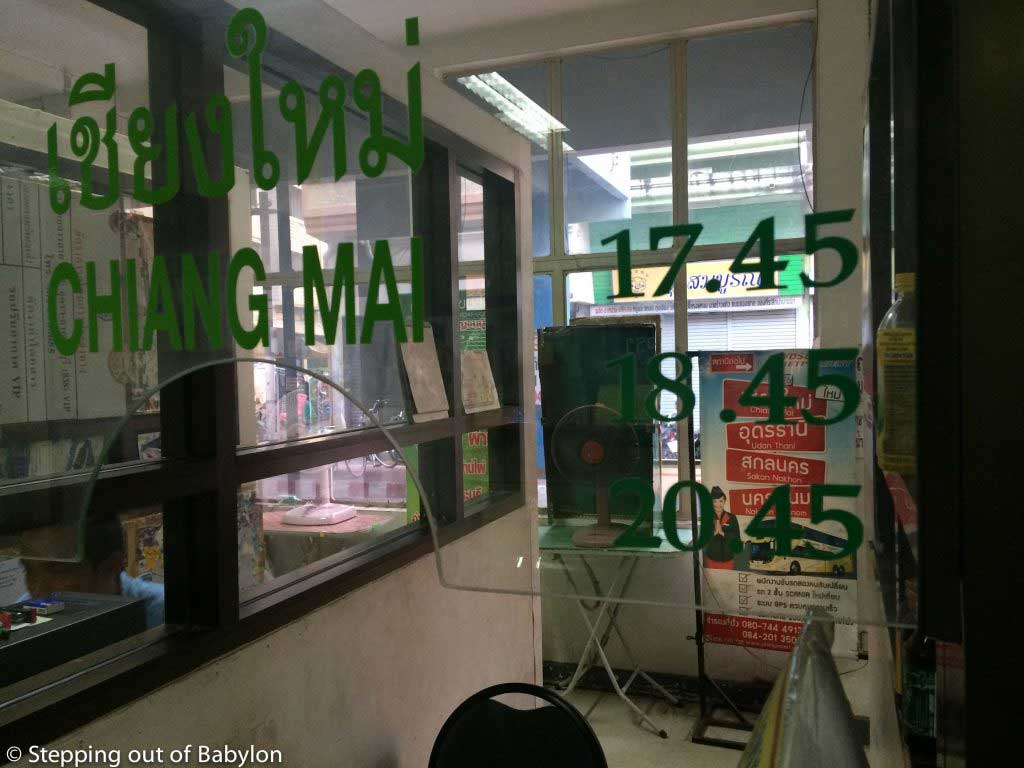
  • Probably you’ll arrive in Udon Thani around 5 pm. At Udon Thani Bus Terminal you need to find the counter that sells tickets to Chiang Mai… the buses departure at:

17.45, 18.45 and 20.45h.

Depending on the demanding you may have the lucky to get a ticket for the first bus… otherwise just need to wait a bit for the next one. There a nice café in the opposite of the entrance of the bus terminal or you can enjoy the air-conditioner of the Central Plaza, a mall very close by.

The bus will pick you at the entrance of the Central Plaza, at the same place where they drop you in the morning of the day before…. just wait there patiently because the bus can arrive a bit later (I wait 30 minutes)…. but no worry because at the kiosk in front (van Station) there a bus company official that can help you.

The bus arrives at Chiang Mai in the next morning, 11 hours later.

And here you are again in Thailand for a couple of more months… and you can even extend this visa for more 30 days!!!!!

Schedule of the bus from Udon Thani to Chiang Mai

Costs of the visa run:

Transportation: 1430 baht (considering not using tuk-tuk in Vientiane)

Sleep: 40.000 kip (dorm with breakfast) (approx. 175 baht)

(The cots of the food in Vientiane are not included as you send more or less the same as in Chiang Mai).

So you will spend minimum 1600 baht plus the 35 USD of the Lao visa.

Bus tickets form Chiang Mai to Udon Thani

About me

Hey there!

I’m Catarina, a wanderer from Lisbon, Portugal… or a backpack traveller with a camera!

My journey as a traveller started in 2013 and led me towards the Asian continent, after a few short trips to Vietnam, India, and Peru.

The first six months were spent in India which gave me the experience, knowledge, and strength to explore the diversity of Southeast Asia, including Thailand, Laos, Myanmar (Burma), Cambodia, the southwestern region of China, Malaysia, Singapore, and Indonesia. 

But it was India where I found myself visiting often and sticking around longer, exploring more remote areas like Ladakh, Kashmir, Nagaland, Rann of Kutch, Thar Desert and Cherrapunji.

In North Africa and the Middle East, I travelled through Iran, Morocco and Turkey.

Later, Sri Lanka and Nepal complemented the first four years of my journey.

Japan and Taiwan are the farthest East places that I have been so far.

After a two-year break during the pandemic, I hit the road again. This time, I focused on shorter trips and closer destinations. East Turkey and Lebanon are my recent passions with their rich history, cultural diversity, and delicious food.

But my recent biggest surprise was Bangladesh, a lesser-visited country without flashy sights, but which truly captured my heart through the kindness and friendliness of its people.

This blog is my travel notebook: here I share information and tips about accommodation, border crossings, visa arrangements, local transportation… all to help you travel safer, cheaper, and explore behind the beaten path.

I’m not exactly sure what keeps me travelling, but definitely photography keeps me pushing forward, food keeps me excited, and people keep me inspired.

Thanks for stopping by. I hope something here inspires you and inspires your next adventure!

Catarina

Love and Respect

How to go from TBS to Chinatown (Kuala Lumpur)

Most of the long distant and inter cities buses, arrive and departure from Terminal Bersepadu Selatan, that everybody knows by TBS. The terminal is located in the south area of Kuala Lumpur and offer good connection with public transportation network at Bandar Tasik Selatan to:

  • Train (KTM Komuter)
  • LRT (Light Train)
  • KLIA train, KL International Airport


Coming out from the bus we are left in a cover bus park with a set of escalators that lead to the main hall of the terminal. Once here, after a short walk inside the building you’ll find an exit on your right, with indications of KLIA.

Following the KLIA signs you’ll cross a metal footbridge; on the other side are stairs and a lift to reach the access to the KLIA train as also to the ground floor.

As you reach the street walk to the right side (for whom are facing the giant building of the terminal), and after passing the taxi rank you’ll find a bus stop.

The Bus 690, Rapid KL (ticket 2 RM) takes 20 minutes (outside rush hours) and ends at Pudu Sentral (Puduraya) in Jalang Pudu near the Plaza building Raykat. From here are five minutes walking to Jalang Petaling, the heart of China Town in Kuala Lumpur.

Bus 690, from TBS to Pudu Sentral (Puduraya). Kuala Lumpur


Tickets, Bus 690, from TBS to Pudu Sentral (Puduraya). Kuala Lumpur

Alternative:

  • After crossing the pedestrian bridge follow signs to the train station, KLIA.
  • Take the KTM-Komuter, Seremban line (2.4 rM) to KL Sentral.
  • At KL Sentral to take the LRT to Pasar Seni (1.4 RM).
  • This alternative takes longer and is more expensive for those whose final destination is Chinatown, but it can be advantageous for those looking for other destinations in the city of Kuala Lumpur.


On the way back, which means from Chinatown to TBS, is better use the LRT + KTM-Komuter specially if you are traveling at rush hours, that can make the bus trip last more than one hours.

By LRT + KTM-Komuter the trip from Pasar Seni to TBS should take less than 45 minutes.


Buy bus tickets in Malaysia:

The TBS has a huge number of ticket counters, centralizing the tickets selling to all destination and bus companies. Arrive at least half-hour before because the lines are big.

If you travel to popular destinations, especially on Fridays, weekends and holidays is better reserve the ticket in advance.

For reserving ticket you can use on of the many site, and pay with credit card, . This web site don’t charge commission.

I use this one: http://www.easybook.com/

Once you arrive to the TBS, nearby the ticket counter you’ll find a counter were you can show your reservation and get the ticket.

100 Cintra @ Georgetown

A building full of personality and style, and friendly and helpful staff make the 100 Cintra a special place with an atmosphere that invites you to stay for long periods.

The building dates from 1897 and was once served as housing the wealthy families of Penang. After suffering a fire was recovered for commercial purposes while retaining the style and materials of traditional architecture. Was recently transformed into hostel, where on the first floor are located the rooms, and where the top floor is occupied with a furniture collection and decorative items that constitute practically a museum, although it is not accessible to the public, can be enjoyed through fence that limits the space.

Good location, in the heart of George Town, the far the most popular and busy streets, in an area where dominates the local market and where it is easy to find food in both Malaya and Chinese food restaurants and street food stalls.

100 Cintra has several common areas, both indoors with decor with antique furniture and objects, and outdoor spaces, terrace and porch, that are nice areas to read a book, take a nap, have a meal or chat with other guests. This spacious and different common areas compensates for the small space of the rooms.

A space that despite being in need of some care offers a memorable stay and makes you sty longer in the city.

100 Cintra Guest House @ George Town. Penang


100 Cintra Guest House @ George Town. Penang


100 Cintra Guest House @ George Town. Penang


100 Cintra Guest House @ George Town. Penang


100 Cintra Guest House @ George Town. Penang


100 Cintra Guest House @ George Town. Penang


100 Cintra Guest House @ George Town. Penang


100 Cintra Guest House @ George Town. Penang


100 Cintra Guest House @ George Town. Penang


* In Malaysian “cintra” means “Japan” because along this street were housed many Japanese during the invasion that lasted until the end of World War II.

100 Cintra

Address: 100, Lebuh Cintra, George Town, Pulau Pinang 10200, Malaysia

http://www.100cintrapenang.com/


Double room: 60 RM (you can try to bargain in low season or for a long term stay)

Bedrooms: 20 RM

All rooms have shared bathroom

Breakfast included (very basic with bread, jam, tea and coffee)

The kitchen can be used for free.

Free Laundry.

Free wi-fi

100 Cintra Guest House @ George Town. Penang


100 Cintra Guest House @ George Town. Penang


100 Cintra Guest House @ George Town. Penang

George Town… street art and street food

Penang often mistaken for George Town. Penang is a state on the west coast of Malaysia, which includes the island of Pulau Pinang. But what attracts most visitors to this site is the city of George Town (or Georgetown) the capital and largest city of this state, whose name is due to the British presence that settled here in the eighteenth century, making this site one of the important posts trade in the region, is the quiet atmosphere in a colonial well preserved heritage.

From this presence resulted a vast architectural heritage ranging from official buildings, churches and shophouses, which are buildings of two or three floors where the ground floor is intended for commerce and the top floors for residence, continuing today to have these functions.

As an important trading post, George Town attracted many merchants from several neighboring countries such as Thai, Burmese, Tamils ​​from south India and many Chinese, which resulted in a great cultural and religious diversity which is revealed in the diversity of temples: Buddhist temples, Hindu temples and mosques, as also the Christian, Catholic and Anglican churches.

From this mixture that learn how to live together taking advantage of their differences, born a very unique identity which joined the Malay culture, resulting in a country that today is an example of religious, ethnic and cultural tolerance. Also resulted in a great culinary diversity for which Penang is famous, finding restaurants and street food stall, a bit all over the old town, each zone with is own type of food, serving during the day, but obeying to a specific schedule according to the food…. you can not find chendul in the evening or Steam Rice Cake during the day.

The old town is considered World Heritage Site by Unesco, where much of the buildings are ancient, with many of the shophouses to maintain the traditional architecture, some converted into trendy cafes, restaurants and accommodation as a result of the large number of tourists.

George Town
George Town


George Town
George Town


George Town
George Town


Food Market. George Town


George Town
George Town


George Town
George Town


George Town
George Town


George Town
George Town


George Town
George Town


Another of the architectural features of the city are called five foot ways, which are a kind of sidewalks formed by the buildings where the ground floor is set back from the facade, creating a passage in the form of arcades, which protects the inhabitants of the sole of rain. The name comes from the width with which they were built that were originally built (approximately 1.5 meters), but there five foot ways of varying sizes by adjusting the width of the streets.

Georgetown is famous for street art, which somehow has become institutional, with many artistic interventions in a planned and organised manner, which removes the subversive and intervention that is one of the street-art facets. And from the many murals which can be found in the old town, only a few works stand out of the homogeneous, simple and innocent set of murals.

Street art. George Town


George Town
George Town

Despite the exposed art on the walls is worth a closer look to what is happening under our feet, where the floors of many five foot ways are coated tiles, with elaborate geometric patterns and attractive colors.

5 foot way. George Town


5 foot way. George Town


Georgetown smells old and at the same time has a modern character in a quiet environment, only interrupted by the bustle of the bars at weekends become part of Lebuh Chulia and Love Lane a messy and noisy area, clashing with the quietness of rest of the city.

George Town
George Town

Where to stay in Georgetown

A building full of personality and style, friendly and helpful staff makes the 100 Cintra a special place with an atmosphere that invites you to stay for a long term.

100 Cintra Guest House @ George Town

100 Cintra

Address: 100, Lebuh Cintra, George Town, Pulau Pinang 10200, Malaysia

http://www.100cintrapenang.com/


Where to eat in Georgetown

Penang is the capital of Malaysian food, resulting from the variety of ethnic and religious diversity present here; George Town is also famous for street food that is here more easily to find than in other Malaysian cities; so it is best to wander around the streets and following intuition… and the nose.

Popular areas for street food:

  • Lebuh Kimberley, near the intersection with Lebuh Cintra (predominantly in the morning, but with some vendors to stay up at night);
  • Penang Jalang between Jalang Campbell and Jalan Dr Lim Leong Chewee where along the small cross streets several street stalls prepare and sell their products: meals, snacks, sweets, ice cream, drinks, etc …
  • Lebuh Chulia between the junction with Love Lane and Jalan Kapitan Masijd Keiling (after dark)


Apom, traditional asian sweet like a cookie. Street food. George Town.


chendul @ Lebuh Keng Kwee. George Town


Food not to be missed in George Town:

  • NG Kee Cake Shop, Plant and cake shop in Lebuh Cintra, with coconut tarts.
  • Veg thali served in banana leaf, the many restaurants in Little India, especially along the Lebuh Penang
  • Steam Rice Cake in Lebuh Cintra in front of a Chinese restaurant Dim Sum, but that only emerges after dark.
  • Lebuh Keng Kwee in chendul

Coconut tarts and traditional Chinese Cookies Shop and Bakery @ Lebuh Cintra. George Town


Delicious traditional malay and chineses fast-food Restaurant @ Lebuh Cintra. George Town


Delicious traditional malay and chineses fast-food Restaurant @ Lebuh Cintra. George Town


Little India... always noisy, colourful in any country. George Town
Little India… always noisy, colourful in any country. George Town


Chinese Restaurant at Lebuh Cintra with traditional Dim Sum. George Town

How to get from Kuala Lumpur to George Town:

Kuala Lumpur TBS Terminal (Terminal Bersepadu Selatan) there are buses throughout the day from the 6:00 am to 12:00 am.

The trip to Penang lasts about five hours, but can be 6 hours or more depending on traffic outside of Kuala Lumpur.

There are two options to get to George Town:

  1. Bus from Kuala Lumpur (TBS Terminal) to Butterworth, and then ferry boat to George Town. The ferry takes 10-15 minutes and costs 2 RM. The distance being the Butterwoth Bus Terminal and the ferry is short but takes about 10 minutes to walk. This bus option to Butterworth may have the drawback of making Sungai Nibong Express stop at the Bus Terminal in Penang, which means cross the bridge to the island and then return back to the terminal service in Butterworth Bus Terminal.
  2. Bus from Kuala Lumpur (TBS Terminal) to Sungai Nibong Express Bus Terminal in Penang. Here you need to catch a local bus to George Town (12 km).

Tickets KL – Butterworth: 35 RM

The ferry is the most pleasant option, especially if the trip coincides with the end of the day.

Check more information:

http://www.penangport.com.my/Services/Ferry-Services


way from Butterworth Bus Terminal to the ferry to Georgetown. Penang


Ferry Butterworth-Georgetown. ferry fees


on the ferryboat Butterworth-George Town


How to get from George Town to Kuala Lumpur:

One option is to go to the pier (on foot or by local bus) and take the ferry to Butterworth, walk until the Butterworth Bus Terminal and from their take a bus to Kuala Lumpur. No reservation needed because many companies do this service so there is a great offer in terms of timetables.

Alternatively you can catch a bus directly from George Town to Kuala Lumpur.

  • Buses leave from Sungai Nibong Express Bus Terminal, located 12 km from George Town.
  • Tickets can be purchased on the same day, and even at the time, one of the many agencies located in Jalan Ria near KOMTAR. The agencies have a shuttle service from the office to the terminal (3 RM)

Bus Tickets George Town (Penang) – Kuala Lumpur: 38 RM + 3 RM (shuttle to the Sungai Nibong Express terminal)

Location of travel agencies that sale bus tickets to Kuala Lumpur @ Georgetown


Travel agencies that sale bus tickets to Kuala Lumpur @ George Town


Schedule of buses from Georgetown to Kuala Lumpur

A walk trough Taman Negara National Park

The natural park of Taman Negara retains one of the oldest rain forests of the world, and is one of the most important park in Peninsular Malaysia attracting enough visitors, both local and foreign. For this reason it is well organized, accessible, and with easy orientation… as a result, the chances of wildlife observation are few and mainly limited to the dense forest; only the ones that opt ​​for longer trails that can take longer one day, could be luckier to spot animals.

The best time to visit the park is out of the rainy season that begins in October and lasts until February. The peak of the tourism season is between April and August. In December rain is not guaranteed, but can arise so suddenly, most od the time in the afternoon; when the day raise sunny and with a sky without cloudless, which makes the air warm enough to form clouds, is almost inevitably to bring rain.

The park is very easy orientation, at least in the tracks near the head quarters, with signs indicating the direction and the correspondent distances, so it is not necessary to use guides. A guide is about 30 RM for the trail to Bukit Teresek, which is the shortest one. Much of the journey to Bukit Teresek is made trough a deck and some stairs, with only a few areas in natural terrain. The access to the Canopy Walkway is also made by a platform.

This time of year, with rain being frequent, the choise was for the closest route of the park, with the walk to Bukit Teresek starting at 8 am reaching the viewpoint at the time of moisture clouds rising slowly from the canopy, forming a thin white layer that hides the blue sky. This show last for a little time with this steam disappearing as the sun warms the air.

In the way back, we arrive at the Canopy Walkway, a series of suspension bridges between the treetops that form a route with about 500 meters. In addition to the balance challenge we have a totally different viewpoint of trees and other vegetation, which constitutes this rich and diverse forest. Portions of this route are located about 30 meters from the ground, and support in trees with more than 250 years… thank you trees!

The journey to Bukit Teresek and Canopy Walkway doesn’t take more than three hours leaving time for a bath in the clear waters of the river Sungei Tahan, a few minutes form the park entrance.

As in terms of wild life this trail doesn’t have much to offer, but as a compensation the forest presents rich and diverse, and a slow walk allows to enjoy the small details of plants and trees, as also the way the light pass through the high and dense canopy creating a with range of greens.

But is not fair to say that we can’t find animal life, because the leeches are a constant presence in most wet parts of the trail, with these persistent animals to nest between the toes… unpleasant experience!

Kuala Tembeling
Kuala Tembeling


Kuala Tembeling
Kuala Tembeling


Tembeling River. Taman Negara


Canopy Walkway .Taman Negara


Canopy Walkway .Taman Negara


Canopy Walkway .Taman Negara


Canopy Walkway .Taman Negara


Taman Negara
Taman Negara


Taman Negara
Taman Negara


Taman Negara
Taman Negara


Taman Negara
Taman Negara


Taman Negara
Taman Negara


Taman Negara
Taman Negara


Taman Negara
Taman Negara


Taman Negara, during the storm
Taman Negara, during the storm that are usual during the rainy season


Taman Negara, after the storm

Kuala Tahan

The small village of Kuala Tahan, situated at the confluence of two rivers, hence the name “Kuala” meaning “junction of two rivers”: the Sungei Tahan of clear waters and Sungei Tembeling dragging a muddy color and that continues until Kuala Tembeling.

Kuala Tahan lives basically from tourism of Taman Negara, being little more than a street, with some restaurants, coffee shops, a internet “café”, travel agencies and some shops (only open in high season). From here you have two accesses to the pier where the long-boats stop and where you can find the “floating restaurants” that are built on rafts serve meals along all day.

Trough the streets of Kuala Tahan, you can find a few of false tourist information office, which are basically travel agencies that sell boat tickets and mini-van trips back to Kuala Tembeling or Kuala Lumpur. Here is also a good place to find accommodation in different styles and budgets: bungalow and guest houses that offer rooms or dorms. Resorts are located a bit away from Kuala Tahan, reached by car that are usually provided by the resort.

In December, having officially begun the rainy season the presence of visitors was discreet, keeping the village streets empty during most of the day except at dinner time, where the only open restaurant serve meals (Que Restaurant) and is also a meeting place for locals to drinking tea or beer while watching a football game on a big screen.

However the busiest time in Kuala Tahan is in the morning, with activity starting early by 7.00 in the morning, with local people gathering in the same restaurant (still closed at this time) for breakfast. On the main road food vendors line up, with serving meals or wrapped food in banana leaf for take-away. Delicious food and pleasant environment that eased the three hours waiting for the bus back to Kuala Tembeling.

Kuala Tahan pier.
Kuala Tahan pier.


Kuala Tahan main street with bus stop at the end

Costs inside Taman Negara:

Entry into the park: 1 RM

Use of camera or iPhone: 5 RM

Canopy Walkway: 5 RM, paid at the beginning or end of the section, as the sense that it makes the route.

Boat to cross the river between Kuala Tahan the entrance of Taman Negara: 1 RM (the trip takes about 2 minutes). The boat start early in the morning, even before 7 am.

Taman Negara fees
Taman Negara fees


Canopy Walkway ticket. Taman Negara

Accommodation in Kuala Tahan:

Around Kuala Tahan are some resorts.

Inside the park, near the head-quarters is also a sophisticated resort, the Mutiara Taman Negara, which has various accommodation options for various prices, as also a dorm, with air-conditioning for 28 RM. The disadvantage is that the outside walks there is not much to do on this side of the river, while in Kuala Tahan, you can watch the peaceful daily life of the population and find cheaper options for food.

The main street of Kuala Tahan are small signs indicating the name of hotels and guest houses, most with only double rooms (with prices of around 60 RM) but where there are some guest-houses with dorms (between price 20 and the 25 RM).

The choice was for Rayyan Hostel, located just off the waterfront, up the ramp on the left that leads to the village of Kuala Tahan. Here there are only dormitories with shared bathroom, with the fan switch (20 RM) or air-conditioner (25 RM). The place is simple and modest, with the friendly and helpful owner, with reasonable toilets and shower (with hot water) made pleasant the two nights here.

Rayyan Hostel. Kuala Tahan


Rayyan Hostel. Kuala Tahan

Where to eat in Kuala Tahan

In addition to the “floating restaurants” that have more atmosphere but are a bit more expensive, the Que Restaurant, located at the corner of Main Street and the street that leads to the pier in front of the school is a good option, with food made to order, with also vegetarian dishes.

As this restaurant is closed in the morning, the option for breakfast are food stalls that are installed in the same location as the restaurant from 7.00 am, serving curries and nasi that are the choice for breakfast of Malaysians, for how rice is indispensable presence at any meals; for the most delicious nasi lemak sign savored in Malaysia, and certainly the cheapest, by 3 RM.

Right next door another restaurant serves rotis from the 8.00 am.

And in the same area, another small space serves tea and coffee, hot or with ice.

Que Restaurant. Kuala Tahan


Kuala Tahan. Local food stall in mais street during mornings

How to get from Kuala Lumpur to Taman Negara

The easiest option is to use the services of a travel agency that ensures the connections between bus and boat. The option was for Han Travels that has a branch in Chinatown in Complex Selancor in Jalang Sultan, in front of the hotel Swiss Inn.

Han Travel office @ Kuala Lumpur

The bus leaves at 8.30 am. Is advisable to buy the ticket one day, especially if high season, but if you want buy tin he same day is better to reached a bit earlier, around 8.00 am.

The trip by mini-van to Kuala Tembeling (takes 3 hours) plus the boat ride to Kuala Tahan (3 hours) costs 95 RM. The trip in mini-van is performed at high speed with the driver doing risky overtakes, resulting that the arrival Kuala Tembeling was around 11.30h, being then necessary to wait until 13.00h for the boat start the trip.

Boat schedules. Kuala Tembeling

Alternative without travel agencies:

  • Go to the Perkeliling Bus Terminal in Kuala Lumpur, and catch a bus to Jerantut: 9:30 am 10:45 am 12:00 pm 5:30 pm 3.30pm; Ticket 19 RM.
  • In Jerantut there are no buses to Kuala Tembeling so it is necessary to use a taxi (16 kilometers away).
  • The boat Kuala Tembeling to Kuala Tahan costs 45 RM.


How to go from Taman Negara to Kuala Lumpur:

The way back can be done similarly, but with the boat trip could be replaced by mini-van. The Han Travels trip to KL start at 10:00 am, and must be booked the day before, in one of the floating restaurants that also work as offices to this travel agency.

Free alternative travel agencies:

  • Local Bus from Kuala Tahan for Jerantut.

The bus leaves the main street of Kuala Tahan, where are located the restaurants and shops, opposite the Internet cafe.

The bus schedule change according the day of the week as also between high and low season, so you should check schedule with local people. Guaranteed every day is the bus at 10.00 and 15.00 h. During high season there are also buses to 7.30h, 12.00h and even during the afternoon.

The journey is pleasant and takes 1.5 hours through the forest until Jerantut.

Ticket: 7 RM

Bus from Kuala Tahan to Jerantut

  • From the bus terminal in Jerantut there are daily buses to Kuala Lumpur (Pekelinling Bus Terminal): 8.45pm, 10.00h, 13.30h, 14.45h, 19.30h 16.00he (the latter only on Sundays).

The journey takes 3.5 hours, depending on traffic on arrival in Kuala Lumpur

Ticket: 19 RM.

If the buses are full there are mini-van service that departs at 12.00h, which costs 40 RM, also bound for Pekelinling Bus Terminal. The journey takes 2 hours.

Pekelinling Bus Terminal is located in the northern suburbs of Kuala Lumpur, and right by the terminal is located on the Monorail line. To get to Chinatown, the closest Monorail station is Maharajalela Station. Ticket 3.3 RM.

  • « Go to Previous Page
  • Page 1
  • Page 2
  • Page 3
  • Page 4
  • Go to Next Page »

Footer

search

Tags

accommodation Assam Bali Border Crossing Borneo Cappadocia Colombo Dalí Dambulla Esfahan Fes Food Gilis Hiking hokkaido Istanbul Itinerary Jakarta Java Kandy Kashan Kataragama Kathmandu Kumano Kodo Lombok Meghalaya Meknes Mekong Nagaland Natural Park Nongriat Northeast States Ouarzazate Sarawak Shiraz Sichuan Province Sumatra Tabriz Tehran transportation Visa Yangon Yazd Yogyakarta Yunnan Province

I’m Catarina, a wanderer from Lisbon, Portugal… or a backpack traveller with a camera!

Every word and photo here comes from my own journey — the places I’ve stayed, the meals I’ve enjoyed, and the routes I’ve taken. I travel independently and share it all without sponsors or ads, so what you read is real and unfiltered.

If you’ve found my blog helpful or inspiring, consider supporting it with a small contribution. Every donation helps me keep this project alive and free for everyone who loves exploring the world.

Thank you for helping me keep the journey going!

BUY ME A COFFEE

Categories

Recent Posts:

  • How to go from Hualien to Dulan Beach
  • Taroko Gorge: between marble cliffs and emerald rivers
  • Hualien: a dull gateway to Taroko Gorge
  • Taiwan: Itinerary for an 16 day trip
  • Vietnam: Itinerary
  • 3 months in India: Kolkata, Tamil Nadu, Karnataka, Goa and Kerala
  • Backpacking Turkey in 24 Days: itinerary & costs
  • English
  • Português

© Copyright 2026 Stepping out of Babylon · All Rights Reserved · Designed by OnVa Online · Login