Nepal


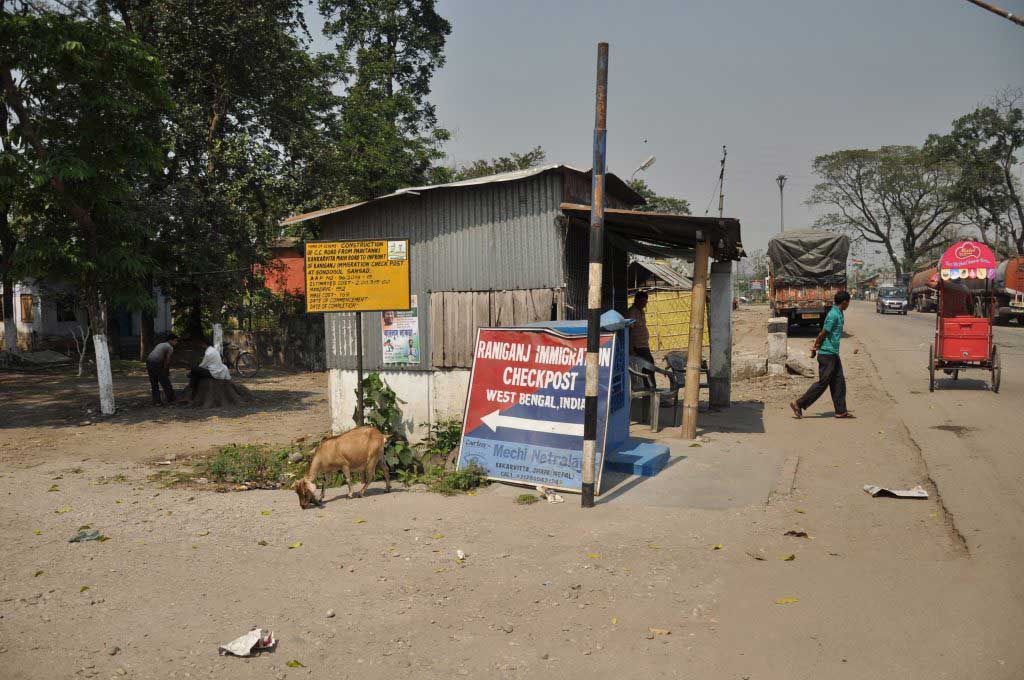
Travel & Photography
India and Nepal have several border crossings open to foreigners. The most popular although is the Sonauli (India) – Belahiya (Nepal), due to its location, more or less in the middle of the south Nepal border, and maybe the shortest route to reach Kathmandu by land. Also, the location of this border cross, between Varanasi and Kathmandu or Pokhara, make this desolated and unfriendly place a choice for those who want to travel by land.
But for those traveling in Northeast India, like Sikkim, Bengal and the so-called North-eastern states (Assam, Nagaland, Meghalaya, Arunachal Pradesh, etc…) the border Panitanki (India) – Kakarbitta (Nepal) located on the east side of Nepal is the best option. For more details about this border crossing check my posts about “Border Crossing” on Tips/Dicas de Viagem category.
The closest train station from the Sonauli – Belahiya border is Gorakhpur, with easy connection with Delhi and Varanasi. Gorakhpur is far from being a charming or appealing place, so try to arrange things in order to avoid one night there.
Just when you come out from the train station, you just need to ignore all the tuk-tuk drivers that will surround you and walk straight forward until the main road. Just on the other side, near crossroad with a statue with a guy on a horse, you’ll see a few buses stop… not a bus terminal or even a bus stand… just a few buses along the road. Try to ask the drivers about one that goes to Sonauli; usually, it stops on the right corner (if you have the trains station on your back).
The bus departure more or less every hour, or even before if it’s full. The buses run all day, starting around 6 am, until evening.
In case that you arrive late, close to evening time, is advisable to sleep in Gorakhpur, and make the trip to Sonauli next morning, as there are not many infrastructures in Sonauli, and the place itself in “not a place to stay”!!! Anyway, the Sonauli – Belahiya border is open 24 hours.
The bus from Gorakhpur to Sonauli, will take about 1.5 hours.
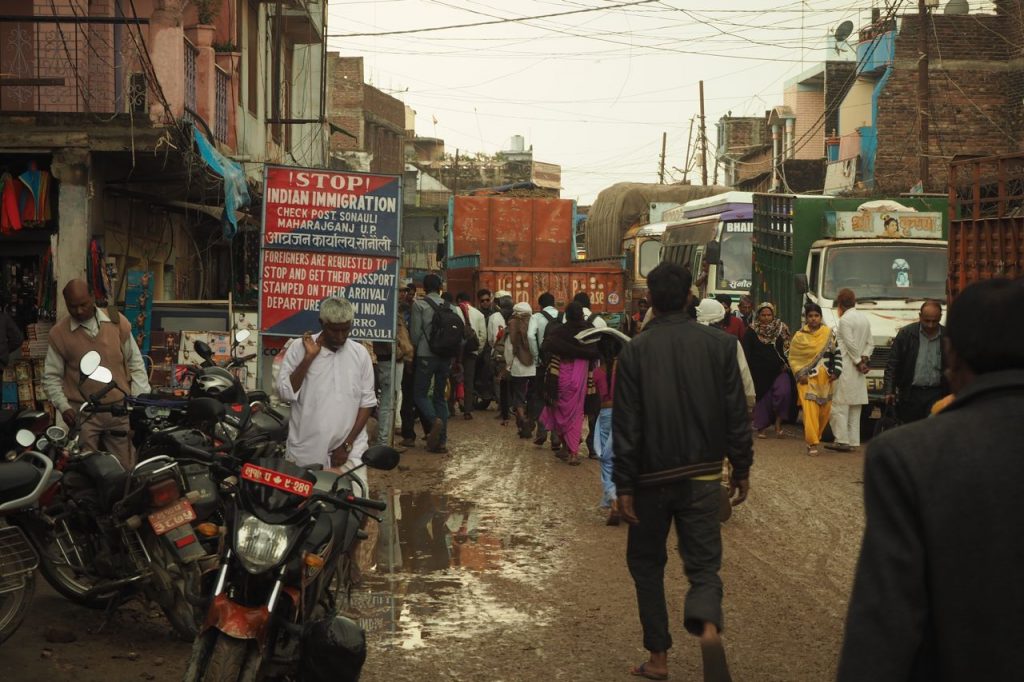
From the bus stand until the Indian Immigration Office is about 600 meters that will take around 10 minutes to walk along a dusty or muddy road (depending the weather) between trucks. Some people prefer to hire a cycle-rickshaw but it just worth if you travel with lots of luggage.
At the Indian Immigration Office you need to fill a form and give it back with your passport to the staff that usually is very friendly. The office is very small and sometimes you need to stay outside while an officer collects the passports and give them back after stamped. Always check if you have the exit stamp before leaving any country!
Don’t be surprised if you see many people crossing the border without passing by the Immigration Office, as the Nepal and Indian citizens don’t need a visa or even a passport to cross any border between India and Nepal.
After this, you keep walking along the same road and will see a big gate that represents the border India – Nepal. Is possible that an officer will ask for your passport, but sometimes they are more focus in controlling local people because of the smuggling than the tourists.
After the gate you walk a few more meters and will see, on the right side, a small house with a kind of garden where is the Nepal Immigration Office. There you need to need to fill a form, give a photo, show the passport and pay the visa fee according to the length of your stay. Usually it will not take more than 10 minutes.
You will be welcomed with a friendly smile and a proud “welcome to Nepal!”.
Nepal has Visa on Arrival, so to get your visa you need:
The Nepal visa can be (September 2016):
At the Nepal side of the border you’ll see a few exchange money shops. From my experience the rates are quite alright.
Probably some will ask if you need a bus to Pokhara or Kathmandu. This maybe is not the beast deal that you can have but save you from walking (or take a bus) to the bus terminal (also called Bhairahawa Bus Park).
From Belahiya there are also buses to Lumbini and Chitwan.
If you are planning to stay in Nepal for 2 months is better to apply for the 3 months visa. Otherwise, you pay 40$ for the first 30 days and then need to extend your visa for more 30 days… so as extending the visa will cost your 2$ a day, an extra month will be 60$… that in total is the same cost of the 90 days visa…. and you save yourself a few hours at the Immigration Office in Kathmandu or Pokhara.
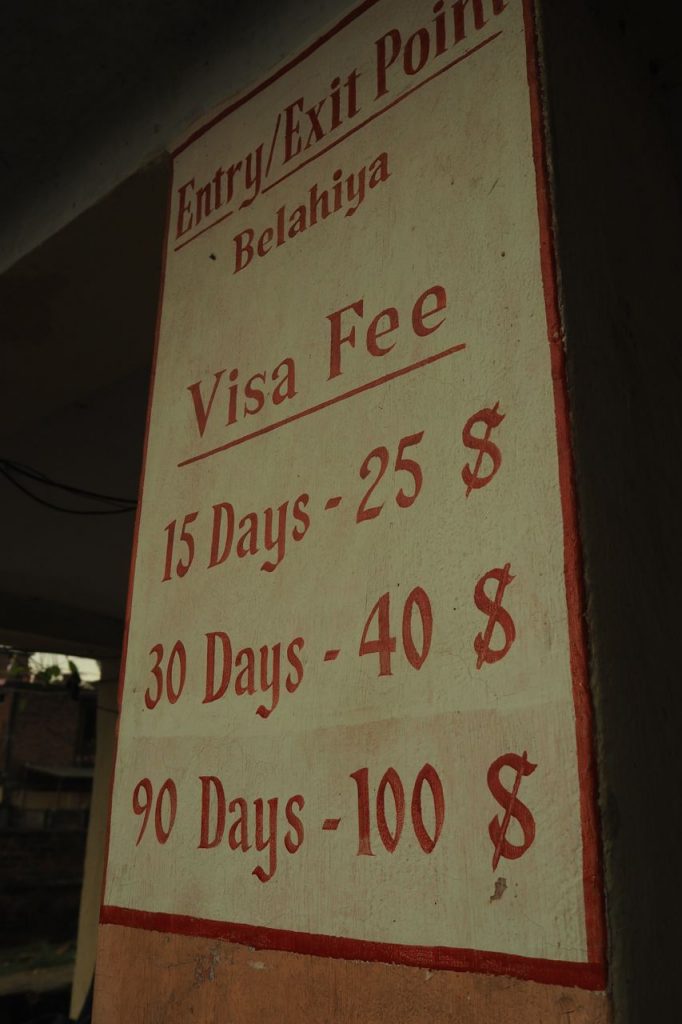
To extend you Nepal Visa, you can do it in Kathmandu or Pokhara.
In Pokhara usually there are fewer people and you can get you new stamp quickly. At Katmandu is always more busier and confuse. But in both places you find helpful staff.
Not that the maximum number of days that you can stay in Nepal is 150 a year.
Just after crossing the border you arrive at Belahiya, the first populated place that you cannot even call a village, but where you can find (after the Immigration Office), also on the right side of the road, a few travel agencies that sell bus tickets to Pokhara and Kathmandu. Usually there are always a few buses parked in a dusty/muddy ground that works like a bus terminal, called Belhiya Bus Park.
The soon you arrive more are the chances to have a bus to your destination, as most of the buses departure in the morning. Still is possible to catch a bus to Kathmandu around 2 p.m. There are also buses that departure at the end of the afternoon, but the information given by these travel agencies are not clear. But watch out: the bus trip to Kathmandu will take more than 8 hours that the ticket seller said… probably 10 hours depending on the traffic at Kathmandu, so if you arrive late to the border be prepared to arrive at Kathmandu in the evening!!!
Sometimes I felt that these private bus companies are taking advantage of people that just arrive and are not yet familiarized with the currency and prices, and I already notice that the bus ticket from Kathmandu to Belahiya is cheaper than the opposit way.
There aren’t public buses in Nepal, except a few local buses in Kathmandu. But if you want to avoid an overcharge ticket at the border (we are talking something about 200 rupees more, more or less 2$) you can walk or take a taxi to the Bhairahawa Bus Park around 7 km further along the main road and from there you have more bus companies but I couldn’t get a proper schedule of the buses to Kathmandu.
Don’t try to eat at Sonauli. It will be difficult to find an inviting place and even if you choose one dhaba (road side restaurant), possible your meal will be disturbed by may touts trying to “help” you crossing the border or changing money.
If you really need a meal is better to wait until cross the border to Nepal side (Belahiya), that has a much quieter and friendly environment. With a short walk you can see the few places available, and it can be an option for a quick meal, but if you look for something more inviting you need to take a local bus (walk by the main road until you find the Bus Terminal on your right side) and go to the nearby village Siddharthanagar (also called Bhairawa or Bahirahawa).
If you are traveling from Varanasi to Nepal, you can make the all trip by bus (there are even bus services from Varanasi to Kathmandu, that I don’t recommend) or by train. The train is the most comfortable option as it allow you to have a reasonable night of sleep and arrive at Gorakhpur early in the morning, with plenty of time to take the bus the Sonaluli-Belahiya border, and with strong chances to reach Kathmandu in the same day… but in the evening!
From Varanasi all the trains that arrive in Gorakhpur in the morning leave late in the evening, so avoid to choose a train that departure from Mugah Sarai, as this station is very far out from the city, and in the evening is not recommended for women or solo travelers. check my previous post: http://steppingoutofbabylon.com/en/2016/06/how-to-go-from-varanasi-to-mugal-sarai-train-station/
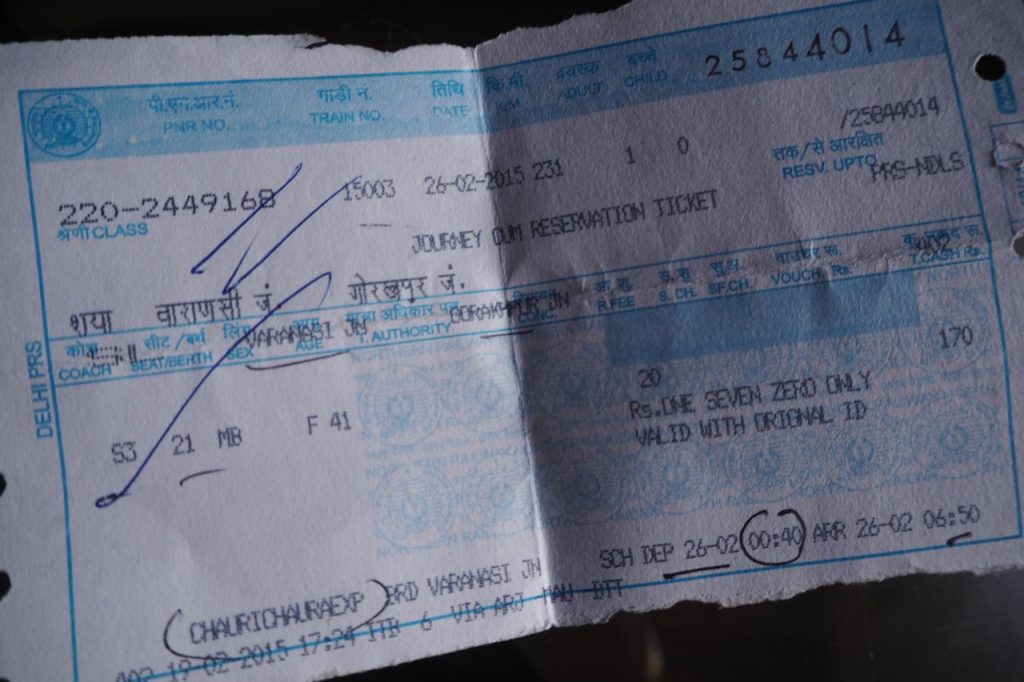
For me the best option was the night train that departure from Varanasi Junction (easily reach buy tuk-tuk even during the night, but I recommend to arranje it with the help of the guesthouse staff): Train number 15003 (Chauri Chaura Express) that departure at 00:40 and arrive to Gorakhpur (last stop) at 6.50 a.m… sometimes with a bit of delay!!!
http://steppingoutofbabylon.com/en/2016/06/how-to-go-from-varanasi-to-mugal-sarai-train-station/
India and Nepal have several border crossings open to foreigners. The most popular although is the Sonauli-Belahiya, due to it location, more or less in the middle of the south Nepal border, and maybe the shortest rout to reach Kathmandu by land. Also the location between Varanasi and Kathmandu or Pokhara, make this desolated and unfriendly place a choice for those how want to travel by land. For more details about Sonauli-Belahiya border crossing check my previous posts. http://steppingoutofbabylon.com/en/2016/09/how-to-cross-the-border-sunauli-belahiya-india-nepal/
But for those traveling in north east India, like Sikkim, Bengal and the so-called North-eastern states (Assam, Nagaland, Megahlaya, Arunachal Pradesh, etc…) the border Panitanki (India) – Kakarbhitta (Nepal) located on the east side of Nepal is the best option.
Being less popular is far more pleasant the Sonauli-Belahiya, but if you destination is Kathmandu you have to face a 16 hours bus trip.
The Panitanki – Kakarbhitta border is open 24 hours on the India side, and from the Nepal side from 6 am to 7 pm.
(Aug 2017 update: the border is open 24 hours on the Nepali side. The gates are open from 6 a.m. to 10 p.m.)
(Feb 2019 update: the border is open until 10 p.m on both sides)
At Panitanki just ask to local people “Nepal” and everyone knows where the border is. From here you can walk until Indian Immigration Office. Not more than 10 minutes walking. The road as asphalt but you must do your walk with truck passing close to you. So if you prefer avoid some sweat and dust you can arrange the entire trip until Nepali side with one of the many cycle rickshaws.
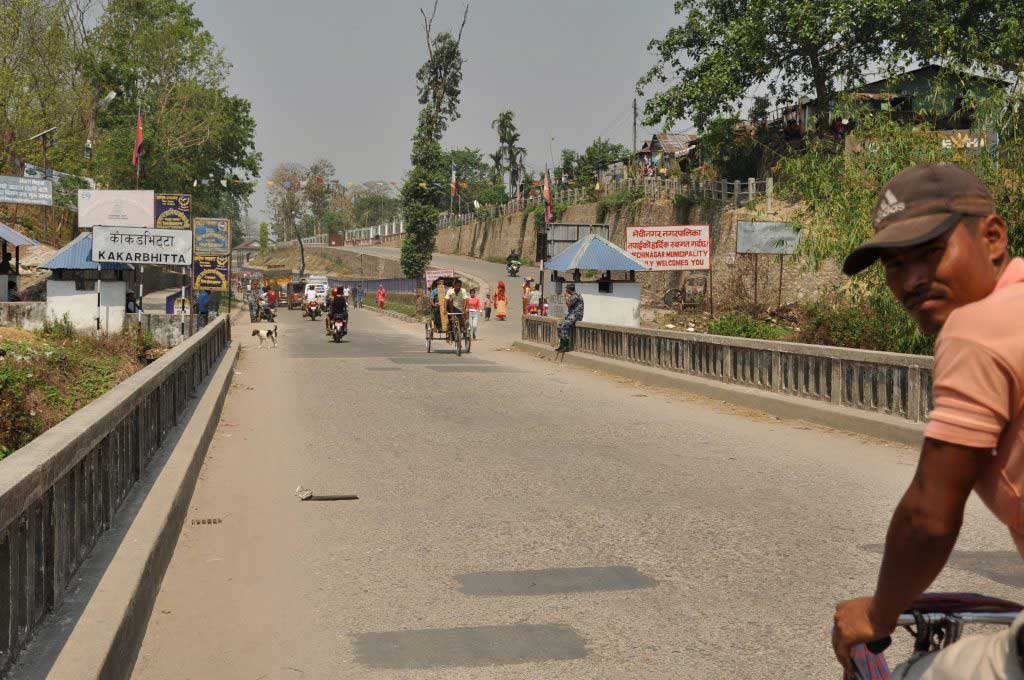
The Panitanki – Kakarbhitta border is marked by a river, and the bridge connection the two sides is a kind of “no mans land”. The Indian Immigration Office is a few meters before the bridge, in a small alley on your left side. Anyway if you miss it, the guards near the gate will call you and show you the way.
At the Indian Immigration Office, you show your passport and in less than 2 minutes you have your exit stamp.
From here you need to cross the bridge. I have made it on foot, and I was not the only one, but if your luggage is heavy or if you are caring many items maybe is better to hire a rickshaws. Anyway walking you have more time to enjoy the view of the river and surroundings that with the heat of April are almost dry, but that after the monsoon rain must offer a pleasant view. The walk make me sweat and regret not had taken a rickshaw, but at the same time offer me lots of smiles from the local people and children waving… not many foreigners cross this point, and even less do it on foot. And above all, crossing a border on foot has always a special meaning… a kind of symbolic entrance in a country… not with the easiness and apparatus of the airports but with a humbleness necessary to a traveler.


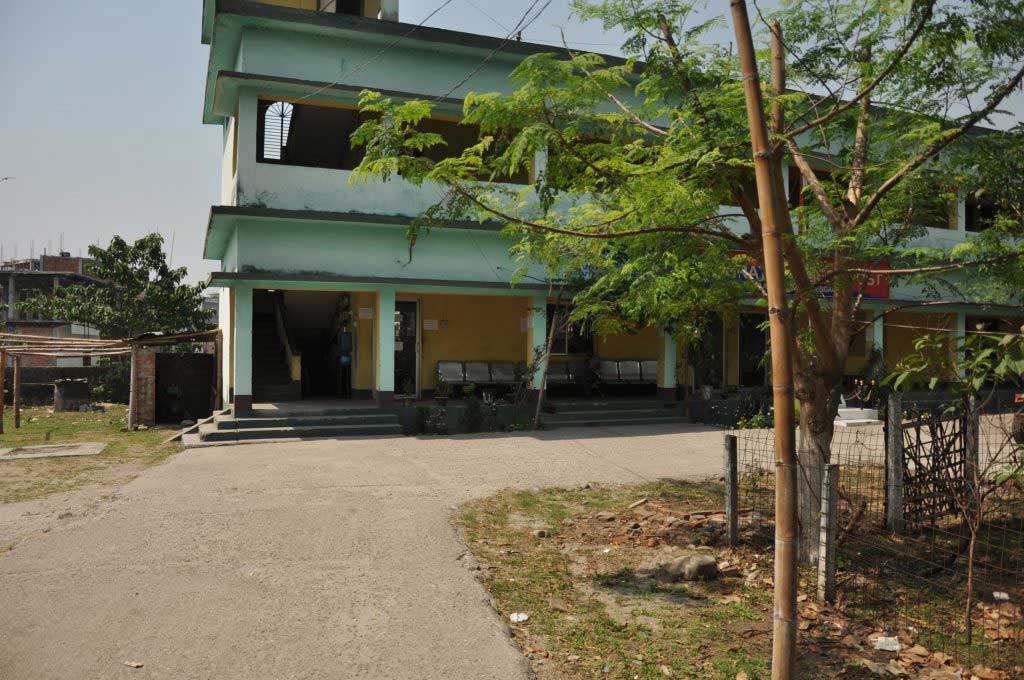
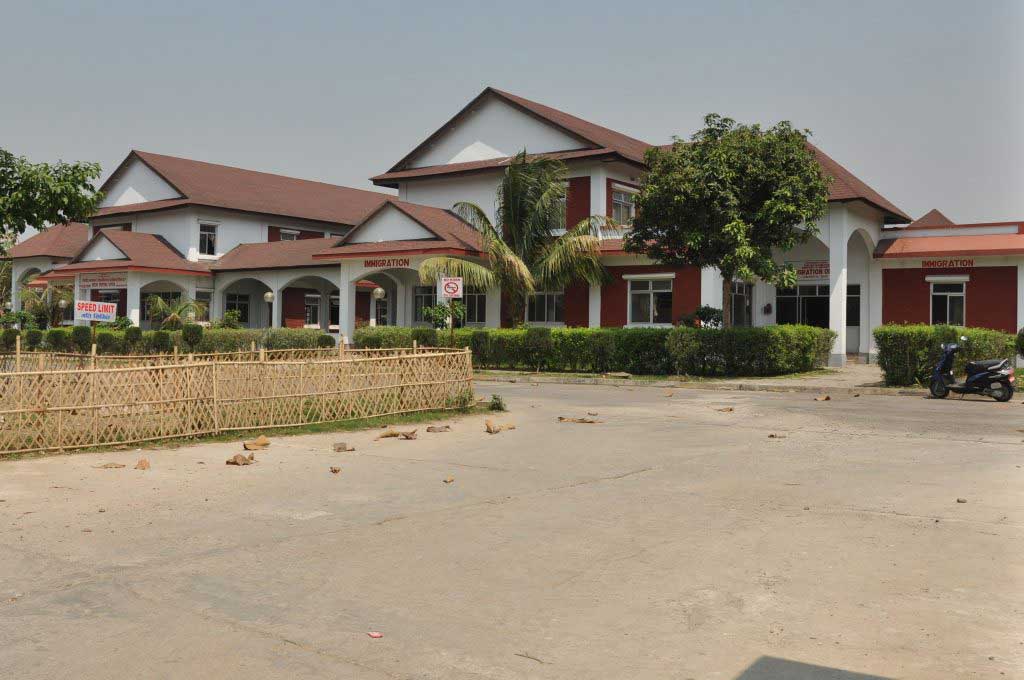
After crossing the bridge you are at Nepal, more properly Kakarbitta. Walking a few meters more you’ll on the right side a ramp that lead you to a gate. Behind the gate is the building of the Nepali Immigration Office. As the both Nepali and Indian don’t need immigration formalities to cross the border, this office is almost empty all day. Nepal has Visa on Arrival, so to get your visa you need:
The Nepal visa can be (April 2016):
The staff at the Nepal Immigration office is very nice and provides a lot of information, especially about schedules and prices for the different kinds of buses. With the help of Nepali officers I could easily avoid touts that always come to try to push you to one of their buses. They are annoying but not persistent.
After have your stamp in the passport, that will take about 5 minutes, you just walk right until you cross a big gate that symbolically mark the entrance in Nepal.

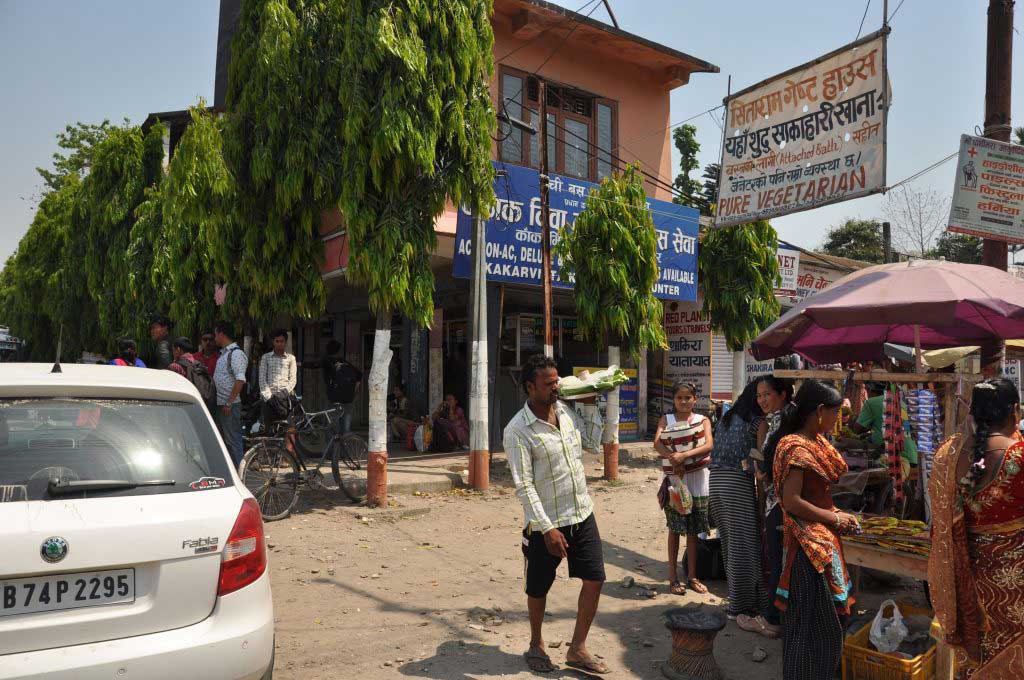
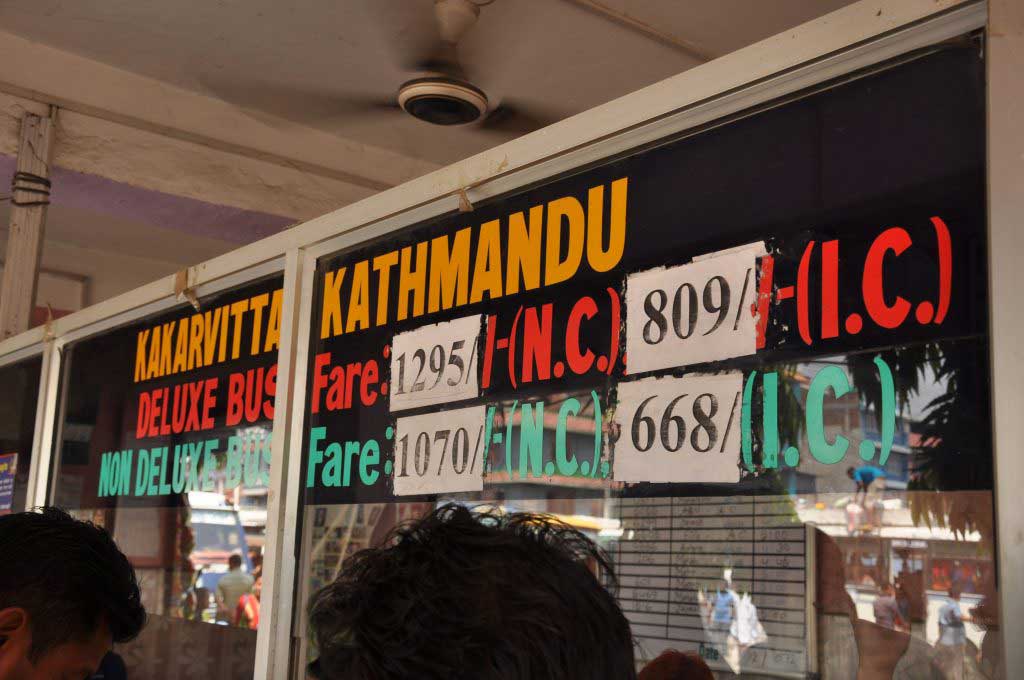
From here you walk a few meters and on your start to see a few shops, keep walking until a corner, where bus tickets are sold. There are several shops, but in this one you are dealing directly with the bus company and avoid extra fees from intermediaries and travel agencies. The shop is open to the street, with the counter surrender by windows. The prices are clearly written on the window. The bus terminal is just in front.
From Kakarbitta there are direct buses to the main nepali cities: Kathmandu, Jonakpur, Biratnagar, Itahari, etc…
Probably you’ll arrive to Panitanki coming from Sikkim, Darjeeling, Siliguri or New Jalpaiguri.
Siliguri is the closest train station from the Nepali border, but most of the trains stop at is New Jalpaiguri also known as NJP, a more important station. Just in front of New Jalpaiguri train station, you’ll see a few nice blue buses parked that go to Siliguri. From there you need another bus to Panitanki. To avoid this bus transfer you must walk a bit further, to the end of the train station car park, until find a bus, not so nice and modern as the other ones, but that goes direct to Panitanki; it takes about 1 hour to make around 35 km, but it stop many times, including Siliguri. If you arrive during the day, there’s no reason to stop in Siliguri, but is never a good option crossing the border during the night.
Bus ticket New Jalpaiguri (NJP) to Panitanki: 20 INR (Indian rupees) (about 1 hour)

As there is no railway service in Nepal just remains two options to reach Kathmandu: by plane or by bus.
The plane far from be the best option is terms of time and comfort is out of a backpacker budget, as also out of the spirit of traveling… so the bus remain as the only reasonable option.
There are good bus connections between Kakarbitta (also referred as Kakarvitta) and the capital, with a/c buses depart early in the morning: 4 am, 5 am, 6 am and 7 am, and in the afternoon: 3 pm, 4 pm and 5 pm. Officially the trip is 12 hours… but it took 16 hours, with the last two hours already in the traffic jam of Kathmandu suburbs.
The evening buses arrive to Kathmandu more or less all at the same time, despite the time of the departure, as later the bus departure, les traffic find on the way.
Despite de 16 hours bus journey, the trip is not so hard as imagined, as about 2/3 of the trip is made on the Terai, the flat area in south of Nepal. The last part is the hardest one with the road going up to the mountain, with quiet some curves and bumps that hardly allow you to sleep.
Is strongly advisable to take air-condition bus (a/c bus) not just because of the heat from the south of Nepal during almost all the year, but also because of the dust and the noise. The a/c with the windows locked provides a more pleasant and relax trip… it worth to pay some extra rupies more.
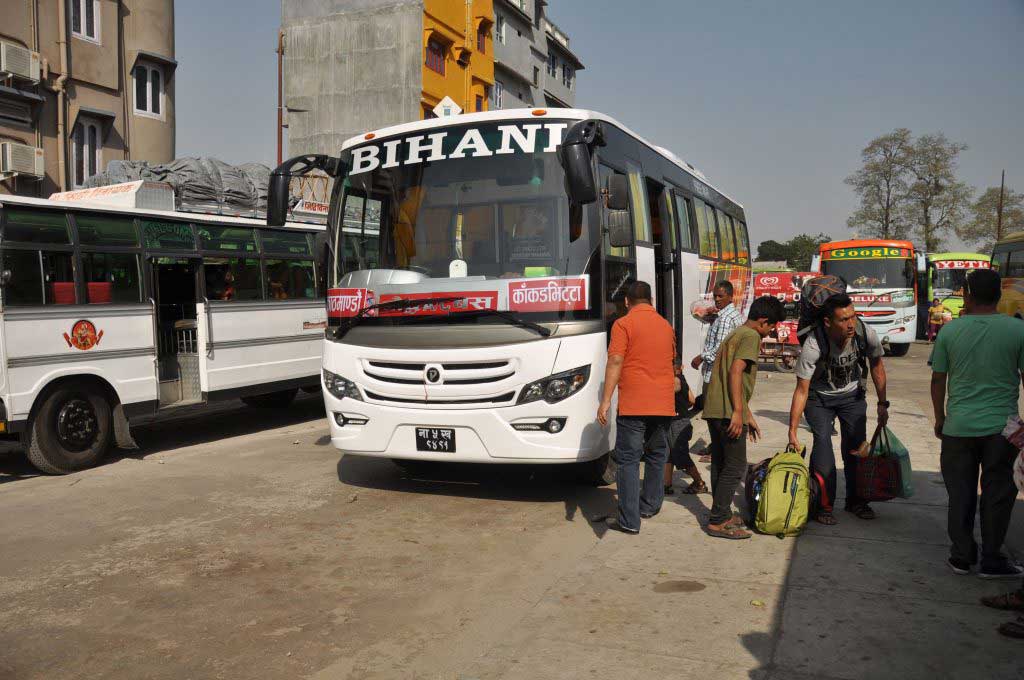
The best buses are from the BIHANI company. Called a/c Delux, are modern, almost new and quiet comfortable, spacious, and the reclining seats, have a support for the legs that provide a almost horizontal position… not a sleeping bus but very confortable. Still your sleep could be disturbed by the music and the movie show on the screen… a kind of Nepali version of Bollywood. The bus stop a coupe of times for food.
ticket fares from Kakarbitta to Kathmandu:
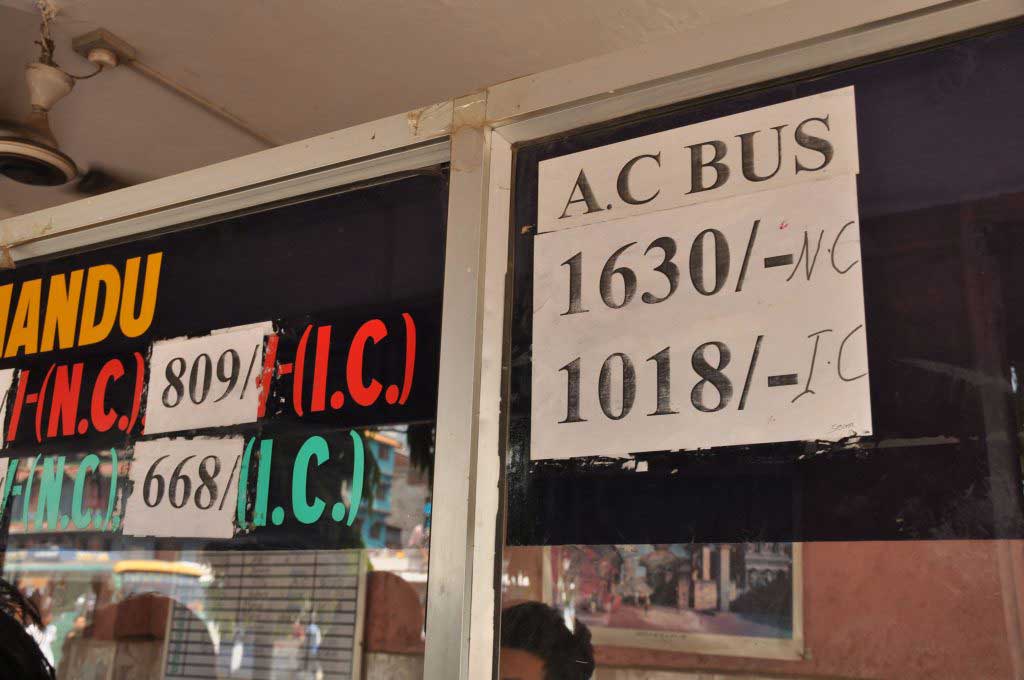
From my experience at Neapli roads I must say that there are no pleasant or easy bus trips in Nepal. Or is too hot, like almost all the year along the Terai, or at mountain the winding roads, or the drivers are crazy, or there are many stops, or the bus is too crowded, or the road is too dusty, or if it’s raining too muddy. Even the super-delux bus is most of the times old, uncomfortable, dirty and even with broken seat.
This trip from Kakarbitta to Kathmandu, on a a/c bus was far the most pleasant trip that I have ever made in Nepal.

As an alternative to these night buses there are mini-vans that take just 11 hours and reach Kathmandu around 5 p.m., very convenient as you can make the trip during the day and arrive in Kathmandu before the sunset. This vans make a kind of short cut, passing through Sindhuli, Dhulikhel and Bhaktapur, before reaching the capital.
Departure time is around 5 a.m.
In the image below you can find the contact of this vans, locally identify as “Hiace”, to get more details about the ticket price and from where they departure.

At Kakarbitta after having my precious bus ticket was time to relax and have some food.
Kakarbitta is far from be attractive town, but nor sob ad from what we are used to expect form a border town. Is quiet, cross by a main road, dusty but that doesn’t have that much traffic. Around the bus terminal, basically the center of all activity at Kakarbita, there are a few shop, restaurants and few fruit stalls.
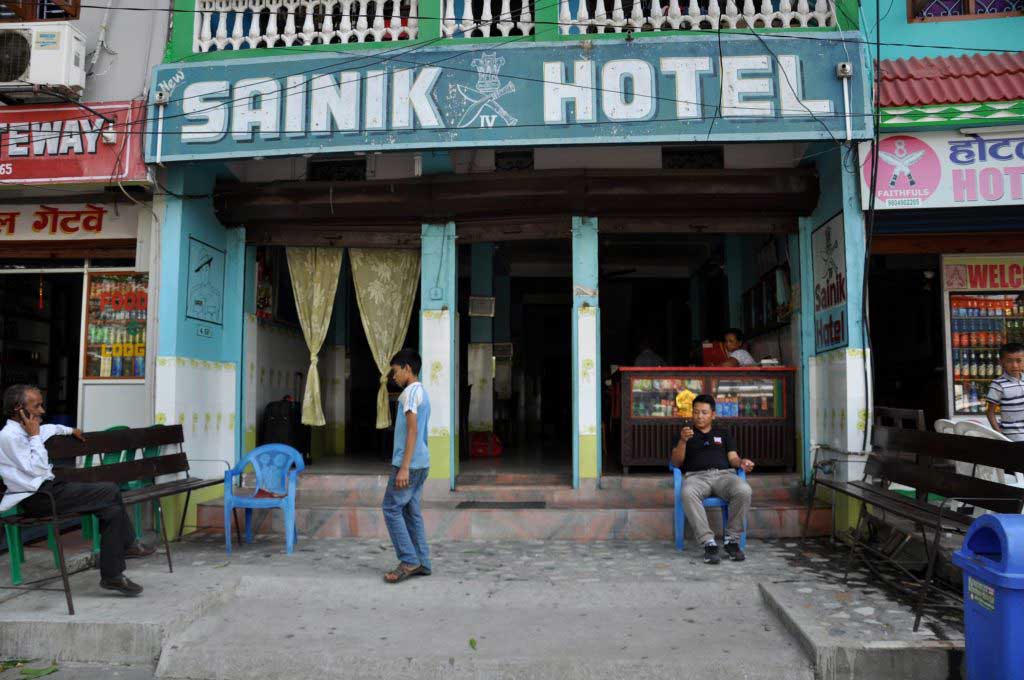
On the opposite side of the terminal, that is quieter, line up a few restaurants, also called hotel, with some also with lodging. The choice was for the Sainik Hotel, clean and spacious. The kana (local meal based on rice, dhal, curry, vegetables and pickle) was delicious and served at the traditional brass plate. The meal with two chai was 80 rupees (NPR) with refill. Strongly recommend.
Beyond the food Sainik Hotel also provide nice conditions to wait about 4 hours for my bus: quiet and with smiley and friendly staff.

To all the attractions that southern India has, in particular the state of Tamil Nadu, we must add the food, which here presents a greater diversity of vegetables and spices, resulting in a wide variety of flavors, colors, and aromas, dominated by spicy, served on banana leaves and accompanied with the ubiquitous cooked rice, which in the south replaces the chapatis that in the north always accompany them with meals. What is also never missing are papadis, a thin sheet of grain pasta seasoned with spices and which is fried and crispy.
For breakfast, dosas are served, a kind of very thin and crispy crepe, made with rice and lentil flour, stuffed with vegetables (almost always potatoes) and served with a fresh and spicy coconut chutney, and with the sambar, a light vegetable curry, where the dosa is soaked.
This combination of sambar and chutney can also accompany iddlys, unfermented bread made from lentil flour, which is steamed, or wadas (or vadas), rings of pasta made with lentil flour, flavored with spices and fried in oil.
But the new was pongal, a paste made from overcooked rice, seasoned with cumin, mustard seeds, pieces of fresh ginger and cashews, all wrapped in ghee and cooked with many leaves of rail. Like other breakfast alternatives, pongal is also served with coconut chutney and sambar or another vegetable curry..
The curry tree leaf, which is used here fresh, appears in almost all dishes served in traditional meals, thalis, consisting of rice and a set of three or more side dishes. Many of the meals include the so-called buttermilk, which is a kind of milk, waterier and slightly fermented that gives it a slightly acidic flavour and is served lightly seasoned with salt..
But more often than buttermilk, it is yoghurt that is mixed with rice and the other side dishes that make up a typical South Indian meal.
In traditional southern dishes, coconut, a flower and the banana tree trunk are often used. The panner (fresh non-melting soft cheese made by curdling milk) that was a constant in the north of India, here in the south has a very discreet presence, away from the Muslim areas.
As for the bread… no naans, no chappati or rotis… here are parathas (here pronounced parotta), made of very elastic dough that is spread with the help of oil, beating the dough on the counter until it is thin and starting to tear, when it occurs a knot tying the ends so that after resting it is extended again with a rustic hand and cooked on a plate, often heated with firewood; they are cute and separate into layers… and of course they accompany with a vegetable curry, usually served in the afternoon, as a snack, but never as a side dish of a meal.
The dahl, stewed with lentils, which is served here in the south, thick and consistent, does not compare with what is usually found in the north of the country: very liquid, more like a soup.
The ever-present chai is drunk at any time throughout India, both after meals and as an accompaniment, also serving as an excuse to take a short break during the workday. In Tamil Nadu, chai is often replaced by coffee, which is also sweetened and drunk with milk, served in metal cups, which in turn come in a cylindrical cup, also made of metal; before serving the coffee is poured from one container to another, several times, before being drunk.
Also in the south, with the characteristic tropical climate, there is a greater variety of vegetables. In addition to the potatoes, carrots and herbs, which are ubiquitous in Indian curries, here is common the use of green leafy vegetables, kelas (a kind of nutty cucumber with an intensely bitter taste but which is quite beneficial for purifying the blood), drumstick (or moringa), coconut (the fruit as also the “milk” and oil), banana (trunk and flower also) and jackfruit, as also a wide variety of legumes that often I cannot identify.
As for fruit, mangoes and bananas dominate, which come in many varieties, not only on the outside but also in flavour. Coconut is also sold everywhere, and its pulp is eaten, with the help of a sliver of coconut skin, cut with a machete, after drinking the liquid from the inside.


For me, South Indian food, especially in the state of Tamil Nadu, is one of the best in the whole country, with only the food of the state of Gujarat as its rival, with a wide variety of flavours and ingredients, intense, spicy and with a certain tropical exoticism, making it simple and unpretentious. All of this makes a meal a delicious experience for the senses.
South India is a vegetarian paradise, with “pure veg” restaurants as well as street food without animal products. However, dairy products are present in both chai and yoghurt, which is often part of thali.
Each visit to Chennai, commonly called Madras, is a delight for the palate, with many options to explore the gastronomic specialities of southern India, from sophisticated restaurants to simple dining halls, not to mention street food !!
South Indian food…. what a delicious memory !!!
https://goo.gl/maps/dzkrWv3MaH92

https://steppingoutofbabylon.com/wp/en/2016/06/how-to-go-from-varanasi-to-mugal-sarai-train-station/
https://steppingoutofbabylon.com/wp/pt/2013/04/india-comboios/
(English version from the text posted in Jun/2014)
308 kilometers and 11 hours of bus separate these two villages near the border with the so-called Autonomous Region of Tibet: Shangri-la, in the Yunnan Province, and Dao Cheng in Sichuan Province.
Although since the mid-eighteenth century Tibet was under the administration of the Emperor of China, it was only in 1950, when occupied by the People’s Liberation Army, that it became part of China, with the majority of its territory on Autonomous Region of Tibet. The remaining area was then divided by the nearby provinces of Qinghai, Gansu, Sichuan and Yunnan.
Given the difficulty of traveling in the Tibet Autonomous Region, which requires specific authorization and obliges to travel in groups, which inevitably push foreigners to travel agencies, that increase significantly the cost of the trip, it gets too expensive to visit Tibet for a backpacker budget. The best option for those who want to know what remains of Tibetan culture and to enjoy the remarkable landscapes of the Tibetan plateau is to visit the villages located nearby the Autonomous Region of Tibet border, where the easiest access is made by the provinces of Sichuan and Yunnan.
Alternatively, the region of Ladakh, in the far north of India, is also another way to get close to Tibet. In Kathmandu, Nepal, and in the state of Himachal Pradesh in northern India, it is possible to have contact with this culture due to the presence of a large number of Tibetan refugees, including the Dalai Lama in Dharamsala district, precisely at McLeod Ganj village.
The bus ride, in spite of the poor road conditions, where part of the beaten path, crossing the mountain chain of Meili Xue Shan, also called Mainri Snow Mountains, climbing high passages and descending to the valleys to cross rivers, with the road winding up the steep slopes, offers breathtaking landscapes.
On the way out of Shangri-la, the landscape is dominated by the green of the pines covering almost every slope of the mountains, except for the highest peaks where the rigor of winter still leaves traces of snow covering these landscapes. In the valleys run streams and rivers whose low level of water reveals a rug formed by stones, rounded by the passages of the icy waters.
Leaving behind small settlements surrounded by modest agricultural fields, arranged along the fertile banks of water lines, where yaks and wild horses graze, we start to go up the steep slopes. Increasingly the landscape gets more desert, with the human presence disappearing almost completely. The abrupt gray cliffs seem to touch the white of the clouds that decorate the blue sky.
The settlements lying along the road, which are no more than a few houses scattered along the road, feature a characteristic Tibetan architecture, with buildings consisting of three thick stone walls forming a rectangle, within which are built With aid of robust wooden trunks the habitation, almost always of two floors; Whose main facade is entirely wood; The doors and windows are framed by elaborate and colorful designs painted in wood carved in intricate geometric shapes that stand out in the white of the walls.
As you enter Sichuan Province, the houses acquire other characteristics, the outer walls being entirely built of stone, with the door and window decorations giving way to a black trapeze frame, making these dwellings more solid and Dark, feeling enhanced by the gray stone walls that at cost stand out from the dry, dusty landscape.
Crossing the highest points, and moving North, the landscape grows more and more arid, with the forest giving way to sandy and rocky slopes of gray and brownish colors, giving the landscape a wild and inhospitable tone… the typical Tibetan plateau landscape!


Note: photos taken from inside the bus
Get the Thai visa in Kathmandu is easy and without big issues!
But you can probably get a visa on arrival for 30 days if you arrive by plane, or 15 days if you arrive by land, totally for free.
The process takes 2 working days, but watch out that during the high season (September and October) it can take up to 5 days. Also check the holiday calendar, as the Thai embassy close during Thai holidays as also the Nepali holidays, and can be closed for several days in a raw like during the Dashain and Tihar festivals. http://www.thaiembnepal.org.np/?do=embassy&index=holidays&lang=en
To apply for a tourist visa (60 days that you can extend for more 30 days during your stay in Thailand in one of the many immigration offices along the country) you need:
You need 3 of these forms, filled with your information and also with an address of the place you gonna stay in Thailand… just put an address of a hotel or guest house that you find on the internet… you’ll also gonna need it to fill the immigration card on arriving at the airport or any land border. http://www.thaiembnepal.org.np/?do=services&index=visa&lang=en
Tourist visa costs: 35.000 rupees. Single entry.

to submit application: 09:30 – 12:00
to collect the passport: 14:00 – 16:00
The visa section is open from Monday to Friday (the Thai embassy don’t follow the Nepali weekend: Friday and Saturday).

To save from being too long on the line, because there are some guys from travel agencies that arrive with a pile of passports, is better to arrive a bit earlier. I arrive 30 minutes before the opening and I was the first one… but just for a few minutes.
All the process took me one hour including the bank stuff!
If by any reason you cannot pick the passport by yourself, anyone can do it for you as far as it has the recipe, but that person will need to show identification, passport or ID card.

Basbari Road, Maharajgunj 167/4 ward 3
http://www.thaiembnepal.org.np/?lang=en
The easiest way is by taxi, and you can even ask the guy to drive you to the bank and then back… but it can be expensive!
The other was is to pick a tempo, a shared tuk-tuk. The tempos start from Sundara/New Road. The one that goes along Basbari Road is the number 5; sometimes the tempos are identified with nepali numbers… or sometimes are not even identified with nothing, but just ask for “Basbari” and someone will point you a white and green ruined three well vehicle.
At Basbari road you can ask to the tempo driver to drop you close to Thai embassy, that probably the driver knows. From the main road is less that 500 meters until you find the gate.
The tempo takes 20 to 30 minutes to reach Basbari, and the ticket cost 15 to 20 rupees. This vehicles a bit uncomfortable so if possible try to get the front seat…

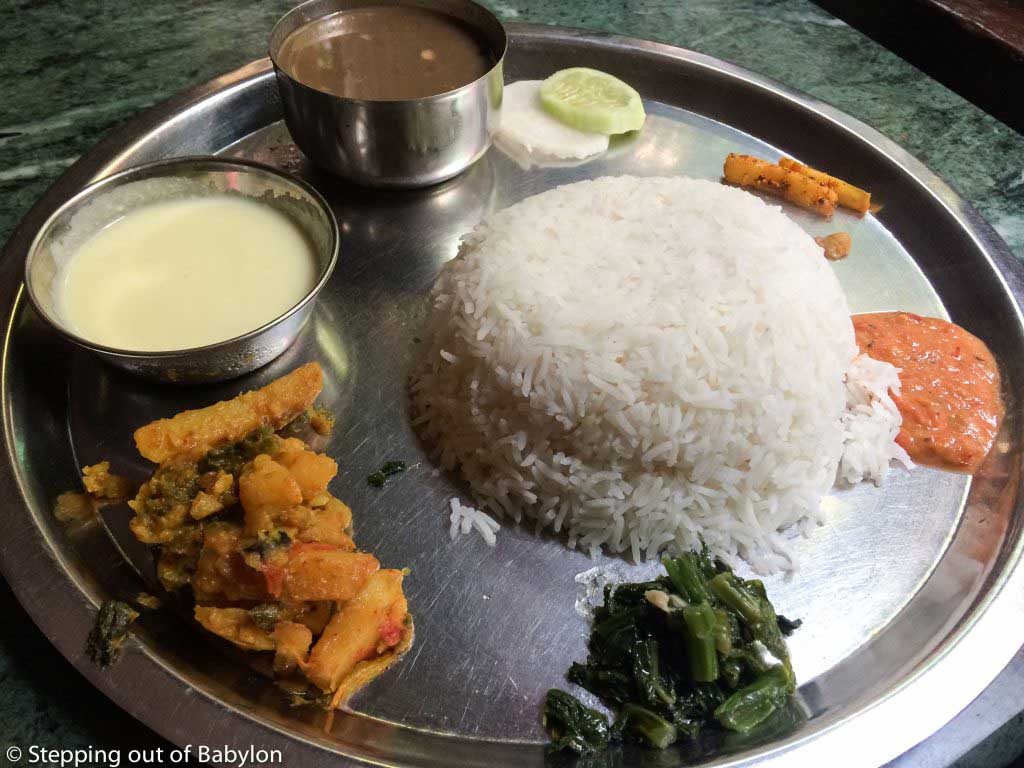
Dal bhat, same as rice and lentils… this is maybe the most famous and eaten Nepali dish, being the staple food of most of the population. The dal bhat, in Nepal also called “khana” is a meal that includes a dal (lentils soup), a vegetable curry (tarkari), saag (stir fry green leaf vegetable). Radish pickle, gundruk, yogurt and hot tomato sauce are added to this dish that is always eaten with steamed rice… a lot of rice!!
Is basically a vegetarian meal but it can also be served with meat, mostly chicken… and at Nepal the consumption of meat is quite common.
It can be eaten as breakfast or as also lunch, and in restaurants is served along all day… but most have home made dal bhat! Usually, you can find dal bhat in restaurants just after 10 am.
Being Nepal a country with so many different cultures, topography, climates, traditions, also the dal baht reflect this diversity. The rice dominates most of the country cuisine, but very high in the mountains the rice is replaced by corn or maize, buckwheat, barley or millet.
Thakali is an ethnic group as also a region located in the farthest northeast of Nepal, close to the Tibetan border, at the high Himalaya. From this remote area comes the most popular version of dal bhat. The restaurants in Kathmandu from this kind of cuisine – thakali bhanchha – serve usually the dal bhat with rice and not with another kind of grains, as usual in the high mountain areas, but are a good option to try this speciality.
In Nepal, the dal bhat is served in a heavy brass plate, with the rice at the center with the curry, saag, salad and seasonings arranged around and with the dal in a small bowl, sometimes also in brass metal. In the non-vegetarian option, the meat is served also in a small bowl, and never in big portions.
***
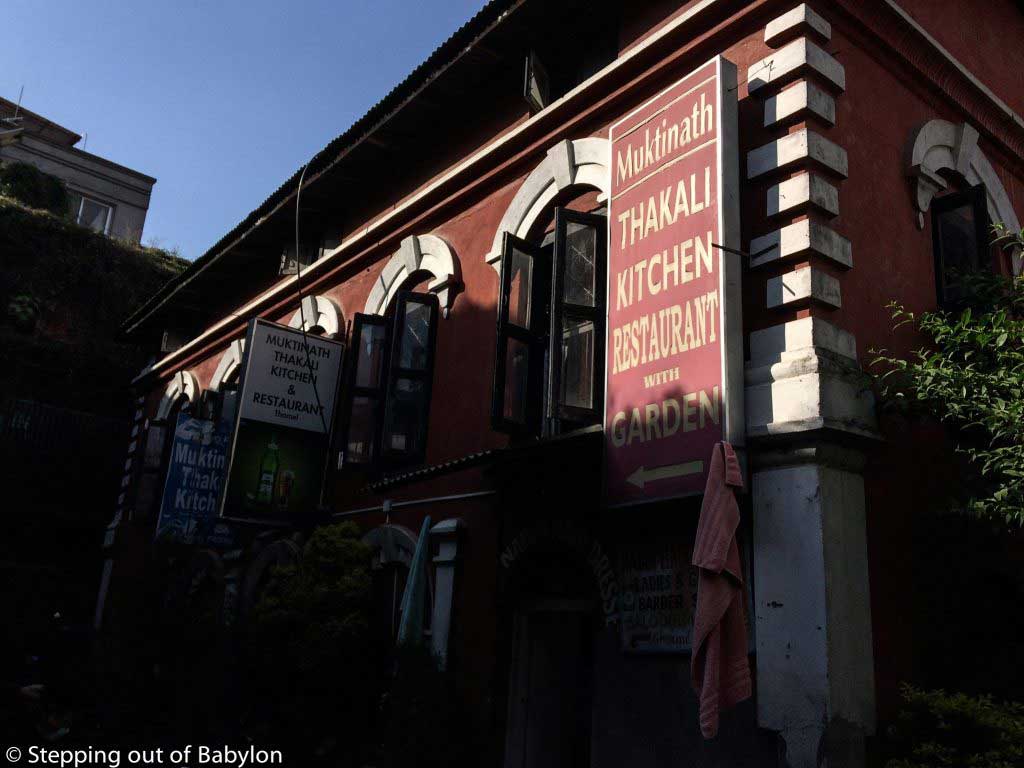
One of my favourites restaurantes in Kathmandu to eat dal bhat is the Muktinath Thakali Kitchen right in the heart of Thamel, but not so visible and easy to find. Is famous between tourists but also very popular among Nepali people that assure the quality of the food!
Here the dal bhat is served with rice, which is not traditional in the Thakali region, but undoubtedly the rice is the most popular cereal in Nepal, and the Nepali can eat a lot of it at each meal 🙂
The dal bhat at Muktinath Restaurant is very rich, served according to the tradition: rice, curry, dal, saag, pickle, salad (just cucumber), spicy sauce… and a with a papad (crispy chips, made from dal and fry in oil). The curry is very tasty, usually not spicy, the dal has the touch of the ghee, and a good quality of rice, with a long grain… and this all cost 200 rupees (vegetarian option) and the staff is super friendly.
This dal bhat is served also yogurt and the gundruk, that for me is one of the main reasons to visit this place, as the gundruk, being a typical homemade season, but not so easy to find in restaurants.

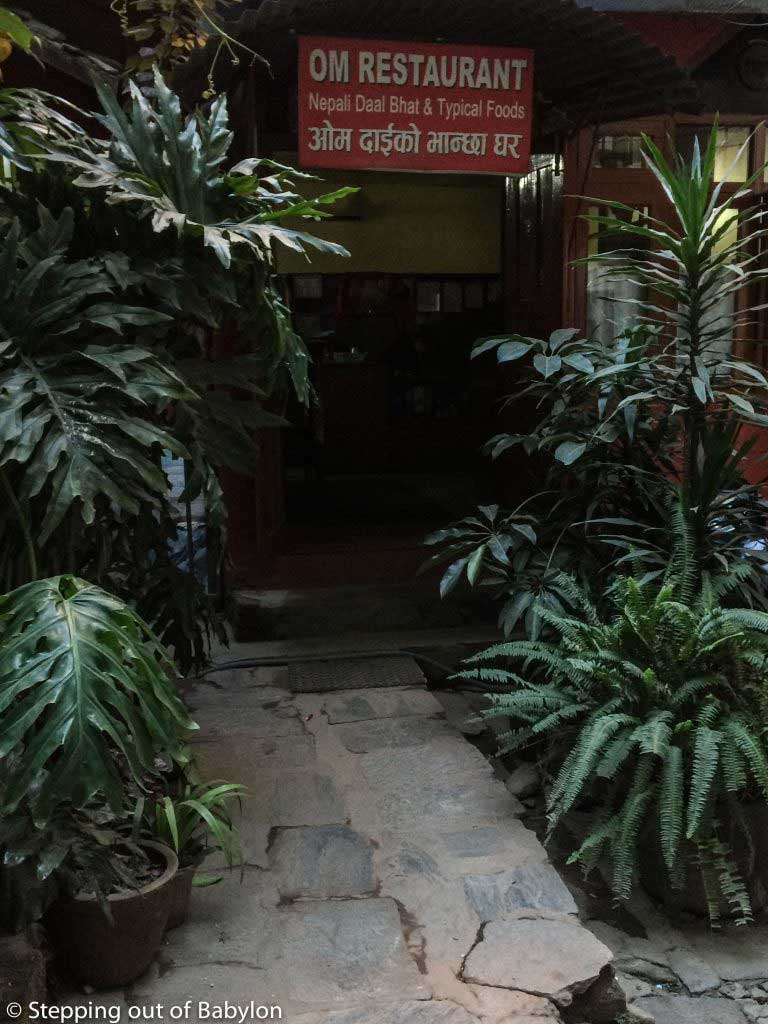
For a more local-underground-cheap version of dal bhat I strongly recommend the Om Restaurant also called as Om Bhava, located in s hidden backstreet of Thamel. The Dal Bhat at Om Bahava is not so rich as the one from Muktinath Kitchen as it comes without the papad and gundruk, but it worth to go there to taste the yummy taste of a homemade dal bhat that makes us forget that we are at a restaurant!
The place is simple and humble, the owner is super friendly smiley Nepali, never saying no to another refill of this amazing food! The price is also good: 130 rupees for the vegetarian option and 200 rupees for the one with chicken.
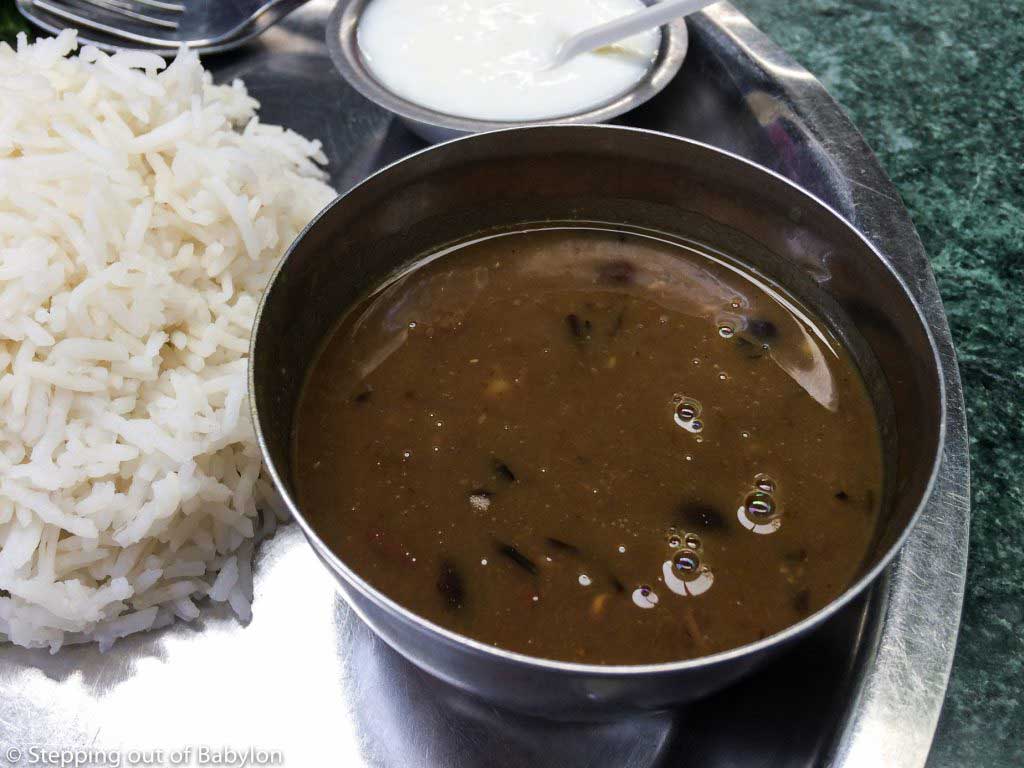
Dal
After rice, this is the core of a Nepali meal! The dal is basically a soup made with lentils, any kind of lentils seasoned with coriander, cumin and turmeric…. and a bit of fresh ginger that give a special flavor Sometimes, as the dal in Nepal is expensive, potatoes are added to this soup, make it thicker.
A spoon of ghee (clarified butter), if added, gives a special touch to this simple dish.
From the big variety of dal, my favorite one in the black dal, in Nepal called “maas ko dal”, from where results a thick and textured soup, where this small beans almost disappear due to the overcooking in a pressure pan. A bit of ginger always give a twist to this soup, bringing a sharpness to the taste.
Gundruk
This is a classic side dish that is served with the dal bhat… unfortunately many places forget this detail that is fundamental for me!!!
The Gundruk is prepared with fermented leafs of spinach, radish or mustard, that are later dried and storage. For serving the dry leafs are soaked in water and fry in a pan with onion, tomato, turmeric, salt and chili, resulting in a mix of acid and spicy flavor.
Due to the fermentation process gundruk is an important font of minerals.
Difficult or almost impossible to find in the market or shops as this is a homemade treat, but at least the dry leafs could be found in the street markets of Kathmandu.

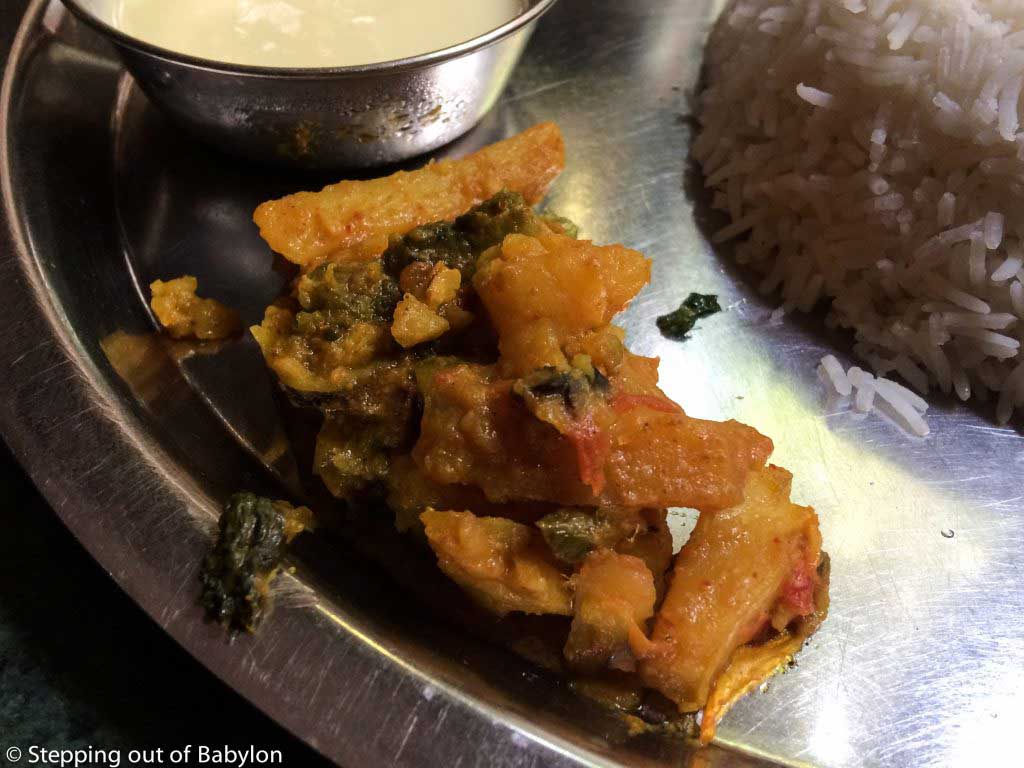
Tarkari
The tarkari is a stew made from different types of vegetables, changing according to the season, but where the potato is almost always present. Coriander, cumin and turmeric are used to season, where is common the presence of onion and garlic.
There’s a huge variety of vegetables available in the market at Kathmandu, some of them totally unknown from the western eyes, but other, like carrot, cauliflower, potato, pumpkin, aubergine, zucchini are quite frequent. Mushrooms coming from the mountains are also used but is a treat reserved for a specific season. Despite all this variety in the tarkari doesn’t have more than two kinds of it, and potato is often one of them.
Changing according to season and from place to place, the tarkari could be a bit spicy, but is never oily or heavy.
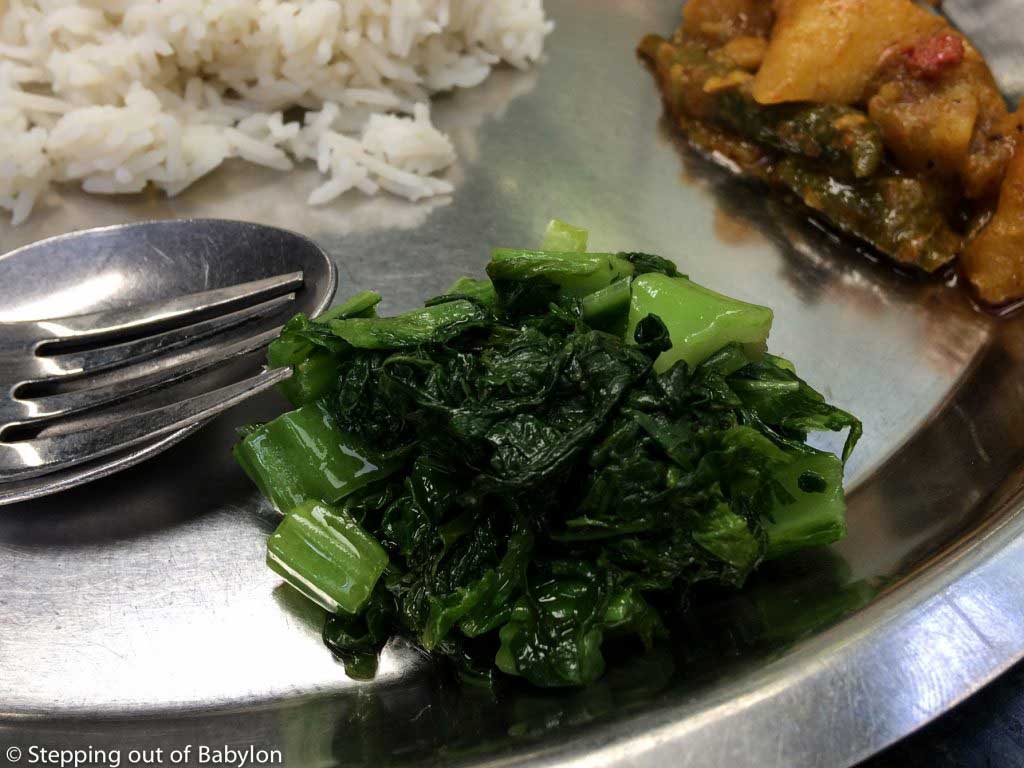
Saag, stir fry spinach leafs, mustard leafs, radish leafs or another kind of green leaf vegetables
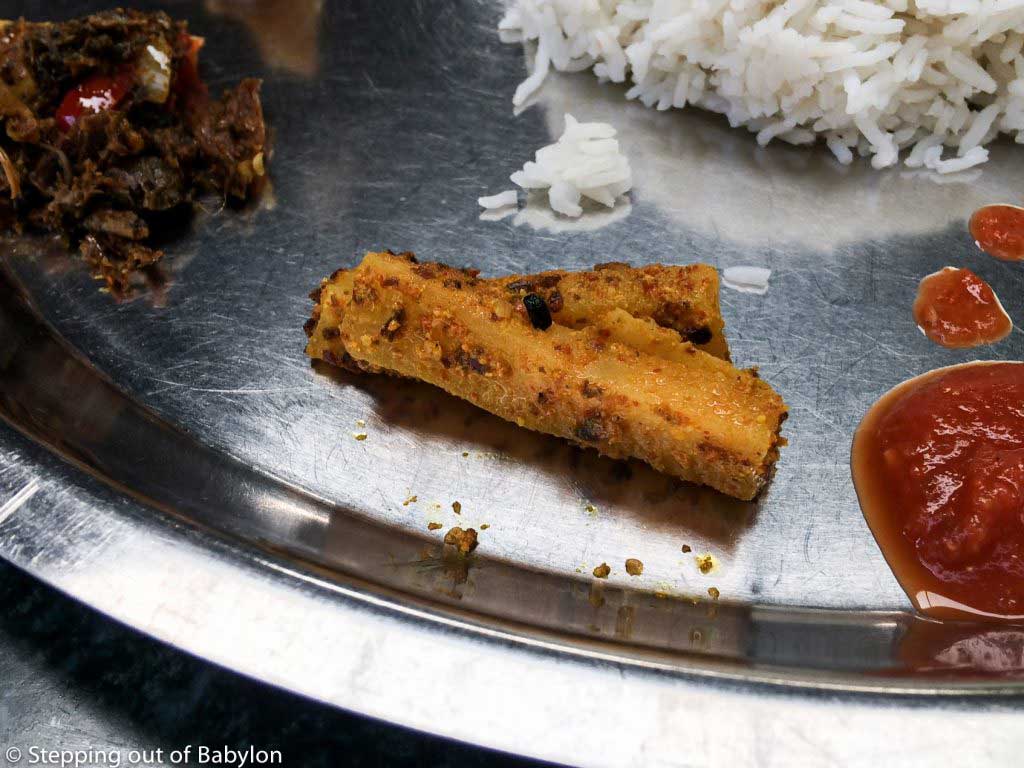
Radish pickle, chopped into small pieces, and seasoned with mustard oil and chili; this side dish is strongly spicy and give a boost to the dal bhat combination of tastes.
Salad… usually not much more that a slice of radish, tomato, carrot or a piece of cucumber.

Yogurt… usually a bit sweet but not always present in some dal bhats; is a good combination with the salt and spicy taste of the rest of the dish.
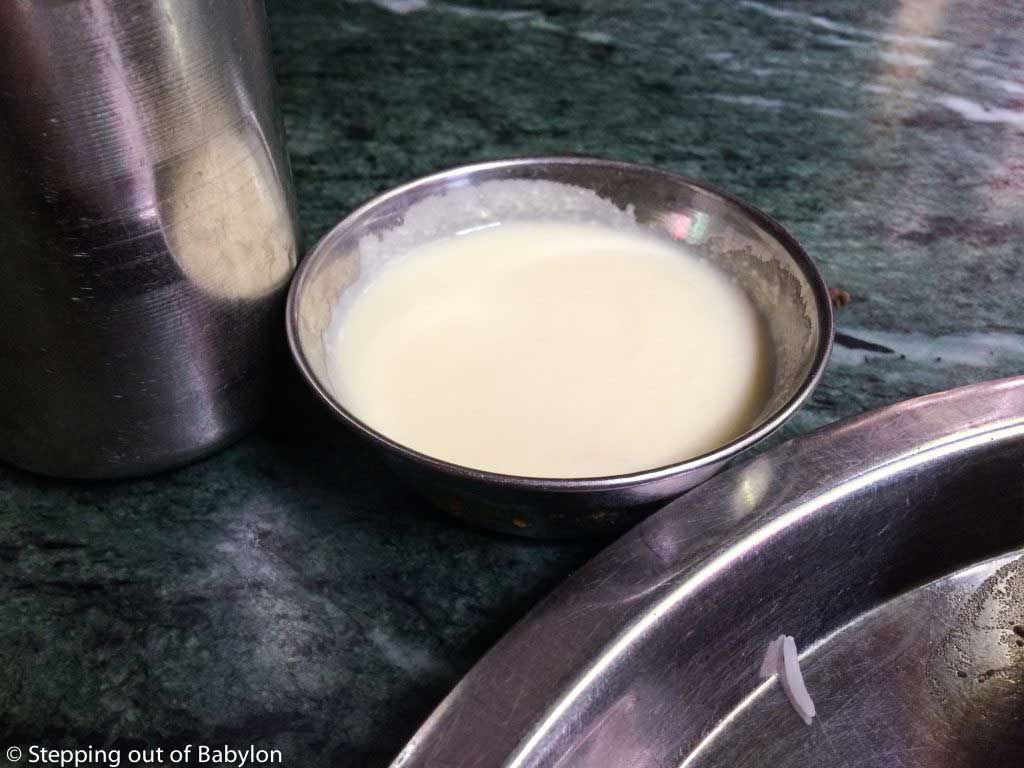
Red sauce, not really my favorite and always skip it, but is made from tomato, chili and Sichuan pepper, having a sour and acid taste.
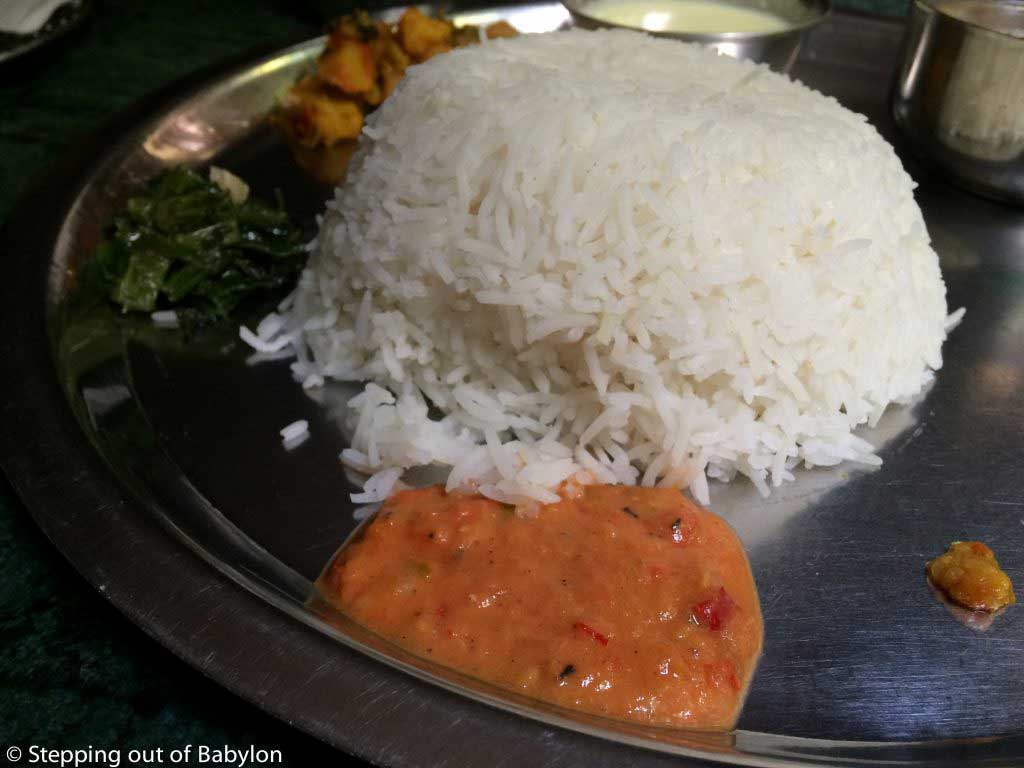
… and last but no the least: Rice, plain and unsalted steamed rice… couldn’t be simpler.
In the center of Thamel… difficult to give a proper address but try to look for Funky Buddha Bar, and passing the entrance gate you’ll see a red brick building on you left where is located the Muktinath Restaurant. Inside, passing the kitchen you have a kind of open-air area more pleasant called “garden”.
The Om Restaurant is hidden in the end of a back street of Thamel. Try to find first the Roots Bar, and from there is less than 100 meters. The place is dark and far from be attractive, but has a kind of character and the dal bhat is delicious… and maybe the cheapest meal in Thamel!
Note that in all restaurants the dal bhat is served in the refill system, which means that the plate is served with a not so big portion of food, but after someone will pass by bringing more food, and you can refill you plate as many times you want!
Another version of the dal bhat, hard to find in restaurants, is made with barley, cereal that grows at high levels as the rice, typical from lowlands, is hard to grow above 2000 meters high.
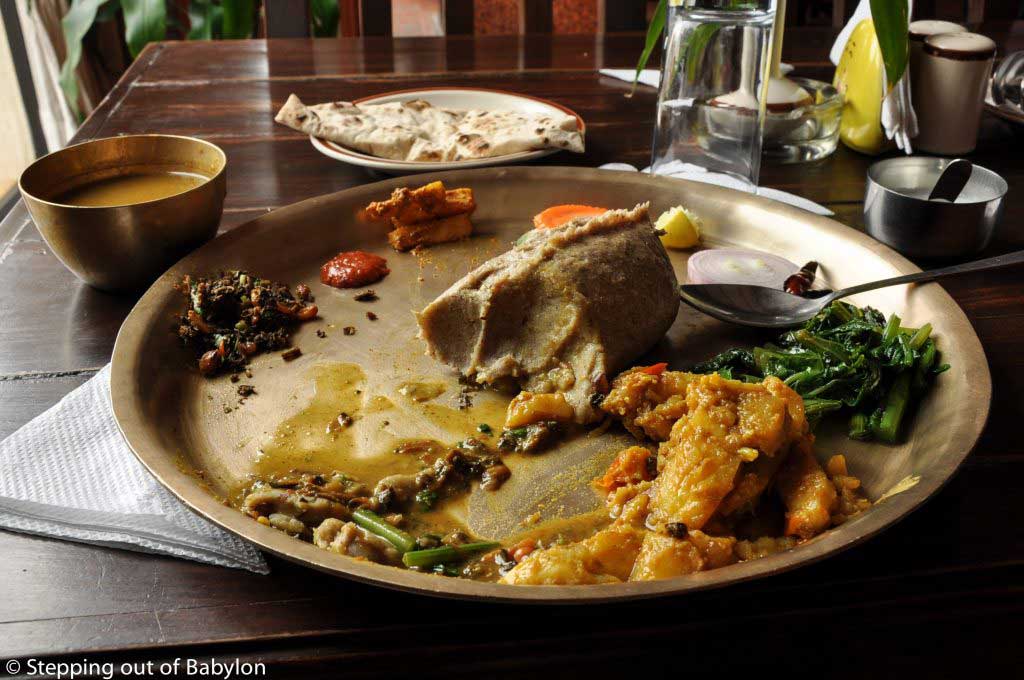
I can’t finish this post without mention a homemade dal bhat, cooked at mountain style, that despite the presence of the rice as also served with corn, cooked and beaten, resulting in a yellow thick paste. Very delicious, with the sweetness of the corn balancing the spiciness of the curry.


I’m Catarina, a wanderer from Lisbon, Portugal… or a backpack traveller with a camera!
Every word and photo here comes from my own journey — the places I’ve stayed, the meals I’ve enjoyed, and the routes I’ve taken. I travel independently and share it all without sponsors or ads, so what you read is real and unfiltered.
If you’ve found my blog helpful or inspiring, consider supporting it with a small contribution. Every donation helps me keep this project alive and free for everyone who loves exploring the world.
Thank you for helping me keep the journey going!