• Skip to main content
  • Skip to footer

Stepping Out Of Babylon

Travel & Photography

  • About me
    • Contact
  • Destinations
    • Africa and Middle East
      • Iran
      • Lebanon
      • Morocco
      • Turkey
    • East Asia
      • China
      • Japan
      • Taiwan (ROC)
    • South Asia
      • Bangladesh
      • India
      • Nepal
      • Sri Lanka
    • Southeast Asia
      • Cambodia
      • Indonesia
      • Lao
      • Malaysia
      • Myanmar
      • Singapore
      • Thailand
      • Vietnam
  • Itineraries
  • Travel tips
    • Border crossing
    • Hiking and Natural parks
    • Food Journey
    • Visa
  • Photography

Search Results for: indonesia

Ogoh-ogoh… the parade of the evil spirits

What a rest!!!!… after the busyness and the excitement of the Ogoh–Ogoh parade the Nyepi day start quietly with a beautiful blue sky decorated with fluffy white clouds, surrounding the laidback village of Ubud, in the heart of Bali island, the only that follows the Hindu religion in all Indonesia.

According to the Saka calendar, the new year is commemorated with a day of silence, the Nyepi day, when all the inhabitants of the island stay at home, all shops and restaurants are closed, no one is allowed to walk or drive on the streets, the activity at home is reduced to the minimum and the lights are turned off or keep dim, there is no music, TV or radio, and even Bali’s airport is closed during 24 hours. These rules are applied to everyone that stays on the island during this day, no matter religion or nationality, and the Pecalang, a kind of civil police, patrols the streets to guarantee that these rules are respected.

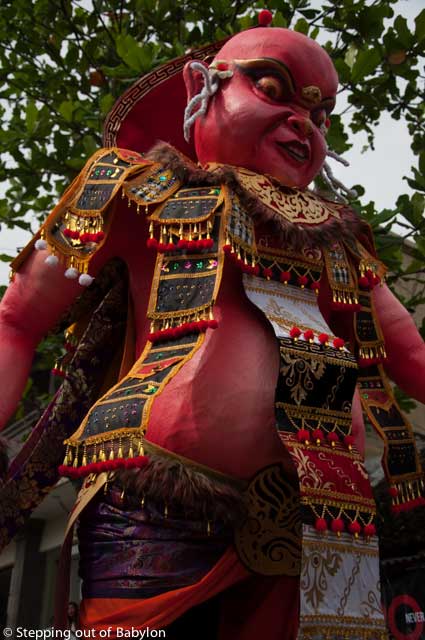
But the day before Nyepi is busy and noisy with the Ogoh-ogoh parade. Statues representing demons are building by different groups in all the villages by the local population, symbolizing the evil and the bad spirits responsible for disease and misery.

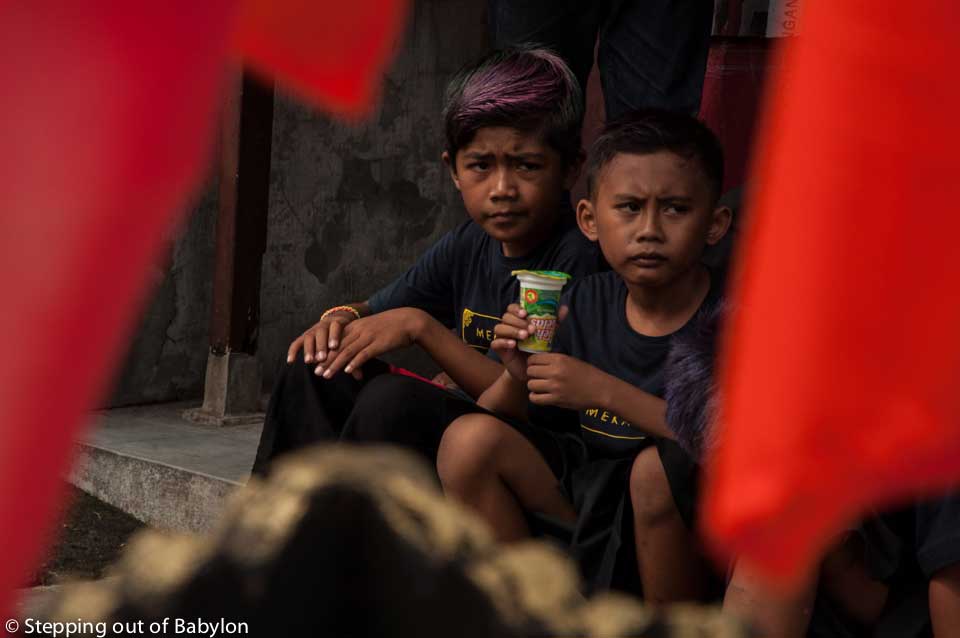
The Ogoh-Ogoh are carried on a bamboo structure the streets, usually by boys and young men, parading in front of the temples, where they execute a kind of dance at the sound of the drums of the Gamelan orchestra. Between voices and shouts, the streets are filled with excitement, every time that the Ogoh-ogohs, made with foam, resin and styrofoam are lifted and carry on the shoulders.

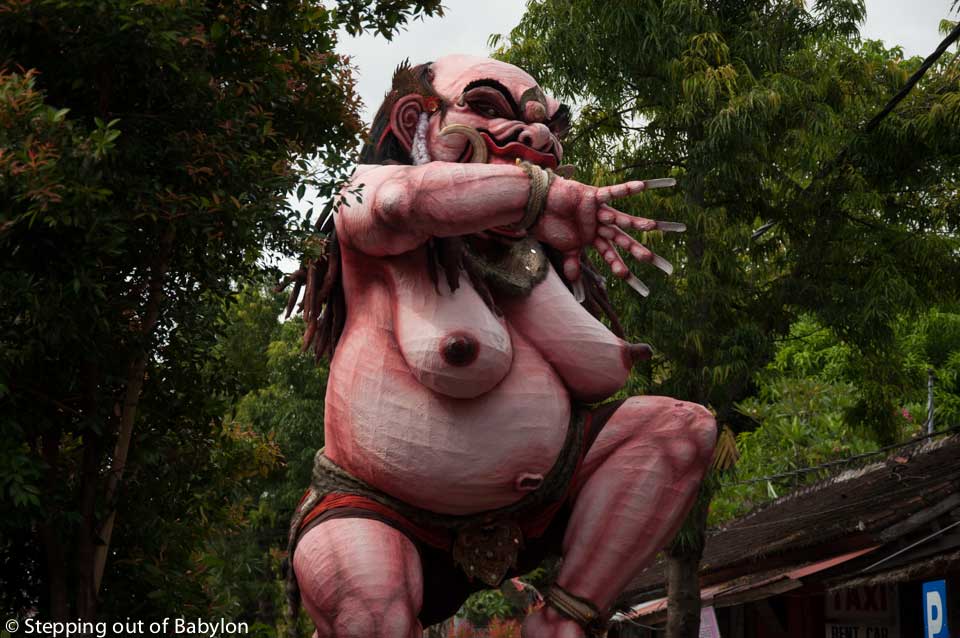
Ogoh-Ogoh Parede, Bali

In the end of the day, before 12 o’clock they are burned, as a ritual of purification. After this everyones return home, and start the 24 hours of silence in all Bali Island.

At home, before the Ogoh-ogoh parade, the family walk around the house shouting and making noise with metal plates, to pushing away the evil spirits, leaving behind a trace burning bamboo sticks.

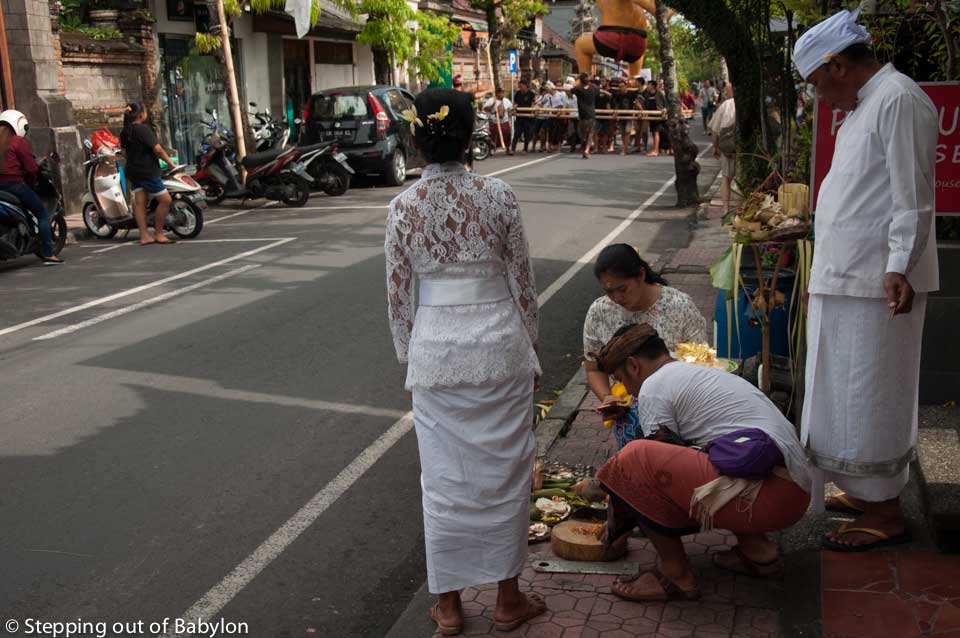
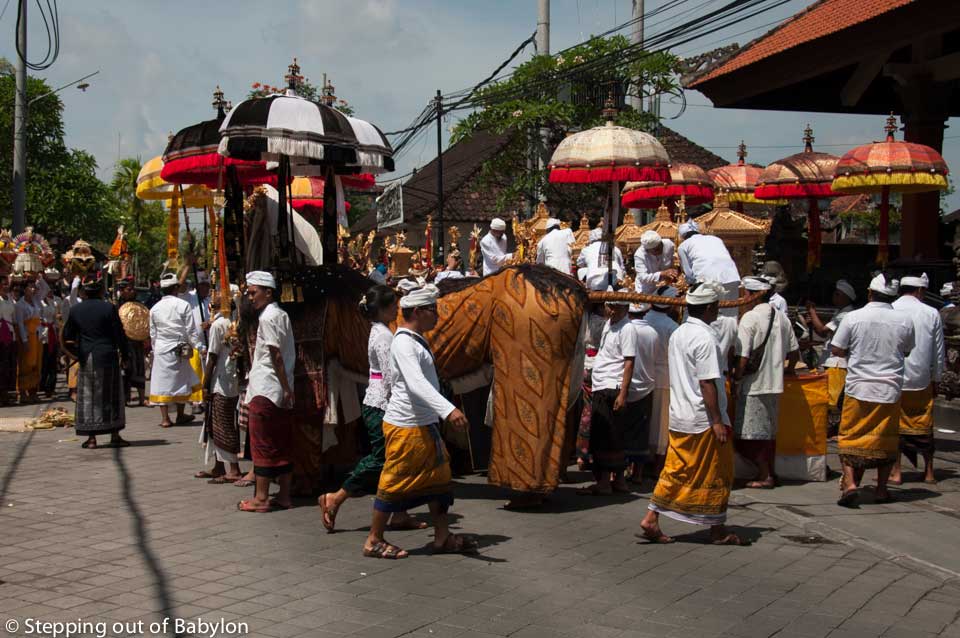
The day before the Nyepi, is busy also around the temples, with the population gathering with offerings made from fruits and flowers, participating in a long and complex ceremony where the foreigners are not allowed but where the music of gamelan, traditional from Bali, is present.

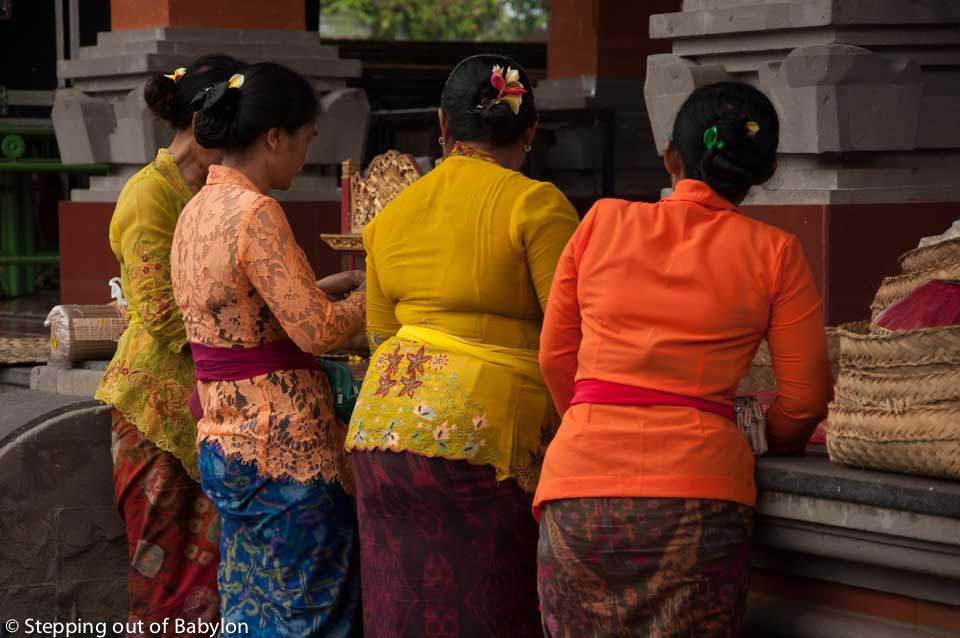
The festive sarongs of the women with shiny color tops (the kebaya) and the hair decorated with flowers, the frangipani flowers that are everywhere around the island, contrast with the more sober outfit of the men, with batik dark color sarongs, white shirt and the udeng, a headband traditional in Bali.

[columns] [span6]

Offerings that can be find every where, streets and houses
Offerings that can be find every where, streets and houses. Ubud, Bali

[/span6][span6]

Special offerings for festivals
Special offerings for festivals, that include flowers, food, coconut and delicate decorations made from bambu. Ubud, Bali

[/span6][/columns]

Bali_Nyepi_ogoh-ogoh_DSC_3376
Rituals in front of the temples on the last day of the Sasak calendar. Ubud, Bali
Bali_Nyepi_ogoh-ogoh_DSC_3384
Ubud, Bali
Special offerings during the festival
Special offerings during the festival. Ubud, Bali
Rituals in front of the temples
Rituals in front of the temples. Ubud, Bali
Bali_Nyepi_ogoh-ogoh_DSC_3496
traditional outfit for festive days. Ubud, Bali
Bali_Nyepi_ogoh-ogoh_DSC_3524
boxes made form bambu with offerings for the rituals on the last day of the year. Ubud, Bali
Bali_Nyepi_ogoh-ogoh_DSC_3400
rituals at the temples before the Nyepi day. Ubud, Bali

Practical information about the Ogoh-ogoh parade in Ubud:

The Ogoh-ogoh parade and the Nyepi festival is celebrated all over Bali island.

The Ogoh-ogoh parade start around 5 p.m. but two hours before you can see the different groups (usually men and boys but also some girls) caring the demons to the ground in front of the temples. And it ends around 9 p.m. with the entire Ogoh-ogoh gathering at the ground near Monkey Forest Temple

The parade move around a few streets in Ubud, but the center of everything is the Jalan Hanoman nearby the Pura Padang Kerta, where the Ogoh-ogoh start to gather around 3 p.m.

But the festival that starts a three or four days before, with ceremonies at the temples, and more elaborated offers in front of the houses.

The foreigners are not allowed at the temples during this period, even if dressed with the traditional ceremony Balinese outfit.
About me

Hey there!

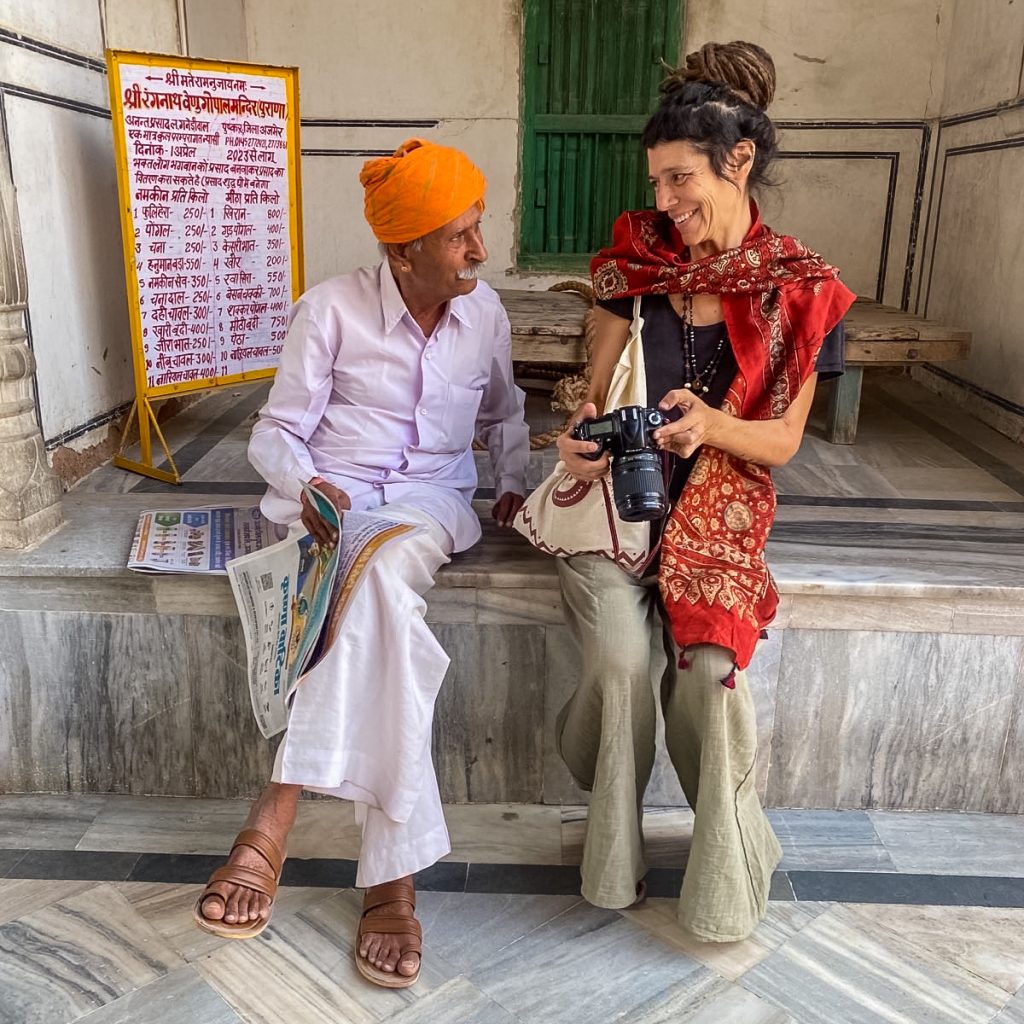
I’m Catarina, a wanderer from Lisbon, Portugal… or a backpack traveller with a camera!

My journey as a traveller started in 2013 and led me towards the Asian continent, after a few short trips to Vietnam, India, and Peru.

The first six months were spent in India which gave me the experience, knowledge, and strength to explore the diversity of Southeast Asia, including Thailand, Laos, Myanmar (Burma), Cambodia, the southwestern region of China, Malaysia, Singapore, and Indonesia. 

But it was India where I found myself visiting often and sticking around longer, exploring more remote areas like Ladakh, Kashmir, Nagaland, Rann of Kutch, Thar Desert and Cherrapunji.

In North Africa and the Middle East, I travelled through Iran, Morocco and Turkey.

Later, Sri Lanka and Nepal complemented the first four years of my journey.

Japan and Taiwan are the farthest East places that I have been so far.

After a two-year break during the pandemic, I hit the road again. This time, I focused on shorter trips and closer destinations. East Turkey and Lebanon are my recent passions with their rich history, cultural diversity, and delicious food.

But my recent biggest surprise was Bangladesh, a lesser-visited country without flashy sights, but which truly captured my heart through the kindness and friendliness of its people.

This blog is my travel notebook: here I share information and tips about accommodation, border crossings, visa arrangements, local transportation… all to help you travel safer, cheaper, and explore behind the beaten path.

I’m not exactly sure what keeps me travelling, but definitely photography keeps me pushing forward, food keeps me excited, and people keep me inspired.

Thanks for stopping by. I hope something here inspires you and inspires your next adventure!

Catarina

Love and Respect

How to apply for Indian Visa in Malaysia and Thailand

At least since December 2015 that is not possible to get an Indian Tourist visa is Malaysia, as also in Thailand.

At the IVS /Indian visa Services) in Kuala Lumpur you can apply for visa, give all the documentation, fill a form as non-resident, make the payment and anyone will tell you that the India Embassy in Malaysia in not longer giving tourist visa to non-Malaysia Resident for more than two years. The only things that they ask is you to sign a paper that you agree to the submission of your application to the High Commission, don’t tell nothing about the meaning of this.

Later you’ll find that there is 99% of chances that you application is refused, and no way to have you money back.

The IVS staff in Kuala Lumpur is extremely impolite and totally incompetent to provide proper and clear information.

The only option if you are in one of this countries (Malaysia or Thailand), is to apply for 1 month e-visa if you are citizen of one of the 133 eligible counties:

Andorra, Anguilla, Antigua & Barbuda, Argentina, Armenia, Aruba, Australia, Bahamas, Barbados, Belgium, Belize, Bolivia, Brazil, Cambodia, Canada, Cayman Island, Chile, China, China- SAR Hongkong, China- SAR Macau, Colombia, Cook Islands, Costa Rica, Cuba, Djibouti, Dominica, Dominican Republic, East Timor, Ecuador, El Salvador, Estonia, Fiji, Finland, France, Georgia, Germany, Grenada, Guatemala, Guyana, Haiti, Honduras, Hungary, Indonesia, Ireland, Israel, Jamaica, Japan, Jordan, Kenya, Kiribati, Laos, Latvia, Liechtenstein, Lithuania, Luxembourg, Malta, Malaysia, Marshall Islands, Mauritius, Mexico, Micronesia, Monaco, Mongolia, Montenegro, Montserrat, Mozambique, Myanmar, Nauru, Netherlands, New Zealand, Nicaragua, Niue Island, Norway, Oman, Palau, Palestine, Panama, Papua New Guinea, Paraguay, Peru, Philippines, Poland, Portugal, Republic of Korea, Republic of Macedonia, Russia, Saint Christopher and Nevis, Saint Lucia, Saint Vincent & the Grenadines, Samoa, Seychelles, Singapore, Slovenia, Solomon Islands, Spain, Sri Lanka, Suriname, Sweden, Taiwan, Tanzania, Thailand, Tonga, Turks & Caicos Island, Tuvalu, UAE, Ukraine, United Kingdom, USA, Uruguay, Vanuatu, Vatican City-Holy See, Venezuela, Vietnam.

https://indianvisaonline.gov.in/visa/tvoa.html


Indian Visa Services (IVS) in Kuala Lumpur


Indian Visa Services (IVS) in Kuala Lumpur

Apply for Indian Visa in Thailand

Since October 2015, it is no longer possible for a non-Thailand residents to get a Indian Tourist visas in Bangkok or any other city.

Indian Tourist Visa is only given to Thai residents.

Check update info at: http://www.travelfish.org/orientation_detail/thailand/bangkok_and_surrounds/bangkok/bangkok/138


The only option is to apply for 1 month e-visa if you are citizen of one of the 133 eligible counties:

Andorra, Anguilla, Antigua & Barbuda, Argentina, Armenia, Aruba, Australia, Bahamas, Barbados, Belgium, Belize, Bolivia, Brazil, Cambodia, Canada, Cayman Island, Chile, China, China- SAR Hongkong, China- SAR Macau, Colombia, Cook Islands, Costa Rica, Cuba, Djibouti, Dominica, Dominican Republic, East Timor, Ecuador, El Salvador, Estonia, Fiji, Finland, France, Georgia, Germany, Grenada, Guatemala, Guyana, Haiti, Honduras, Hungary, Indonesia, Ireland, Israel, Jamaica, Japan, Jordan, Kenya, Kiribati, Laos, Latvia, Liechtenstein, Lithuania, Luxembourg, Malta, Malaysia, Marshall Islands, Mauritius, Mexico, Micronesia, Monaco, Mongolia, Montenegro, Montserrat, Mozambique, Myanmar, Nauru, Netherlands, New Zealand, Nicaragua, Niue Island, Norway, Oman, Palau, Palestine, Panama, Papua New Guinea, Paraguay, Peru, Philippines, Poland, Portugal, Republic of Korea, Republic of Macedonia, Russia, Saint Christopher and Nevis, Saint Lucia, Saint Vincent & the Grenadines, Samoa, Seychelles, Singapore, Slovenia, Solomon Islands, Spain, Sri Lanka, Suriname, Sweden, Taiwan, Tanzania, Thailand, Tonga, Turks & Caicos Island, Tuvalu, UAE, Ukraine, United Kingdom, USA, Uruguay, Vanuatu, Vatican City-Holy See, Venezuela, Vietnam.

https://indianvisaonline.gov.in/visa/tvoa.html


Malaysian food… underestimated cuisine!

Two things stand out in the cuisine of Malaysia… the ethnic, cultural and religious diversity that brings us to China, India, Thailand, Indonesia… and the rice which is present in almost all dishes.

From the staying in Borneo and West Malaysia several representative dishes of Malaysian cuisine remain, like lontong, laksa, nasi lemak, nasi goreng… “nasi” means rice and “goreng” refers to fried, so fried rice is one of the dishes easily find anywhere at any time of day, usually made with chicken, beef or seafood, with pork away from a gastronomy of a Muslim country.

Being a predominantly muslim country, Malaysian cuisine is dominated by meat dishes, but the strong presence of the Chinese community as well the Tamil from South of India bring other options that suits the vegetarian diet! 

In terms of nasi goreng, there are many variants (kampung, pattaya, ayam …), differing ingredients, seasonings and spices, always excelling spicy. The nasi goreng pattaya is basically fried rice (fried rice with meat, seafood or vegetables), involved in egg and drizzled with a sweet and spicy condiment. In Borneo this dish is often served with a bowl of broth that makes it less dry. Despite being unpopular and does not appear in the menus it is also possible to order vegetarian nasi goreng, but that is almost always made with egg, and not many vegetables.

Nasi Goreng Pattaya. Malaysia

But it is the nasi lemak that is the “king” and can be considered the Malaysian national dish. Usually eaten for breakfast, being basic and very simple to prepare. It consists of rice and small portions of fried small anchovies, fried peanuts, cucumber slices and egg, that can be boiled or fried. This meal can be served on the plate or wrapped in banana leaf for take-away. But what makes this special dish is the sambal, a red and thick paste, made with chilies, onion, ginger, garlic, anchovies and a few more spices, resulting in a very tasty mixture.

Nasi Lemak. Malaysia

Laksa is another popular Malay dish that can be classified between a soup and a curry. It’s basically a broth, sweet and spicy, which includes the coconut milk, ginger, lime leaf (kaffir) and lemongrass, which involves fine rice noodles and bean sprouts. To this base usually is added meat, but you can also order it with tofu.

In Borneo, the laksa is creamier, with more coconut milk and usually served with tofu and seafood, where seafood comes down to shrimp or squid… but wherever it is always served with lime that brings out the other flavors.

Laksa. Kota Kinabalu. Malaysia

Laksa. Melaka. Malaysia

Lontong, a traditional Indonesian dish that was built in Malaysian cuisine, and its vegetarian in is origin. Made with a compressed rice with a roll shape, cut in big pieces. To these these “chunks” is added a soft vegetable curry cooked in coconut milk, to which joins tofu, tempeh and boiled egg (or sometimes fried). Like the nasi lemak is served with a spoonful of sambal, also part of the popular dishes eaten for breakfast.

Lontong. Malaysia
Lontong. Malaysia

A popular snack in Borneo, and probably can also be found in the rest of Malaysia is called fried carrot cake, which despite its name has nothing to do with carrots, made from cooked and compressed rice-shaped blocks, which are cut into pieces and fried with egg, spicy and sometimes with soy sauce. Unhealthy due to amount of oil but very delicious.

In cities, especially in neighbourhoods dominated by Indian culture, often called Little India, it’s easy to find the traditional cuisine of southern India as a result of the strong presence of the Tamil community living here for generations. In addition to the delicious curries that give life to a dish of rice, often served in a banana leaf, you can also find murtabak, dosas and other typical Indian snacks, served with coconut chutney and sambar.

But what stands out are the roti canai, also called roti prata or paratta. It is a flat unleavened bread, but whose dough is extended until get very thin, thrown with mechanical and precise gestures against the table, repeatedly until almost getting ripped, in a process that requires a lot of oil. After is extended and rolled to create rough layers and is then fried in a metal plate until crisp and slightly toasted. The roti is accompanied by a small dish of curry, were it is is soaked.

You can find several versions of this roti, stuffed with egg, banana, sweetened milk…

Roti canai. Malaysia

From the presence of the Chinese community, result many restaurants and all variations around the noodles soup and fried noodles, and along with nasi goreng, are a popular option and easy to find at any time of day. As they are prepared at the moment they can be made in a vegetarian variant, where it is often added tofu, a notorious influence of Chinese cuisine.

The fried rice noodles in Malaysia answering to the name Kueh Teow Goreng, and are always made with egg, bean sprouts and some raw chives.

Kueh Teow Goreng. street food. Kuching. Malaysia

The dim sum, traditional Cantonese meal steamed in bamboo baskets, is a presence in some Chinese restaurants, some of which still retain the traditional system in which the food is circulated in trolleys through the tables with customers choose the food among the dozens of varieties… were hardly can be find vegetarian food.

Very popular in areas with the highest concentration of the Chinese community, as are the Chinatown in different cities of Malaysia, are the shops specialised in dried meat that is prepared in different ways, ranging from sweet to spicy.

But what stands out the Chinese food, resulting from the attractive price and the wide range of options is the rice dish serve in buffet style: a plate of with a portion of rice were different dishes are added chosen from trays of food, which can be meat, fish, eggs, vegetables and the popular tofu that is cooked in different ways. This system is very popular, not limited to Chinese cuisine, extending the Malaysian food restaurants that although more focus in meat also offer a wide variety in terms of vegetarian food. Just need to ask for “rice” and we are given a plate with of rice for each one add the dishes.

Rice plate restaurant. George Town. Malaysia

Rice plate. George Town. Malaysia

Rice plate street food. George Town. Malaysia

About street food, Malaysia will get a lot of inspiration to neighboring Thailand, and is easier to find in the cities of the north of the country than for example in Borneo. In small stalls that arise several hours a day in specific locations of the city can be found apom, steam rice cake, fried banana, and the popular and delicious apam balik that are pancakes stuffed peanuts… and many more delicious options that also include snacks, often fried.

Apom. George Town. Malaysia

street stall of chendul (chendol). George Town. Malaysia

Markets are also great places to enjoy and experience the wide variety of food, a lot of which is difficult to identify, whether it is sweet or salt, whether it is meat or vegetarian… but always arouses curiosity.

Street food. Central Market. Kota kinabalu. Borneo. Malaysia

Shellfish. Central Market. Kota kinabalu. Borneo. Malaysia

As a tropical country abound bananas, mangoes and papayas… but also in the markets as street vendors also are pineapple, jackfruit, watermelon and melons… but it is the durian, the king of tropical fruits, much appreciated as hated by intense and characteristic smell, that make it forbidden to carry in the subway.

Durian. Kota Kinabalu. Malaysia

Fruits. Central Market. Kota kinabalu. Borneo. Malaysia

Sweets

The chendul (or chendol) is a traditional cold sweet very popular in Malaysia, based on coconut milk and crushed ice, sweetened with palm sugar syrup and served with a green noodles (whose color comes from a vegetable often used in sweets and dishes, the pandan) and a few sweetened beans. It may seem odd but it is delicious and refreshing and in some places, like George Town people line up in small street stalls to buy chendul.

Chendul (chendol). Melaka. Malaysia

Fry Banana. Central Market. Kota kinabalu. Borneo. Malaysia

Sweet and deep fry snacks at Central Market. Kota Kinabalu. Malaysia

Very popular is kaya, a coconut and egg jam, that sometimes can have the green color, if it’s added pandan. Kaya is used to spread on toast, which served with eggs and tea is also one of the option in terms of traditional breakfast in Malaysia, mainly in cities. Kaya Jam is also used to fill puff tarts as the ones sold in a small corner shop in Kuala Lumpur’s Chinatown.

Kaya Jam. Malaysia
Kaya Jam at breakfast. Malaysia

Coconut puff tart. Chinatown. Kuala Lumpur. Malaysia

Adding to the list of popular sweet is the beancurd (also called soybean pudding) a kind of pudding made of soy, which is sweetened with palm sugar syrup, is also popular in most dominant Chinese areas.

Beancurd. Kuala Lumpur. Malaysia

Drinks

Being a predominantly Muslim country, alcohol is unusual at local restaurants but is easy to find in bars and restaurants in more tourist sites, especially the beer.

But the most popular in terms of drinks is teh tarik, which is tea to which is added sweetened milk, and can be served hot or with ice (teh ais). It is consumed in the morning, usually hot, accompanying meals, like roti canai for example, or during the day, as a break in the workday.

Coffee is also easy to find, being in Malaysia usual the filtered coffee, served in a very strong version in terms of caffeine, with a dense and dark look but soft flavor.

Teh Ais (Ice tea with condensed meilk). Malaysia

Coffee. Malaysia
Coffee. Malaysia

For vegetarian food the best option are the Indian restaurants, due to the influence of the Hindu religion and some Chinese restaurants that resulting to the connection with Buddhist religion can sometimes exclude animal products. In restaurants more targeted to the Malay cuisine is notorious the strong presence of meat dishes, and yet respecting the halal rules, which pork is exclude. Yet pork meat is quite popular in Chinese dishes.

In general there are few dishes exclusively vegetarian in Malaysia gastronomy, and even those who appear to have no animal products, can often be served with a condiment called “sambal” that includes anchovies or any other small fish.

For those who are used to eating knife and fork, it is here to adapt to the use spoon and fork, because the knife is an instrument that does not arrive at the table, being unnecessary since the food is cut into pieces being brought to mouth by the spoon, serving the fork to push food into the spoon. In Malaysia the food is take to mouth with the right hand. In Indian restaurants it is common to use the fingers to bring food to the mouth, but spoons are always available. Spoon and chopsticks are used in Chinese restaurants. In general, the restaurants do not have napkins.

And as in other Asian countries the first meal of the day is made on the basis of rice and noodles, soups or curries. The rotis are also popular for breakfast. Many restaurants serving breakfast open at 6 am, but this are not always open until dinnertime, closing by 3 or 4 pm. But there are others who not opening so soon, serve meals until dinnertime, but not much later than 9 pm. Take-away system is very popular with both restaurants and street stall to be prepared to parcel food in proper containers or more traditionally in banana leaf.

Rice and curry for for take away. Malaysia

In general, even with the limited vegetarian choices, Malaysia gastronomy offers a great diversity of flavours, with simple dishes, fast and easy to prepare but very tasty… I miss the laksa, lontong and nasi lemak.

Food Costs in Malaysia

In food courts a meal costs between 3.5 and 5 RM, which means that you can easily get a meal for 1 €.

The same applies to the so-called rice plat, with two or three varieties of vegetarians side dishes costs about 4 MR. The food costs in Kuala Lumpur are a bit higher were a rice plate eaten in a restaurant can costs about 5 RM, but van be cheaper is a street food stall

Dishes with meat, fish or seafood always have higher prices.

Kuala Lumpur… the big city

A city that changes abruptly and that surprises and challenges us: from a compact and uniform urban area, we are faced with huge office towers; a walk through side streets bumped long avenues where traffic is intense and often congested; from a colonial architecture we jump to modern and bold buildings; shopping streets that end in freeways that create almost insurmountable barriers; garden and green areas isolated by massive concrete viaducts.

The usual hustle and bustle of everyday Asian shocked by the aggressive urban traffic… an accumulation of contrasts that left a memory of an attractive city, where the main activities are shopping in malls and visiting the skyscrapers and towers that are the brand image of the city of Kuala Lumpur.

Despite the big growing that Malaysia’s economy had in recent years, and which the Petrona Towers and the Menara KL Tower are proud symbols, the city of Kuala Lumpur mirror the social and economic contrasts, with the city attracting not only the rural population as well as a large number of immigrants, many from Indonesia, that not always find here the expected success.

The area of ​​Chinatown is an example of these asymmetries, bringing together many homeless, beggars and drug addicts, although without noted danger in terms of security in the streets, even at night, and yet no attractive for night walks.

Nearby is the calling Colonial District… where examples of British colonial architecture, both churches and train stations (as Kuala Lumpur Station) as also public and administrative buildings, now turned into museums.

He was to miss a visit to Batu Caves… a green oasis in the middle of this giant capital.

Kuala Lumpur
Kuala Lumpur


Chinatown. Kuala Lumpur


Kuala Lumpur
Kuala Lumpur


Kuala Lumpur
Kuala Lumpur


Kuala Lumpur
Kuala Lumpur


Kuala Lumpur
Kuala Lumpur


Kuala Lumpur
Kuala Lumpur


Kuala Lumpur Train Station. Kuala Lumpur

Accommodation:

Kuala Lumpur offers many options in terms of accommodation, for various budgets. Chinatown is reputed to gathering the largest number of budget hotel and guest houses, thus attracting most backpacker who in general do not take longer than a day or two, and KL often the last stop of those who traveling through Southeast Asia.

Good location, easy accesses by public transport, great offer in terms of food make Chinatown an attractive place. The area attracts many homeless, beggars and drug addicts, without noted danger in terms of security in the streets.

In terms of price a double room in Chinatown, with shared toilet, free wi-fi and basic breakfast (bread, jam, margarine, tea and coffee) is not less than 60 RM. For this budget ​​there are many options, and worth to walk around Jalan Tun H.S. Lee and the Jalan Sultan, because there are significant differences between the condition offers by different guesthouses.

The choice was for the Submarine Guest House, modern, not very large and quiet, with a nice common area. It has no breakfast but you can use the utensils, microwave, kettle and existing refrigerator.

Submarine Guest House

Address: 206, Jalan Tun HS Lee, Kuala Lumpur 56100, Wilayah Persekutuan, Kuala Lumpur. (There is another next to Central Market)

Double room: officially is 70 RM, but can be bargain to 50 RM (room without window, and with air-conditioner).

Bed Dorm: 30 RM

Shared-toilet; free wi-fi; water-refill available.

Chinatown is easily accessible from Pasar Seni (LRT) and the Maharajalela Station (Monorail), or Plaza Rakyat, near the Puduraya Bus Station (LRT).

However KL Sentral is far and difficult to reach on foot.

Submarine Guest House. Chinatown. Kuala Lumpur


Where to eat:

There are many choices in the Chinatown area, but the prices are a bit higher in KL than in other Malaysian cities, particularly along the Jalang Petaling where the large presence of tourists inflates prices and would decrease the quality.

The choice location for good quality food, the hygiene and the friendliness (with some fluctuations depending on the staff) went to the Al Ariffin Restaurant, serving Malaysian food but belonging to the Tamil community, with many vegetarian options, a wide range rice dishes (nasi) delicious rottis and tandori oven where to cook naan, traditional Indian bread. Also with self-service system with rice based dishes were the costs depend on the number of side dishes is about 4 MR. Delicious ice-tea… but with condensed milk!!!

Al Ariffin Restaurant

Address: Jalan Sultan Mohammed, directly opposite the bus station and MRT station Pasar Seni.

Kuala Lumpur
Kuala Lumpur

But it’s worth a walk into Jalang Petaling, despite the confusion, noise and permanently busy to taste the delicious Bean Curd (a kind of pudding made from soybeans that is sweetened with palm sugar syrup), which is sold daily in a small stall in aluminum and jornal articles with articles about the “famous” bean curd… it’s not easy to find, despite the frequent line of clients, just ask to any of the street vendors.

Bean Curd @ Jalang Petaling, Chinatown, Kuala Lumpur


At the corner of Jalan Tun HS Lee and Jalan Tun Cheng Lock, a tiny shop is that can easily go unnoticed, S ‘Ban Siew Pow, whose schedule is difficult to figure. But it is worth making a few tries to be able to taste the delicious paties made form puff pastry filled with sweet coconut jam. Also available are other stuffed savory varieties with pork.

Sweets from S’ Ban Siew Pow @ Chinatown, Kuala Lumpur


Sweets from S’ Ban Siew Pow @ Chinatown, Kuala Lumpur


How to go from TBS (Terminal Bersepadu Selatan) to Chinatown (Kuala Lumpur)

Arriving at the terminal TBS are left near a set of escalators that lead to the main hall of the terminal; here a little after a short walk you can see a exit on the right side, with indications of KLIA, providing access to the footbridge; on the other side are stairs and elevator to reach the ground floor. When you reach the street, walk to the right side (for who is facing the giant terminal building); just after the taxi rank is a bus stop.

The Bus 690, Rapid KL takes 20 minutes (out of rush hours) and ends at Pudu Sentral (Puduraya), near the Plaza Raykat building; from here is 5 minutes walking to Jalang Petaling, the heart of Chinatown in Kuala Lumpur.

To make the return trip, the Bus 690, start the journey back to TBS at the same place where it ends: in Jalang Pudu, Pudu Sentral near the (Puduraya). Attention, Bus 690 does not stop inside the terminal but on the street, in a parking area next to Jalang Pudu.

Bus ticket (TBS to Pudu Sentral-Puduraya): 2 RM.


Bus 690, from TBS to Pudu Sentral (Puduraya). Kuala Lumpur

Alternative:

Crossing the pedestrian bridge outside the TBS, follow the signs to the train station KTM-Komuter. Follow Seremban Line to KL Sentral line (2.4 RM). At KL Sentral change train and take the LRT to Pasar Seni (1.4 RM). This alternative is more expensive but has the advantage of being more reliable at rush hours, as the traffic in Kuala Lumpur can make the bus trip between the city and TBS takes over an hour.

Tickets, Bus 690, from TBS to Pudu Sentral (Puduraya). Kuala Lumpur

Malacca or Melaka?!?

The day rises hot with the intense light of the sun relentless hurting the eyes and force us to seek refuge in the shadows of the low-rise buildings of the old part of the town. But reaching the middle of the day, the blue sky quickly disappears with the silent arrival of heavy gray clouds, which bring with them a moist, thick air. The wind that brings some relief to the heavy atmosphere announces storm and with routine gesture merchants withdraw the products to inside the shops. Suddenly, heavy raindrops fill the streets of water, forcing all people to seek shelter in accelerated step imposed by the pace of thunder. A show that leave many people as if hypnotised watching the water gushing from the eaves of the roofs, or peering into the sky in hopes of seeing the luminous trail of lightning.

Melaka_DSC_6224
Melaka

Melaka_DSC_6234
Chinatown. Melaka

Melaka, or also called Malacca, whose name comes from a tree, have a long history and significant impotence in economy and culture of Malay people. It was since the beginning of the fifteenth century successively under Portuguese rule, Dutch and later under the British, due to its privileged position next to Indonesia and strategic location on the trade route between Asia and Europe. From this European presence that lasted until 1957 result strong architectural heritage, military, civil and religious, which is now the historic center, named a World Heritage Site by Unesco. In this compact area formed by the main square – Jalan Gereja – and a small hill adjacent concentrate churches and many colonial buildings left by the Dutch and the British, with many of these buildings converted into museums.

Here are concentrated most of the attractions that give fame to Melaka, attracting the usual souvenirs shops, cafes and restaurants. And it is also here that focus dozens of cycle-rickshaws that left behind the simple local transport function to turned into tourist attraction, moving around the city playing loud music that echoes in the sleepy city streets. Each cycle-rickshaws is a proper naive art installation and a compliment to the kitsch, with decorations related to cartoons and other popular topics, whose passengers are more interested in taking selfies than in admiring the route through the city.

But just crossing a small bridge over the river and we arrive to Chinatown, which despite its name is a mixture of ethnic groups and cultures, but where the shop-houses remind us the presence Chinese traders who settled here for generation. It is here, in the calm and quiet streets that best can enjoy the relaxed pace of the city and its inhabitants, as well as traditional Malaya food, the nasi lemak, the laksa and lontong, taste the spicy Indian curries and try the sweet and refreshing cendol that despite being present in several Asian countries, has a special place here.

Revealing the ethnic and religious diversity that characterises Malaysia today, we can find at the same street, along the Jalan Tokong, the Majid Kampung Klig mosque and the Hindu temple Sri Poyyatha Vinayagar Moorthi that at sometimes look that are in competition for attention, with the mullah calling for one of the five prayers of the day and the temple bells ringing frantically during the puja of the Hindu community.

Dutch Square. Melaka


Melaka
Melaka


Majid Kampung Klig. Chinatown. Melaka


Melaka
Melaka


Chinatown. Melaka
Chinatown. Melaka


Melaka
Melaka


Accommodation:

A good atmosphere in a guesthouse can make all the difference in the time that you spend in a city or place, and the quiet and friendly atmosphere of Jalan Jalan Guest House marked the stay in Malacca. Situated in the old town but away from the confusing environment of so-called Dutch Square (Jalan Gereja) entirely devoted to tourism, Jalan Jalan Guest House is located in a traditional building construction in wood, simple and unpretentious, in Chinatown neighborhood.

The staff is of the utmost kindness and friendly. Are places like these, that the environment and atmosphere make us stay longer than planned…

Jalan Jalan Guest House

Address: Jalan Tokong, 75200 Melaka, Malaysia

Phone: +60 19-655 1131

Double room: 40 RM

Dorm: 16 RM

Free wi-fi. Free coffe and tea.

Shared toilets.

Laundry Service.

Jalan Jalan Guest House. Melaka
room @ Jalan Jalan Guest House. Melaka


Jalan Jalan Guest House. Melaka
Dorm @ Jalan Jalan Guest House. Melaka

_Melaka_Jalan Jalan Guest house_DSC_6227
Jalan Jalan Guest House. Melaka

Jalan Jalan Guest House. Melaka

_Melaka_Jalan Jalan Guest house_DSC_6194
Jalan Jalan Guest House. Melaka

Where to eat:

Cendol:

The traditional iced sweet, very popular in Malaysia, made from coconut milk, ice, palm sugar syrup and served with a green noodles (whose color comes from a plant often used in jam, pandan) and sweet beans. You can find it easily in shops and restaurants in Melaka, but the choice was for a Chinese restaurant that has this sweet as a is specialty (20, Jalan Besi Tukang… same street of Jalan Jalan Guest House).


Cendol @ 20, Jalan Tukang Besi), Chinatown. Melaka


Malaysian Food:

Sayyid Antique (in Lorang Hang Jebat, opposite the Jalang Kampung Kuli) an antique shop where items for sale serve as decoration, and where a very nice couple serves simple and tasty Malaysian meals like nasi Lemak, longtong, laksa… and as the food is prepared on the moment you can ask for a vegetarian version with tofu. The atmosphere is quiet and cozy.

Sayyid Antique. Antique shop and restaurant. home-made Malay. food. Melaka


Lontong @ Sayyid Antique. Antique shop and restaurant. home-made Malay. food. Melaka


Laksa @ Sayyid Antique. Antique shop and restaurant. home-made Malay. food. Melaka

Indian food:

Sri Kaveri Catering (115, Lorang Hang Jebat) with tahli served in banana leaf, with the right to refill by 8 RM. Simples and basic restaurant, that also serves rotis.

Sri Kaveri Catering. Chinatown. Melaka


How to go from Melaka Sentral to the city center (Jalan Gereja):

Arriving at Melaka Sentral bus terminal go into the building, a mix of bus terminal, waiting room and shopping center, and look for the signs “Domestic Bus“, from where the buses to Melaka departure.

Take Bus number 17 that stop at Dutch Square (Jalan Gereja).

Ticket: 1.5 RM

_Melaka_Bus from Sentral to City_DSC_6102 _Melaka_Bus from Sentral to City_DSC_6104

Food in Singapore… so may vegetarian options!!

Singapore is proud to be the culinary capital of Asia, receiving influences of Chinese Malaysian, Indian and Indonesia cuisines, as also Sri Lanka and Thailand. Arise even traces of Portuguese and English presence in the region, were the “portuguese egg tart” which is no more than the famous pastel-de-nata.

Singapore like any big city offers a wide range of choice in terms of restaurants, not only in terms of cuisine, where Asian food dominates but also with many Western and World option, but also in terms of cost of a meal.

And through the city, we are faced with the simplest and informal restaurants, whose space is open to the street, to the most sophisticated places, passing through many restaurants “a la carte” that feature a wide range of prices. In between is a myriad of choices, showing that food plays an important role in the social live of Singaporeans, that given the high purchasing power fill up restaurants, especially on Fridays and Saturdays.

And here we are faced with the question what really is the typical Singaporean food… the answer is: that’s a bit of everything, not a mixture of influences from which resulted an own cuisine that reflects the geographical position, climate, fauna and flora of the region, but an offer of diversity in terms of gastronomy that reflects the ethnic and religious diversity is what best defines this country-city-state.

10 local dishes to try in Singapore

Rochor Beancurd House: soy-milk, beancurd e “portuguese egg tart”!

The areas of Little India, Kampong Glam and Chinatown are the most attractive in terms of food, with any of them with options for all pockets. The shopping centers also have many options in terms of restaurants apart from fast food and big international food chains.

In Singapore the food although more expensive than in neighboring Asian countries is affordable, as you stick to food-courts and markets, as there isn’t in Singapore “street food”. These sites provide meals from 4 S$, which corresponds to € 2.5.

A bit all over the city, with the exception of the most sophisticated and wealthy areas (Wafles Place, Marina Bay, etc…) there are food-courts that comprised several kiosks, stall or small restaurants grouped in the same space sharing a common area consisting of tables and chairs, were people have meals or drinks. Each of these places has it own type of food that usually is served in take-away system. These food-courts could be huge to the point where a person almost get lost in there or of more modest dimensions, but they are always the cheapest and quickest option and the one that attracts most of the local people.

Usually these places offer several options in terms of food, Chinese, Malay, India … but some are more targeted to Chinese food, where it is sometimes difficult to find vegetarian food. The fried-rice and fried-noodles are easy to find and are a good vegetarian options, as the food is made in the moment and is possible to ask to replace the meat or seafood, for vegetables and sometimes tofu. Also very popular is the so called fast food or simply rice or rice plate, where food is exposed on trays in buffet style with many vegetarian options, and each person make his own plate, based on rice, paying for the number of varieties that are served. This type of meal can cost around 4 to 5 S$ and have a lot of choices for vegetarians, with lots of legumes, tofu and soy product dishes.

Chinatown Complex
Chinatown Complex

Chinatown Peoples Park Complex.

Chinatown. food court

With so much diversity is not difficult to find vegetarian or even vegan restaurants, but these usually in more sophisticated areas of the city, and not so affordable. But Singapore brings together different types of cuisines and almost everywhere have at least one vegetarian option, with the Chinese food the most difficult in this field, and the Indiana the easiest since in Singapore there are a big Hindu community. The Malaysian food also has some traditional dishes, that depending on the restaurant may have or not animal products, but you can try to ask to replaced meat, fish or shellfish by tofu, which due to Chinese influence is quite popular.

But attention because sometimes the pastes that seasoning the food are often made with fish-source or other animal condiments. For vegans is more difficult as the eggs are a constant presence in many of the dishes.

Tooth Relic Temple
Tooth Relic Temple

Kampong Glam, the so-called Arab Quarter featuring up around the mosque Masjid Sultan, one can find food from Morocco, Tunisia, Turkey and Iran, as also many more options being an ideal place to enjoy traditional Malaysian dishes: laksa, lontong, nasi lemak, nasi goreng … where “nasi” means rice, that could be steamed or stir-fry in various forms and flavors, with vegetables, egg, chicken, beef or seafood… pork is excluded from Malay gastronomy as this is Muslim country.

The nasi lemak can be considered one of the most popular dishes from Malaysia and is usually consumed at breakfast, simple and very easy to prepare is based on rice with fried anchovies, fried peanuts, cucumber slices and egg (boiled or fried) at the side. The nasi lemak can be served on the plate or wrapped in banana leaf to take-away. But what makes this special dish is the sambal, a red paste resulting from a mix of chilies, onions, garlic, ginger and a few more spices, resulting in a spicy mixture, but very tasty.

Laksa is another popular Malaysian dishes easily found in Singapore, comprising a curry based on coconut milk, sweet and spice with ginger and lemongrass, which involves rice noodles and some vegetables. It may also served with shellfish.

Lontong is a traditional Indonesian dish that was built in Malaysian cuisine, and also popular in Singapore. Made with pressed rice forming a roll which is then cut into pieces seasoning with a vegetable curry cooked on coconut milk, to which joins tofu, tempeh and boiled egg. Like the nasi lemak, it adds a fish-based sambal.

Laksa
Laksa

Nasi Lemak
Nasi Lemak

lontong
lontong

Kampong Glam is one of the best places to try the biryani, an Indian dish made of rice, traditional in Muslim areas, but with a Malay “twist” with a strong meat presence. Here you can also appreciate the roti prata, or simply roti, or paratta, which is traditional South Indian specialty but that was incorporated in Malaysian cuisine being also very popular in Singapore. It is a flat bread, unleavened, but whose dough is extended to be very thin, with the help of much oil and then worked and flattened, in order to create rough layers, which later sintered in metallic surface until becomes slightly crispy. It is served with a small dish of curry, were pieces of the roti are soaked. We can find many versions of this dish, with the roti stuffed with egg, banana, sweetened milk…

roti @ Singapore Zam Zam Restaurant

For those who like Indian food, Little India is the place that offers best variety, especially focus traditional food of South India, as most of the Indian community resident here has his origins the state of Tamil Nadu. In addition to all the most popular type of snacks are the thalis with many restaurants serving this meal, vegetarian or non-vegetarian, in a banana leaf. Here are also the popular rotis, the dosa, uttapam, vada, puri, etc … Little India is also the best place to buy Indian origin products such as spices and condiments, lying in grocery stores a large variety of vegetables .

veg thali @ Famous Indian Curry Food Restaurant. Little India

In Chinatown, even more than in other parts of the city, buzzing with activity around the food, dominating the food-courts, where you can meet hundreds of food stalls and find a bit of everything in terms of Asian cuisine, attracting thousands of people and open from morning until the evening, with food being served throughout the day. One of the most popular is the Chinatown Complex, where the environment is noisy and busy but it provides an interesting insight into the way of life, culture and way of being of the population. A meal in these food-courts can cost between 4 to 5 S$, with the meat and seafood dishes higher-priced.

One of Chinese specialties is the popiah, a very thin dough roll involving a mix of lettuce, soy sprouts, peanuts, cooked carrots and a spicy sauce. They are delicious, and a great vegetarian option for a snack.

Chinatown Complex. Popiah

Chinatown Complex. Popiah

Also in Chinatown, the Buddha Tooth Relic Temple, there is a canteen in the basement where only vegetarian food is served, but according to Chinese recipes, where the meat is replaced by derivatives from vegetable origin that resemble meat in appearance and consistency. A ideal way to explore the rich Chinese cuisine for vegetarians. Each meal, which consists of a rice dish with two dishes cost 3 $S. Only open till 3 pm. The food is good, the atmosphere is calm and has charitable purposes.

Tooth Relic Temple
Tooth Relic Temple

In terms of drinks tea is very popular among the Chinese community, being seen for medicinal purposes; but it is the milk-tea that gained in popularity, which is tea with sweetened milk that can be served hot or with ice. A sweet and refreshing drink that goes well with the hot and humid climate of Singapore. Addictive.

The coffee is also very popular and can be found at sophisticated coffee shops, coping the western style with espresso, cappuccino, latte, etc… or alternatively you can taste the Singaporean coffee, kopi, a filtered coffee extremely dense and very strong in terms of caffeine, which is served in different ways:

  • Kopi: coffee with condensed milk, served hot
  • Kopi C: hot coffee served with milk and sugar
  • Kopi: with sugar
  • Kopi Kosong: without sugar and without milk

Kopi, Singaporean coffee, served with green tea cake

Where to eat in China Town:

  • Tooth Relic Temple: canteen with Chinese Vegetarian Food: 3 S$.

Address: 288 S Bridge Rd, Singapore 058840

Tooth Relic Temple. Schedule

  • Chinatown Complex: the fresh market in the basement, laundry on the ground floor and food on the first floor where the options are so many it’s hard to choose with different types of cuisines and specialty stalls in specific dishes; meals from 3 S$.

Chinatown Complex
Chinatown Complex. Maret, food market and food-court

Where to eat in Little India:

  • Komala Villas: Typical South Indian food at affordable prices; thali served in a banana leaf.

Address: 76 Serangoon Road, Singapore 217981

Komala Vila Restaurante. Little India

  • Famous Indian Curry Food Restaurant: serving delicious thali in banana leaf, in a informal and quiet restaurant in with vegetarian options. 6 S$

Address: 30/32 Upper Dickson Road, Singapore 207489

Famous Indian Curry Food Restaurant. Little India

Where to eat in Kampong Glam (Arab Quarter):

  • Kampong Glam Cafe: good food with a wide variety of Malaysian dishes (lontong, laksa, nasi lemak, nasi goreng and many more), rotis and also with the self-service option where based on rice can compose the dish with various side dishes to choose from a big range of option, and where you can also find vegetarian Optimal location for a meal or just for a drink (no alcohol) and watching the local way of life. Meals from 3.5 S$.

Address: 17 Bussorah St, Singapore 199438

Kampong Glam Café
Kampong Glam Café

  • Singapore Zam Zam Restaurant: very popular for byriani (only meat) and the rotis

Address: 697-699 N Bridge Rd, Singapore 198675

Singapore Zam Zam Restaurant

Where to eat in Geyland:

  • Rice House (Wang Da Zhou): This casual restaurant confeciona the recipes of Chinese cuisine but using derived from vegetable products, mainly soybeans, which are similar in texture to the meat, and we can thus enjoy “hainanese chicken rice” without sacrificing animals ☺

Address: Blk 129 # 01-102 Geylang East Avenue 2, Singapore380129, Singapore

  • Rochor Beancurd House: here are produced and serve to soy-based products, for example soy-milk and beancurd (also called soybean pudding) a pudding made of very soft and smooth tofu that is served as a dessert or snack, washed down with sugarcane syrup, a typical product of Chinese cuisine. In addition, there is the “portuguese egg tart”!

Address: 745 Geyland Road (Lor 39), Singapore 389653

Rochor Beancurd House:soy-milk, beancurd e “portuguese egg tart”!

Orangutan… men of the Jungle

In the local language “orang-utan” means the “men of the jungle” and they are the ones that feature in the dense jungle of Borneo, with its orange plumage, movements and relaxed and confident presence.

Are spread almost everywhere in the island of Borneo, both Malaysia and Indonesian side where their habitat was not yet destroyed by men, by logging for exotic woods trade or by the massive planting of palm trees for palm oil production. But as these creatures are not easy to find and the jungle not let easily being invade, the options was to visit the Semenggoh Wildlife Rehabilitation Centre, located a few kilometers south from Kuching.

This center is housed in a nature reserve collects orang-utans victims or left orphans by man actions, keeping the animals in the wild, only providing food in two specific locations, to which the animals flock in search of easy food especially during the season where there’s less fruit on the trees around the park.

The presence of these mammals, totally relaxed and accustomed to human presence attracts all the attention of a few dozen people gathered at the point of observation, hearing the clicking of many cameras and i-phones, trying to catch the clumsy movements of the younger animals. The presence of these ” men of the jungle ” is not guaranteed, nor the number that each day is shown next to the feeding area, since they are in total freedom. On this day, in the middle of December, there were two of these lovely creatures, a female and a juvenile, in which the latter was keen to show some of their skills hanging on ropes and eating bananas upside down.

Orang-utans. Semenggoh Park. Sarawak


Orang-utans. Semenggoh Park. Sarawak


Orang-utans. Semenggoh Park. Sarawak


Orang-utans. Semenggoh Park. Sarawak

But the visit is not limited only to the “men of the jungle” may be wandering the various trails of the park without the need to travel long distances to feel the contact with nature and the power of the jungle. The constant humidity you feel, makes the pace slow and the body heavy, but gives time to enjoy the small details of the plant world that takes on a special glow and magical colors under the light filtered through the canopy of tall trees that hide the blue sky.

Semenggoh Park. Sarawak


Semenggoh Park. Sarawak


Semenggoh Park. Sarawak


Semenggoh Park. Sarawak


Semenggoh Park. Sarawak


Semenggoh Park. Sarawak


Semenggoh Park. Sarawak


Semenggoh Park. Sarawak


Semenggoh Park. Sarawak


Semenggoh Park. Sarawak


Semenggoh Park. Sarawak


Semenggoh Park. Sarawak

How to get to Semenggoh Park

The Semenggoh Wildlife Rehabilitation Centre is located 32 km south from Kuching, being easy reach by public transport. Buses leave the small terminal in downtown Kuching (Jalan Masjid or Mosque Jalang) and ends just opposite the entrance to the Semenggoh Park. Hence it is necessary to walk a paved road to the area where orangutans are feed, which takes about 15 minutes.

The bus leaves from Kuching to: 07.20h, 09.50h, 15.00h, 13:00h

On returning to Kuching the bus part of the Semenggoh: 08.20h, 11.05h, 16.05h 14.05h

The journey takes about 1 hour.

The bus ticket costs 4 RM.

Bus to Semenggoh Park. schedule. Kuching

To have opportunity to see the orang-utans should go at times when food is distributed:

Morning: 9.00 h

Afternoon: 15:00 h

However the park is open longer and worth a visit:

Morning: 8.00 to 11:00 h

Afternoon: 14.00 until 16.00

Ticket: 10 RM

Semenggoh Park. schedule. Kuching


Semenggoh Park. Tickets. Kuching

  • « Go to Previous Page
  • Page 1
  • Interim pages omitted …
  • Page 3
  • Page 4
  • Page 5
  • Page 6
  • Go to Next Page »

Footer

search

Tags

accommodation Assam Bagan Bali Border Crossing Borneo Colombo Dalí Dambulla Dao Cheng Esfahan Fes Food Gilis Hiking hokkaido Istanbul Itinerary Jakarta Java Kashan Kuala Lumpur Kumano Kodo Lombok Majuli Meghalaya Meknes Mekong Nagaland Natural Park Nongriat Northeast States Ouarzazate Sarawak Shiraz Sichuan Province Sumatra Tabriz Tehran transportation Visa Yangon Yazd Yogyakarta Yunnan Province

I’m Catarina, a wanderer from Lisbon, Portugal… or a backpack traveller with a camera!

Every word and photo here comes from my own journey — the places I’ve stayed, the meals I’ve enjoyed, and the routes I’ve taken. I travel independently and share it all without sponsors or ads, so what you read is real and unfiltered.

If you’ve found my blog helpful or inspiring, consider supporting it with a small contribution. Every donation helps me keep this project alive and free for everyone who loves exploring the world.

Thank you for helping me keep the journey going!

BUY ME A COFFEE

Categories

Recent Posts:

  • How to go from Hualien to Dulan Beach
  • Taroko Gorge: between marble cliffs and emerald rivers
  • Hualien: a dull gateway to Taroko Gorge
  • Taiwan: Itinerary for an 16 day trip
  • Vietnam: Itinerary
  • 3 months in India: Kolkata, Tamil Nadu, Karnataka, Goa and Kerala
  • Backpacking Turkey in 24 Days: itinerary & costs
  • English
  • Português

© Copyright 2026 Stepping out of Babylon · All Rights Reserved · Designed by OnVa Online · Login