• Skip to main content
  • Skip to footer

Stepping Out Of Babylon

Travel & Photography

  • About me
    • Contact
  • Destinations
    • Africa and Middle East
      • Iran
      • Lebanon
      • Morocco
      • Turkey
    • East Asia
      • China
      • Japan
      • Taiwan (ROC)
    • South Asia
      • Bangladesh
      • India
      • Nepal
      • Sri Lanka
    • Southeast Asia
      • Cambodia
      • Indonesia
      • Lao
      • Malaysia
      • Myanmar
      • Singapore
      • Thailand
      • Vietnam
  • Itineraries
  • Travel tips
    • Border crossing
    • Hiking and Natural parks
    • Food Journey
    • Visa
  • Photography

South Asia

Arugam Bay… at the beach in low season

Arugam Bay being one of the best places for surfing in Sri Lanka has two appearances: the peak season, from May to August… and the rest of the year, were Arugam Bay is not much more that a fishing village!

Between November and April can be considered the best time to visit Sri Lanka, with the months of December and January to reach the peak of tourist. But the east coast and the northern part of the island, that are the least visited areas, difficult to reach and that for many years place of war, have a different climate, with rainfall during this period. The months from May to October are those with a more favorable climate in the north and on the east coast, where lies the beach of Arugam Bay.

Arugam Bay Beach
Arugam Bay Beach
Arugam Bay Beach
Arugam Bay Beach
Arugam Bay Beach
Arugam Bay Beach

But for those who do not chase the “waves” visit Arugam Bay or any other place, during the low season provides some advantages: more peace, more space, more affordable rooms, less crowded transport… on the other hand many restaurants and guest houses are closed, less social life and sometimes rain that may show persistent and annoying. Although the temperature is never chill, and the sea never cold.

As the southwest coast rather dry and arid, the visit during the rainy season, which still does not bring rain every day, provides a landscape full of green and enough water to make Arugam Laguna attractive to many birds that gathering here looking for food.

Arugam Laguna
Arugam Laguna
Arugam Laguna
Arugam Laguna

the stay at Arugam Bay provided calm and long walks along the almost desert beach, accompanied by the heavy rhythm of the waves, feeling the moist air that comes from the sea and the warm water temperature that plays around our feets. Walkings that can be extended to the lagoon, located north of the bay, which separates Arugam Bay Beach from Pottuvil.

With light filtered through the soft layer of clouds, the sea shows up with heavy dark colors as well as the sand, which tones along with the abundant garbage brought by the tides is far from forming a paradise image of this place. Nevertheless, this picture changes in the months where dozens of surfers compete for waves that form at the entrance of the bay.

Arugam Bay Beach
Arugam Bay Beach

Arugam Bay lives from the surf and surf related business, like surf schools, rentals, rooms, etc… As off-season there’s no activity in terms of surf, with a rough and disorganized sea, at an upper level than usual making the beach narrow, the local population is targeted for fishing, which remains the main occupation and source of income this small town that was seriously affected by the 2004 tsunami, which severely hit the south and east coast of Sri Lanka.

Arugam Bay Beach
Arugam Bay Beach
Fisherman at Arugam Ba
Arugam Bay Beach
Arugam Bay Beach
Fisherman at Arugam Ba
Fisherman at Arugam Bay

Arugam Bay is not only a place where you go… you have to get there… it’s on the opposite coast of Columbus and the only international airport, between are the mountains and to escape the mountains you must go around to the south or to the north, passing extensive tropical plains… whatever option are trips that do not are not made in one day, forcing always to one or a more stops along the way.

Arugam Bay. Road Pottuvil-Panama
Going to school. Arugam Bay. Road Pottuvil-Panama

Where to stay in Arugam Bay:

In low season, most places are closed or whether they were open probably are deserted. Along the main road, on both sides, line up successive accommodation of different styles and for different budgets.

The Beach Hut is one of the oldest places and, therefore, very popular even in low season attracting most of the foreigners, some passing by but others that remain here for long periods, enjoying the tranquility of the place and the proximity of the sea, which is around twenty meters far. There are several types of accommodation, rooms and huts with different levels of amenities and comfort. The Beach Hut has a restaurant provides a nice common area surrounded by forest.

double bedroom with en-suite: 1000 LKR (low-season)

Free wi-fi

Beach Hut @ Arugam Bay
Beach Hut Room @ Arugam Bay
Beach Hut @ Arugam Bay

Where to eat in Arugam Bay:

Many of the guesthouses have a restaurant, but during the low season many are closed. Those who are open, such as the Beach Hut, offer the usual menu with many international options.

On the main road that crosses Arugam Bay (road Pottuvil-Panama) there are some local food restaurants, serving only tea, rotis and fried-rice, but most of them just open during the high season.

But proved to be indifferent to variations of tourists and surfers, because essentially live from the local population, there’s a restaurant in the south of Arugam Bay, along the national road, very close to the curve that in some way marks the border of the village. Working also as a kind of small grocery, sells delicious King coconuts, serves rotis, kotus and a variety of snacks, including some Sri Lanka traditional sweets, popular as breakfast, like coconut rotis and coconut hoopers, that runs out quickly in the morning. At lunch the usual rice and curry, for which foreigners are overcharged with 250 LKR; yet delicious, rich and entitled to refill.

rice and curry @ Arugam Bay
restaurante @ Arugam Bay

Bus from Arugam Bay to Batticaloa:

In the morning there is only one direct bus from Arugam Bay to Batticaloa, passing on the main road by 5 am or 5.30 am, and reaches Batticaloa around 10:30 am.

Alternative is a tuk-tuk to Pottuvil (100 LKR) and at the bus terminal catch one of the many buses bound for Batticaloa, but most of them aren’t direct buses; although at 10 am there’s one that avoids stopover.

The Pottuvil Bus Terminal, which is no more than a set of buses parked perpendicular to the road, with tuk-tuks waiting on the other side, there are buses with high frequency to Kalmunai, from where you can find another to Batticaloa.

Bus Pottuvil – Kalmunai: 93 LKR (2.15h)

Bus Kalmunai – Batticaloa: 59 LKR (1.5h)

Pottuvil Bus Terminal
Bus Pottuvil to Kalmunai, on the way to Batticaloa @ Pottuvil Bus Terminal

The trip between Pottuvil and Kalmunai is particularly beautiful with the road crossing vast plains of rice fields and many natural vegetation zones with a scarce human presence, and form the Lahugala National Park.


Ecowave Sri Lanka

Is a organisation based in Arugam Bay, focuses in developing projects to support local community in a sustainable way.

There are many things going on in Ecowave, that suites a travellers, like stay with a local family, and cooking classes, in a way to show the local cuisine and also local products that come from their own organic farm. There are also more tourist activities, in a more responsible and  sustainable way.

Check their page so se what’s going on or just pass bay their shop in Arugam Bay Road (not far from the entrance to “Beach Huts” where you can find organic products as food and cosmetics as also handicrafts made local community.

https://www.facebook.com/ecowavelk/

https://www.facebook.com/EcowaveTravels/

About Elephants and buses… from Kataragama to Arugam Bay

Having already visited the south coast, is time to look for other places, but the topography of the island, with a mountain range to occupy the entire center of the southern part of the territory, make it an unattractive option with slow journeys, pushing you to longer but more easy and accessible itineraries.

Other obstacles are the natural parks, which make the roads go around large areas, with Sri Lanka to stand out for a total of 26 wildlife reserves in an area 1.4 times larger than Portugal.

And an image that stays in the memory after traveling through Sri Lanka is green. The green of palm trees and tropical forest. The green plains of rice fields. The green forests in the mountains. The green of the water lilies and lotus flowers covering lakes and wetlands.

And out of the most densely populated areas such as the southwest coast, south of Colombo and the triangle covering Colombo-Kandy-Galle, scarce villages and dozens of kilometers can be made trough a landscape that still maintains natural.

The Kataragama travel toward the East Coast is far from being linear, taking a longer route to avoid the Yala National Park. First to the north towards the anonymous Buttala, then northeast to the unknown Monaragala, and then heading east to Pottuvil. But the final destination of this route is the beach of Arugam Bay, about 4 km south of Pottuvil.

While about the stops in Buttala and Monoragala to change buses there’s no trace of memory, as well as the road that links this two places, with houses, shops, restaurants, workshops and other buildings line up along the road.

But between Kataragama and Buttala is one of the nicest bus trips made in Sri Lanka, that in a month were more than 20… not counting with the usually necessary bus change during the same trip. This route passes near the Yala National Park, a vast area that ranks as the second largest natural park in the country, whose significant population of elephants and leopards attracts lots of visitors.

But leaving the animals peacefully live their life away from human hanging in jeeps that roam the streets of the park, visits to national parks were off the itinerary.

But as a compensation, the bus ride between Kataragama and Buttala offered an unexpected whole show, with the passage of an elephant that circulated by the roadside, that without showing any kind of fear or surprise, stopped as if to observe the giant vehicle that was crossing his path. But spotting wildlife along this road is not unusual, forcing the vehicle running at low speed and avoid beeps, which makes this a truly relaxing trip, offering the possibility to quietly enjoy the natural landscape. From wetlands, the road goes gradually getting drier as one moves north, with the reddish soil where vegetation comes down to trees and small leaf bushes, through which it was possible to see yet another Sri Lanka elephant, a subspecies of the Asian elephant.

Bus Kataragama to Buttala. bus trip Katamarama-Arugam Bay

Leaving behind Monaragala and as it moves to the east toward Pottuvil road extends almost in a straight line along wooded plains that offer a bit of freshness to the tropical temperatures of the region, refreshing the body and softening the intense sunlight. The last kilometers before Pottuvil landscape let behind the trees transforming into endless plains of rice fields. We are again close to another national park, not as popular as the Yala but whose lagoon features attract many species of birds: the Lahugala National Park.

The warm breeze coming in through the windows, while the bus glides smoothly through the endless road and the serenity of the landscape that fills the eyes, provide a deep sense of calm and tranquility, that along with the unexpected “encounter” with an elephant, made this trip a strong memory of positive feelings.

Monaragama to Pontuvil. bus trip Katamarama-Arugam Bay

How to go from Kataragama to Arugam Bay bus:

The route has a total of 137 kilometers but it took six hours to do it.

As the only direct bus that leaves Kataragama to Pottuvil is at 6 am, the alternative was to go first to Buttala. In Buttala just ask for a bus in the direction of Pottuvil, and as there is no direct connection is necessary to stop in Monaragala and change there to another bus to the final destination, Pottuvil.

Some buses end in Pottuvil, the largest village in the area, but others continues up to Panama stopping at Arugam Bay. If the bus ends in Pottuvil the only option is to take a tuk-tuk to make the last 4 kilometers that separate the bus terminal the first guesthouses of Arugam Bay. If you want to go to the “center” of Arugam Bay you need to walk another kilometer, but in any case, the tuk-tuk shouldn’t cost more than 100 LKR.


Bus from Kataragama to Buttala: 46 km (9.35h – 11h)

Ticket: 85 LKR


Bus from Buttala to Monaragala: 20 km (11.05h – 11.55h)

Ticket: 40 LKR


Bus from Monaragala to Arugam Bay: 71 km (12:30 – 15:30)

Ticket: 120 LKR

Bus Kataragama to Buttala. bus trip Katamarama-Arugam Bay
Monaragama Bus terminal. bus trip Katamarama-Arugam Bay

But all bus changes required during a journey are not as bothersome as they seem at first glance, as all the buses stop at the terminals, where it is not difficult to find the next bus; yet is necessary ask for help to the local population or bus drivers waiting in the terminal, as many times there are no proper information or signs.

These breaks in the terminals, given the high frequency of buses, never take longer than 30 minutes, the most usual is to find a bus that is about to depart, being only necessary to “jump” inside. Alway take your backpack with you, inside de bus, no matter what the drive helper can say as the trunks are dirty and full of dust or mud, on rainy days.

Tickets are always sold inside the vehicle, whatever the route or the bus company.

The bus terminals are away of being an attractive area, but if you have to wait for a few minutes this places always provide the chance to of finding a meal, fruit, roti or another kind of snack to eat during the trip… even rice and curry properly wrapped for take-away, which only has the drawback of not being provided cutlery as in Sri Lanka food is eaten by hand, and only the restaurants offer spoons.


The buses are neither good nor bad… they’re basically all the same, all made in the same factory Lanka Ashok Leyland, following all the same model… the only difference is that there are older ones and newer ones, that means in better conditions, but even the older buses never appear properly degraded, and are only used in urban areas and for short distances.


The red buses belonging to the state-owned company (SLTB); blue and white buses are from private companies, more focused on profit, which leads to the bus stop every time someone on the roadside or at any point of the city makes a signal to stop, and every time someone want to get off at a particular site. Buses from SLTB are more respectful of bus stands but are less often.


Despite the discomfort caused by too full buses, by numerous stops, by constant honking, by dangerous overtaking and the unbridled driving of some drivers, the bus is no doubt the best way to travel by Sri Lanka, which in addition to cover the whole territory they provide a stimulating contact with the population and multiple smiles…. and a lot of Sinhalese music !!!!!


Tickets. bus trip Katamarama-Arugam Bay

How to get out of Arugam Bay:

In the morning, only one bus pass by Arugam Bay destination North towards Batticaloa, with the inconvenient time of 5 or 5.30am, being difficult to get accurate information.

The Arugam bay bus stand is in front of the school, in the northern part of the beach, not far from the bridge that crosses the lagoon that separates Arugam Bay from Potuvil.

The alternative is to take a tuk-tuk to Pottuvil (100 LKR) and from the bus terminal catch one of the many buses to north, in direction of Batticaloa.

Pottuvil bus terminal_DSC_7695
Pottuvil Bus Terminal

Kataragama and the “puja”

Kataragama with Sri Pada are both important places of pilgrimage for Buddhists, Hindus and Muslims. However, Kataragama seems to be more popular among the Hindu population, largely made up of Tamil ethnic group.

The Ella trip to Kataragama took almost three hours, with the road winding along the valley, with dangerous descents, becoming flatter as you walk south toward Tissamaharama. Soon the landscape changed from forest to extensive rice fields, that at this time of year (January) are of an intense green. The heat of the afternoon made the short bus ride seem longer, with the tropical humidity mix with the sweat, letting the skin moist and sticky.

Bus Ella to Kataragama

But at about five in the afternoon, after resting the bus ride, is the ideal time for a quiet walk through the streets toward the Temple Park, a wide forested area where the several temples concentrate: a Hindu temple, a Buddhist stupa and a Muslim mosque. Along the way, increase the number of shops selling religious articles and offerings for the puja, indicating that we are near the entrance.

After passing a small river, where some pilgrims bathe following religious rites, we walked through an avenue where cows wander slowly between pilgrims carrying trays of fruit decorated with plastic ornaments, creating a colorful scene toward the temple. Behind stays the almost deserted mosque in a mostly Hindu area.

Temple Park. Kataragama
Hindu Puja offerings. Kataragama.
Hindu Puja offerings. Kataragama
Kataragama_DSC_7474
Temple Park. Kataragama
Maha Devale. Kataragama

Passing the entrance gate, where the shoes must stay outside guarded a zealous staff, is a walled enclosure with temples and other buildings and at the center has the Maha Devale, a small Hindu temple unable to accommodate the hundreds of people here heads for 6 hours, at which time begins puja.

Around other temples also attract devotees who also carry offerings and performing prayers. But it is around the bodhi tree, the same species of the tree where Buddha attained enlightenment and considered sacred to both Hindus and Buddhists, which families gather praying, meditating or reading sacred texts while children run and play losing laughter and shouts that break the solemn atmosphere of the place.

Bodia Tree. Temple Park. Kataragama.
Maha Devale. Kataragama

But while the puja doesn’t start is the time to walk down a long avenue until the end of the park toward Kirivehra, a Buddhist temple-shaped stupa, white immaculate painted. Along the way small kiosks selling lotus flowers, ghee (clarified butter, ie cleared of traces of water or impurities) and incense that pilgrims use as offerings, with ghee to serve to keep lit lamps that as the sun goes down on the horizon offer a higher brightness, in contrast with the sky that is becoming dark.

Kirivehara Stupa. Temple Park. Kataragama
Temple Park. Kataragama

But back Maha Devale which has already started the puja, a small crowd of pilgrims, visitors and tourists, if gathering at the three temple entrances, trying to observe the puja ritual that takes place inside where only one dozen of people has space to stand. Suddenly, after a prolonged silence that allows you to enjoy the calm and serenity of the place, already shrouded in darkness, begin the bells start to ring inside the temple, which along a big and heavy bell that is outside, forming a compact mass of sound, hysterical and aggressive, breaking the stillness of place, but whose devotees seem to be indifferent.

Temple Park. Kataragama
Kataragama_Maha Devale_DSC_7415
Maha Devale. Kataragama

The stay in Kataragama offered a different view of Sri Lanka, away from the tour groups, the boutique hotels, the world heritage tag, the inflated prices, the international food… here beyond the usual friendliness and smiling faces, we are received with warm and sincere smiles that blend some curiosity, a humble and relaxed atmosphere that makes us feel genuinely welcome.

According to the guidebooks, it is better to stay in Tissamaharama and visit Kataragama on a day-trip, and this is the option followed by almost everyone, as in the evening after the puja there were more foreigners in town. But it is worth staying, at least, one night in Kataragama, enjoying the quietness of the streets at dawn, where the few people move without hurry, but with time and availability for a short chat and a friendly smile. The streets are quiet, away from the usual mess of traffic or beeps, and even the national road that crosses Kataragama, the Tissa Road, is away from the usual movement and bustle of others.

Spending the night at Kataragama, gave an opportunity to walk around the city streets and the park next to the temples, lighted by the soft light of dawn, when the air is still fresh and you can see the awaking of town… a place that looks sleepy until puja time, where it get busy.

Kataragama
Kataragama
Kataragama_DSC_7451
Kataragama
Kataragama
Kataragama
Kataragama_DSC_7315
Kataragama
Kataragama
Kataragama
Kataragama
Kataragama
Kataragama
Kataragama

Where to stay in Kataragama:

Right next to Kataragama bus terminal, it is not even necessary to cross the Tissa Road, is the Lake House Pilgrim Rest. Despite the tablet have an indication Lake House Resort, the place has nothing fancy, offering reasonably priced and cheaper than other places marked on tourist guides as budget options. According to the receipt, this property belongs to “The Associated Newspapers of Ceylan, Ltd.”, is designed for pilgrims but is open to all visitors.

double room with bathroom: 900 LKR (no hot water, but the temperatures in this region, even in January are very warm).

No wi-fi

An annex building, more modern, are the most sophisticated rooms with air conditioning, wi-fi and other amenities.

The location is great and quiet, with some rooms with a balcony overlooking a sea of ​​green formed by rice fields.

The staff speaks little English.

Address: Pussadewa Mawatha (right next to the Kataragama bus terminal)

Lake House Pilgrim Rest (Lake House Resort). Kataragama
Room view from Lake House Pilgrim Rest (Lake House Resort). Kataragama
Lake House Pilgrim Rest (Lake House Resort). Kataragama

Where to eat in Kataragama:

It is not difficult to find local food restaurants, but who is looking for international food does not have many chances in Kataragama, with maybe the exception of some fancy hotels.

By indication of local people, the lunch was at Ruhunu Bakery and Hotel that despite the hotel name only serves food. Serves a competent rice and curry, whose vegetarian option costs 80 LKR, and is available from the beginning of the day. In addition, some are also many pastry snacks. It is not easy to communicate in English with the menu and the prices posted on the walls in Sinhalese.

Address: Abhaya Mawatha, Kataragama, Hatton, Kandy

Ruhunu hotel and Bakery. Kataragama

Along the central streets of the small and concentrated Kataragama, there are more restaurants also serving rice and curry, rotis, kotus, hoppers, etc… with the choices changing according to the time of day. They are also groceries selling delicious coconuts, whose existing variety in Sri Lanka called King Coconut, with yellow skin, very juicy and flavorful, and sweeter than the usual green coconut shell.


As dinner is hard to find rice and curry, Kataragama offered the chance to try the hoppers (also known in other countries by apam) are a kind of pancakes made from rice flour and coconut milk. In Sri Lanka the hoppers can be eaten at breakfast or in the evening as a meal, with or without egg, being soaked and small bowls of spicy curries.

Hoppers. Kataragama
Hoppers. Kataragama


Transport in Kataragama:

The town is small and can be covered on foot, and from the bus terminal to the main entrance of the complex formed by the various temples is not more than 5-10 minute walking.

From the quiet of Kataragama bus Terminal, depart frequently buses to Tissamaharama, Buttala, Wellawaya, Matara, etc …

Kataragama bus terminal

Population: 21,000

Altitude: 48 meters

Ella

Ella is a small town that emerges almost at the end of the railway line that runs through the Hill Country, a mountain area located in the center-south of the island of Sri Lanka. Along the way, from Kandy to Ella, the train meanders through hill dominated by tea plantations, a green but monotonous landscape, punctuated here and there by small clusters of houses, mostly belonging to one of the dozens of tea plantations, the Tea Estate, that keep the colonial philosophy of boarding workers and family.

Along the way are the most popular stations among foreign visitors, as Nanu Oya to visit Nuwara Eliya, a relic of British colonialism, Haputale near the Horton Plains National Park and World’s End, two natural parks that provide good hikes in the mountains. Any of these destinations was out the route of this visit Sri Lanka; Nuwara Eliya by having the reputation for being hard to find budget accommodation, with most lodgings in the cottage and heritage hotels; the walks through nature parks imply a $15 entry fee, higher than the daily budget for a backpacker traveling through Sri Lanka.

So the best solution to avoid this highly touristic itinerary, was the humble but peaceful train trip, especially the section between Haputale and Ella, which provided magnificent landscapes illuminated by the calm light of the down, that here comes early, with the sun hiding behind the mountains, leaving room for the fresh mountain air that forcing to dress one more layer of clothing.

between Haputale e Ella
Strain station between Haputale e Ella

Ella at first glance little has attractive because it is no more than a set of buildings along the national road, with one or two more streets. However, the site offers in January a mild climate with sunny days, not too hot, with cool but not freezing nights.

The high number of guest houses and homestays offers rooms for all budgets, the small size of the village, and the quiet and informal atmosphere makes Ella an attractive destination for a couple days of rest, after Adam’s Peak hike.

Excelling in Ella landscape is called Ella Gap, a valley that forms a kind of canyon that descends steeply towards the southern plains of Sri Lanka, by a winding road between steep slopes. Making this journey toward the south, is notorious the abrupt change of the climate just as you arrive at the next town, Wellawaya, leaving behind the fresh mountain air to soak in the hot and humid tropical climate.

Ella left a memory of a peaceful and relaxing days in a tasteless village; but above all the strong memory of delicious food, with Ella unexpectedly provide the best rice and curry, tasted during the 30 days stay in Sri Lanka … where wasn’t a day without rice and curry !!!!

Ella Gap
Ella Gap
Ella Gap
Ella Gap


Where to stay in Ella:

Ella has many accommodation options, one or the other next to the train station, some along the national road (which by the way is not very noisy); but the majority is spread along the slopes around the village, at a walking distance from the train station of from the bus stop, that is in the middle of Ella.

The wide balcony, a view of the Ella Gap and an atmosphere that takes us to the past, not only by the architecture of the house, an old mansion but also by the decor and furniture, in a mix of antique and kitsch, were decisive in the choice of Rock View Guest House. It’s located very near the center of Ella, less than 10 minutes walking from the train station, near the main road, but given the high position you’ll not disturb by the traffic noise. There are several rooms in different buildings: some are more modern but others still maintain an attractive and charming patina.

Rock View Guest House

double room with bathroom: 3000 LKR

Free Wi-fi

http://rockviewella.com/

Rock View Guest House. Ella


Where to eat in Ella:

By attracting much tourism due to the peaceful environment that chooses to remain a few days in Ella, there are plenty of options in terms of restoration, from traditional rotis and kotus, to the most sophisticated restaurants with international cuisine, pizzerias, cafes…

Prices are inflated even in for local food, with dishes adapted to western taste, away from excessive spicy food by which Sri Lanka is famous. It is not easy to find a restaurant that serves an authentic rice and curry, but by chance, the attention was for a small grocery store with a placard at the entrance advertised buffet of rice and curry: Latha Rice Shop.

Serving delicious curries (pumpkin, jackfruit, green beans, bananas, etc…) the usual pol sambol (a spicy seasoning to coconut base) or gotukola sambol (one raw mixture of a green leaf vegetable with coconut and chilli), the always present dhal (lentils), two varieties of rice (white and red) and a lot of sympathy make this hidden location a choice among the local population. The best rice and curry experienced during a month in Sri Lanka. Very spicy!

The meal costs 200 LKR with a refill.

Address: on the right side of Passara Road, a bit up after a modern and shiny bulding


Rice and curry. Latha Rice Shop. Ella


Apparently Ella is famous for curd and honey, which is no more than yogurt drizzled with honey, which in fact is not honey but treacle. It can be found in almost all restaurants. One traditional stall, now converted into a restaurant, the Curd Shop, is one of the places where you can try this delicious combination. Among several options, the choice fell to curd and honey with rice, which makes it a good choice for breakfast.

Apparently Ella is famous also for the curd with honey, that in fact is not honey but a sugar syrup. Here was served with rice that make a good option for breakfast


Train from Hatton to Ella:

The train trip from to Ella takes close to four hours, and can be hard to find a seat, at least in the beginning of the journey, if you are taking the first train of the day. However after Nanu Oya, many passengers get out, leaving the train quieter and make it easy to find a seat.

Ella station is less than 10 minutes from the center of the village, a distance easily covered on foot.

Train ticket: 160 LKR (2nd class)


Direct Bus from Ella to Kataragama:

At the junction between the main road and spent Road (the only two roads in Ella) is a tourist information stall where you can get some information about buses and trains schedules for Ella. The Curd Shop directly opposite is also a good source of information.

So for those who want to go to Kataragama (direct bus): 13.00h, 14.00h, 14.45h, 15.30h

The journey takes 2.40h (with a 15-minute break for lunch). You should arrive earlier to the bus stop because the bus doesn’t always respect the departure time: for example, 13h left at 12.55h.

Bus Ticket: 166 LKR

Bus Kandy to Kataragama, that stops in Ella


Direct bus from Ella to Tissamaharama (bound for Matara):

8.40h, 9.20h, 11.00h, 12.00h, 14.45h, 15.30h, 16.40h

The bus number 10, which makes the Kandy-Kataragama connection goes through Tissamaharama (Tissa) before reaching Kataragama, at the times indicated above (13.00h, 14.00h, 14.45h, 15.30h) are also valid for those routes Yala National Park.

For those making the trip to Tissamaharama and Kataragama in the morning outside this schedule, can take one of the several buses passing through the center of Ella, toward the south to the village of Wellawaya. In Wellawaya is necessary to change from bus to the desired destination, which may require an intermediate bus exchange.

Ella. distances for nearby places


There isn’t a proper bus stop at Ella. Buses heading north stop in front of Curd Shop. For those who follow south to stop is about 10 meters down the intersection with Pasara Road, in front of a hotel.

Ella Bus stop at Main Road


Ella population: 44,500

Ella altitude: 1041 m

Sri Pada… chasing Buddha’s footprint

With about 2243 meters high Adam’s Peak is not the highest point of Sri Lanka island, but is somewhat one of the most sacred, not only for Buddhists that found here the footprint of Buddha and call this place Sri Pada, as for the Hindu with the footprint of Shiva and for Muslims and Christians the trail left by Adam.

Apparently on the top of the hill is a depression in the rock and with some imagination can be considered a giant foot, which mixed with some religious devotion make this mountain one of the main pilgrimage sites in Sri Lanka.

The favorable season for the pilgrimage is from December (Unduwap ​​poya*) and May (Wesak poya*) with January and February being the best months to climb, as they provide better visibility and more stable climate, without risk of rain. However at this altitude, the temperature drops a lot during the night when it is more common pilgrim climbing 1400 meters separating Dalhousie from the summit. During the May and October months is not recommended to climb Adam’s Peak because the mountain is shrouded in clouds most of the time and the weather is unstable.

During the pilgrimage season over 20,000 people go up Adam’s Peak during the weekends, what makes these days not recommended for who come here for the hike and don’t want to spend hours to make the ascent… but by the lack of information, the chosen day happened on a Friday, with the aggravating circumstance of being a longer weekend due to another religious holiday, the Thai Pongal day celebrated by the Tamil community, and also a national holiday. So the day chosen to make the climb was probably the busiest day of the pilgrimage season.

The walk began promptly at two in the morning, with 4 hours to quietly make the climb (that same people says can be done in three hours) in order to reach the summit at sunrise and so be able to watch the show that has a bit of mysticism where, for few moments, appears reflected on the opposite slope a shadow with a perfect triangular form, that have nothing to do with the peak shape, but that probably results from an optical effect caused by the scattering of light at sunrise mixed with the effect of altitude… but which produces a single phenomenon.

on the way to Sri Pada
just before dusk on the way to Sri Pada
last third of Sri Pada path

The beginning of the trail is very easy with the ascent to be made by small groups of ramps or steps but where the cold and the darkness makes this a monotonous way. However, the route is fairly light by a few lamps but mainly by shops arranged along the way, selling religious items, warm clothing, toys, candies and others serving tea and food, 24 hours a day. Prices will increase as you go up, which is reasonable fair as everything from rice, lentils, bottled water, soft drinks, vegetables, gas cylinders, etc… have to be carried by porters up the hill, that receive at the best 1500 rupees in case of delivering things on the topmost restaurant, which should take between go and come back all day, with results in less than 10 euros per day of hard and seasonal work.

After making the first third of the way, the trail so far wide begins to narrow and to be totally made by stairs, often occupied by pilgrims who take the opportunity to rest from the effort, which delays a bit the movement of other visitors, forced to slow down the speed.

And at a slower pace, when the ego is no longer powered by the rapid rise, the pride of good physical shape and by competition to reach quickly the top, arises space to be aware of what surrounds us. Time to observe the devotion that brings thousands of people to do this climbing, not being too hard is not easy, especially for those who do it with children on his lap or for elderly people, that slowly and with many stops walk with determination. It is touching to see families of three generations walking at the pace of the slowest, mothers breastfeed babies during a break on the steps, fathers carrying children asleep in their arms and observe as teenager support the tired steps of grandparents.

The walk was proceeding smoothly until the approach to the last third of the way, when the stairs become narrower, and the high number of pilgrims which gathered with some tourists, made the climb impossible, with the path blocked by people, that almost didn’t let space for who made the descent. So close to the summit was not the time to give up, and as there were still two hours to the sunrise, remained no alternative but to join the crowd and walking up the stairs at very-very slow pace. The hours passed slowly in the cold to blight the hopes and the lack of movement to leave the body chilled with cold air blowing on the unprotected side of the mountain.

The sun rose in a magnificent spectacle of diaphanous light as if a cloak of darkness was slowly being removed revealing the landscape of colors that were slowly gaining strength. But the top was still far and more than two hours after the dawn the top, where you will find the Buddha’s footprint was still far from being achieved. So having been lost sight of the optical effect of the shadow who comes up with the sunrise, and without the religious motivation of pilgrims, whom the wait is not too much to reach that sacred site, fatigue won and at 8 o’clock it was time to start the descent.

sunrise on the way to Sri Pada

Despite some disappointment for not having reached the top, the descent made at the soft morning light revealed a stunning landscape of pristine vegetation with no trace of human presence, lakes occupying the bottom of the valleys, gentle slopes where the tea plantations form a wavy carpet, and a sea of ​​green that fills the eyes, broken here and there by brown rust of granitic rocks that seem to radiate glow when exposed to the first rays of sun.

Sri Lanka_Sri Pada_Adam's Peak_DSC_7226

Descent after the sun rise. Sri Pada path

Dalhousie that jut exists because of the pilgrims is no more than a street along which line up few houses, guest houses, restaurants and many candy stalls, all selling almost the same sweet stuff. In the middle of the village in a kind of bus terminal, stops the buses that connect Dalhousie and Hatton, the nearest railways station. It’s in Dalhousie that begins the trail that leads to the mountain ridge, and where most people stay overnight, although many people arrive by bus and starts immediately the ascent, leaving the site as soon as they return back to Dalhousie.

Dalhousie
Dalhousie
Dalhousie
Dalhousie
Dalhousie
Dalhousie
Dalhousie
Dalhousie

Dalhousie_Adam's Peak_DSC_7116

* Poya: are holy days according to the Buddhist calendar that coincides with the full moon. So every month in Sri Lanka has a holiday, were most of the shops as well as official services (banks, post office, etc.) are close.


Meteorology in Adam’s Peak:

http://www.mountain-forecast.com/peaks/Adams-Peak/forecasts/2243


What you need to climb Adam’s Peak:

Basically, not much. Comfortable cloths that keep you warm during the low temperatures of the night that on the top mix with a unpleasant chill wind. On the way down little by little you need to get ride of some layers of cloths and probably end in a t’shirt.

Most of the foreigners use hiking shoes but you can do it with good sandals, but during the evening ib better put socks. Most of the local people do it with sandals, or even more frequently flip-flop, with many people do it barefoot despite the cold temperatures.


Shortcut to Sri Pada (Adam’s Peak):

In the days of higher affluence is better to use an alternative way to get to Adam’s Peak summit. Who used this “shortcut” made it in time to see the sunrise, having started the route also at 2 o’clock in the morning.

After you go about two-thirds of the track is a junction with a Buddha statue. On the right side starts a track that at night requires the use of a flashlight, because the path is irregular with rocks and tree roots. At the end of this trail comes to a cemented path that leads to other stairs that also access the top of Adam’s Peak, but not so busy.

beginning of the "alternative" path to Sri Pada
beginning of the “alternative” path to Sri Pada
"alternative" path to Sri Pada
“alternative” path to Sri Pada

Where to stay in Adam’s Peak (Dalhousie):

When the buse drop you at Dalhousie (last stop) you are in the center of the village. Walking a little backward, you’ll find most of the guesthouses. Walking forward, toward the beginning of the trail you can also find two more guest houses and rooms for rent. Prices are clearly inflated and a small room with only a bed, with shared toilet, reaches 2500 LKR per person.

Walking a bit further, after passing the “Adam’s Peak” sign painted in yellow on the rock, through the row of sweets shops, along Sri Pada Road, you’ll find on your right, after going down some steps, a house that rent rooms: Dilani Ligh House.

The rooms are ultra basic, with only a bed but the price can be negotiated: 1000 LKR for a room for two people. The toilet is shared and is outside the house in a small construction, and the bath must be at open-air, with cold water. But good enough to spend a few hours before starting the hike, leave your luggage safe and get some rest after the walk.


Where to eat in Adam’s Peak (Dalhousie):

Right next to the Dilani Ligh House guest house, at the Sri Pada Road, a restaurant with the same name, that serves from morning until the early afternoon, a simple but pretty good rice and curry, although extremely spicy, for 100 LKR, which helps to recover the energy.

Along the way, you always finds food in the restaurants located along the path, almost until reach the top. Open 24 hours, even without rice and curry are always ready delicious coconut rotis (a kind of savoury pancake made with grated coconut) and other typical snacks of Sri Lanka.

vada and coconut roti at Sri Pada trail

How to get to Adam’s Peak:

Dalhousie is a small village that hardly shows up on the map and Hatton is the nearest town with some infrastructure. Hatton being one of the most important settlements in the tea route in Sri Lanka, is served by rail, by a route that crosses through the “hill country”, which starts in Colombo, pass by Kandy and ends in Bandulla.


  1. Kandy to train Hatton

Train tickets to 1st class are sold out with about 45 days in advance, but can be found in travel agencies, who buy them in advance and then sell them to tourists charging a high commission. However, even at the travel agencies in Kandy is not easy to find tickets because usually these places are reserved for organized tours.

So the alternative is to travel in 2nd or 3rd class where there are no reserved seats.

There is only one train a day that starts in Kandy to Bandulla, and leaves at 3:30 am, making it an unattractive option. All other trains depart from Colombo and reach Kandy already full, making difficult get a place in the train in the days of greater affluence as weekends and holidays. The train was late and left the station with greater delay because of the difficulty of placed all passengers, mostly foreigners with big backpacks, on a train that already arrived full to Kandy.

The trip took 2.5 hours, and certainly through an interesting landscape, but as there was no chance of having a seat the best option was to sit in a minimal space on the floor.

Train Ticket: 110 LKR (2nd class)

Hatton train station
  1. Hatton to Dalhousie bus

Just off Hatton railway station, stopped on the left side you’ll see the bus (red) bound for Dalhousie, awaiting the arrival of the train passengers, starting as soon as it gets full… which does not take long in the high season.

Bus Ticket: 70 LKR

Next step is a 1:50 hours bus trip to cover the 33 kilometers that separated Hatton from Dalhousie, made by a narrow and winding road between tea plantations from where trees survive from what was once a forest.

The view along the way is stunning but the accelerated driving makes this tedious and prone to carsickness.

The bus terminates in a ground which is the Dalhousie bus terminal which is the center of the village.

Dalhousie Bus stand
Dalhousie Bus stand

_Hatton_Bus to Delhousie_DSC_7235

Hatton Train Station. Bus ticket to Dalhousie


There are no ATM in Dalhousie; the closest one is at Hatton.

Mirissa and the whales

Taking advantage of the stay in Narigama Beach and to break the routine made from swimming in the warm sea and walk along the beach, a boat ride for whale watching show up as a good option, as the south coast of Sri Lanka is considered one of the best places to observe the Blue Whale, the largest mammal on the planet.

The best time of year for whale watching, not only blue whale but also of other species is from November to April and July to September when this giant remain in the warm waters of the Indian Ocean for feed. But the months of December to March are the ones that provide a more quiet sea, however, it is still easy to get sick with the ripple that is not so smooth.

The boat ride to the favorable place for watching cetaceans takes over an hour to go, but not that far that you can not see the coast. Along the way, a group of dolphins (Spiner dolphins) crossed the boat’s trajectory always offering a lively show.

When the boat arrived at the place and put the engines in slow rotation waiting for some whales to show up, already about one-third of the passenger was sick, not even giving the chance to eat the breakfast provided at the beginning of the trip along with a tea in an unexpected china cup!

Once that was seen one of the characteristic winches breath of the cetaceans, the various boats waiting on site, over ten, speed the engines trying to get the best position to watch the whales, which even considering that the safety rules are being respected may cause some stress to the animal.

However the creature spotted, a blue whale, returned two more to the surface to breathe, between long intervals, always creating a strange feeling of a shiver for being there before such gigantic animal, able to shows an unreal gentleness, each time it comes out to breath or when the tail emerges from the water.

The return, that always looks faster than the outward journey, there was time and “stomach” for the breakfast and to observe a sea turtle swimming in the same direction of the boat and that briefly remained on the surface before diving into the dark waters of the southern coast of Sri Lanka.

Boat trip to reach observation area
Blue Whale (baleia azul). Mirissa
Sea turtle (tartaruga marinha). Mirissa
Whale watching rules. Mirissa
Whales and dolphins species. Mirissa

The little time spent in Mirissa, once a fishing village and now focuses more on tourism, where the main attraction is the observation of marine animals, whether on boat rides or diving, revealed to be a quiet and laid back place, that keeps the local lifestyle and where people are always willing to receive us with a genuine smile.

Mirissa Fish Harbour
Mirissa
Mirissa

Where to stay in Mirissa

There are handfuls of options in terms of accommodation in Mirissa, including many guest houses and homestays that rent rooms. Prices are slightly higher than in Narigama but also Mirissa attracts more people because it has a more lively nightlife, that focuses on a small but nice beach along a bay a bit more sheltered from the swell.

Moon Glow Guest is a homestay, where friendly and very willing owner rents rooms on the ground floor while the rest of the family occupies the top floor. The house is new and is spotlessly clean, with the room with mosquito-net (a must) and a clean and modern shared toilet. It is located on a small side street off the main street that connects the Mirissa beach the harbor; is about 5 minutes walk from the harbor where whale watching boats leave.

double room (with shared toilet): 2000 LKR

Address: Kapparamulla, Mirissa

Contact: 077 3955172, 041 2254901

free wi-fi

_Mirissa_Moon Glow Guest house_DSC_6906
Moon Glow Guest House. Mirissa
Moon Glow Guest house. Contacts. Mirissa

Where to eat in Mirissa

Along the beach line up many restaurants as also some hotels serving both Sri Lankan food as international food but where the bet is on grilled fish and seafood.

But along the national highway A2 are many local food restaurants, which usually do not serve dinners, but where you can find rice and curry for lunch. For a later meal or a dinner, the options are rotis and kutus.


How to go to Mirissa by bus:

The most economical way to get to Mirissa is by bus, but many people choose to make the journey in a tuk-tuk, which is more comfortable to do the 35 kilometers that separate the two sites and it takes about 1 hour; expect to pay more than 1000 LKR, depending on each one negotiation skills.

If you choose to do the trip by bus you must change bus in Galle Bus Terminal, but that shouldn’t take more than 5 minutes since the frequency is really high during day time.

Bus Narigama – Galle: 35 LKR; 30 minutes

Bus Galle – Mirissa 50 LKR (or 52 LKR); 1 hour


Whale watching tour:

A bit everywhere, even in Hikkaduwa and Narigama, there are ads for excursions to see the whales along the southern coast of Sri Lanka.

At Hikkaduwa, these tours cost 5000 LKR per person and include tuk-tuk ride to Mirissa and the boat trip. The tour starts at 5 a.m. and ends by 12 p.m.

At Mirissa, you can get a better price, with the boat ride costing 4000 LKR.

However, going directly to the harbour, where dock the boats that make this whale watching trips, easily identifiable by the double-deck filled with chairs and benches, and speaking directly with the boat staff you can easily get at least 2000 LKR per person, including breakfast (a small sandwich, boiled egg, pineapple and bananas) and water, as the mandatory lifejacket. On board are also available pills for sea sickness.

However this option being the cheapest it involves spending a night in Mirissa because the boats depart at 7 am, but you need to arrive early at 6 am, that makes it difficult to arrive on time if you came by bus to Mirissa. After the boat ride that can take longer than just the morning, depending on the distance to where the whales can be watched) one just take any bus that passes on the national road towards Galle and then look for another bus towards Hikkaduwa (150 LKR total per person, both ways).

The boat was the Blue Ocean, that limits the number of passengers to about 10 or 12, which means that there´s plenty of room on board, and don’t risk the stability of the vessel when all passengers rush to one side to see and take pictures to the whales.

Whale watching tour: 2000 LKR… and few rupees more for tipping the crew.

Whale watching. Mirissa
Mirissa Hourbour
Mirissa Hourbour
Whale watching Tickets and Conditions. Mirissa

Galle and the Fort

Galle is one of the cities with the greatest heritage and history of the southwest coast of Sri Lanka, with its fort built originally by the Portuguese and later taken over and expanded by the Dutch, preserves within its walls many examples of colonial architecture, whether in public buildings, religious or habitation.

With the growth of tourism Galle has turned much of the heritage in upscale hotels, boutique hotels, cafes and restaurants that contribute to keeping most of the buildings in excellent condition. However perceives a certain lack of authenticity, as if we face a postcard rather than a city with its own life and personality.

Through the streets groups tourists wandering attracted by sophisticated shops of souvenirs and crafts, Sinhalese visitors gathering here in family enjoying the bay still water near the fort and school children coming in with their spotless white uniforms. We hear the bells of a church when it passes near a Buddhist stupa, breaking the stillness of the place.

Surrounding the compact stone fortress comes the sea of ​​light tones of a translucent blue, which contrasts with the intense green of the tropical vegetation and the white that covers most of the buildings in Galle Fort. The breeze blowing from the sea has a cooling effect but intensifies the humidity that sticks to the skin.

Galle Fort
Galle Fort
Galle Fort
Galle Fort
Tenis scholl at Galle Fort
Galle Fort
Galle Fort
Galle Fort
Galle Fort
Galle Fort
Galle Fort

Outside the fort lies a city that lives at a completely different pace, with the usually disorganized traffic, the beeping of buses and tuk-tuks, the accelerated movement of the people that know where they are going. A few meters from Fort is the Dutch market, a picturesque building that brings together sellers of fruit and vegetables, but where prices are clearly inflated for tourists.

Galle although picturesque and well preserved not aroused great enthusiasm but provided a pleasant walk along the ramparts overlooking the sea.

Galle
Galle
bread stall
bread stall
Galle
Galle

Where to stay in Galle:

Most accommodations are located inside the Fort walls, but all focused on a top budget tourism and groups that come in organized tours, that makes Galle not an inviting place for a “backpacker” budget.

As the city of Galle, the “new town” shows unattractive the best option is to visit Galle Fort a day-trip. For those who are lodge in one of the southwest coast beaches, like Bentota, Hikkaduwa, Narigama or Mirrisa, Gale is located within a reasonable distance to be made by bus, visited and come back in the same day.


Where to eat in Galle:

Inside the fort, the offer points to sophisticated restaurants and cafes, far more expensive that you can find outside the wall, but of course with other comfort and refinement.

So the best alternative to find a rice and curry is in one of the “new-town” restaurants, with several options lying right next to the bus station or in the side streets, and it isn’t necessary to walk more than 500 meters to find a good rice and curry per 200 LKR.

Right next to the bus terminal are several small shops and stalls selling rotis and the usual variety of deep-fried patties that always serve as a meal if you arrive too late and the rice and curry had already finished.

Go to Dutch Market in search of fruit at local prices does not appear feasible, with sellers accustomed to tourists charging twice the price. Also, near the bus terminal, there are a few fruit sellers where the prices are displayed… usually, the price is not per kilogram, but by the number of pieces of fruit that you can get for 100 LKR, i.e.

Street near Galle Bus Terminal where you can find restaurants, snack stall and fruit vendors
rice and curry in Galle

5 apples for 100 rupees but if they are big apples you can only get 3 apples for that price… this is the fruit of sale system in Sri Lanka!


Transport in Galle:

Galle has a railway station and is one of the most important stops on the Colombo-Matara line. However the frequency of trains and the difficulty of reserve a seat, especially on weekends and holidays, makes the train a less attractive option. But despite these disadvantages, the train offers a more calm and relaxing trips, away from pollution, traffic and the constant noise of horns, which all drivers used intensively, including bus drivers. Often trains make tracks away from urban areas and provide the best views of the natural landscape, but do not cover the entire island.

Right across from the train station is the bus terminal, both for long-distance services (for Colombo and other cities) as local nearby villages. The terminal looks at first too confuse by a large number of people, but is quite well organized with signs indicating the destination of each bus. There is also a information desck in the middle of the terminal on the lower level, which provides accurate information about destinations, prices, and schedules.

Bus Galle – Mirrisa: 1 hour, 50 LKR

Bus Galle – (Narigama) Hikkaduwa: 30 minutes, 35 LRK


How to get from Galle to Colombo:

For those on Hikkaduwa, Narigama, Mirissa and other beaches scattered around the southwest coast and plan to go to Colombo, you have several alternatives:

  1. Take one of the many buses that make the journey along the national road A2 Galle-Colombo, but these buses are not “express” ie make multiple stops often picking up passengers outside stops “official”.

The journey takes more than four hours, between dangerous overtaking and infernal honks. It is not guaranteed seating position not sure if she ate the trip at the beginning of the route, for example, Matara and Galle.


  1. There’s also a/c buses (small vehicles with air-conditioning) that also make the journey by the national road A2 as the “normal” buses but do not carry out as many stops; the fact that the windows go always closed eliminates pollution and noise, making the journey less tiring. They departure from Galle Bus Terminal every 30 minutes.

Officially the trip takes three hours, but it is most likely take close to four hours, depending on traffic in the city of Colombo, since the bus has to cross the whole city to get to Colombo-Fort where the terminal and which is at the north end of town.

The bus route starts in Galle Bus Terminal, platform number 2.

Ticket Galle-Colombo-Fort: 275 LKR (3 hours)


  1. There are a modern and comfortable bus with a/c, Galle to Maharagama, and that is the route the expressway which takes 1.45 hours and departs every 30 minutes from the top left side of Galle Bus Terminal.

Reaching Maharagama, a town 15 km south of Colombo, it is necessary to change to a city bus bound for Colombo-Fort who has to cross the entire city, because the bus station is at the north end of town, which reveals a long 1 hour trip.

Galle ticket to Maharagama: 375 LKR (1.45 hour)

Ticket Maharagama to Colombo-Fort: 50 LKR (1 hour)


  1. Use the train, but as not all trains stop at all stations, it is best to head to Galle and then start the journey to Colombo. The question of the train is always the same: get a seat since tickets for 1st class (the one with seating) are usually sold out in advance.

Travel between Galle and Colombo-Fort takes about 3 hours.

Ticket Galle to Colombo Fort: 180 LKR (in 2nd class)

Gale Train Station
Gale Train Station
Train Schedule from Galle
Gale Train Station
Gale Train Station
Train Schedule from Colombo
Train fares from Galle


Galle population: 99.000

Galle elevation: 1 meter

Arriving in Sri Lanka… a quick guide!!

The international airport of Sri Lanka (formally named Bandaranaike International Airport) is located 30 km north from Colombo, close to the city of Negombo, and informally is known by Negombo Airport.

This location makes the stay in Negombo a good option if you have an early flight or if you arrive in the evening. But if you want to go straight to Colombo, and want to avoid the taxis (that cost minimum 2.500LKR) you have the bus that links the airport to the city center (Colombo fort) 24 hours and costs 100 LKR. The bus trip takes around 1 hour and use the express way, that means that avoid much stops and the busy national roads.

When you arrive, and pass the immigration process (quiet fast) and collect the luggage, you reach to a hall where you can find the ATM and the Information desk, as also some small office/shops of pre-paid taxis, hotels, travel agencies and money exchangers.

The ATM are located on the left side. As also the Information desk is not so obvious and others desk also offer tourist information but that are related to hotels and travel agencies, and probably will try to push you to more expensive option.

As I wanted to travel directly from the airport to Kandy, one of this travel in one of this desks told me that the only option was to take a taxi, as the last bus already left, and immediately a pre-paid taxi driver approach to confirm the information… but it wasn’t true, as I realised later.

Information desk at Sri Lanka International Airport (Bandaranaike International Airport)

Katunayake is a small village just next to the airport, about 1.5 km, and to reach the bus terminal of Katunayake you can do it on foot, but with the luggage maybe a tuk-tuk is a good option that will cost 100 LKR. When you leave the airport the tuk-tuk that are waiting in the front of the gate will ask much more… sometimes 800 LKR… is a good test for your bargains skill, that you’ll going to need during your stay in Sri Lanka!

So, to arrive to Katunayake Bus Terminal, when you exit the airport gate and reach the main road (where the tuk-tuks are) you must turn left. From here you need to walk south along the main road; there is no side walk but part of the way you have a kind you green are that keep you in a safe distance from the traffic. When you reach a big intersection (ignore the first intersection), after passing a kind of arc (looks like a gate over the main road), you need to turn left and walk more 500 meters to reach the Bus Terminal, that is located in a small street on your left side. Here you just need to ask the direction to the local people. Katunayake Bus Terminal is small and very basic and without much signs in English, so you need to ask to the local people where the bus stops.


How to go from the Airport (Negombo) to Colombo

But if your destiny is Colombo, is much easier. As you exit the airport arrivals building (that in fact is the same building as the departures) you must walk left and after 100 meters you’ll see a few buses stop on your left, even before you exit the airport gate. These buses governmental buses (SLTB) that leave the airport every 15 minutes. During the night the frequency decrease to 1 bus every hour.

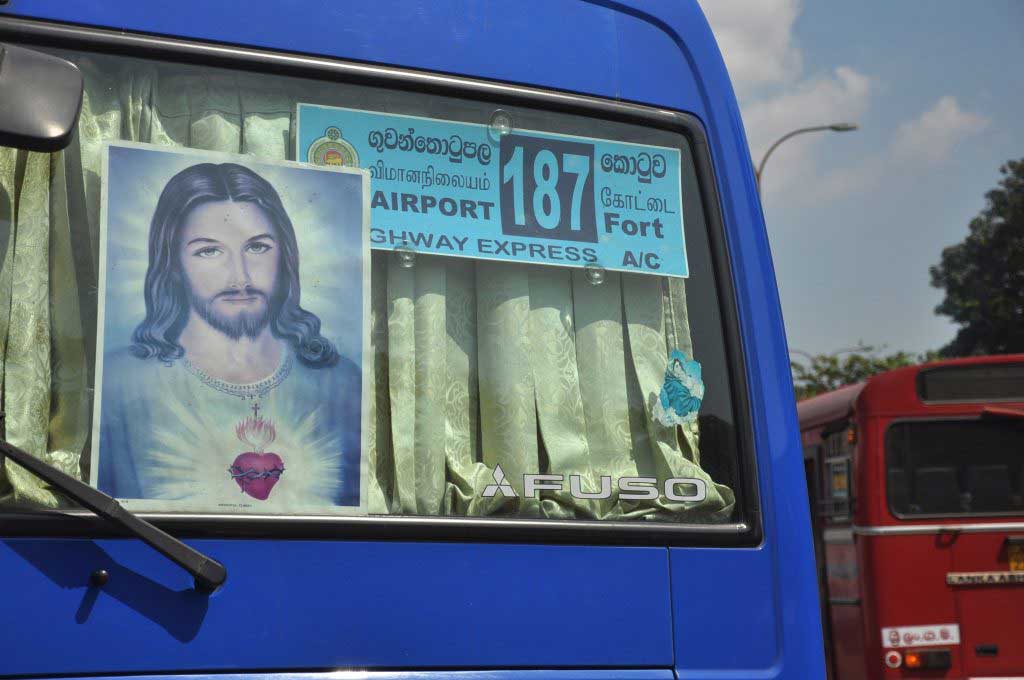
The bus number is 187 (air condition bus) and uses the expressway to reach Colombo, which takes around 1 hour, but could be more, depending of the traffic.

The 187 bus run 24h.

It cost 100 LKR.

The bus let you in Colombo-Fort, close from the Railways station and from Colombo Central Bus Stand and Bastian Mawatha Bus Station.

Bus 187 that links the airport to Colombo Fort. 24 hours. 100 LKR

Bus 187 that links the airport to Colombo Fort. 24 hours. 100 LKR

How to go from Colombo to Kandy

  1. The cheapest option is the train, that cost you 190 to 280 LKR (depending if it’s “express” or “normal” train) and take 3 hours, but arrive a bit later that the schedule. Although is difficult to have a seat, as the reserved seat (just for 1st class) are sold out in advance. There are 8 trains a day doing Colombo-Kandy trip.
  1. The most expensive option it hired a taxi, but also the faster and more confortable. An option to have in consideration if you travel in a group of 4.

Táxi Colombo to Kandy: 6000 LKR (2 h)

  1. The buses are the easiest option, not expensive and are always available during day time since 5 in the morning. They are uncomfortable, and due to the intense traffic the drivers are constantly speed and braking, making any trip that last more than 3 hours a tiresome journey, also because of the constant beeping of the bus and all the others vehicles that circulate on the road. The buses run most of the time full and sometimes is difficult to get a seat. The trip takes at least 4 hours as the bus stop every time that someone in the road side is waiting, no mater if it is a bus stand or not!!!

There are also a/c buses that departure form Bastian Mawatha Bus Station, located in the opposite side of Central Bus Station. If you leave the train station, turn left and keep walking along that sidewalk, passing in front of a kind of street market and stall until you arrive to a more empty area; keep walking in the same direction until you see a dirty road and on your left there’s an entrance to the Bastian Mawatha Bus Station.

Here you need to find (is better just ask) for a/c bus to Kandy. There are small blue buses that usual and get quickly full, but you can wait for the next bus that don’t take more than 15 minutes to come.

Bus Colombo Forte to Kandy: 265 LKR (almost 4 hours)

Sri Lanka_bus_DSC_6874
“normal” bus in Sri Lanka
Sri LAnka_bus Colombo-Kandy_DSC_7063
Bus Stand at Bastian Mawatha Bus Station. Colombo
Sri LAnka_Bus Colombo-Kandy_DSC_7065
Ar-condition Bus from Colombo to Kandy

How to go from Airport (Negombo) straight to Kandy

If you want to go north or to east, you don’t necessarily need to go to Colombo, instead you just need to Katunayake Bus Terminal, and from there you can take a direct bus to Kandy or in the direction of Dambulla, Anuradhapura, Polonnaruwa, Jafna but for this destinations you must change bus (maybe more than one time) probably in Kurunegala, and later in others “unkown” cities).

The trip from Katunayake to Kandy takes more that 4 hours, and is not guarantee that you’ll have a seat.

The ticket costs 133 LKR.


Bus from Katunayake to Kandy

a bit about ATMs in Sri Lanka:

The maximum amount of money in Sri Lanka ATMs is 50.000 LKR, but also depends of the maximum amount allowed to withdrawal in your country. The Portuguese bank have the maximum of 200€ per withdrawal and 400€ per day; that makes 30.000 LKR the maximum amount that you can get per withdrawal.

In Sri Lanka banks usually charge a fee 200 LKR (HNB-Hatton National Bank) to 300 LKR (Comercial Bank…for exemple).

Sri Lanka population: 20.5 millions

Sri Lanka Life expectancy: 74 years


  • « Go to Previous Page
  • Page 1
  • Interim pages omitted …
  • Page 5
  • Page 6
  • Page 7
  • Page 8
  • Go to Next Page »

Footer

search

Tags

Assam Bali Border Crossing Borneo Colombo Esfahan Fes Food Gilis Hiking Hikkaduwa hokkaido Imlil Istanbul Itinerary Jakarta Java Kandy Kashan Kathmandu Kumano Kodo Lombok Marrakesh Meghalaya Meknes Mekong Nagaland Natural Park Northeast States Ouarzazate Sarawak Shiraz Sichuan Province Sumatra Tabriz Taipei Tehran transportation ubud Varanasi Visa Yangon Yazd Yogyakarta Yunnan Province

I’m Catarina, a wanderer from Lisbon, Portugal… or a backpack traveller with a camera!

Every word and photo here comes from my own journey — the places I’ve stayed, the meals I’ve enjoyed, and the routes I’ve taken. I travel independently and share it all without sponsors or ads, so what you read is real and unfiltered.

If you’ve found my blog helpful or inspiring, consider supporting it with a small contribution. Every donation helps me keep this project alive and free for everyone who loves exploring the world.

Thank you for helping me keep the journey going!

BUY ME A COFFEE

Categories

Recent Posts:

  • How to go from Hualien to Dulan Beach
  • Taroko Gorge: between marble cliffs and emerald rivers
  • Hualien: a dull gateway to Taroko Gorge
  • Taiwan: Itinerary for an 16 day trip
  • Vietnam: Itinerary
  • 3 months in India: Kolkata, Tamil Nadu, Karnataka, Goa and Kerala
  • Backpacking Turkey in 24 Days: itinerary & costs
  • English
  • Português

© Copyright 2026 Stepping out of Babylon · All Rights Reserved · Designed by OnVa Online · Login