• Skip to main content
  • Skip to footer

Stepping Out Of Babylon

Travel & Photography

  • About me
    • Contact
  • Destinations
    • Africa and Middle East
      • Iran
      • Lebanon
      • Morocco
      • Turkey
    • East Asia
      • China
      • Japan
      • Taiwan (Formosa)
    • South Asia
      • Bangladesh
      • India
      • Nepal
      • Sri Lanka
    • Southeast Asia
      • Cambodia
      • Indonesia
      • Lao
      • Malaysia
      • Myanmar
      • Singapore
      • Thailand
      • Vietnam
  • Itineraries
  • Travel tips
    • Border crossing
    • Hiking and Natural parks
    • Food Journey
    • Visa
  • Photography

Stepping out of Babylon

Shangri-lá (Zhongdian)… reality or fiction?

(English version from the text posted in Jun/2014)

The city, where clearly dominates the Tibetan culture, was in its origins named Gyeltang or Gyalthang but changed to Zhongdian under Chinese influence since the 50’s. But it was when it was recognised its tourist potential, with the old zone formed by an intricate and narrow set of streets, with its houses showing the traditional architecture of the region, in stone and richly carved wood that starts to be called Shangri-la. The name came from a novel from the British writer James Hilton, that apparently placed the story in this city, conferring to this place a mystical atmosphere, synonymous with paradise.

On arrival, after the short bus trip from the bus terminal to the old part of the city, Shangri-la show a completely desolate scenery, with a big area damaged by a fire that in January of this year destroyed part of the old city. The landscape is now occupied by the scorched debris and by the machines and trucks that clean and rebuilds the old city, giving to the place an apocalyptic atmosphere.

In spite of this initial vision, the stay in Shangri-la (Zhongdian) was pleasant, with the days spent between visits to the temple that dominates the old part of the city, next to which there is a gigantic prayer wheel. The gold that decorates the prayer wheel stands out among the grove that covers the modest hill. Strolling through the streets of the old city and making some inroads into the modern part of the city, of Chinese layout and architecture, but where you can find a strong presence of people from different ethnic groups, proudly wearing their traditional costumes often combined with western clothing.

The negative impression from the first sight was dissipating, and the fact that the fire destroyed part of the city’s patrimony also caused it to remove the commercial and excessively touristy atmosphere that previously existed, and that somewhat de-characterizes the cities of Dalí and Lijiang, visited before.

Here you can begin to feel the effects of altitude… insomnia, headaches, shortness of breath, and heart beating each time you climb a ladder or a steeper slope.


parte antiga da cidade destruída por um incêndio no inicio deste ano, oferendo uma imagem desolada de Shangri-lá
old part of  Shangri-lá after the fire
Parte antiga de Shangri-lá (Zhongdian)
 Shangri-lá (Zhongdian) old town
Shangri-lá (Zhongdian)
Gigantesca Roda de Orações situada na colina junto da praça central, onde se encontram mais dois templos budistas, um de arquitectura tibetana e outro, mais moderno de arquitectura chinesa
Prayer Wheel
Shangri-lá (Zhongdian)
Roda de orações e templo budista que encimam a pequena colina à volta da qual se desenvolve cidade antiga de Shangri-lá (Zhongdian)
Prayer wheel and Buddhist temple at Shangri-lá (Zhongdian)
Mercado de Zhongdian
Zhongdian market
Mercado de Zhongdian
cooking dumplins at Zhongdian market
Stupa situada num dos cruzamentos da cidade poupados ao incêndio, mas cuja área envolvente foi praticamente destruida
Stupa in on town
Templo budista localizado numa colina a sul de Shangri-lá, um pouco mais afastada do centro da cidade que é conhecido por “templo das galinhas” visto situar-se numa zona mais rural
Buddhist temple called “chicken temple”
Rodas de orações no exterior do “templo das galinhas” em Shangri-lá
Prayer whell from the “chicken temple” in Shangri-lá
OLYMPUS DIGITAL CAMERA
“chicken temple” in Shangri-lá
“templo das galinhas” em Shangri-lá
“chicken temple” in Shangri-lá
“templo das galinhas” em Shangri-lá
“chicken temple” in Shangri-lá
documentos contendo escritos sagrados que são geralmente envolvidos em panos e que se encontram frequentemente nos mosteiros e nos templos budistas
Buddhist holy scripts
Pinturas em estilo “tankha” com informação relacionada com a medicina tradicional tibetana que recorre ao uso de plantas e minerais
“tankha” paitings
Templo no museu dedicado à cultura Tibetana existente no centro de Shangri-lá
Tibetan culture Museum in Shangri-lá

Population: 120.000

Elevation: 3270 m

Sumtseling Monastery… an impressive Buddhist temple

(English version from the text posted in Jun/2014)

A few kilometers north of Zhondgian is the famous Sumtseling Monastery (Sumtseling Gompa), which is considered to be the most important Buddhist monastery in Southwest China, with more than 300 years, with about six hundred monks.

The monastery, dominating one of the slopes of the mountains that surround the city of Zhondgian is formed by multiple buildings, mainly destined to the lodging of the monks, emphasizing in the top of the elevation the main temples crowned by the golden glow of the roofs.

In spite of the presence of large groups of visitors guided by guides that at the expense of small loudspeakers lead the visitors through the various temples, it is possible to find in this monastery lonely nooks that invite to the introspection, while observing Buddha statues covered of antiquity and to appreciate the wind that drags the cold dry air from the summit of the mountains and fiercely shakes the bodies exposed to the implacably intense sun that the few clouds that scatter the sky can not cushion.


Mosteiro de Sumtseling

Mosteiro de Sumtseling

Mosteiro de Sumtseling

Mosteiro de Sumtseling

Mosteiro de Sumtseling

Mosteiro de Sumtseling

Mosteiro de Sumtseling

Mosteiro de Sumtseling

Mosteiro de Sumtseling

Mosteiro de Sumtseling

Mosteiro de Sumtseling

Mosteiro de Sumtseling

Mosteiro de Sumtseling

Mosteiro de Sumtseling

Mosteiro de Sumtseling

Mosteiro de Sumtseling

Mosteiro de Sumtseling

Mosteiro de Sumtseling

Mosteiro de Sumtseling

Mosteiro de Sumtseling

Mosteiro de Sumtseling

Mosteiro de Sumtseling

Mosteiro de Sumtseling

Mosteiro de Sumtseling

Mosteiro de Sumtseling

Mosteiro de Sumtseling

Mosteiro de Sumtseling

Mosteiro de Sumtseling

Mosteiro de Sumtseling

Mosteiro de Sumtseling

Mosteiro de Sumtseling

Mosteiro de Sumtseling

Mosteiro de Sumtseling

Mosteiro de Sumtseling

How to visit the Sumtseling Monastery

  • Tickets: 140 yuan (ticket includes transportation from the Monastery )
  • For those who want to visit the Monastery for free should take the Bus 3 (2 yuan), which passes close to the Old Town, towards North; the driver requires all tourists to leave to move to gigantic installations ticketing.

To the rear of this building are the buses that transport visitors directly to the monastery.

Skirting the building on the left (the right side is a guard) picks up the road that goes towards the monastery.

The path is always going up but doesn’t take more than 15 minutes, and allows you to make a detour to the left toward a hill where they run the “sky burial” and where it has a phenomenal view, both in terms of landscape as the Monastery.

Continuing the ascent, you reach a high point where you can go straight down the road towards the main entrance of the monastery or alternatively down toward a lake, bypassing it with a wooden walkway; the latter route is longer but more beautiful.

Arriving at the monastery, you must walk to the left side (the main entrance is on you right) to find a secondary entrance that is not guarded.

From here you climb up to the temples.

To exit, one can use the main door because there is no control.

The return can be done by Bus 3 that part of the enclosure opposite the main entrance of the Monastery; ticket price of bus: 2 yuan.

Lijiang… a modern ancient city

(English version from the text posted in Jun/2014)

While in Dalí dominates the grey stone, in Lijiang the brown of the wood stands out. Larger and more touristy, with a large number of bars and restaurants, an endless number of souvenir shops. The narrow streets, arranged in an intricate mesh, fill up throughout the day, making a walking through the old part of the city in a test of patience.

With the small streams running gently through the narrow canals that run along the main streets, the shade of the trees whose green scatters with the fuchsia of bougainvillea, the squares where groups of women gather to dance to the sound of folk music and with the intricate wood carving which decorates the buildings, the ancient city of Lijiang is the place of choice for Chinese tourism which found here the ideal setting for photos with elaborate poses, sometimes wearing the colourful traditional costumes of the various ethnic minorities that can be rented in the shops.

Like Dali, Lijiang’s sinfulness and lack of spontaneity are not expected in an ancient city, where the buildings appear to be new, with some still under construction, where the pavement of the streets is impeccably arranged, where the temples are painted new, where everything was thought to be safe, functional and pleasing to the eye… one might say, with a bit of irony: a modern old town!!!

pequenas embalagens de chá à venda nas muitas lojas especializadas que facilmente se encontram espalhadas na parte antiga da cidade, onde se pode fazer uma prova de chá servidos com o ritual e o requinte tradicionais chineses
Lijiang
Parte antiga de Lijiang onde as ruas estreitas protegem do intenso sol que rompe o permanente céu azul que cobre a cidade
Lijiang
Lijiang
Lijiang

Lijiang
Lijiang

Lijiang
Lijiang

lojas com a turística iconografia comunista, onde a fotografia de Mao, tendo já perdido o respeitoso significado, faz parte dos merchandising chinês
Lijiang

loja onde sobressaem os artigos religiosos budistas, muitos de inspiração tibetana, muito populares entre os visitantes chineses que os compram mais por recordação do local do que por devoção religiosa
Lijiang
Chá prensado e embalado em forma de discos, cujo preço varia conforme a qualidade e antiguidade do produto podendo ultrapassar as centenas de euros
Lijiang

"disco" de chá embalados em folhas de bambu
Lijiang

Population: 1200.000 (Old town e New town)

Elevation: 2400 m

Dalí… the postcard city

(English version from the text posted in Jun/2014)

Dali is a small town in the Yunnan region which stands out because it is located on the trade route between China and Burma (Myanmar) and although it has lost importance with the closure of this access it has been able to take advantage of its architectural features to become a tourist place, attracting thousands of visitors, mostly Chinese, who come here on a day trip or choose to stay longer attracted by the picturesque calm of the village.

The old part of Dali is concentrated in the interior of thick lower walls, forming a square, with a door in each of the faces, oriented according to the cardinal points. Of these ornate doors with elaborate wooden constructions painted with gaudy corrals and which contrasts strongly with the gray of the stones that form the walls, one gets a clear idea of the privileged location of the city, which on the one hand has the massive presence of a seemingly An insurmountable mountainous chain, from where small streams flow through the city, flowing into Lake Dian (Diã Chí) that is on the opposite side.

The gray of the stone that serves as the base for most of the buildings and the clay used in the fabrication of the characteristic tiles that uniformly cover the houses of Dalí, make the city a gray and dull stain that defers in the blue of the sky that punctuated of thick white clouds frame Almost always the landscape.

The main streets are exclusively dedicated to the sale of traditional items from the region, between weaving and goldsmith, food products dominated by dried meat and flower-based sweets, amulets and clothes inspired by the traditional costumes of various ethnic groups and many tea shops, by which the Yunnan region is famous.

In the evening, countless restaurants fill up, livening the streets with live music, along which craftsmen expose their work, in a more creative and alternative approach to the local crafts.

In Dali, the Bai ethnic group predominates, whose traditional costumes are only worn by guides who lead large groups of Chinese tourists through the city streets, in silent electric vehicles, visiting museums and temples and strolling along the walls surrounding the old part of the city.

From Dalí lies a touristy and picturesque town, calm and organised, but where a certain spontaneity is lacking, breathing a “postal” atmosphere. The small market located in one of the corners of the wall offers a bit of color and exoticism due to the diversity of the products on display, some difficult to identify in the eyes of a Westerner not accustomed to Chinese cuisine.

Dalí
Dalí

Dalí
Dalí

Dalí
Dalí

Ao fim do dia, numa das maiores praças da cidade reúnem-se mulheres que ao som de musica chinesa praticam exercício que mais se assemelha a uma dança
Dalí

ao longo de algumas das ruas, correm pequenos riachos
Dalí

Dalí
Dalí

Um das portas de acesso à cidade antiga de Dalí que se encontra cercada por espessas muralhas
Dalí

Dalí
Dalí

Dalí
Dalí

Dalí
Dalí

Uma das ruas principais de Dalí, totalmente dedicadas ao comércio de produtos locais pelos quais esta região da província de Yunnan é famosa, como doces feitos à base de flores, carne seca, e especialmente o chá
Dalí

Dalí
Dalí

Dalí
Dalí

Mercado de Dalí
Dalí Market

Mercado de Dalí
Dalí Market

Mercado de Dalí
Dalí Market

OLYMPUS DIGITAL CAMERA
Dalí

OLYMPUS DIGITAL CAMERA
Dalí

Population: 110.000

Elevation: 1900 m

How to apply for Indonesian visa in Bangkok

The rules changed in 2016, so maybe the Indonesian visa system looks a bit confuse when you search information on the Internet. Basically, there are three types of Visa to enter in Indonesia for tourists:

  • Free visit visa:
    • This visa is valid for 30 days, only
    • You CANNOT extend this visa
    • Check if your passport country is on the list of the 90 countries elected for free visa
    • Passport must be valid for 6 months and must have at least one page free


  • Visa on arrival:
    • Valid for 30 days
    • You can extend this visa for more 30 days at the Immigration services in Indonesia; the processes can take three days to a week depending on the city where you apply, and you need to go 3 times to the Immigration office (apply and pay, give the passport, and collect the passport); is better to choose a Immigration office in a more touristic area as they are more prepared for foreigners that the small cities where the process get more bureaucratic; you don’t need a sponsor anymore
    • You can arrange this visa at the immigrations services at the Indonesian international airports and seaports
    • It costs: 35 USD (and must be paid in USD cash)
    • Passport must be valid for 6 months and must have at least one page free


  • 60 days visa:
    • to get the 60 days visa, you must apply for this visa before entering Indonesia, in one of the Immigration offices
    • It costs: 50 USD (and must be paid in USD cash)
    • Passport must be valid for 6 months and must have at least one page free

(see details of the application process below)


NOTE: If you have already been in Indonesia with a working visa, I got informations that the Indonesia Immigration services in Bangkok issues 60 day tourist immediately after business visa expires, without any problem!

60 days visa payment recipe

Overstaying in Indonesia

If you really want to stay until the end of your visa in Indonesia, take into consideration that the day that you arrive counts as day 1, and the day that you leave the country must also be included.

If you overstay your visa you’ll need to pay a fee of 300.000 INR for each day.

60 days visa application process at Indonesia immigration office in Bangkok:

day 1: submit the application, give the passport and pay

  • at the immigration office, you’ll find the application form (you don’t need to use the ones that are on the website)
  • fill the form and proceed to the next room
  • you must give at the counter:
    • your passport, valid for 6 months and must have at least one page free
    • 1 recent passport-sized photograph
    • Copy of the flight ticket (they ask me for a return ticket but I told them that didn’t have any idea in which island I will be after two months)
  • On the next counter, you must pay the visa fee: 50 USD that and must be paid in USD cash. The banks nearby the Indonesia embassy don’t exchange baht to foreigner currencies. The only one that I found was nearby the Platinum Fashion Mall. Is better to bring the USD with you to avoid stress and long walks.
  • On the payment recipe, is written the day and hour (always in the afternoon) when you can pick your passport.


day 2: pick your passport

After two working days (minimum) you must pick your passport with the visa stamp. For that just show the payment receipt.


note 1:

the Indonesian Immigration office in Bangkok don’t give a new 60 days visa if you already have been in Indonesia for a 90 days period. You must wait 90 days outside Indonesia before apply again for a 60 days visa... but the Immigration office in Singapore don’t apply this “rule” that in fact isn’t written on the official website.

note 2:

the Indonesian Immigration office at Kuching (Borneo) the 60 days visa can be arranged on the same day.


Indonesia Immigration office in Bangkok

Visa Application Submission:

Monday – Friday: 09:00-12:00

Visa Collection:

Monday – Friday: 14:00-16:00

Watch out for the holiday calendar, as the immigration services in Bangkok will be closed on Indonesia holidays as also in Thailand holidays.

Address:

The Embassy of the Republic of Indonesia

600-602 Petchburi Road, Ratchatewi, Bangkok 10400

Phone: (66-2) 2523135-40

e-mail : kukbkk@ksc.th.com

The closest metro/subway line is the Ratchathewi BTS Station, about 800 meters, but there are a few buses passing just in front of the Indonesian embassy.

Indonesia Immigration office in Bangkok


Note:

Dress properly every time you visit the Immigration office, in Thailand or in Indonesia: no shorts, no short skirts, no bare shoulders… “dress modestly”!

Kunming… the life around the Green Lake

(English version from the text posted in Jun/2014)

Kunming, the capital of Yunnan province, breathes a modern and cosmopolitan atmosphere, with wide avenues, organised traffic, some green spaces and which despite its slightly more than 1 million inhabitants offers a calm and relaxed atmosphere.

The so-called Green Lake dominates the center of Kunming, if one can call this area a center, as most of the Chinese cities practically nothing remains really old, with traditional buildings already being replaced by concrete buildings, some of which are already being demolished to give way to modern buildings, and with huge orthogonal streets, with wide sidewalks where the traffic circulates at the rhythms of luminous signs.

The state of Yunnan, bordering Tibet, Burma, Laos and Vietnam and its population mirrors these influences well, with the highest concentration of ethnic groups and where nearly half of the population is non-Han, the major Chinese ethnic group.

A little of this ethnic diversity is evident in the activity around Green Lake Park, where, in the shadow of countless trees, various groups gather to perform dances, forming wheels around modest sound columns, filling the space with color and variety of traditional costumes that many insist on wearing.

Green Lake, Kunming
Green Lake, Kunming

Green Park, onde pela manhã muitos dos habitantes de Kunming praticam tai-chi
Green Park, where in early morning people gathering to practice tai-chi

Green Lake, Kunming
Green Lake, Kunming

Green Lake, Kunming
Green Lake, Kunming

Green Lake, Kunming
Green Lake, Kunming

Kunming
Kunming

Green Lake, Kunming
Green Lake, Kunming

Green Lake, Kunming
Green Lake, Kunming

Kunming
Kunming

Kunming
Kunming

Kunming
Guang Hua, the “old street” where the old buildings are being renew

Kunming
one of the many comercial areas with the most famous international brands

Kunming
Kunming

Kunming
Kunming

Kunming
school kids, Kunming

Kunming
Kunming

Kunming
islamic temple in Kunming

Kunming
Kunming

Kunming
playing cards is a popular outdoor activity

Population: 1.044.000

Elevation: 1890 m

Nasi Campur… so simple and so delicious!!

In the Indonesian language “nasi” means rice and “campur” means mixture, and nasi campur is basically a dish that mix steamed rice with other dishes: meat, fish, vegetables or egg, seasoned with sambal (see below).

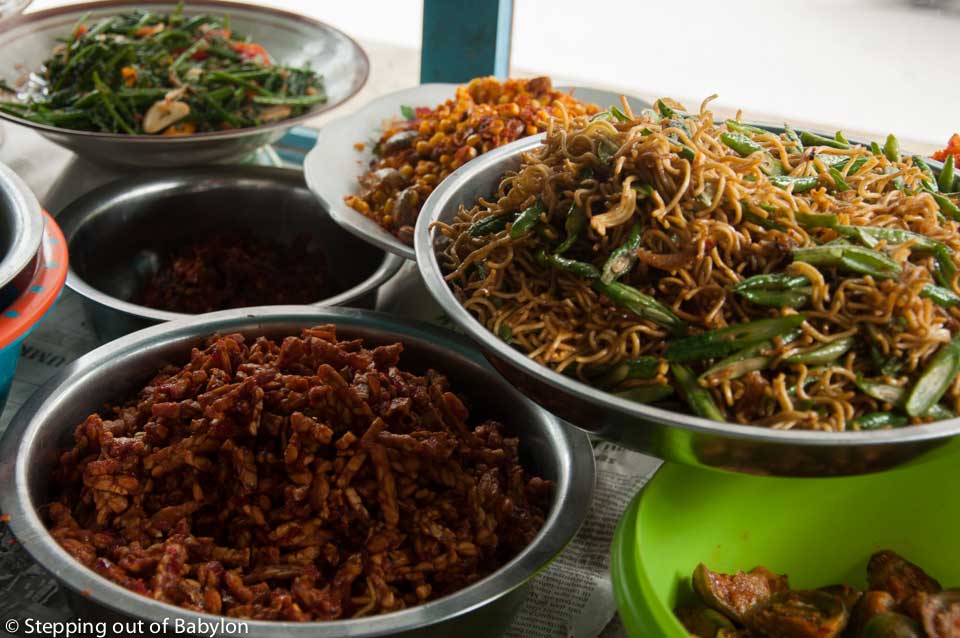
In Java, the nasi campur is usually served with a portion of fried noodles, a style that hardly be found in other Indonesian Islands, which probably is an old influence from Chinese gastronomy, as also the tofu that is a regular presence in the Javanese cuisine.

In a certain way, nasi campur (pronounce as “champoor”) is quite similar to what can be found in Sumatra Island, called nasi kapau or nasi padang, but with different ingredientes and recipes, with the Javanese food being cooked with less gravy, less spicy and more sweetness than the neighbouring island. The presence of noodles, tofu and tempeh also makes a difference from this rice dish served in Java and in other islands.

nasi campur
nasi campur served in the traditional way in banana leaf and cooked on Javanese style with fry noodles, sweet tempeh and some vegetables… with a bit of a grind coconut, fried, sweet and seasoned with spices
nasi campur
The Javanese “nasi campur” in a vegetarian version, just with sit fry vegetables, fry noodles and sweet tempeh over a scoop of rice… the “sambal” stands up in the plate by it’s bright red colour

Thanks to the usual presence of vegetables (sayur in Indonesian language) like green beans, papaya and cassava leaf, bean sprouts, cabbage, spinach and other green leaf vegetables… the Indonesian cuisine, despite not being vegetarian (not even in Bali that is an island dominated by Hinduism) has a lot of options for vegetarians. And the frequent presence of tofu and tempeh especially in Java, Bali and Lombok create a wider range of options, even for the ones that want to avoid eggs.

But watch out if you are a “purist” about vegetarianism as there are a few animal products hidden in some of the Indonesian dishes, like the shrimp past that is used in the sambal… some super-small fishes mix in tempeh and vegetable dishes… and also in some crackers served with gado-gado and other salads that are flavoured with peanuts or shrimp past.

the most popular places to eat the "nasi campur" are small informal eateries that are easily identify by the window where the food is exposed in tray os plates... the noodles are an influence of the Chinese gastronomy but the "tempeh" is a traditional Indonesian food made from fermented soy beans, which can be cooked in different ways
the most popular places to eat the “nasi campur” are small informal eateries that are easily identify by the window where the food is exposed in tray os plates… the noodles are an influence of the Chinese gastronomy but the “tempeh” is a traditional Indonesian food made from fermented soy beans, which can be cooked in different ways

Something about tempeh…

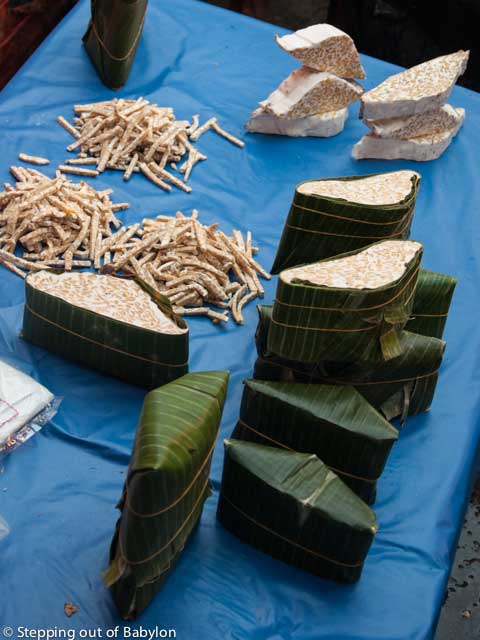
But the Javanese cuisine as something unique to offer: the tempeh!! Tempeh is made from fermented soybean, that gets aggregated forming a soft but compressed block, sometimes warped in banana leaf, which is sold fresh in local markets all over Java but that can also be found in nearby islands of Sumatra, Bali and Lombok.

Due to its compact consistency, the tempeh can be cut in slices or chopped in small pieces. Unlike most of the soy products, the tempeh isn’t an influence from China, but an Indonesian product that is present almost in every restaurant that serves rice dishes.

Is difficult to identify the taste of the tempeh as it isn’t something that stands up in a dish despite being a fermented product, but it can be described as something between beans and mushrooms, resulting from the fermentation of the soybeans that creates a thin layer of mould. It has a heavy and thick consistency but smooth on the month, giving a feeling sensation in the stomach.

The same way as the tofu, the tempeh can be simply deep-fried (goreng) or simply fried in a pan, but can also be cooked with fry peanuts in a sweet and red sauce made from spices and sugar… that is one on the reason why the Javanese food is famous for the sweetness.

[columns] [span6]

tempeh
The tempeh is usually sold in blocks that can be cut in slices or chopped in small pieces.. according to the time of the fermentation the tempeh may look different and have distinctive smells

[/span6][span6]

tempeh
Tempeh packed sold in markets

[/span6][/columns]

tempeh
tempeh sold in a street stall and wrapped in banana leaf… where is visible the layer of mould between the soybeans
fry tempeh... one of the most popular way to cook the tempeh
fry tempeh… one of the most popular way to cook the tempeh… delicious and crunchy

Sambal?!?!

Sambal (don’t mistake with “sambol” a Sri Lankan dish made from coconut) is a spicy condiment made from chilies, usually with a bright red colour but that can also be found in green. The sambal is a must in any nasi campur plate and gives a special touch to any meal. Sometimes a meal can just be some fried tempeh seasoned with sambal and served with a portion of steamed rice!

The sambals in Indonesia are hot but not extremely spicy and the recipe also includes tomato, garlic, shrimp paste and lime juice… but can have more other ingredients, with each restaurant having its own recipe.

The Indonesian sambal change from island to island, from market to market, from restaurant to restaurant… but are a mandatory presence at any rice dish served in Indonesia.

Sambal
Different kinds of “sambal” sold in a Market in Bukittinggi (Sumatra). The “sambal” is a condiment that can be find everywhere in Indonesia that is always added to a rice dish
Tempeh served with sambal and rice


Where to eat nasi campur?

Basically, you can find nasi campur everywhere! It is served in a la carte restaurants, in informal eateries where the food is exposed in trays at the window, in a improvised stall set up in front of a house, in a hidden back street kiosk or inside the markets in a kind of food courts. The nasi campur can also be found in street hawkers that usually hang around the food markets, caring a basket loaded with the familiar paper cones that wraps the food.

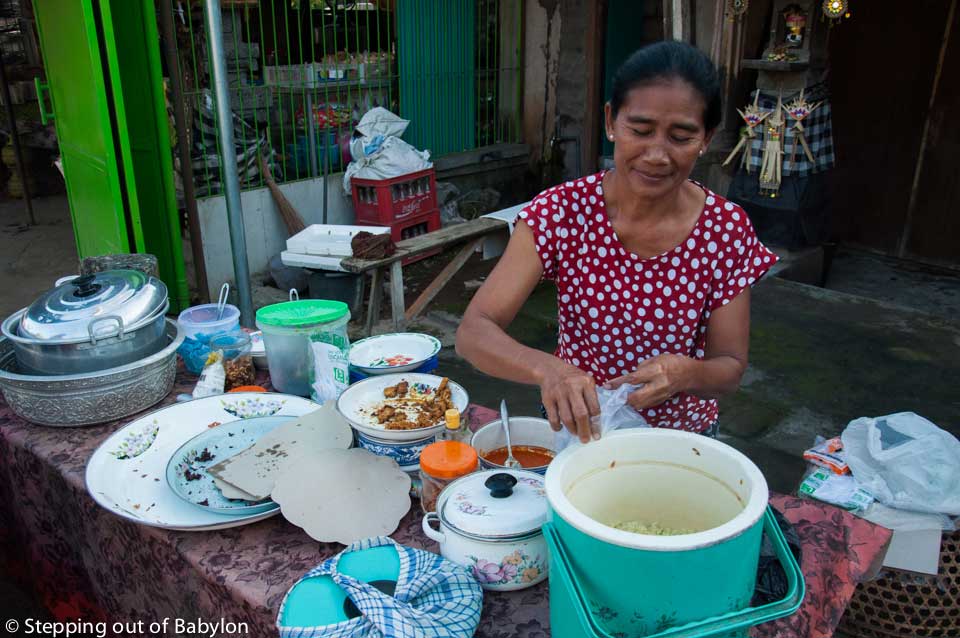
Early morning is the best time to find this informal way to eat the nasi campur, as many housewives set up a table on the street selling food, most of the times for take-away by people on the way to the work, but where is always possible to ask for a plate and seat on the side walk, interacting with other customers and enjoying the movement of the street.

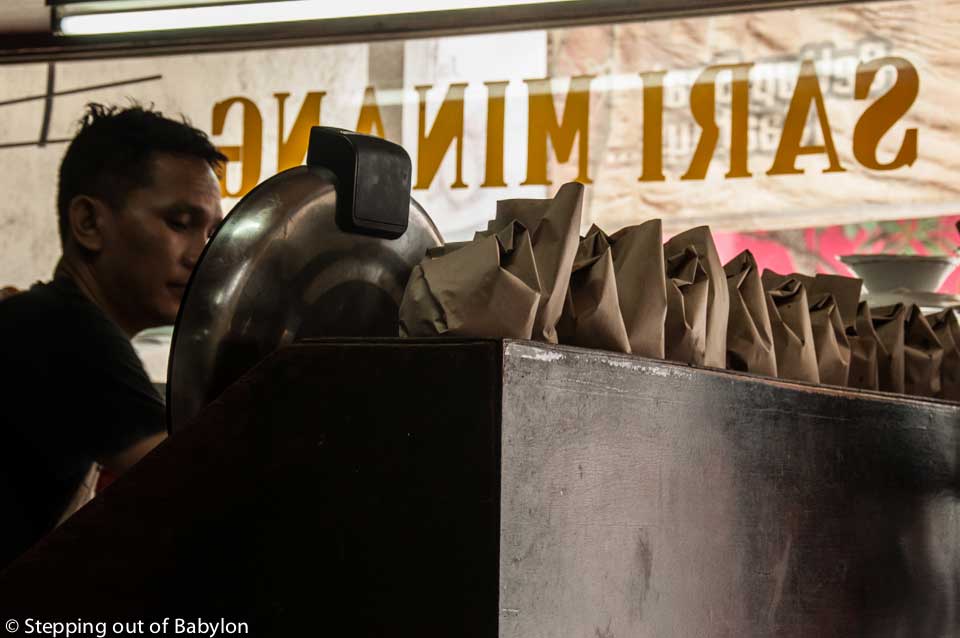
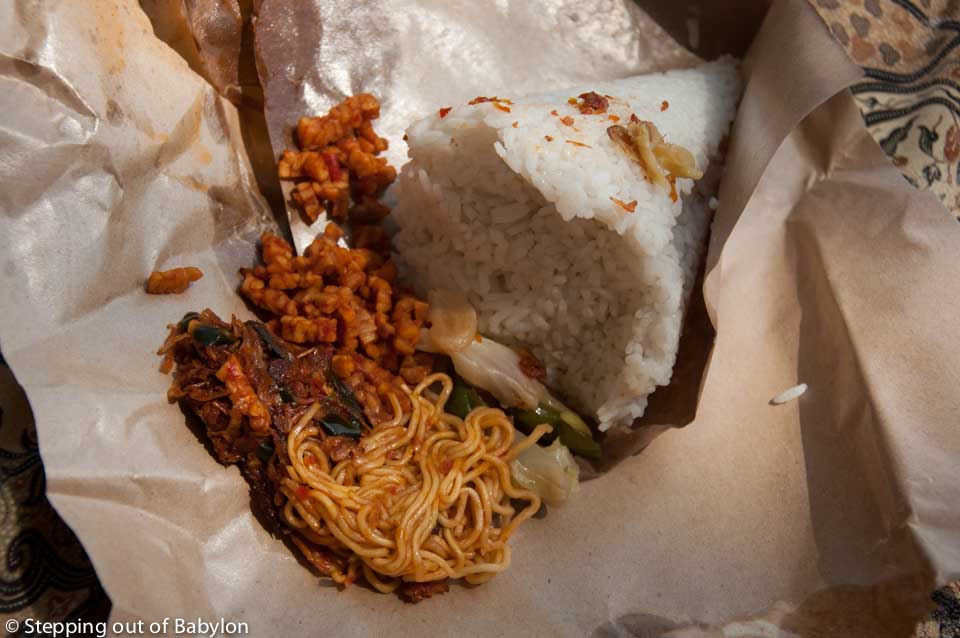
small eateries that are a bit everywhere in Indonesia that serve nasi campur, where the take away sytem is very popular, with the food wraped in paper sheets forming a cone
small eateries that are a bit everywhere in Indonesia that serve nasi campur, where the take away sytem is very popular, with the food wrapped in paper sheets forming a cone
Nasi campur can also be found in improvised food stall that pop up in the mornings along the streets
nasi campur for take away: rice, fry noodles, sweet fry tempeh

Despite the fried rice being the dish easiest to find in Indonesia, mostly due to the easy and quick way to prepare, the nasi campur can be considered the most popular Indonesian food staples, including here all the variations resulting from the different cultures, traditions and climates that characterise this huge country!

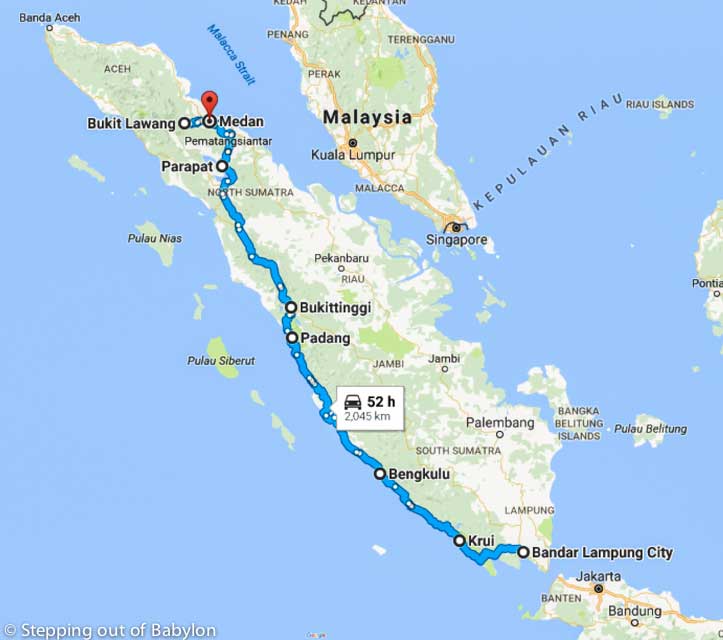
22 days in Sumatra: itinerary & costs

Itinerary:

  • Ferry crossing Merak-Bakauheni (from Java to Sumatra by ferry)
  • Bandar Lampung: 1 day
  • Krui: 5 days
  • Bengkulu: 1 day
  • Padang: 3 days
  • Bukittinggi: 4 days
  • Lake Toba: 3 days
  • Bukit Lawang: 3 days
  • Medan: 2 days

Costs:

13.4 €/day

… considering traveling solo, eating just local (vegetarian) food, no a/c rooms, sometimes dorms, travel by public transport, no alcohol and no soft drinks, making my own laundry and walking a lot on foot… Shopping and souvenirs are also not included, as well health expenses and communications (SIM card, mobile, telephone, internet…).

Costs in Sumatra:

  • room (fan): minimum 60.000 Rp up to 100.000 Rp (one person); in Sumatra the accommodation is usually cheaper that other Indonesian islands. There are many places with dorms in the cities for 60.000 or 80.000 Rp; nearby the beach areas the prices increase reaching 100.000 Rp. Most of the times the breakfast isn’t included.
  • meal: less than 20.000 Rp for a meal (local food, street-food, vegetarian meals). The water is usually free at the guesthouses, as also coffee and tea.
  • rent a scooter: 70.000 Rp/day or 100.000 Rp/day; a litter of petrol: 10.000 Rp in road side shops (at the pump station is 8.500 Rp/l)
  • angkot (small local bus): costs from 2.000 Rp to 10.000 Rp for an urban area trip.
  • ojek (moto-taxi): 10 km cost around 15.000 Rp (but the price of the ojek depends on your bargain skills and the needs of the driver, weather, time of the day…).
    At Medan the GoJek, Uber and Grab companies offer moto-taxi services, that are an easy way to move around.
  • There is only one passenger train service in Sumatra (Bandar Lampung to Palembang), so the bus is the most common option but the distances are big and sometimes the plain is the best option as the prices are not much higher than the bus, and a bus trip of 15 hours can be mande in 1 hour by plane. Still… all this Sumatra trip was done by land!!!!
  • A bus trip of 680 km costs around 200.000 Rp, in a air-con bus.
  • At Sumatra the cost with transportation increase significantly compared with Bali, Lombok or Java) as the distances are bigger. But the accommodation is cheaper than in the other islands that i visit.

Note: this trip was made duriing Jun 2017, which still is still considered the low season, when the prices of the accommodation are lower, that can be significant at beach areas.

MAP_Bandar Lampung City, Lampung, Indonesia to Medan - Google Maps-1-2
Sumatra: itinerary


see also:

Masakan Padang… the most popular Indonesian cuisine

  • « Go to Previous Page
  • Page 1
  • Interim pages omitted …
  • Page 8
  • Page 9
  • Page 10
  • Page 11
  • Page 12
  • Interim pages omitted …
  • Page 31
  • Go to Next Page »

Footer

search

Tags

Amed Arugam Bay Assam Bali Bogor Border Crossing Borneo Colombo Esfahan Fes Food Gilis Hiking Hikkaduwa hokkaido Istanbul Itinerary Jakarta Java Kashan Kohima Kumano Kodo Lombok Marrakesh Meghalaya Meknes Mekong Nagaland Natural Park Northeast States Ouarzazate Sarawak Shan State Shiraz Sichuan Province Sumatra Tabriz Tehran transportation Varanasi Visa Yangon Yazd Yogyakarta Yunnan Province

I’m Catarina, a wanderer from Lisbon, Portugal… or a backpack traveller with a camera!

Every word and photo here comes from my own journey — the places I’ve stayed, the meals I’ve enjoyed, and the routes I’ve taken. I travel independently and share it all without sponsors or ads, so what you read is real and unfiltered.

If you’ve found my blog helpful or inspiring, consider supporting it with a small contribution. Every donation helps me keep this project alive and free for everyone who loves exploring the world.

Thank you for helping me keep the journey going!

BUY ME A COFFEE

Categories

Recent Posts:

  • How to go from Hualien to Dulan Beach
  • Taroko Gorge: between marble cliffs and emerald rivers
  • Hualien: a dull gateway to Taroko Gorge
  • Taiwan: Itinerary for an 16 day trip
  • Vietnam: Itinerary
  • 3 months in India: Kolkata, Tamil Nadu, Karnataka, Goa and Kerala
  • Backpacking Turkey in 24 Days: itinerary & costs
  • English
  • Português

© Copyright 2026 Stepping out of Babylon · All Rights Reserved · Designed by OnVa Online · Login