• Skip to main content
  • Skip to footer

Stepping Out Of Babylon

Travel & Photography

  • About me
    • Contact
  • Destinations
    • Africa and Middle East
      • Iran
      • Lebanon
      • Morocco
      • Turkey
    • East Asia
      • China
      • Japan
      • Taiwan (Formosa)
    • South Asia
      • Bangladesh
      • India
      • Nepal
      • Sri Lanka
    • Southeast Asia
      • Cambodia
      • Indonesia
      • Lao
      • Malaysia
      • Myanmar
      • Singapore
      • Thailand
      • Vietnam
  • Itineraries
  • Travel tips
    • Border crossing
    • Hiking and Natural parks
    • Food Journey
    • Visa
  • Photography

Stepping out of Babylon

Rajasthan & Himalayas: itinerary

Itinerary:

  • New Delhi
  • Jaipur – Agra – Jaipur
  • Pushkar
  • on the road… from the desert to the mountains
  • Dharamsala: Mc Leod Ganj, Daramkot, Bhagsu and Triund (hiking)
  • Rishikesh
  • Varanasi
  • Sunauli – Belahiya (India – Nepal)
  • Kathmandu


https://goo.gl/maps/dzkrWv3MaH92

MAP_India_North_Nepal


See also:


https://steppingoutofbabylon.com/wp/en/2016/06/how-to-go-from-varanasi-to-mugal-sarai-train-station/


https://steppingoutofbabylon.com/wp/pt/2013/04/india-comboios/


Gujarat & Thar Desert: map and itinerary


Itinerary:

  • Jaisalmer
  • Khuri and Thar Desert
  • Udaipur
  • Bhuj
  • Rann of Kutch and Kutch region
  • Than Monastery
  • Mandvi
  • Junagarth
  • Ahmedabad
  • Diu

https://goo.gl/maps/H8omHfuj9As


Screen Shot 2018-12-23 at 13.05.52


See also:

https://steppingoutofbabylon.com/wp/pt/2014/12/gastronomia-do-gujarat/


https://steppingoutofbabylon.com/wp/pt/2013/09/notas-da-india-4/


Stepping out… on TV

Stepping out… on TV

CLICK HERE!

How to apply for Chinese visa in Laos

Definitely getting the Chinese visa, even for tourism, isn’t a simple task, requiring more documents than it’s normal for most of the South East Asia countries.

China doesn’t have the visa upon arrival.

The tourist visa, type “L”, is 30 days and is valid for three months from the date of issue. Staying longer than the thirty days entitles you to a heavy fine and a formal apology request based on a good justification (according to information collected on the net the fine is 500 yuan), running the risk of being banned from entry in China forever.

My first attempt to obtain the visa was at the Chinese embassy in Bangkok, which is a time-consuming and demanding task. It’s advisable to arrive early, as visa services only work in the morning, and yet there is no shortage of a wait of more than four hours, in a crowded room, which can be extended in the afternoon.

Even though I had arrived a little more than half an hour after the opening of the doors, I came upon a veritable throng which filled the vast hall with more than two hundred people.

According to information gathered from other tourists who are more accustomed to this process, it is practically impossible to apply for an entry visa in China if there is no copy of a return plane ticket, which I did not have because my objective was to enter China along the border with Laos. It is also necessary to provide proof of accommodation reservations during your stay in China.

I gave up! Following some advice, I chose to apply for a visa elsewhere, which in Thailand may be in Chiang Mai, or in Vientiane, capital of Laos, which in my case was more favorable.

I choose Laos because it was on the way to China…. the process in Vientiane proved to be simple and easy, taking no longer than 10 minutes, including the time for completing the application form, for a total of four pages.


Documents required for visa application to China:

  1. Passport valid for 6 months;
  2. Visa application form: it’s available in the embassy, duly filled in, which in addition to identification data, company name and contact details of the employer (may be fake data because this information is not verified by consular services) , should also include the planned itinerary and the number of days and should be excluded allusions to a visit to Tibet ;
  3. Photograph with light background;
  4. Copy of passport
  5. Copy of flight ticket: it is enough to one-way ticket; if you choose to enter China by crossing land border, the best is to forge a ticket based on any another, changing dates and names using Photoshop or other image editing software;
  6. Copy of bank statement proving financial means to bear the expenses of the stay;
  7. Proof of booking of accommodation: just send a few emails to various hotels or hostels to book room for the dates outlined in the application form for a visa; is then re-contact these entities to cancel the reservation; if they not accept reservations without payment of a percentage (the case of many lodges associated with Hostelworld), just take the email reply and edit the text confirming the booking.
  8. Cost

Single Entry                                          $ 30

Double Entry                                        $ 45

Multiple Entry valid for 6 months      $ 60

Multiple Entry valid for 12 months    $ 90

Multiple Entry valid for 24 months    $ 90

This amount can be paid in dollars or in local currency. In Bangkok payment is made in the embassy services, but in Vientiane is necessary to go to the Bank of China to make the payment, which adds a payment of 1,000 kip for bank charges.

For citizens with American passports the visa fee is $130.

  1. Visa is ready in 4 days.

Embaixada Chinesa em Vientiane, Laos (Chinese embassy in Vientiane, Laos)

Website: http://la.china-embassy.org/eng/

Email: chinaemb_la@mfa.gov.com

Ambassador: Mr. Bu Jianguo

Address: Wat Nak Road, Sisattanak, Vientiane, Lao P.D.R (P.O.Box 898)

Office Hours: 8:00-11:30, 14:00-17:00 Monday-Friday

Tel: +856-21-315100

Fax: +856-21-315104

Email: chinaemb_la@mfa.gov.com

Consular Office

Office Hours: 9:00-11:30 Monday-Friday

Tel: +856-21-315105

Embaixada Chinesa em Bangkok, Tailândia (Chinese embassy in Bangkok Thailand)

Website: http://www.chinaembassy.or.th

Email: chinaemb_th@mfa.gov.cn

Ambassador: Mr. Guan Mu

Address: 57, Ratchadapisek Road, Bangkok, 10310, Thailand

Tel: +66-2-2450088, 2457043, 2457044 (direct)

Fax: +66-2-2468247

Consular Office

Office Hours: 09:00-11:30, Monday-Friday

Tel: +66-2-2457033, 2457036 (24 hour Auto Answer), 2478970 (14:00-17:00 Working Day)

Fax: +66-2-2472214

China Visa
China Visa


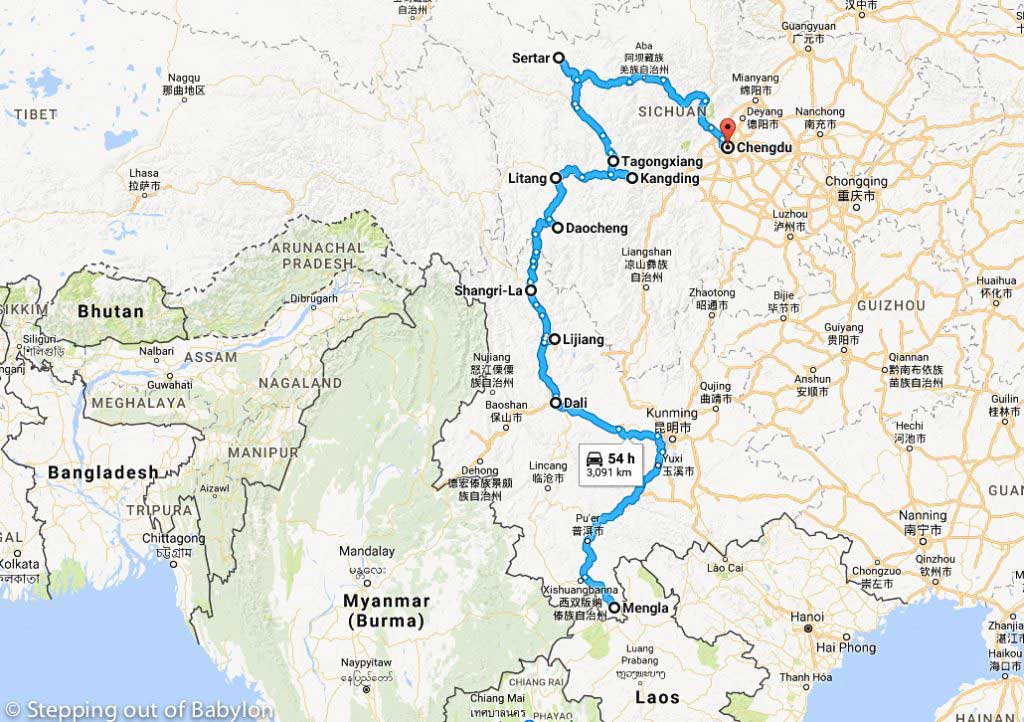
28 days in China: itinerary & costs

Itinerary:

Kunming: 4 days

Dali: 3 days

Lijiang: 3 days

Shangri-la (Zhongdian): 3 days

Daocheng and Yading Natural Park: 3 days

Litang: 3 days

Kanding: 1 day

Sertar and Larung Gar: 4 days

Chengdu: 4 days

China: itenerário
China: itinerary

Cost:

18,5 € / day

… per person, considering traveling alone, eating only local (vegetarian) food in informal restaurants, markets and street-food; Sleeping mostly in hostels with dormitories, travel by public transport whenever possible; Without alcohol, soft drinks or tobacco; Communications (telephone calls and Internet) is not contemplated in this value; Shopping and souvenirs are also not included.

Note: this trip was held in May / June 2014.

See also:

https://steppingoutofbabylon.com/wp/en/2017/08/apply-for-chinese-visa-in-laos/

https://steppingoutofbabylon.com/wp/en/2017/08/food-in-china-so-much-choice/


https://steppingoutofbabylon.com/wp/en/2017/08/youth-hostels-yha-cheap-and-good-accommodation-in-china/


Food in China… so much choice!

This is a difficult subject to address given the gastronomic diversity of China and the short visit to the provinces of Sichuan and Yunnan provide good examples, so it is difficult to choose a traditional dish or a typical meal that is homogeneously found in all places.

However, in the visited areas, restaurants can easily be found where the common denominator is the existence of a fridge where the available food is exposed, from vegetables, meat, mushrooms, tofu, eggs… and from where the customer can chooses the desired combinations, which are cook in a few minutes. The dishes the come to the table are always shared among the group of friends or family, gathered around the table, being polite to remove one piece of food at a time and put it in the bowl, from where, after mixing with a piece of rice it’s eaten. At the end of the meal, it is respectful to leave some food on the plates, a sign of the abundance of food.

Contrary to what is common in Southasian countries, in China it’s unusual to find “street-food”. The most popular and economical option is the small family restaurants, informal and open to the street, where the kitchen is located at the entrance of the restaurant advertising the menu. The most common in these eateries is the noodles soup with all the possible meat variations: pork, beef, chicken, intestines and other internal organs… ghrrr!

In fact, China is not an easy country for vegetarians, and the concept itself is a kind of unknown is more remote areas, even among the Buddhist and the Tibetan communities. Although, vegetables are a constant presence in Chinese meals that are compost by several dishes where meat is an almost mandatory presence. The tofu, as a Chinese intention, is easy to find both in restaurants menus as in snack stall, as it is part of traditional food the tofu isn’t seen as a vegetable alternative as in western countries. Mushrooms are also very common and can be a good choice for vegetarian dishes. However, some traditional Chinese dishes are practically impossible to find without meat, fish or seafood, as is the case with dumplings, steamed buns and the dim sun. But rice and noodles dishes, stir-fry or in soups, are good alternatives for vegetarians as far as you can order them without animal meat… the communication is always the big issue!!! The good thing for vegans is that dairy is almost 100% excluded from the traditional Chinese cuisine, and things like cheese and milk are rare. On the other hand, soy milk is very popular and is part of the traditional Chinese food, particularly a the breakfast.

In Sichuan, famous for its aromatic pepper, the gastronomy stands out for the spicy taste present in almost all dishes, from soups, stir fry or grill. The ingredients, usually vegetables and meat, often cook in a thick of spicy gravy, come wrapped in oil, but with a delicious and aromatic!

In areas closer to the Tibet Autonomous Region you can find some of the typical Tibetan dishes, although the number of restaurants serving them is small compared to the overwhelming presence of Chinese food restaurants. It stands out the traditional tupka, a soup of vegetables or meat, in a thick broth and with barley pasta cut roughly in pieces. The dumplings that in the Tibetan version are called momos, are also traditional in this area and can be found as a morning meal.

Traditionally from the cold Tibetan areas is butter tea that accompanies meals. The salty butter’s taste stands out in this drink, which as it cools creates a thin layer of fat at the surface.

Refeição típica chinesa, em que dois ou mais pratos acompanham uma tijela de arroz. Sempre presente está o chá que muitas vezes é disponibilizado gratuitamente
Typical Chinese meal where two or more dishes are eaten with steam rice. The tea is the most common drink and many time is served for free at the restaurants.

Sopa à base de noodles sobre os quais é despejado um caldo e são acrescentados legumes ou carne, assim como condimentos salgados ou picantes, de acordo com o gosto de cada pessoa
noodles soup

Legumes no mercado de Dali
Dali Market

Raiz de lótus, à venda no mercado de Dalí, muito popular na gastronomia chinesa
Lótus root, at Dalí market

ovos sujeitos a um prolongado processo de fermentação tornando a clara transparente e que lhes confere um gosto muito particular cuja intensidade os torna repulsivos para certos paladares
fermented eggs with a funny smell and taste… that doesn’t suite everyone

Legumes no mercado de Dali
Dali market

sopa fria de noodles: encontra-se por vezes ao fim da tarde nas ruas das cidades de Yunnam, onde pequenas banca oferecem um diversidade de noodles, tanto em forma, cor e sabor, que são condimentados com um molho picante, algumas ervas frescas, cebolinho e amendoim ralado
Cold noodles soup: easy to find in the end of the day in the street of Yunnan cities, seasoned with spicy sauce, fresh h and grind peanuts

OLYMPUS DIGITAL CAMERA
Amazing dinner prepared by my two travel mates. The food is an serious issue in China, and is always prepared with fresh ingredients brought everyday in the markets

dumplings feitos de massa de arroz, geralmente recheados de carne, e cozinhados ao vapor. São uma das mais populares opções par ao pequeno almoço, com os restaurantes fazendo-se anunciar pelas grandes panelas metálicas constituídas por diversos tabuleiros, de onde sai um intenso vapor que se espalha pelas ruas; são acompanhados por um molho picante e por vezes com um caldo feito à base de arroz cozido, simples e praticamente sem sal
dumplings made with rice dough, usually fill with meat and steamed, are the most popular option for the breakfast. the eateries that serve the dumplings are easily spotted by the big metal pans that stand outside the front door

outra opção de pequeno almoço, com uma sopa de noodles de sabor acre e ácido, acompanhada de ovo cozido e de pão frito, de massa semelhante às “farturas” mas de sabor salgado
another option for the breakfast are the noodles soup with a sour taste, served with egg and fry bread

panelas para cozinhas dumplings ao vapor e o pão frito em forma de longos palitos, que se pode também encontrar no Laos e na Tailândia como acompanhamento da primeira refeição da manhã
dumplings pan and the fry bread that is also traditional in Thailand and Laos

Cozinha de um restaurante na China
Kitchen from a restaurant in China

Cozinha de um restaurante na China
Kitchen from a restaurant in China

Cozinha de um restaurante na China
Kitchen from a restaurant in China

noodles frescos à venda no mercado de Chengdu
fresh noodles at Chengdu market

dumplings de vegetais acompanhando um "sumo" feito de arroz muito cozido ligeiramente adocicado e que constitui uma das populares opções para acompanhamento do pequeno-almoço a par com o leite de soja
vegetarian dumplings for breakfast and a drink made with soy milk

cabeças de pato e pescoços de galinha, grelhados e condimentados: popular como snack entre refeições
duck heads and chicken necks can be a snack between meals

Um dos pratos pelo qual a gastronomia de Sishuan é muito popular em que num caldo espesso e oleoso, condimentado com especiarias e pimenta, são cozinhados vegetais, cogumelos e algas, com ou sem carne, decorado com cebolinho e sementes de sésamo, e que é acompanhado de arroz
One of the most popular Sichuan dishes, a thick and oily gravy, seasoned with spices and pepper, where meat, mushrooms or vegetables are cooked

O tofu encontra-se presente em muitos restaurantes, sendo contudo mais fácil de encontrar nas grandes cidades
The tofu is easy to find in China, and is a good alternative to vegetarians in a gastronomy where the meat is a constant presence

restaurante junto à estação de comboios de Chengdu que dispõem de tofu confecionado localmente e onde os dumplins são cozinhados nos tradicionais recipientes de bambu
eatery in Chengdu with tofu and dumplings cooked in the traditional bambu baskets

pão feito de massa de arroz e cozido ao vapor, muito popular nas zonas regiões tibetanas, e que pode ser simples ou recheado de legumes, carne (quase sempre porco), cogumelos ou à base de feijão azuki que lhe confere um sabor ligeiramente doce
steamed bread, popular in tibetan areas, that can be plain or filled with meat, vegetables or with Azuki beans that give a touch of sweetness

queijo à base de leite de yak, e que no caso de ser fumado adquire um tom acastanhado; apesar do aspecto tosco a este queijo tem uma forte consistência apresentando-se compacto e “borachoso” ao mastigar
cheese made with yak milk

Hot-pot, muito popular em vários países asiáticos, mas com diferentes cambiantes em relação aos ingredientes, mas reservada para dias festivos ou jantares de fim de semana, em que um caldo é mantido quente com ajuda de carvão ou de um dispositivo elétrico ou a gás, colocado na mesa, e onde os comensais vão mergulhado os diverso ingredientes. Na região do Tibete, este prato é constituído por legumes, cogumelos, algas e algumas tiras de carne que vêm já misturadas com o caldo.
Hot-pot, reserved for special day and family gatherings. Different ingredients are cooked in a stock that is kept war at the table.

Tupka tibetana
Tupka, tibetan traditional soup that can be made vegetarian

uma sopa à base de dumplins recheados de legumes na região de Sertar, mais ligada à gastronomia do Tibete... deliciosa para aquecer o corpo e o espírito nos frias noites do planalto tibetano
dumplings soup in Sertar region, a warmer Tibetan version adjust to the colt temperatures

Traveling by train in China… nice and easy!

(English version from the text posted in Jun/2014)

The Kunming railway station more closely resembles an airport’s boarding rooms, with baggage check, ticket verification, and with its various gates, each identified with the train’s number and destination, and where efficient Officials validate tickets, and from which passengers are directly referred to the boarding pier. At the door of each of the carriages, is a formal employee, wearing an authoritative and complex uniform of military appearance, in a dry gesture direct the passengers to the respective carriages.

At the entrance of the train, we are greeted by the sound of a classical music orchestra, whose epic tone evokes the arrival of the cavalry that grows in intensity, while the passengers search the place and accommodate the luggage, until reaching the peak at the exact moment in which the Train begins its march. There follows a long sequence of instructions or information, spoken in Chinese, which passengers seem to ignore, absorbed by various electronic devices, entertained with games, messages, photographs and telephone conversations, food and drinks.

This trip, like the one previously held between Kunming and Dali, offered great comfort, not only for the quality of the carriages but also for the good condition of the road, which appears to be relatively new, offering ample stations with generous passenger berths, apparently oversized for the present demand.

Entrada da estação de comboios de Kunming

Sala de embarque da estação de comboios de Kunming

OLYMPUS DIGITAL CAMERA

... de Kunming a Dalí

Estação de comboios de Dalí

comboio entre Kunming e Dali, numa viagem que demorou cerca de 7 horas e que por isso foi feita em carruagem-cama (hard-sleep)

OLYMPUS DIGITAL CAMERA

bilhete de comboio entre Kunming e Dalí, onde uma viagem de cerca de 360 km custa aproximadamente 12€ em carruagem-cama (hard sleep)

Info

For information about China trains timetable, prices and duration of the trip:

www.chinatrainguide.com

Youth Hostels (YHA)… cheap and good accommodation in China

(English version from the text posted in Jun/2014)

Definitely, the best solution in terms of accommodation in China are the Youth Hostels that despite the name are not limited to welcoming young people.

They are generally well located, in city centers, near bus or train stations, or near tourist attractions. These type of accommodation are scattered all over the country, and there are at least two or three for each province of the vast Chinese territory. They offer good conditions, with double or single rooms, with private or shared bathroom. However the most popular option is the dormitory or shared room, of four, six or eight beds, always in the bunk system, that can have or not a bathroom inside the room.

The YHA hostels are presented with good decoration, clean and airy. Filtered, hot or natural water is always available free of charge. They have security lockers, usually by the bed or sometimes at the front desk. The shower and sometimes the sink have hot water. A hairdryer is usually provided at the front desk upon payment of a deductible which is refunded upon return.

Depending on the climate of the region, the rooms are sometimes equipped with central heating, fans and even some with air conditioning. In regions where winters are harsher, it is often found electric blankets to warm up the beds. Only in the big cities, it’s possible to find a laundry service in this hostels, however, there are always washing and drying facilities. There is also the option of using the washing machine costing around 10 yuan per charge.

Depending on the location and the size of the hostel, they may also have a restaurant, a TV, lounge room, snooker, games, a small library but mostly with Chinese books… the best ones have even small green spaces such as Hello Chengdu, which make you forget that you are in the center of a city of more than four million people.

At the reception of these Youth Hostels, there is always someone who speaks English, who is able to provide information about transport and places to visit in the vicinity. In the hostels located in the big cities, it’s possible to book bus and train tickets for a commission, as well as tours and organized visits to the more touristy places.

Free wi-fi.

Prices for dorms range from 30 to 40 yuan but may be higher depending on the conditions offered and the location, being generally more expensive in large cities compared to the one located in smaller settlements or remote areas. With a Member Card, with the annual cost of 50 yuan, it is possible to have discounts in the various hostels and the value of one night in a dormitory can have a discount of 5 to 10 yuan.

http://www.yhachina.com/index.php?hostID=2

Kunming: Upland Youth Hostel

http://www.yhachina.com/ls.php?id=288&hostID=2

Kunming: Upland Youth Hostel

Kunming: Upland Youth Hostel

Kunming: Upland Youth Hostel

Kunming: Upland Youth Hostel

Kunming: Upland Youth Hostel

Kunming: Upland Youth Hostel

Kunming: Upland Youth Hostel

Kunming: Upland Youth Hostel

Kunming: Upland Youth Hostel

Kunming: Upland Youth Hostel

Dali: Spoor Youth Hostel

http://www.yhachina.com/ls.php?id=347&hostID=2

Dali: Spoor Youth Hostel

Dali: Spoor Youth Hostel

Dali: Spoor Youth Hostel

Dali: Spoor Youth Hostel

Dali: Spoor Youth Hostel

Dali: Spoor Youth Hostel

Dali: Spoor Youth Hostel

Dao Cheng: MaMa Hotel

http://www.yhachina.com/ls.php?id=217&hostID=2

Dao Cheng: MaMa Hotel

Dao Cheng: Yading Backpacker International Youth Hostel

http://www.yhachina.com/ls.php?hostID=2&id=208

Dao Cheng: Yading Backpacker International Youth Hostel

Dao Cheng: Yading Backpacker International Youth Hostel

Dao Cheng: Yading Backpacker International Youth Hostel

Dao Cheng: Yading Backpacker International Youth Hostel

Dao Cheng: Yading Backpacker International Youth Hostel

Foto: Litang: Summer International Youth Hostel

http://www.yhachina.com/ls.php?id=367&hostID=2

Litang: Summer International Youth Hostel

Litang: Summer International Youth Hostel

Litang: Summer International Youth Hostel

Litang: Summer International Youth Hostel

Kanding:

Konka Youth Hostel

Konka Youth Hostel

Konka Youth Hostel

Konka Youth Hostel

Konka Youth Hostel

Konka Youth Hostel

Chengdu: Hello Chengdu International Youth Hostel

http://www.yhachina.com/ls.php?hostID=1&id=251&hostID=2

Chengdu: Hello Chengdu International Youth Hostel

Chengdu: Hello Chengdu International Youth Hostel

Chengdu: Hello Chengdu International Youth Hostel

Chengdu: Hello Chengdu International Youth Hostel

Chengdu: Hello Chengdu International Youth Hostel

OLYMPUS DIGITAL CAMERA

Chengdu: Hello Chengdu International Youth Hostel

Chengdu: Hello Chengdu International Youth Hostel

Chengdu: Hello Chengdu International Youth Hostel

Chengdu: Hello Chengdu International Youth Hostel

  • « Go to Previous Page
  • Page 1
  • Interim pages omitted …
  • Page 6
  • Page 7
  • Page 8
  • Page 9
  • Page 10
  • Interim pages omitted …
  • Page 31
  • Go to Next Page »

Footer

search

Tags

Arugam Bay Assam Bali Bogor Border Crossing Borneo Colombo Esfahan Fes Food Gilis Hiking Hikkaduwa hokkaido Istanbul Itinerary Jakarta Java Kashan Kumano Kodo Lombok Marrakesh Meghalaya Meknes Mekong Nagaland Natural Park Northeast States Ouarzazate Sarawak Shan State Shiraz Sichuan Province Sumatra Tabriz Taipei Tehran transportation ubud Varanasi Visa Yangon Yazd Yogyakarta Yunnan Province

I’m Catarina, a wanderer from Lisbon, Portugal… or a backpack traveller with a camera!

Every word and photo here comes from my own journey — the places I’ve stayed, the meals I’ve enjoyed, and the routes I’ve taken. I travel independently and share it all without sponsors or ads, so what you read is real and unfiltered.

If you’ve found my blog helpful or inspiring, consider supporting it with a small contribution. Every donation helps me keep this project alive and free for everyone who loves exploring the world.

Thank you for helping me keep the journey going!

BUY ME A COFFEE

Categories

Recent Posts:

  • How to go from Hualien to Dulan Beach
  • Taroko Gorge: between marble cliffs and emerald rivers
  • Hualien: a dull gateway to Taroko Gorge
  • Taiwan: Itinerary for an 16 day trip
  • Vietnam: Itinerary
  • 3 months in India: Kolkata, Tamil Nadu, Karnataka, Goa and Kerala
  • Backpacking Turkey in 24 Days: itinerary & costs
  • English
  • Português

© Copyright 2026 Stepping out of Babylon · All Rights Reserved · Designed by OnVa Online · Login