• Skip to main content
  • Skip to footer

Stepping Out Of Babylon

Travel & Photography

  • About me
    • Contact
  • Destinations
    • Africa and Middle East
      • Iran
      • Lebanon
      • Morocco
      • Turkey
    • East Asia
      • China
      • Japan
      • Taiwan (Formosa)
    • South Asia
      • Bangladesh
      • India
      • Nepal
      • Sri Lanka
    • Southeast Asia
      • Cambodia
      • Indonesia
      • Lao
      • Malaysia
      • Myanmar
      • Singapore
      • Thailand
      • Vietnam
  • Itineraries
  • Travel tips
    • Border crossing
    • Hiking and Natural parks
    • Food Journey
    • Visa
  • Photography

Stepping out of Babylon

Arriving in Sri Lanka… a quick guide!!

The international airport of Sri Lanka (formally named Bandaranaike International Airport) is located 30 km north from Colombo, close to the city of Negombo, and informally is known by Negombo Airport.

This location makes the stay in Negombo a good option if you have an early flight or if you arrive in the evening. But if you want to go straight to Colombo, and want to avoid the taxis (that cost minimum 2.500LKR) you have the bus that links the airport to the city center (Colombo fort) 24 hours and costs 100 LKR. The bus trip takes around 1 hour and use the express way, that means that avoid much stops and the busy national roads.

When you arrive, and pass the immigration process (quiet fast) and collect the luggage, you reach to a hall where you can find the ATM and the Information desk, as also some small office/shops of pre-paid taxis, hotels, travel agencies and money exchangers.

The ATM are located on the left side. As also the Information desk is not so obvious and others desk also offer tourist information but that are related to hotels and travel agencies, and probably will try to push you to more expensive option.

As I wanted to travel directly from the airport to Kandy, one of this travel in one of this desks told me that the only option was to take a taxi, as the last bus already left, and immediately a pre-paid taxi driver approach to confirm the information… but it wasn’t true, as I realised later.

Information desk at Sri Lanka International Airport (Bandaranaike International Airport)

Katunayake is a small village just next to the airport, about 1.5 km, and to reach the bus terminal of Katunayake you can do it on foot, but with the luggage maybe a tuk-tuk is a good option that will cost 100 LKR. When you leave the airport the tuk-tuk that are waiting in the front of the gate will ask much more… sometimes 800 LKR… is a good test for your bargains skill, that you’ll going to need during your stay in Sri Lanka!

So, to arrive to Katunayake Bus Terminal, when you exit the airport gate and reach the main road (where the tuk-tuks are) you must turn left. From here you need to walk south along the main road; there is no side walk but part of the way you have a kind you green are that keep you in a safe distance from the traffic. When you reach a big intersection (ignore the first intersection), after passing a kind of arc (looks like a gate over the main road), you need to turn left and walk more 500 meters to reach the Bus Terminal, that is located in a small street on your left side. Here you just need to ask the direction to the local people. Katunayake Bus Terminal is small and very basic and without much signs in English, so you need to ask to the local people where the bus stops.


How to go from the Airport (Negombo) to Colombo

But if your destiny is Colombo, is much easier. As you exit the airport arrivals building (that in fact is the same building as the departures) you must walk left and after 100 meters you’ll see a few buses stop on your left, even before you exit the airport gate. These buses governmental buses (SLTB) that leave the airport every 15 minutes. During the night the frequency decrease to 1 bus every hour.

The bus number is 187 (air condition bus) and uses the expressway to reach Colombo, which takes around 1 hour, but could be more, depending of the traffic.

The 187 bus run 24h.

It cost 100 LKR.

The bus let you in Colombo-Fort, close from the Railways station and from Colombo Central Bus Stand and Bastian Mawatha Bus Station.
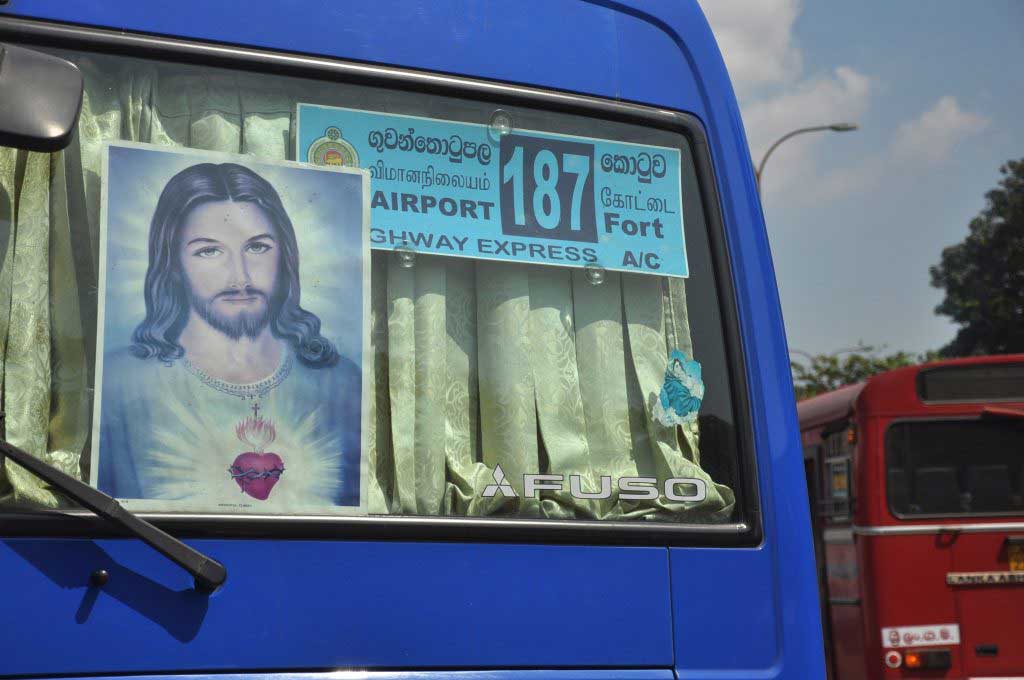
Bus 187 that links the airport to Colombo Fort. 24 hours. 100 LKR

Bus 187 that links the airport to Colombo Fort. 24 hours. 100 LKR

How to go from Colombo to Kandy

  1. The cheapest option is the train, that cost you 190 to 280 LKR (depending if it’s “express” or “normal” train) and take 3 hours, but arrive a bit later that the schedule. Although is difficult to have a seat, as the reserved seat (just for 1st class) are sold out in advance. There are 8 trains a day doing Colombo-Kandy trip.
  1. The most expensive option it hired a taxi, but also the faster and more confortable. An option to have in consideration if you travel in a group of 4.

Táxi Colombo to Kandy: 6000 LKR (2 h)

  1. The buses are the easiest option, not expensive and are always available during day time since 5 in the morning. They are uncomfortable, and due to the intense traffic the drivers are constantly speed and braking, making any trip that last more than 3 hours a tiresome journey, also because of the constant beeping of the bus and all the others vehicles that circulate on the road. The buses run most of the time full and sometimes is difficult to get a seat. The trip takes at least 4 hours as the bus stop every time that someone in the road side is waiting, no mater if it is a bus stand or not!!!

There are also a/c buses that departure form Bastian Mawatha Bus Station, located in the opposite side of Central Bus Station. If you leave the train station, turn left and keep walking along that sidewalk, passing in front of a kind of street market and stall until you arrive to a more empty area; keep walking in the same direction until you see a dirty road and on your left there’s an entrance to the Bastian Mawatha Bus Station.

Here you need to find (is better just ask) for a/c bus to Kandy. There are small blue buses that usual and get quickly full, but you can wait for the next bus that don’t take more than 15 minutes to come.

Bus Colombo Forte to Kandy: 265 LKR (almost 4 hours)

Sri Lanka_bus_DSC_6874
“normal” bus in Sri Lanka
Sri LAnka_bus Colombo-Kandy_DSC_7063
Bus Stand at Bastian Mawatha Bus Station. Colombo
Sri LAnka_Bus Colombo-Kandy_DSC_7065
Ar-condition Bus from Colombo to Kandy

How to go from Airport (Negombo) straight to Kandy

If you want to go north or to east, you don’t necessarily need to go to Colombo, instead you just need to Katunayake Bus Terminal, and from there you can take a direct bus to Kandy or in the direction of Dambulla, Anuradhapura, Polonnaruwa, Jafna but for this destinations you must change bus (maybe more than one time) probably in Kurunegala, and later in others “unkown” cities).

The trip from Katunayake to Kandy takes more that 4 hours, and is not guarantee that you’ll have a seat.

The ticket costs 133 LKR.


Bus from Katunayake to Kandy

a bit about ATMs in Sri Lanka:

The maximum amount of money in Sri Lanka ATMs is 50.000 LKR, but also depends of the maximum amount allowed to withdrawal in your country. The Portuguese bank have the maximum of 200€ per withdrawal and 400€ per day; that makes 30.000 LKR the maximum amount that you can get per withdrawal.

In Sri Lanka banks usually charge a fee 200 LKR (HNB-Hatton National Bank) to 300 LKR (Comercial Bank…for exemple).

Sri Lanka population: 20.5 millions

Sri Lanka Life expectancy: 74 years


How to apply for Indian Visa in Kandy (Sri Lanka)

The process in Kandy isn’t difficult but need some patience and some extra rupees due the bureaucracy and rigid rules.

The Indian Visa Services in Kandy (IVS) is almost empty all the time, so you don0t need to wait for a long for your turn. The IVS is also easy and cheap to reach by local bus.

Documents:

  • Passport (valid for 6 months and at least two blank pages)
  • Copy of passport
  • Copy of Sri Lanka visa page
  • Reference Form, aka FAX
  • 3 photos (not just 2 like everywhere else)
  • fee: 6172 LKR


Some observations:

  • The Reference Form or FAX Form, can be downloaded from the official page of IVS (http://ivsvisalanka.com/ForeignPassport.aspx). Although this form is not accepted by the Kandy services and you must buy a new one (with the same information but in a different format) inside de IVS (40 LKR);
  • You can fill the form on line, but probably the officers will find some mistake and make you fill another one. If you don’t want to fill the form again and come back in the next day you can go to one of the nearby agencies that do it for you (350 LKR)… that’s why you need 3 photos, because this guys can’t upload your photo. Inside the IVS, behind a photocopy machine there’s also a man that can do it (250 LKR)

Visa applications shops_DSC_7093

Anyway, some tips that can be useful for you to fill the form:

  • If you have been in India before you must have a copy of the last visa, and mention that in the on-line form.
  • If you don’t have a previous visa stamp in the current passport, just say NO when you fill the form on line.
  • If you want to apply for 6 months visa with multiple entries you must write “all ports” in the field “port of arrival” and “port of exit”.


After you have all the paper, the process at the IVS doesn’t take more than 10 minutes.

The approval process takes 5 working days. Meanwhile you keep your passport with you.

Then on the 6th day (or later) you need to submit your passport at 9 am.

In the same day you can pick it at 4 pm.


Usually, if you already have a visa in your passport, probably you can only get a 3 months visa if you apply in a foreigner country. In your country you cam always get the 6 months with multiply entries. Anyway, this is no a official rule, just a knowledge get by my experience and information shared with other travellers.


List os countries elected for visa on arrival to India
List os countries  for visa on arrival to India


Address:

No. 675,
William Gopallawa Mawatha,
Kandy.
Email: infokandy@ivsglobal.in


Submission Time: 8:30 am to 2:00 pm
Collection Time: 16:00 to 17:00
Website:  http://www.ivsvisalanka.com


Schedule. IVS (India Visa Services) @ Kandy

How to go to IVS in Kandy:

Form the bus terminal close to Clock Tower, ask for a bus that go to Peradeniya Road.

And ask to get out at the “India visa” or at the “Amaya Channel Center” that are at the same place.

Bus ticket: 12 LKR

Bus from Clock Tower bus stand to IVS (Kandy)


IVS location @ Kandy

How to apply for Indian Visa in Malaysia and Thailand

At least since December 2015 that is not possible to get an Indian Tourist visa is Malaysia, as also in Thailand.

At the IVS /Indian visa Services) in Kuala Lumpur you can apply for visa, give all the documentation, fill a form as non-resident, make the payment and anyone will tell you that the India Embassy in Malaysia in not longer giving tourist visa to non-Malaysia Resident for more than two years. The only things that they ask is you to sign a paper that you agree to the submission of your application to the High Commission, don’t tell nothing about the meaning of this.

Later you’ll find that there is 99% of chances that you application is refused, and no way to have you money back.

The IVS staff in Kuala Lumpur is extremely impolite and totally incompetent to provide proper and clear information.

The only option if you are in one of this countries (Malaysia or Thailand), is to apply for 1 month e-visa if you are citizen of one of the 133 eligible counties:

Andorra, Anguilla, Antigua & Barbuda, Argentina, Armenia, Aruba, Australia, Bahamas, Barbados, Belgium, Belize, Bolivia, Brazil, Cambodia, Canada, Cayman Island, Chile, China, China- SAR Hongkong, China- SAR Macau, Colombia, Cook Islands, Costa Rica, Cuba, Djibouti, Dominica, Dominican Republic, East Timor, Ecuador, El Salvador, Estonia, Fiji, Finland, France, Georgia, Germany, Grenada, Guatemala, Guyana, Haiti, Honduras, Hungary, Indonesia, Ireland, Israel, Jamaica, Japan, Jordan, Kenya, Kiribati, Laos, Latvia, Liechtenstein, Lithuania, Luxembourg, Malta, Malaysia, Marshall Islands, Mauritius, Mexico, Micronesia, Monaco, Mongolia, Montenegro, Montserrat, Mozambique, Myanmar, Nauru, Netherlands, New Zealand, Nicaragua, Niue Island, Norway, Oman, Palau, Palestine, Panama, Papua New Guinea, Paraguay, Peru, Philippines, Poland, Portugal, Republic of Korea, Republic of Macedonia, Russia, Saint Christopher and Nevis, Saint Lucia, Saint Vincent & the Grenadines, Samoa, Seychelles, Singapore, Slovenia, Solomon Islands, Spain, Sri Lanka, Suriname, Sweden, Taiwan, Tanzania, Thailand, Tonga, Turks & Caicos Island, Tuvalu, UAE, Ukraine, United Kingdom, USA, Uruguay, Vanuatu, Vatican City-Holy See, Venezuela, Vietnam.

https://indianvisaonline.gov.in/visa/tvoa.html


Indian Visa Services (IVS) in Kuala Lumpur


Indian Visa Services (IVS) in Kuala Lumpur

Apply for Indian Visa in Thailand

Since October 2015, it is no longer possible for a non-Thailand residents to get a Indian Tourist visas in Bangkok or any other city.

Indian Tourist Visa is only given to Thai residents.

Check update info at: http://www.travelfish.org/orientation_detail/thailand/bangkok_and_surrounds/bangkok/bangkok/138


The only option is to apply for 1 month e-visa if you are citizen of one of the 133 eligible counties:

Andorra, Anguilla, Antigua & Barbuda, Argentina, Armenia, Aruba, Australia, Bahamas, Barbados, Belgium, Belize, Bolivia, Brazil, Cambodia, Canada, Cayman Island, Chile, China, China- SAR Hongkong, China- SAR Macau, Colombia, Cook Islands, Costa Rica, Cuba, Djibouti, Dominica, Dominican Republic, East Timor, Ecuador, El Salvador, Estonia, Fiji, Finland, France, Georgia, Germany, Grenada, Guatemala, Guyana, Haiti, Honduras, Hungary, Indonesia, Ireland, Israel, Jamaica, Japan, Jordan, Kenya, Kiribati, Laos, Latvia, Liechtenstein, Lithuania, Luxembourg, Malta, Malaysia, Marshall Islands, Mauritius, Mexico, Micronesia, Monaco, Mongolia, Montenegro, Montserrat, Mozambique, Myanmar, Nauru, Netherlands, New Zealand, Nicaragua, Niue Island, Norway, Oman, Palau, Palestine, Panama, Papua New Guinea, Paraguay, Peru, Philippines, Poland, Portugal, Republic of Korea, Republic of Macedonia, Russia, Saint Christopher and Nevis, Saint Lucia, Saint Vincent & the Grenadines, Samoa, Seychelles, Singapore, Slovenia, Solomon Islands, Spain, Sri Lanka, Suriname, Sweden, Taiwan, Tanzania, Thailand, Tonga, Turks & Caicos Island, Tuvalu, UAE, Ukraine, United Kingdom, USA, Uruguay, Vanuatu, Vatican City-Holy See, Venezuela, Vietnam.

https://indianvisaonline.gov.in/visa/tvoa.html


How to cross the Border Kedah – Sadao (Malaysia/Thailand)

Crossing the Border Kedah – Sadao…. by bus

It takes time but is easy and without any troubles!

When the bus arrive to the Malaysian immigration you need to get the stamp… it’s a quick and easy process that don’t take more than 5 minutes. The bus driver will help and show you were to go.

After you need to get in the bus again to drive a few meters until you arrive to the Thai immigration services, were the lines are long… this took about 1 hour.

After the immigration process, were you must show your passport and immigration form,  you’ll take the same bus, yet you need to take your bags with you when cross the border.

Note: Before arriving to the Thai Immigration counter you must fill a immigration form, a card with your name, nationality and a few more information, that is staple to your passport after stamped. This should be available at the border.

Although before we reach the border the bus stop in a rest area/restaurant and the driver collect the passports of all passengers, give then back with the immigration form already fill and ask 5 RM for the service. Apparently this is a unnecessary charge as you can do it by yourself, but everybody accepted, included Malaysia and Thai passengers… scam?!?!?!

At this time (Dec.2015) visa on arrival by land is 15 days. The 30 days visa on arrival are only at International Airports.

How to go from Kuala Lumpur to Hat Yai (Thailand)

From TBS Terminal Bersepadu Selatan departure everyday buses from different companies to Hat Yai, crossing the Malaysia-Thai border: Kedah – Sadao.

Schedule: 8.00h, 8.45h, 9.30, 22.00h, 22.30h, 22.45h, 23.00h.

Ticket: between 55 RM (VIP, with 3 seat in a row) and 80 RM (double decker bus).

The bus trip takes 8 hours, but can be more depending of the time at the Malaysia-Thai border

The bus to Hat Yai departure from Terminal Bersepadu Selatan, that everybody knows by TBS. The terminal is located in the south area of Kuala Lumpur and offer good connection with public transportation network at Bandar Tasik Selatan to:

  • Train (KTM Komuter)
  • LRT (Light Train)
  • KLIA train, KL International Airport
Bus ticket from Kuala Lumpur to Hat Yai (Thailand)

Buy bus tickets in Malaysia:

The TBS has a huge number of ticket counters, centralising the tickets selling to all destination and bus companies. Arrive at least half-hour before because the lines are big.

If you travel to popular destinations, especially on Fridays, weekends and holidays is better reserve the ticket in advance.

For reserving ticket you can use on of the many site, and pay with credit card. Most of the web sites don’t charge commission. I use this one: http://www.easybook.com/

Once you arrive to the TBS, nearby the ticket counter you’ll find a counter where you can show your reservation and get the ticket.


How to go from TBS to Chinatown (Kuala Lumpur)

Most of the long distant and inter cities buses, arrive and departure from Terminal Bersepadu Selatan, that everybody knows by TBS. The terminal is located in the south area of Kuala Lumpur and offer good connection with public transportation network at Bandar Tasik Selatan to:

  • Train (KTM Komuter)
  • LRT (Light Train)
  • KLIA train, KL International Airport


Coming out from the bus we are left in a cover bus park with a set of escalators that lead to the main hall of the terminal. Once here, after a short walk inside the building you’ll find an exit on your right, with indications of KLIA.

Following the KLIA signs you’ll cross a metal footbridge; on the other side are stairs and a lift to reach the access to the KLIA train as also to the ground floor.

As you reach the street walk to the right side (for whom are facing the giant building of the terminal), and after passing the taxi rank you’ll find a bus stop.

The Bus 690, Rapid KL (ticket 2 RM) takes 20 minutes (outside rush hours) and ends at Pudu Sentral (Puduraya) in Jalang Pudu near the Plaza building Raykat. From here are five minutes walking to Jalang Petaling, the heart of China Town in Kuala Lumpur.

Bus 690, from TBS to Pudu Sentral (Puduraya). Kuala Lumpur


Tickets, Bus 690, from TBS to Pudu Sentral (Puduraya). Kuala Lumpur

Alternative:

  • After crossing the pedestrian bridge follow signs to the train station, KLIA.
  • Take the KTM-Komuter, Seremban line (2.4 rM) to KL Sentral.
  • At KL Sentral to take the LRT to Pasar Seni (1.4 RM).
  • This alternative takes longer and is more expensive for those whose final destination is Chinatown, but it can be advantageous for those looking for other destinations in the city of Kuala Lumpur.


On the way back, which means from Chinatown to TBS, is better use the LRT + KTM-Komuter specially if you are traveling at rush hours, that can make the bus trip last more than one hours.

By LRT + KTM-Komuter the trip from Pasar Seni to TBS should take less than 45 minutes.


Buy bus tickets in Malaysia:

The TBS has a huge number of ticket counters, centralizing the tickets selling to all destination and bus companies. Arrive at least half-hour before because the lines are big.

If you travel to popular destinations, especially on Fridays, weekends and holidays is better reserve the ticket in advance.

For reserving ticket you can use on of the many site, and pay with credit card, . This web site don’t charge commission.

I use this one: http://www.easybook.com/

Once you arrive to the TBS, nearby the ticket counter you’ll find a counter were you can show your reservation and get the ticket.

Malaysian food… underestimated cuisine!

Two things stand out in the cuisine of Malaysia… the ethnic, cultural and religious diversity that brings us to China, India, Thailand, Indonesia… and the rice which is present in almost all dishes.

From the staying in Borneo and West Malaysia several representative dishes of Malaysian cuisine remain, like lontong, laksa, nasi lemak, nasi goreng… “nasi” means rice and “goreng” refers to fried, so fried rice is one of the dishes easily find anywhere at any time of day, usually made with chicken, beef or seafood, with pork away from a gastronomy of a Muslim country.

Being a predominantly muslim country, Malaysian cuisine is dominated by meat dishes, but the strong presence of the Chinese community as well the Tamil from South of India bring other options that suits the vegetarian diet! 

In terms of nasi goreng, there are many variants (kampung, pattaya, ayam …), differing ingredients, seasonings and spices, always excelling spicy. The nasi goreng pattaya is basically fried rice (fried rice with meat, seafood or vegetables), involved in egg and drizzled with a sweet and spicy condiment. In Borneo this dish is often served with a bowl of broth that makes it less dry. Despite being unpopular and does not appear in the menus it is also possible to order vegetarian nasi goreng, but that is almost always made with egg, and not many vegetables.

Nasi Goreng Pattaya. Malaysia

But it is the nasi lemak that is the “king” and can be considered the Malaysian national dish. Usually eaten for breakfast, being basic and very simple to prepare. It consists of rice and small portions of fried small anchovies, fried peanuts, cucumber slices and egg, that can be boiled or fried. This meal can be served on the plate or wrapped in banana leaf for take-away. But what makes this special dish is the sambal, a red and thick paste, made with chilies, onion, ginger, garlic, anchovies and a few more spices, resulting in a very tasty mixture.

Nasi Lemak. Malaysia

Laksa is another popular Malay dish that can be classified between a soup and a curry. It’s basically a broth, sweet and spicy, which includes the coconut milk, ginger, lime leaf (kaffir) and lemongrass, which involves fine rice noodles and bean sprouts. To this base usually is added meat, but you can also order it with tofu.

In Borneo, the laksa is creamier, with more coconut milk and usually served with tofu and seafood, where seafood comes down to shrimp or squid… but wherever it is always served with lime that brings out the other flavors.

Laksa. Kota Kinabalu. Malaysia

Laksa. Melaka. Malaysia

Lontong, a traditional Indonesian dish that was built in Malaysian cuisine, and its vegetarian in is origin. Made with a compressed rice with a roll shape, cut in big pieces. To these these “chunks” is added a soft vegetable curry cooked in coconut milk, to which joins tofu, tempeh and boiled egg (or sometimes fried). Like the nasi lemak is served with a spoonful of sambal, also part of the popular dishes eaten for breakfast.

Lontong. Malaysia
Lontong. Malaysia

A popular snack in Borneo, and probably can also be found in the rest of Malaysia is called fried carrot cake, which despite its name has nothing to do with carrots, made from cooked and compressed rice-shaped blocks, which are cut into pieces and fried with egg, spicy and sometimes with soy sauce. Unhealthy due to amount of oil but very delicious.

In cities, especially in neighbourhoods dominated by Indian culture, often called Little India, it’s easy to find the traditional cuisine of southern India as a result of the strong presence of the Tamil community living here for generations. In addition to the delicious curries that give life to a dish of rice, often served in a banana leaf, you can also find murtabak, dosas and other typical Indian snacks, served with coconut chutney and sambar.

But what stands out are the roti canai, also called roti prata or paratta. It is a flat unleavened bread, but whose dough is extended until get very thin, thrown with mechanical and precise gestures against the table, repeatedly until almost getting ripped, in a process that requires a lot of oil. After is extended and rolled to create rough layers and is then fried in a metal plate until crisp and slightly toasted. The roti is accompanied by a small dish of curry, were it is is soaked.

You can find several versions of this roti, stuffed with egg, banana, sweetened milk…

Roti canai. Malaysia

From the presence of the Chinese community, result many restaurants and all variations around the noodles soup and fried noodles, and along with nasi goreng, are a popular option and easy to find at any time of day. As they are prepared at the moment they can be made in a vegetarian variant, where it is often added tofu, a notorious influence of Chinese cuisine.

The fried rice noodles in Malaysia answering to the name Kueh Teow Goreng, and are always made with egg, bean sprouts and some raw chives.

Kueh Teow Goreng. street food. Kuching. Malaysia

The dim sum, traditional Cantonese meal steamed in bamboo baskets, is a presence in some Chinese restaurants, some of which still retain the traditional system in which the food is circulated in trolleys through the tables with customers choose the food among the dozens of varieties… were hardly can be find vegetarian food.

Very popular in areas with the highest concentration of the Chinese community, as are the Chinatown in different cities of Malaysia, are the shops specialised in dried meat that is prepared in different ways, ranging from sweet to spicy.

But what stands out the Chinese food, resulting from the attractive price and the wide range of options is the rice dish serve in buffet style: a plate of with a portion of rice were different dishes are added chosen from trays of food, which can be meat, fish, eggs, vegetables and the popular tofu that is cooked in different ways. This system is very popular, not limited to Chinese cuisine, extending the Malaysian food restaurants that although more focus in meat also offer a wide variety in terms of vegetarian food. Just need to ask for “rice” and we are given a plate with of rice for each one add the dishes.

Rice plate restaurant. George Town. Malaysia

Rice plate. George Town. Malaysia
Rice plate street food. George Town. Malaysia

About street food, Malaysia will get a lot of inspiration to neighboring Thailand, and is easier to find in the cities of the north of the country than for example in Borneo. In small stalls that arise several hours a day in specific locations of the city can be found apom, steam rice cake, fried banana, and the popular and delicious apam balik that are pancakes stuffed peanuts… and many more delicious options that also include snacks, often fried.

Apom. George Town. Malaysia
street stall of chendul (chendol). George Town. Malaysia

Markets are also great places to enjoy and experience the wide variety of food, a lot of which is difficult to identify, whether it is sweet or salt, whether it is meat or vegetarian… but always arouses curiosity.

Street food. Central Market. Kota kinabalu. Borneo. Malaysia
Shellfish. Central Market. Kota kinabalu. Borneo. Malaysia

As a tropical country abound bananas, mangoes and papayas… but also in the markets as street vendors also are pineapple, jackfruit, watermelon and melons… but it is the durian, the king of tropical fruits, much appreciated as hated by intense and characteristic smell, that make it forbidden to carry in the subway.

Durian. Kota Kinabalu. Malaysia
Fruits. Central Market. Kota kinabalu. Borneo. Malaysia

Sweets

The chendul (or chendol) is a traditional cold sweet very popular in Malaysia, based on coconut milk and crushed ice, sweetened with palm sugar syrup and served with a green noodles (whose color comes from a vegetable often used in sweets and dishes, the pandan) and a few sweetened beans. It may seem odd but it is delicious and refreshing and in some places, like George Town people line up in small street stalls to buy chendul.

Chendul (chendol). Melaka. Malaysia
Fry Banana. Central Market. Kota kinabalu. Borneo. Malaysia
Sweet and deep fry snacks at Central Market. Kota Kinabalu. Malaysia

Very popular is kaya, a coconut and egg jam, that sometimes can have the green color, if it’s added pandan. Kaya is used to spread on toast, which served with eggs and tea is also one of the option in terms of traditional breakfast in Malaysia, mainly in cities. Kaya Jam is also used to fill puff tarts as the ones sold in a small corner shop in Kuala Lumpur’s Chinatown.

Kaya Jam. Malaysia
Kaya Jam at breakfast. Malaysia
Coconut puff tart. Chinatown. Kuala Lumpur. Malaysia

Adding to the list of popular sweet is the beancurd (also called soybean pudding) a kind of pudding made of soy, which is sweetened with palm sugar syrup, is also popular in most dominant Chinese areas.

Beancurd. Kuala Lumpur. Malaysia

Drinks

Being a predominantly Muslim country, alcohol is unusual at local restaurants but is easy to find in bars and restaurants in more tourist sites, especially the beer.

But the most popular in terms of drinks is teh tarik, which is tea to which is added sweetened milk, and can be served hot or with ice (teh ais). It is consumed in the morning, usually hot, accompanying meals, like roti canai for example, or during the day, as a break in the workday.

Coffee is also easy to find, being in Malaysia usual the filtered coffee, served in a very strong version in terms of caffeine, with a dense and dark look but soft flavor.

Teh Ais (Ice tea with condensed meilk). Malaysia
Coffee. Malaysia
Coffee. Malaysia

For vegetarian food the best option are the Indian restaurants, due to the influence of the Hindu religion and some Chinese restaurants that resulting to the connection with Buddhist religion can sometimes exclude animal products. In restaurants more targeted to the Malay cuisine is notorious the strong presence of meat dishes, and yet respecting the halal rules, which pork is exclude. Yet pork meat is quite popular in Chinese dishes.

In general there are few dishes exclusively vegetarian in Malaysia gastronomy, and even those who appear to have no animal products, can often be served with a condiment called “sambal” that includes anchovies or any other small fish.

For those who are used to eating knife and fork, it is here to adapt to the use spoon and fork, because the knife is an instrument that does not arrive at the table, being unnecessary since the food is cut into pieces being brought to mouth by the spoon, serving the fork to push food into the spoon. In Malaysia the food is take to mouth with the right hand. In Indian restaurants it is common to use the fingers to bring food to the mouth, but spoons are always available. Spoon and chopsticks are used in Chinese restaurants. In general, the restaurants do not have napkins.

And as in other Asian countries the first meal of the day is made on the basis of rice and noodles, soups or curries. The rotis are also popular for breakfast. Many restaurants serving breakfast open at 6 am, but this are not always open until dinnertime, closing by 3 or 4 pm. But there are others who not opening so soon, serve meals until dinnertime, but not much later than 9 pm. Take-away system is very popular with both restaurants and street stall to be prepared to parcel food in proper containers or more traditionally in banana leaf.

Rice and curry for for take away. Malaysia

In general, even with the limited vegetarian choices, Malaysia gastronomy offers a great diversity of flavours, with simple dishes, fast and easy to prepare but very tasty… I miss the laksa, lontong and nasi lemak.

Food Costs in Malaysia

In food courts a meal costs between 3.5 and 5 RM, which means that you can easily get a meal for 1 €.

The same applies to the so-called rice plat, with two or three varieties of vegetarians side dishes costs about 4 MR. The food costs in Kuala Lumpur are a bit higher were a rice plate eaten in a restaurant can costs about 5 RM, but van be cheaper is a street food stall

Dishes with meat, fish or seafood always have higher prices.

100 Cintra @ Georgetown

A building full of personality and style, and friendly and helpful staff make the 100 Cintra a special place with an atmosphere that invites you to stay for long periods.

The building dates from 1897 and was once served as housing the wealthy families of Penang. After suffering a fire was recovered for commercial purposes while retaining the style and materials of traditional architecture. Was recently transformed into hostel, where on the first floor are located the rooms, and where the top floor is occupied with a furniture collection and decorative items that constitute practically a museum, although it is not accessible to the public, can be enjoyed through fence that limits the space.

Good location, in the heart of George Town, the far the most popular and busy streets, in an area where dominates the local market and where it is easy to find food in both Malaya and Chinese food restaurants and street food stalls.

100 Cintra has several common areas, both indoors with decor with antique furniture and objects, and outdoor spaces, terrace and porch, that are nice areas to read a book, take a nap, have a meal or chat with other guests. This spacious and different common areas compensates for the small space of the rooms.

A space that despite being in need of some care offers a memorable stay and makes you sty longer in the city.

100 Cintra Guest House @ George Town. Penang


100 Cintra Guest House @ George Town. Penang


100 Cintra Guest House @ George Town. Penang


100 Cintra Guest House @ George Town. Penang


100 Cintra Guest House @ George Town. Penang


100 Cintra Guest House @ George Town. Penang


100 Cintra Guest House @ George Town. Penang


100 Cintra Guest House @ George Town. Penang


100 Cintra Guest House @ George Town. Penang


* In Malaysian “cintra” means “Japan” because along this street were housed many Japanese during the invasion that lasted until the end of World War II.

100 Cintra

Address: 100, Lebuh Cintra, George Town, Pulau Pinang 10200, Malaysia

http://www.100cintrapenang.com/


Double room: 60 RM (you can try to bargain in low season or for a long term stay)

Bedrooms: 20 RM

All rooms have shared bathroom

Breakfast included (very basic with bread, jam, tea and coffee)

The kitchen can be used for free.

Free Laundry.

Free wi-fi

100 Cintra Guest House @ George Town. Penang


100 Cintra Guest House @ George Town. Penang


100 Cintra Guest House @ George Town. Penang

George Town… street art and street food

Penang often mistaken for George Town. Penang is a state on the west coast of Malaysia, which includes the island of Pulau Pinang. But what attracts most visitors to this site is the city of George Town (or Georgetown) the capital and largest city of this state, whose name is due to the British presence that settled here in the eighteenth century, making this site one of the important posts trade in the region, is the quiet atmosphere in a colonial well preserved heritage.

From this presence resulted a vast architectural heritage ranging from official buildings, churches and shophouses, which are buildings of two or three floors where the ground floor is intended for commerce and the top floors for residence, continuing today to have these functions.

As an important trading post, George Town attracted many merchants from several neighboring countries such as Thai, Burmese, Tamils ​​from south India and many Chinese, which resulted in a great cultural and religious diversity which is revealed in the diversity of temples: Buddhist temples, Hindu temples and mosques, as also the Christian, Catholic and Anglican churches.

From this mixture that learn how to live together taking advantage of their differences, born a very unique identity which joined the Malay culture, resulting in a country that today is an example of religious, ethnic and cultural tolerance. Also resulted in a great culinary diversity for which Penang is famous, finding restaurants and street food stall, a bit all over the old town, each zone with is own type of food, serving during the day, but obeying to a specific schedule according to the food…. you can not find chendul in the evening or Steam Rice Cake during the day.

The old town is considered World Heritage Site by Unesco, where much of the buildings are ancient, with many of the shophouses to maintain the traditional architecture, some converted into trendy cafes, restaurants and accommodation as a result of the large number of tourists.

George Town
George Town


George Town
George Town


George Town
George Town


Food Market. George Town


George Town
George Town


George Town
George Town


George Town
George Town


George Town
George Town


George Town
George Town


Another of the architectural features of the city are called five foot ways, which are a kind of sidewalks formed by the buildings where the ground floor is set back from the facade, creating a passage in the form of arcades, which protects the inhabitants of the sole of rain. The name comes from the width with which they were built that were originally built (approximately 1.5 meters), but there five foot ways of varying sizes by adjusting the width of the streets.

Georgetown is famous for street art, which somehow has become institutional, with many artistic interventions in a planned and organised manner, which removes the subversive and intervention that is one of the street-art facets. And from the many murals which can be found in the old town, only a few works stand out of the homogeneous, simple and innocent set of murals.

Street art. George Town


George Town
George Town

Despite the exposed art on the walls is worth a closer look to what is happening under our feet, where the floors of many five foot ways are coated tiles, with elaborate geometric patterns and attractive colors.

5 foot way. George Town


5 foot way. George Town


Georgetown smells old and at the same time has a modern character in a quiet environment, only interrupted by the bustle of the bars at weekends become part of Lebuh Chulia and Love Lane a messy and noisy area, clashing with the quietness of rest of the city.

George Town
George Town

Where to stay in Georgetown

A building full of personality and style, friendly and helpful staff makes the 100 Cintra a special place with an atmosphere that invites you to stay for a long term.

100 Cintra Guest House @ George Town

100 Cintra

Address: 100, Lebuh Cintra, George Town, Pulau Pinang 10200, Malaysia

http://www.100cintrapenang.com/


Where to eat in Georgetown

Penang is the capital of Malaysian food, resulting from the variety of ethnic and religious diversity present here; George Town is also famous for street food that is here more easily to find than in other Malaysian cities; so it is best to wander around the streets and following intuition… and the nose.

Popular areas for street food:

  • Lebuh Kimberley, near the intersection with Lebuh Cintra (predominantly in the morning, but with some vendors to stay up at night);
  • Penang Jalang between Jalang Campbell and Jalan Dr Lim Leong Chewee where along the small cross streets several street stalls prepare and sell their products: meals, snacks, sweets, ice cream, drinks, etc …
  • Lebuh Chulia between the junction with Love Lane and Jalan Kapitan Masijd Keiling (after dark)


Apom, traditional asian sweet like a cookie. Street food. George Town.


chendul @ Lebuh Keng Kwee. George Town


Food not to be missed in George Town:

  • NG Kee Cake Shop, Plant and cake shop in Lebuh Cintra, with coconut tarts.
  • Veg thali served in banana leaf, the many restaurants in Little India, especially along the Lebuh Penang
  • Steam Rice Cake in Lebuh Cintra in front of a Chinese restaurant Dim Sum, but that only emerges after dark.
  • Lebuh Keng Kwee in chendul
Coconut tarts and traditional Chinese Cookies Shop and Bakery @ Lebuh Cintra. George Town


Delicious traditional malay and chineses fast-food Restaurant @ Lebuh Cintra. George Town


Delicious traditional malay and chineses fast-food Restaurant @ Lebuh Cintra. George Town


Little India... always noisy, colourful in any country. George Town
Little India… always noisy, colourful in any country. George Town


Chinese Restaurant at Lebuh Cintra with traditional Dim Sum. George Town

How to get from Kuala Lumpur to George Town:

Kuala Lumpur TBS Terminal (Terminal Bersepadu Selatan) there are buses throughout the day from the 6:00 am to 12:00 am.

The trip to Penang lasts about five hours, but can be 6 hours or more depending on traffic outside of Kuala Lumpur.

There are two options to get to George Town:

  1. Bus from Kuala Lumpur (TBS Terminal) to Butterworth, and then ferry boat to George Town. The ferry takes 10-15 minutes and costs 2 RM. The distance being the Butterwoth Bus Terminal and the ferry is short but takes about 10 minutes to walk. This bus option to Butterworth may have the drawback of making Sungai Nibong Express stop at the Bus Terminal in Penang, which means cross the bridge to the island and then return back to the terminal service in Butterworth Bus Terminal.
  2. Bus from Kuala Lumpur (TBS Terminal) to Sungai Nibong Express Bus Terminal in Penang. Here you need to catch a local bus to George Town (12 km).

Tickets KL – Butterworth: 35 RM

The ferry is the most pleasant option, especially if the trip coincides with the end of the day.

Check more information:

http://www.penangport.com.my/Services/Ferry-Services


way from Butterworth Bus Terminal to the ferry to Georgetown. Penang


Ferry Butterworth-Georgetown. ferry fees


on the ferryboat Butterworth-George Town


How to get from George Town to Kuala Lumpur:

One option is to go to the pier (on foot or by local bus) and take the ferry to Butterworth, walk until the Butterworth Bus Terminal and from their take a bus to Kuala Lumpur. No reservation needed because many companies do this service so there is a great offer in terms of timetables.

Alternatively you can catch a bus directly from George Town to Kuala Lumpur.

  • Buses leave from Sungai Nibong Express Bus Terminal, located 12 km from George Town.
  • Tickets can be purchased on the same day, and even at the time, one of the many agencies located in Jalan Ria near KOMTAR. The agencies have a shuttle service from the office to the terminal (3 RM)

Bus Tickets George Town (Penang) – Kuala Lumpur: 38 RM + 3 RM (shuttle to the Sungai Nibong Express terminal)

Location of travel agencies that sale bus tickets to Kuala Lumpur @ Georgetown


Travel agencies that sale bus tickets to Kuala Lumpur @ George Town


Schedule of buses from Georgetown to Kuala Lumpur
  • « Go to Previous Page
  • Page 1
  • Interim pages omitted …
  • Page 22
  • Page 23
  • Page 24
  • Page 25
  • Page 26
  • Interim pages omitted …
  • Page 31
  • Go to Next Page »

Footer

search

Tags

Amed Assam Bagan Bali Border Crossing Borneo Colombo Esfahan Fes Food Gilis Hiking hokkaido Istanbul Itinerary Jakarta Java Kashan Kuala Lumpur Kumano Kodo Litang Lombok Majuli Meghalaya Meknes Mekong Mulay Idriss Nagaland Natural Park Northeast States Ouarzazate Sarawak Shangri-lá (Zhongdian) Shiraz Sichuan Province Sishuan Sumatra Tabriz Tehran transportation Visa Yangon Yazd Yogyakarta Yunnan Province

I’m Catarina, a wanderer from Lisbon, Portugal… or a backpack traveller with a camera!

Every word and photo here comes from my own journey — the places I’ve stayed, the meals I’ve enjoyed, and the routes I’ve taken. I travel independently and share it all without sponsors or ads, so what you read is real and unfiltered.

If you’ve found my blog helpful or inspiring, consider supporting it with a small contribution. Every donation helps me keep this project alive and free for everyone who loves exploring the world.

Thank you for helping me keep the journey going!

BUY ME A COFFEE

Categories

Recent Posts:

  • How to go from Hualien to Dulan Beach
  • Taroko Gorge: between marble cliffs and emerald rivers
  • Hualien: a dull gateway to Taroko Gorge
  • Taiwan: Itinerary for an 16 day trip
  • Vietnam: Itinerary
  • 3 months in India: Kolkata, Tamil Nadu, Karnataka, Goa and Kerala
  • Backpacking Turkey in 24 Days: itinerary & costs
  • English
  • Português

© Copyright 2026 Stepping out of Babylon · All Rights Reserved · Designed by OnVa Online · Login