• Skip to main content
  • Skip to footer

Stepping Out Of Babylon

Travel & Photography

  • About me
    • Contact
  • Destinations
    • Africa and Middle East
      • Iran
      • Lebanon
      • Morocco
      • Turkey
    • East Asia
      • China
      • Japan
      • Taiwan (Formosa)
    • South Asia
      • Bangladesh
      • India
      • Nepal
      • Sri Lanka
    • Southeast Asia
      • Cambodia
      • Indonesia
      • Lao
      • Malaysia
      • Myanmar
      • Singapore
      • Thailand
      • Vietnam
  • Itineraries
  • Travel tips
    • Border crossing
    • Hiking and Natural parks
    • Food Journey
    • Visa
  • Photography

Southeast Asia

Yangon revisited

Three years passed since my last visit to Myanmar, many changes happens in the country… since 2014, the military government that run the country since 1962 was pushed away, the first democratic election gave a smashing victory to the National League for Democracy, open the door for the elections of the first non-military president in 54 years, resulting in big political, economic and social reforms in a country that conquer again the freedom of speech. Aung San Suu Kyi, the face of the fight for freedom, human rights and democracy in Myanmar is now everywhere, more visible than ever, has her father, Aung San, whose features are printed on the old kyat bill, that people proudly hang on the house walls.

Despite all these positive changes, Myanmar is still far from be a pacified country: nowadays fights resulting from ethnic conflicts still going on between the army and “rebel” groups in Shan hills, and religious and ethnic differences are responsible for the massacre of the Rohingya people in Rakhine State, in a country where the Buddhism is the dominant religion and where the monks play a strong influence in the rule of Myanmar.

Yangon... Where bodhi tree grows freely on the buildings, taking advantage of the wall cracks, softening the austerity of colonial British-style buildings
Yangon… Where bodhi trees grow freely on the old buildings, taking advantage of the wall cracks, softening the austerity of colonial British-style buildings

But all these don’t change much the life at the old capital of Myanmar, before called Rangon, where the old colonial buildings keep the decadent charm, resulting of years of neglect…

…where a layer of mold slowly takes over the blue and green pale color of the walls…

…where bodhi trees grow freely on the old buildings, taking advantage of the wall cracks, softening the austerity of colonial British-style buildings…

…where the pigeons wait patiently aligned along electric cables, nearby a corner where a corn seller wait for customers that will come to create good karma feeding the birds…

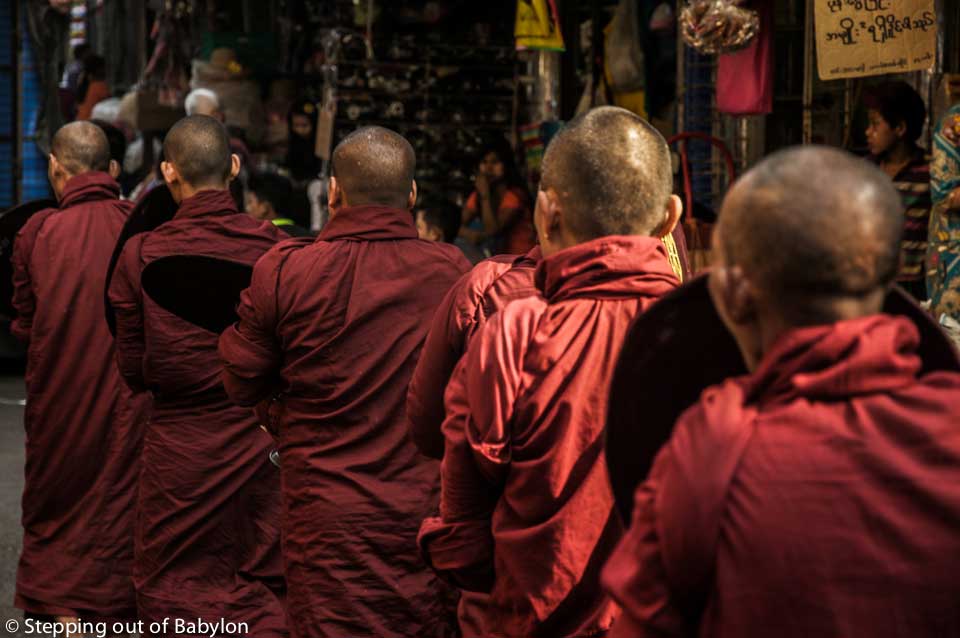
…where every morning monks walk along the city begging for alms, dyed the street with the maroon color.

…where the markets keep their usual fuss, and where the smell of dry fish mixes with the fermented bamboo sprouts, with the people’s voices muting the beeps of the cars…

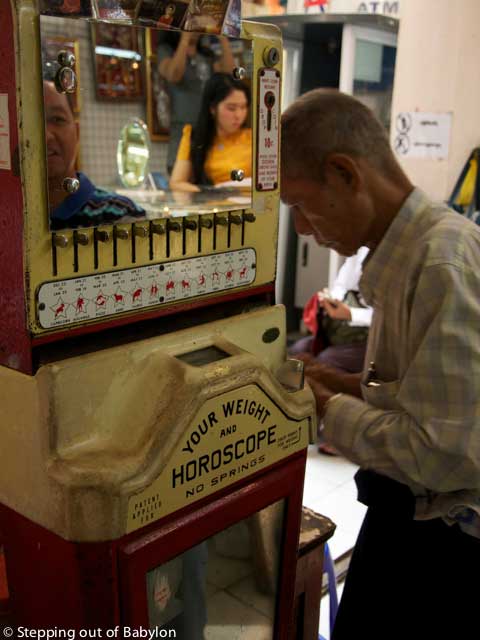
…where fortune tellers and astrologers wait for customers on the shade of a tree, in a country where the Buddhism didn’t erase totally superstition and the animist traditions…

…where reading the news is an almost mandatory activity between male citizens, no matter religion or ethnic group…

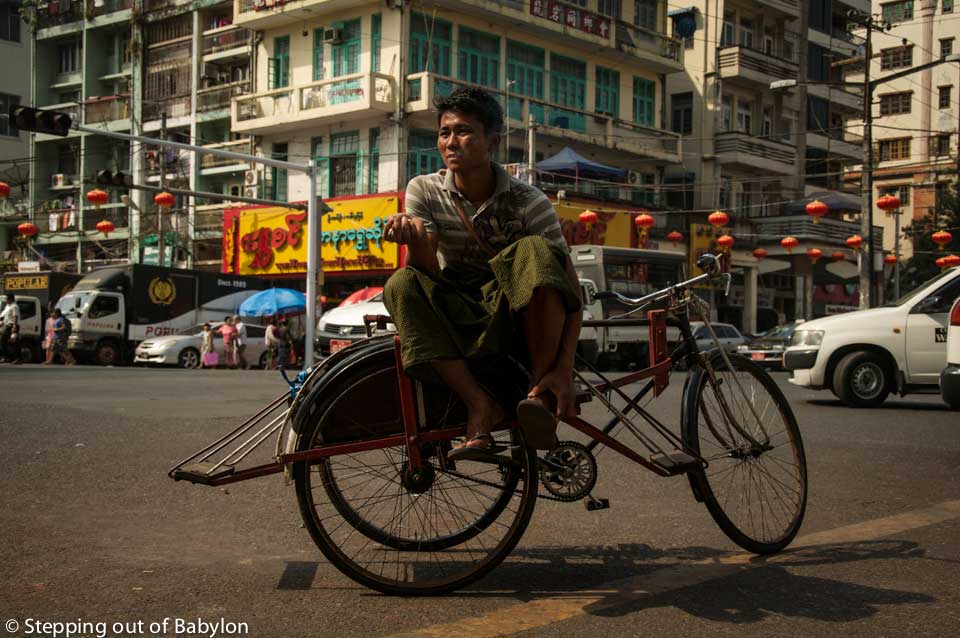
…where the rickshaw drivers wait quietly indifferent to the busy traffic of the city, chewing paan or smoking a cigar…

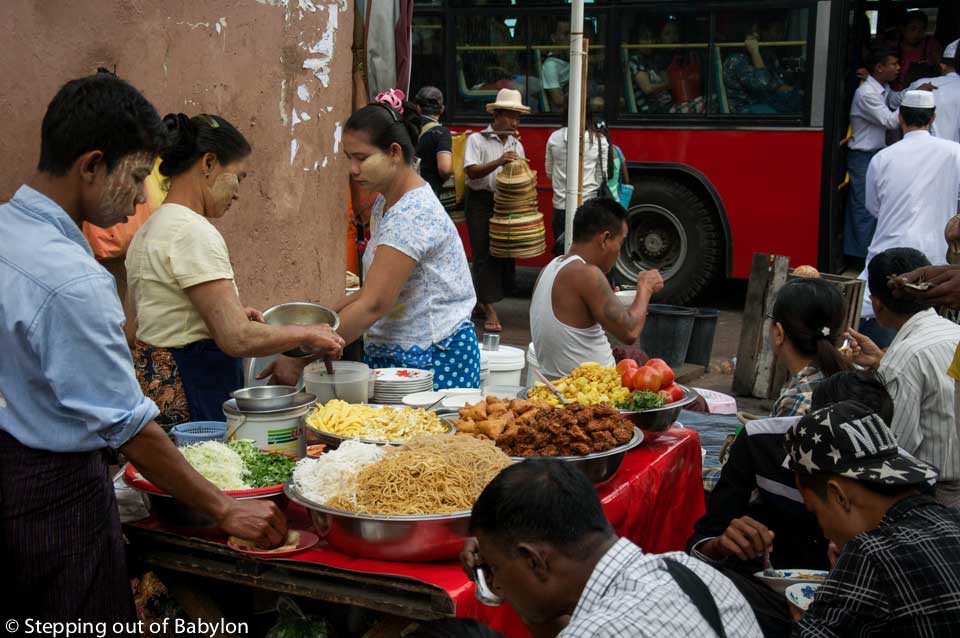
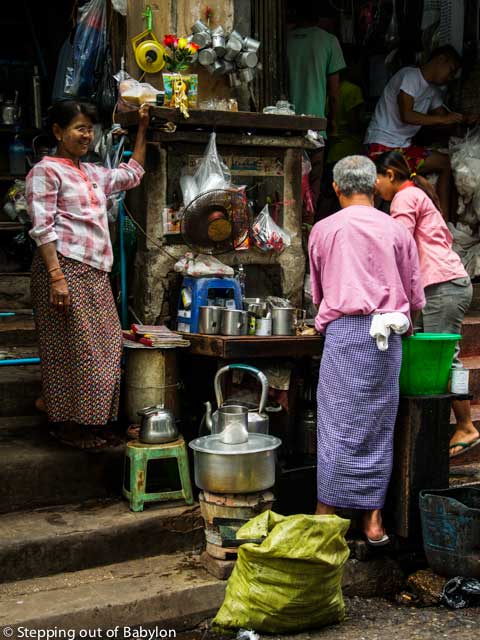
…where the street food is present everywhere, following a precise but indecipherable schedule, with a paratha stall vanish and replaced by a paan hawker in a blink…

…where a Synagogue is located a few meters from a Buddhist temple, from where you can see the minaret of the mosque, while listening to the sound of the bells from the Hindu temple…

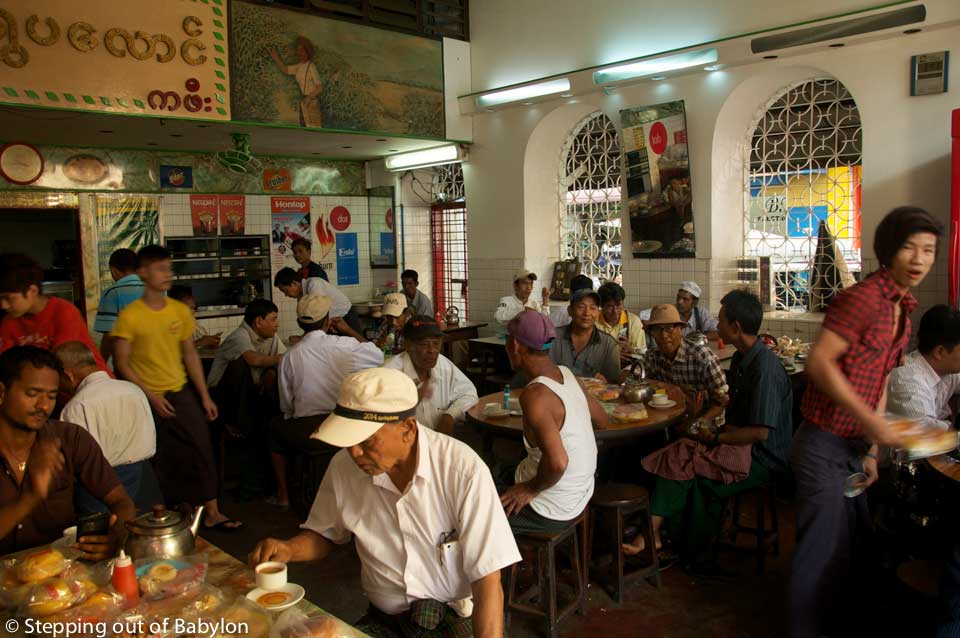
…where the teahouses, remind us of the Chinese presence, a heritage of the Chinese presence in the country, serve an excessively sweetened milk tea mixed with the sound of the male chat, under the freshness of the lazy ceiling fans…

…where the smiles pop up easily from any faces revealing, most of the times, the teeth red dyed by the areca nut and the betel leaf, as chewing paan is a national addiction.
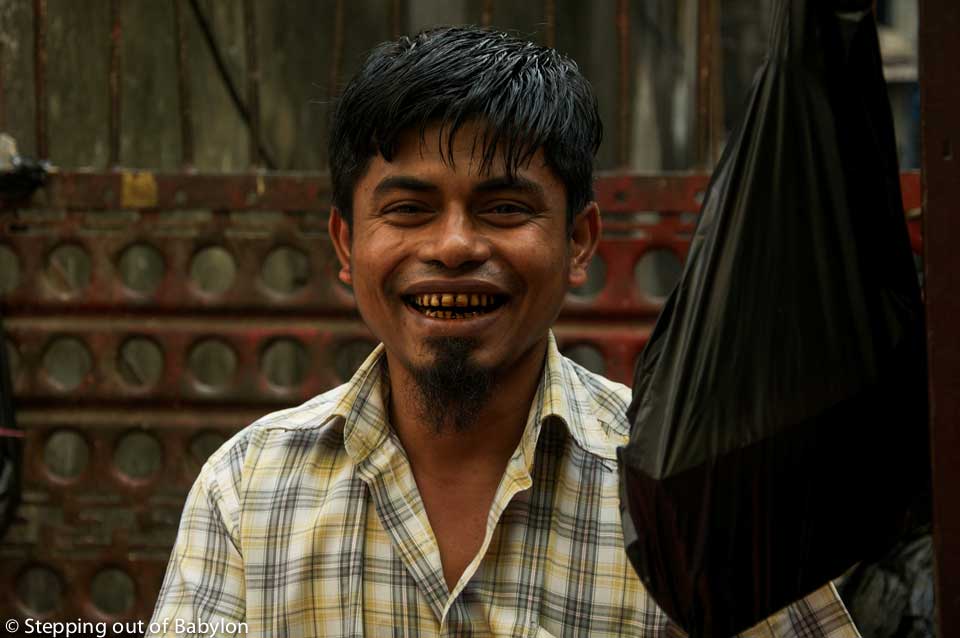
Yangon... where the smiles pop up easily from any faces revealing, most of the times, the teeth red dyed by the areca nut and the betel leaf, as chewing paan is a national addiction
Yangon… where the smiles pop up easily from any faces revealing, most of the times, the teeth red dyed by the areca nut and the betel leaf, as chewing paan is a national addiction

Yangon... where the teahouses, remind us of the Chinese presence, a heritage of the Chinese presence in the country, serve an excessively sweetened milk tea mixed with the sound of the male chat, under the freshness of the lazy ceiling fans
Yangon… where the teahouses, remind us of the Chinese presence, a heritage of the Chinese presence in the country, serve an excessively sweetened milk tea mixed with the sound of the male chat, under the freshness of the lazy ceiling fans

Yangon... here every morning monks walk along the city begging for alms, dyed the street with the maroon color
Yangon… here every morning monks walk along the city begging for alms, dyed the street with the maroon color

Yangon... where the rickshaw drivers wait quietly indifferent to the busy traffic of the city, chewing paan or smoking a cigar.
Yangon… where the rickshaw drivers wait quietly indifferent to the busy traffic of the city, chewing paan or smoking a cigar

Yangon... where the street food is present everywhere, following a precise but indecipherable schedule, with a paratha stall vanish and replaced by a paan hawker in a blink.
Yangon… where the street food is present everywhere, following a precise but indecipherable schedule, with a paratha stall vanish and replaced by a paan hawker in a blink.

Yangon... where the pigeons wait patiently aligned along electric cables, nearby a corner where a corn seller wait for customers that will come to create good karma feeding the birds
Yangon… where the pigeons wait patiently aligned along electric cables, nearby a corner where a corn seller wait for customers that will come to create good karma feeding the birds

[columns] [span6]

Yangom... Where fortune tellers and astrologers wait for customers on the shade of a tree, in a country where the Buddhism didn’t erase totally superstition and the animist traditions
Yangom… Where fortune tellers and astrologers wait for customers on the shade of a tree, in a country where the Buddhism didn’t erase totally superstition and the animist traditions

[/span6][span6]

Yangon
Yangon… a tea shop in every corner

[/span6][/columns]

Yangon definitively is a city that seduces and engages, cosmopolitan and authentic, where the different cultures, ethnic and religions live together in a peaceful and respectful way.
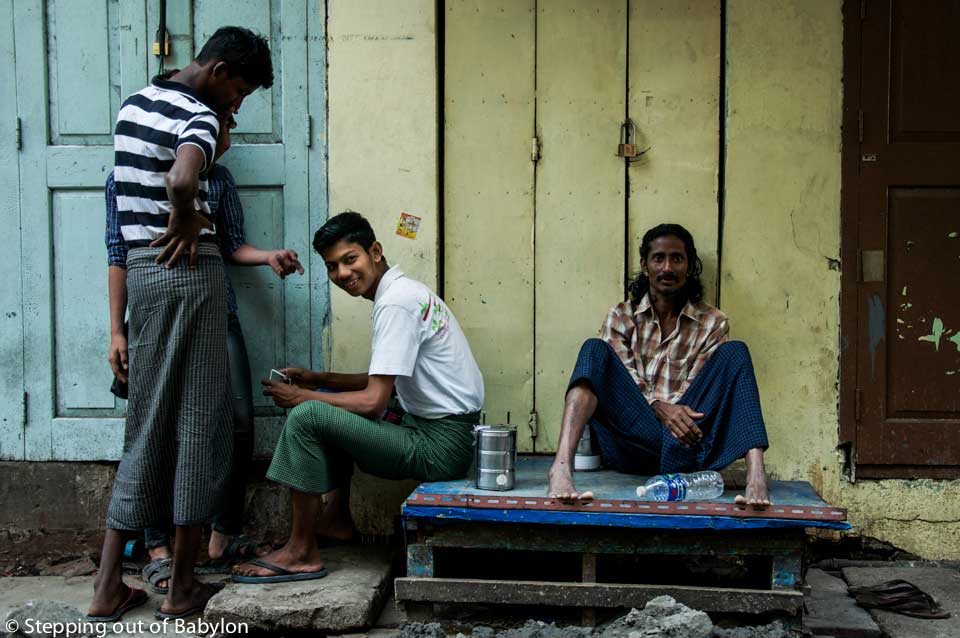
Yangon... multiethnic and multicultural and multireligious
Yangon… multiethnic and multicultural and multireligious


How to get a Thai visa in Vientiane… from Chiang Mai

The so-called “visa run” is a classic for travels that choose to stay for a long time in Thailand. But let’s start with what is a visa run?? Running for a visa? More or less!!! Means go to a nearby country, cross to border and come back to Thailand again, preferentially in the same day!!

Laos, Cambodia, Myanmar and Malaysia are the neighboring countries, but being in the north of Thailand, the easiest way to get a new 60 days tourist visa is going to Vientiane, the capital of the Lao People’s Democratic Republic

Mae Sai, in Myanmar, is also a popular option but crossing by land only give you 15 days visa (NOTE: since 31st December 2016, you can get 30 days tourist visa, on arrival, for free).


Step by step… time and costs:

Day 1: from Chiang Mai to Thai Consulate in Vientiane

  • Bus from Chiang Mai to Udon Thani: 545 baht

The best price is from Phetprasert company (good and comfortable buses), that has several buses leaving during the day, but the best option is the on that departure at 7.30 pm, from Terminal 2 of Arcade Bus Station, otherwise you’ll arrive unnecessarily early to the border.

A VIP bus can cost around 800 bahts and is better to buy the ticket in one of the counters of the Terminal 3.

If you don’t carry much luggage you can go on foot from the old town to the Arcade Bus Station, and it will take you between around 40 minutes walking.

  • The bus departure at 30 pm and arrive to Udon Thani around 6.30 am. The bus drops the passengers in from of the City Plaza, a modern mall. Watch out because this is not the last stop.
  • After the bus leave, you’ll see on the other side of the street a kiosk (with Van Station sign) where you can buy a ticket for the mini-van that take you to the border: Nong Khai
Mini-van kiosk at Udon Thani, in front of Central Plaza

The mini-van ticket from Udon Thani to Nong Khai cost 50 baht. It takes 1.5 hours and drops you at the Immigration area.

  • Thai Immigration at Nong Khai: basically you need to wait on the line and show the passport and the departure card.

If you overstay in Thailand you need to line on the counter on the left and pay the fee (500 baht a day).

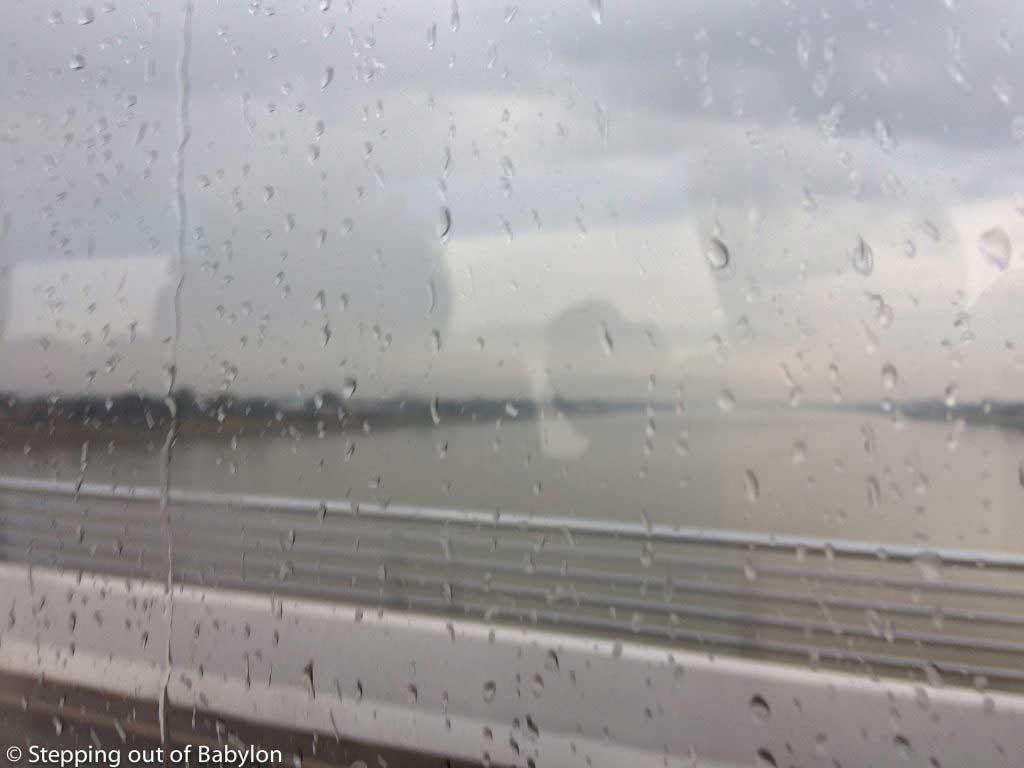
  • After you get the stamp you´ll find a desk outside the room that sells the tickets to a bus that cross the Thai-Lao Friendship Bridge over the Mekong. Apparently crossing the bridge on foot is not allowed!

The bus ticket cost 20 baht, and the trip takes about 10 minutes. The bus departure when is full.

The bus will drop you just at the Thanaleng border crossing and you just need to walk a few meters to the Lao Immigration.

Crossing the Thai-Lao friendship bridge
  • Lao Immigration procedures: when you get off the bus you’ll see a counter on your left side, where you can find the immigration form.

For the Lao visa you need:

  • 1 passport photo,
  • Immigration form,
  • 35 USD (you can pay in baht – 1500 baht – but it will be more expensive). The fee depends on from your country but most of the Europeans countries pay the same. The French citizens pay 30 USD. Check your situation on line.

After you present the document and pay the visa fee (everything in the same counter) you need to wait a few minutes. Every now and then the third window of the counter will open and your name will be called and the passport gave back to you, with a 30 days visa, single entry. A transit visa will cost you the same and will give you more trouble.

Note: the Lao Immigration works from 8 am to 4 pm, so if you cross the border out of this schedule, no matter in which way, you need to pay 1 USD extra.

  • As soon you cross the border gate, mini-van drivers that take you to Vientiane or directly to the Thai embassy approach you. You need to wait until there at least 3 passengers.

The mini-van trip cost you 25.000 kip or 100 baht (the driver will be happy to receive baht… so don’t rush to exchange money at the border and just wait to arrive at the Vientiane to get a better rate!!!) the trip takes around 30 minutes.

  • If your trip to Laos is just to get the visa, so is better go directly to the embassy, as it closes at noon.

Consular Section: Monday to Friday

08.30 – 12.00: Application for Visa

13.00 – 15.00: Distribution of Passports with visa

Close on Saturday and Sunday (check also Thai and Lao holidays http://vientiane.thaiembassy.org/en/embassy/calendar.php)

  • Procedures at Thai Embassy in Laos:

For the Thai visa you’ll need:

  • 2 passport photos
  • a copy of the last Thai visa and also the page with the stamp of entry in the country
  • a copy of the Lao visa

At the Consulate the things are a bit chaotic and busy.

As you cross the Consulate Gate you must go first to the building on your left where you can ask for the application form, and where you can also take the copies of your passport: 20 baht each (you can pay baht or kip).

Inside this building there are some desks where a few consular officials can help you to fill the forms and glue the photos… you must pay 4.000 kip for this service, but filing the form has no big issues and you can save time and money doing it by yourself!!!

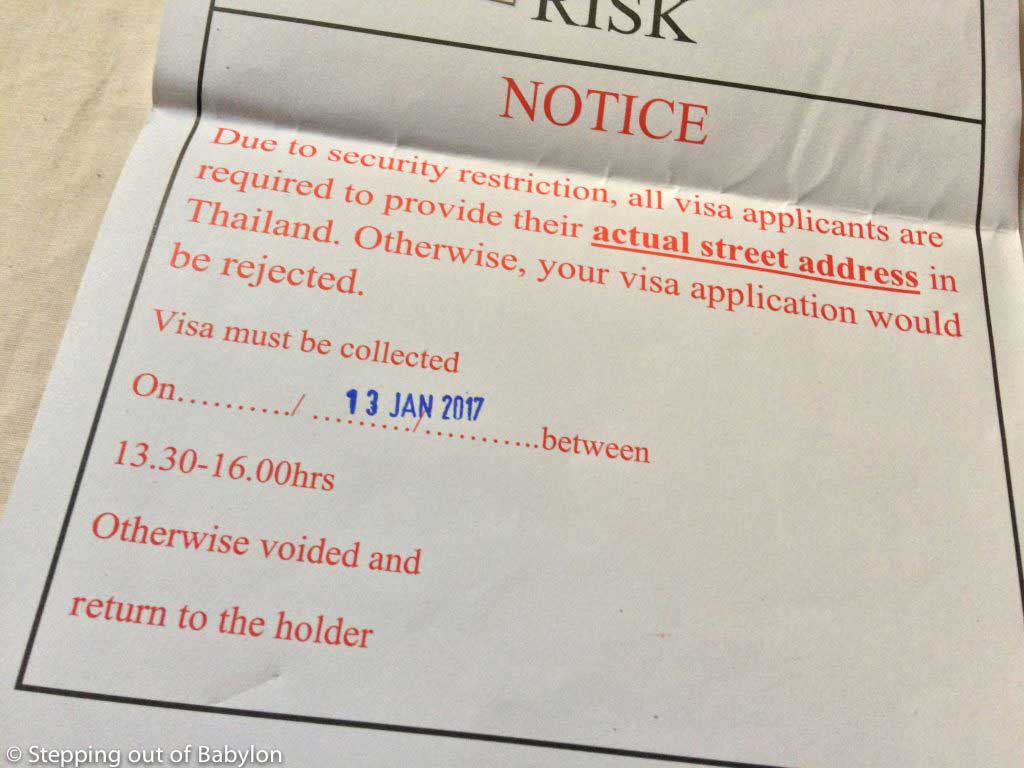
Note: you must write an address of a place or the guest house where you plan to stay in Thailand… don’t need to make proof of any reservation but you must provide a valid name and an address.

Note: you must write an address of a place or the guest house where you plan to stay in Thailand... don’t need to make proof of any reservation but you must provide a valid name and an address.
Note: you must write an address of a place or the guest house where you plan to stay in Thailand… don’t need to make proof of any reservation but you must provide a valid name and an address.

With all this paper stuff ready you need now to join the long queue that zig-zag under the shed, that you see as you come out of the building. This part is fast, as is just the time need to the consular officials check your documents, and give you a number, that you’ll use next day to pick the passport with the new visa stamp, for 60 days with a single entry.


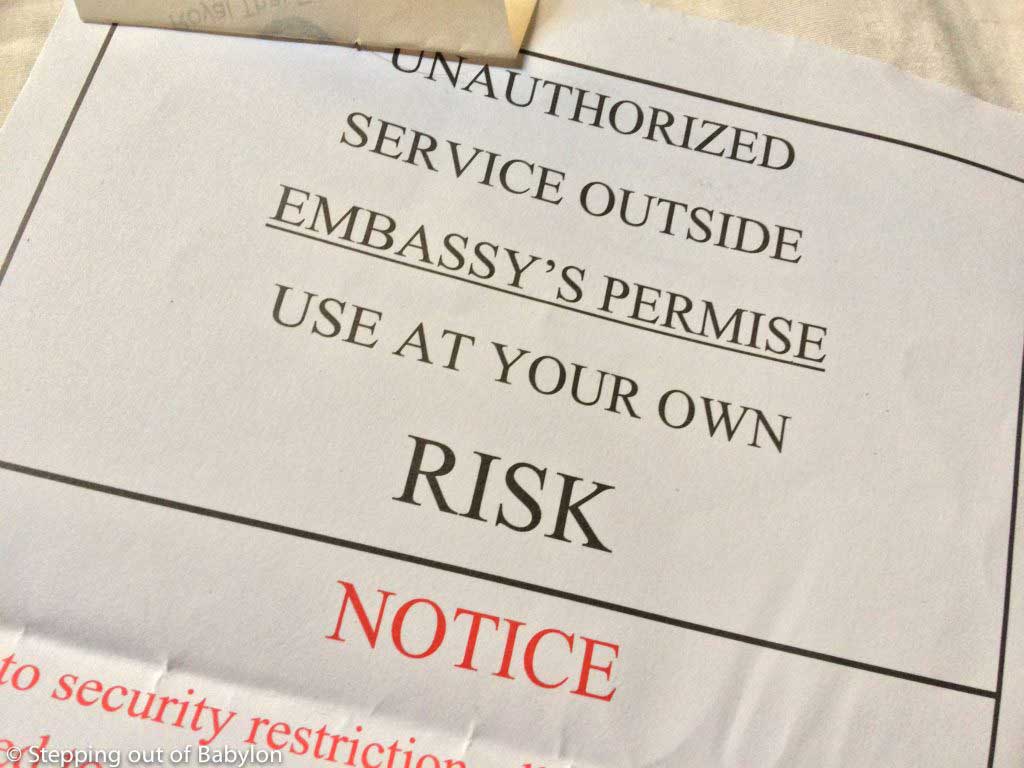
Watch out: when you come off the mini-van, maybe someone forward you to one of the improvised offices where someone fill the form for you, make the copies and arrange everything for you (4.000 kips), even with the promise that paying an extra you can get the visa on the same day… don’t trust in this touts! The consular officials reject the forms that they have… and then you need to do it by yourself inside de consular services.

Watch out: when you come off the mini-van, maybe someone forward you to one of the improvised offices where someone fill the form for you, make the copies and arrange everything for you (4.000 kips), even with the promise that paying an extra you can get the visa on the same day... don’t trust in this touts! The consular officials reject the forms that they have... and then you need to do it by yourself inside de consular services.
Watch out: when you come off the mini-van, maybe someone forward you to one of the improvised offices where someone fill the form for you, make the copies and arrange everything for you (4.000 kips), even with the promise that paying an extra you can get the visa on the same day… don’t trust in this touts! The consular officials reject the forms that they have… and then you need to do it by yourself inside de consular services.


Exceptionally, from 1st of December 2016 until 28th of February 2017, the 60 days tourist visa is free. http://vientiane.thaiembassy.org/en/news/announce/detail.php?ID=362

Now that you have you have the ticket with the number is time to find a guesthouse, have rest and some food in the sleepy Vientiane.

You can reach the center of the city on foot, which that take around 40 minutes walking slowly.

In Vientiane, you can get a bed dorm for 40.000 kips (Garden Hostel, Sihome), get street food for 10.000 kips and watch the time pass by near the Mekong waters.

Day 2: from the Thai Consulate in Vientiane to Chiang Mai

  • On the next day, after 1 pm you can go the embassy to collect your passport. The officer behind the counter will calls people by the ticket number given to you the day before. But don’t worry, is ok if you arrive later (2 pm is a good time), as this way you just need to go to the counter and show your recipe, no matter if it already call your number. This is super fast.
  • Outside de Consulate the mini-van driver will be waiting to take the foreigners back to the Thai border. Again you can pay in baht or kip the mini-van ride: 100 baht.
  • Arriving at the Lao Immigration you must get your passport stamped.
  • Take the bus to cross the Thai-Lao Friendship Bridge: 20 baht
  • Fill the arriving/departure card and get your passport stamped with the day that you must leave the country.
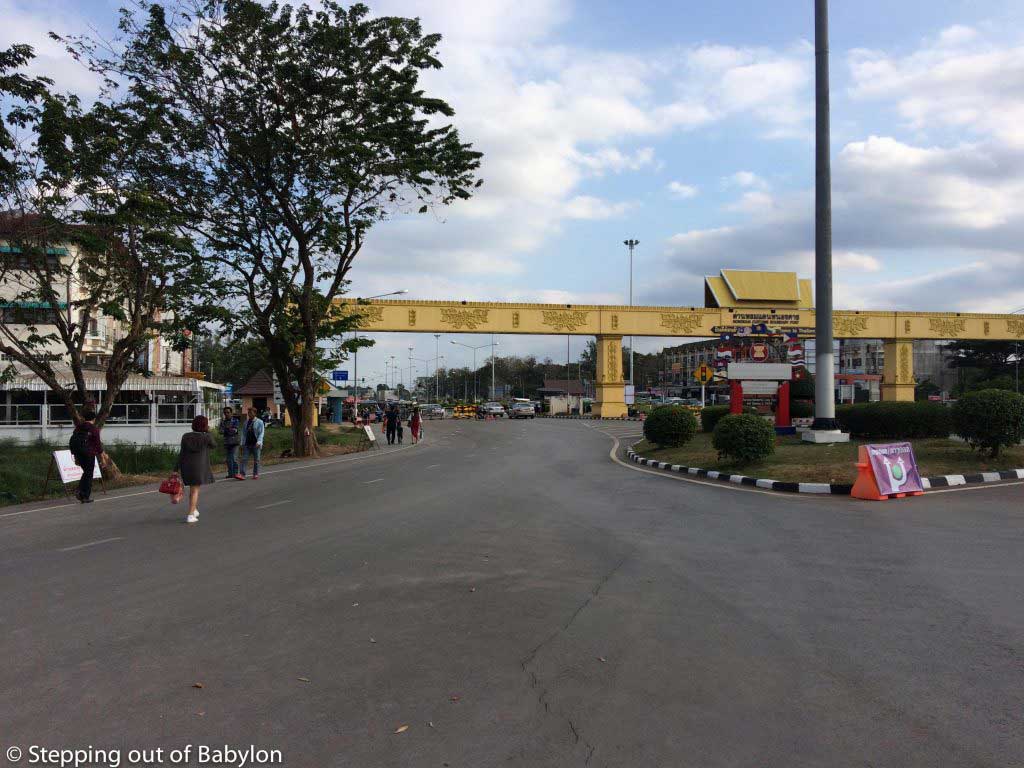
  • After the Thai Immigration procedures, you must walk out the border crossing area, until you pass under a big gate decorated in gold. Many taxi and tuk-tuk drivers will approach you to take you to Nong Khai (if you are going to the south, like Bangkok) or Udon Thani if you are going back to Chiang Mai, for a big amount of money. Ignore them!

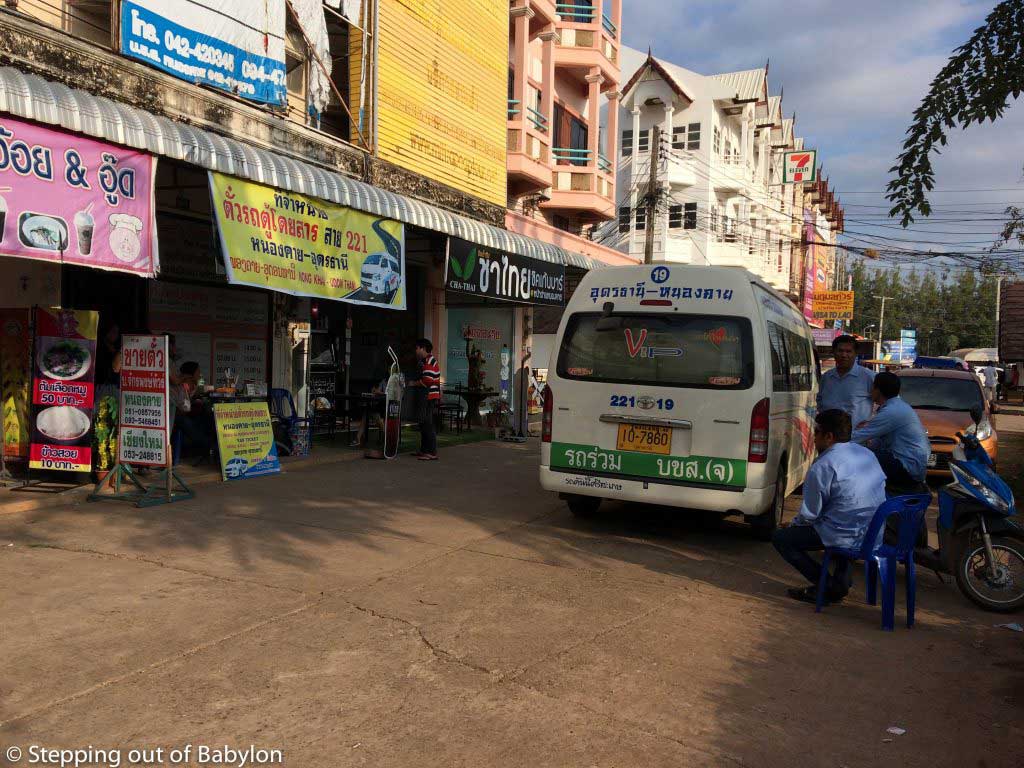
Keep walking a bit further after the gate and you’ll see a few tuk-tuk line up on your left (if you arrive at a 7 eleven, you walk too much), behind them is the office of the mini-van company that takes you to Udon Thani for the just 50 baht! Just need to wait a bit, as the mini-vans run every hour.

Thai border at Nong Khai, after passing under this gate you'll fin the mini-van to Udon Thani and Nong Khai Bus Station
Thai border at Nong Khai, after passing under this gate you’ll fin the mini-van to Udon Thani and Nong Khai Bus Station
office of Mini-van from Nong Khai to Udon Thani
Schedule of the mini-van that link Nong Khai border with Nong Khai Bus Terminal and Udon Thani Bus terminal... you dont need to hire one of the expensive taxis or tuk-tuks
Schedule of the mini-van that link Nong Khai border with Nong Khai Bus Terminal and Udon Thani Bus terminal… you dont need to hire one of the expensive taxis or tuk-tuks
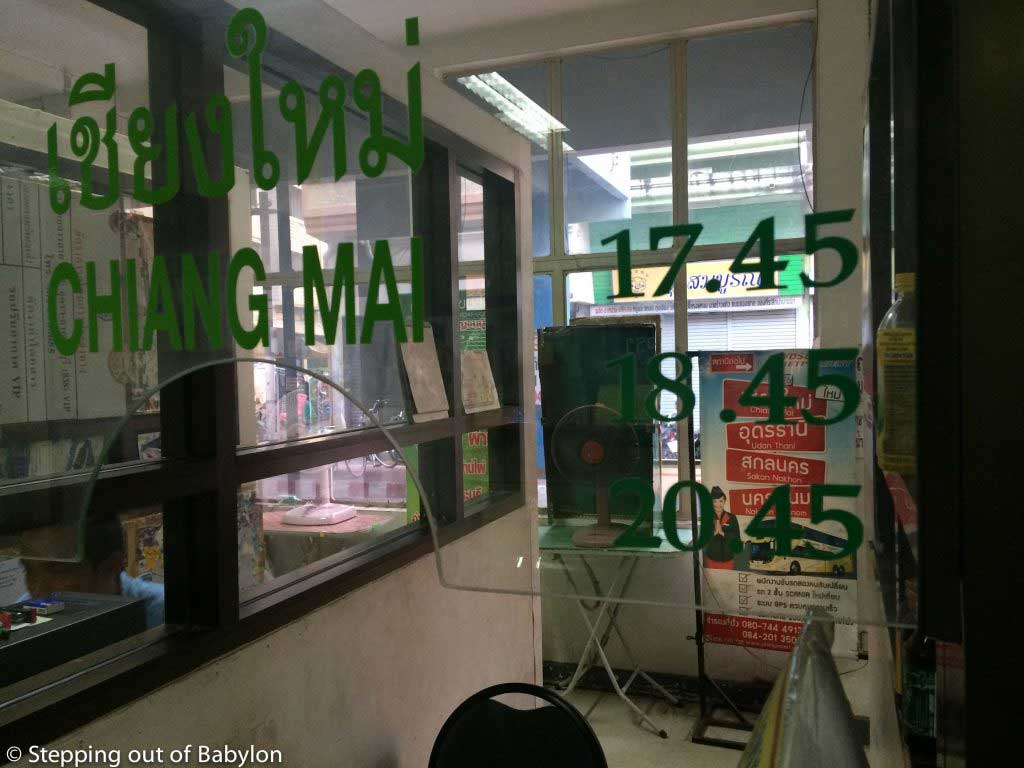
  • Probably you’ll arrive in Udon Thani around 5 pm. At Udon Thani Bus Terminal you need to find the counter that sells tickets to Chiang Mai… the buses departure at:

17.45, 18.45 and 20.45h.

Depending on the demanding you may have the lucky to get a ticket for the first bus… otherwise just need to wait a bit for the next one. There a nice café in the opposite of the entrance of the bus terminal or you can enjoy the air-conditioner of the Central Plaza, a mall very close by.

The bus will pick you at the entrance of the Central Plaza, at the same place where they drop you in the morning of the day before…. just wait there patiently because the bus can arrive a bit later (I wait 30 minutes)…. but no worry because at the kiosk in front (van Station) there a bus company official that can help you.

The bus arrives at Chiang Mai in the next morning, 11 hours later.

And here you are again in Thailand for a couple of more months… and you can even extend this visa for more 30 days!!!!!

Schedule of the bus from Udon Thani to Chiang Mai

Costs of the visa run:

Transportation: 1430 baht (considering not using tuk-tuk in Vientiane)

Sleep: 40.000 kip (dorm with breakfast) (approx. 175 baht)

(The cots of the food in Vientiane are not included as you send more or less the same as in Chiang Mai).

So you will spend minimum 1600 baht plus the 35 USD of the Lao visa.

Bus tickets form Chiang Mai to Udon Thani

How to Apply for Thai visa in Kathmandu

Get the Thai visa in Kathmandu is easy and without big issues!

But you can probably get a visa on arrival for 30 days if you arrive by plane, or 15 days if you arrive by land, totally for free.

The process takes 2 working days, but watch out that during the high season (September and October) it can take up to 5 days. Also check the holiday calendar, as the Thai embassy close during Thai holidays as also the Nepali holidays, and can be closed for several days in a raw like during the Dashain and Tihar festivals. http://www.thaiembnepal.org.np/?do=embassy&index=holidays&lang=en

To apply for a tourist visa (60 days that you can extend for more 30 days during your stay in Thailand in one of the many immigration offices along the country) you need:

  • Passport valid for 6 months
  • 3 passport size photos
  • 3 prints of the form that you can find online.

You need 3 of these forms, filled with your information and also with an address of the place you gonna stay in Thailand… just put an address of a hotel or guest house that you find on the internet… you’ll also gonna need it to fill the immigration card on arriving at the airport or any land border. http://www.thaiembnepal.org.np/?do=services&index=visa&lang=en

  • A print of the balance of your bank account.
  • A Print of passport and Nepali visa
  • A print of the flight ticket to Thailand. On the website is written that you must have a return ticket but I just show one-way ticket and didn’t had any problem and didn’t even need to justify nothing.

Tourist visa costs: 35.000 rupees. Single entry.


Thai embassy at Kathmandu

Schedule of visa section

to submit application: 09:30 – 12:00
to collect the passport: 14:00 – 16:00

The visa section is open from Monday to Friday (the Thai embassy don’t follow the Nepali weekend: Friday and Saturday).

visa section schedule of Thai embassy at Kathmandu

Visa application process:

To save from being too long on the line, because there are some guys from travel agencies that arrive with a pile of passports, is better to arrive a bit earlier. I arrive 30 minutes before the opening and I was the first one… but just for a few minutes.

  • At the counter, you submit the documents and passport.
  • if everything is ok you’ll need to go to the Bank of Kathmandu to make the payment. The Bank of Kathmandu is located about 10 minutes walking from the Thai embassy. Basically, you go down along the main road (Basbari Road) and when you reach the big junction you must turn right. Then the back is on the first floor of a building located 300 meters ahead,
  • At the bank you fill a form, and make the deposit in the name of the Thai Embassy… don’t worry because the staff is used to it). Note that you need to pay 100 rupees extras as back fees!
  • Returning to the embassy you show up the payment recipe (that is also the recipe that you need to show to pick the passport) and it will be stamped with the day when you can pick your passport.

All the process took me one hour including the bank stuff!

If by any reason you cannot pick the passport by yourself, anyone can do it for you as far as it has the recipe, but that person will need to show identification, passport or ID card.

Bank of Kathmandu where the visa fee must be deposited

Address:

Basbari Road, Maharajgunj 167/4 ward 3

http://www.thaiembnepal.org.np/?lang=en

How to go to Thai embassy at Kathmandu:

The easiest way is by taxi, and you can even ask the guy to drive you to the bank and then back… but it can be expensive!

The other was is to pick a tempo, a shared tuk-tuk. The tempos start from Sundara/New Road. The one that goes along Basbari Road is the number 5; sometimes the tempos are identified with nepali numbers… or sometimes are not even identified with nothing, but just ask for “Basbari” and someone will point you a white and green ruined three well vehicle.

At Basbari road you can ask to the tempo driver to drop you close to Thai embassy, that probably the driver knows. From the main road is less that 500 meters until you find the gate.

The tempo takes 20 to 30 minutes to reach Basbari, and the ticket cost 15 to 20 rupees. This vehicles a bit uncomfortable so if possible try to get the front seat…


tempo number "5" that pass by Barbari st.
tempo number “5” that pass by Basbari st.

Myanmar food… where India meets China!!

Reflecting the cultural and ethnic diversity of this country, situated between the Indian subcontinent and Southeast Asia, the Burmese cuisine is very rich and diverse, where is visible a strong Indian and Chinese influence.

Compared to neighbouring Thailand, Burmese dishes may seem poor and too simple, but have the advantage of offering a wide variety of tastes in the same meal, ranging from salty to bitter, and from spicy to sour. Away from the refined palates and sweet taste of Thai curries, and with a strong presence of oily and deep-fried food.

Both meat and fish, from river or sea, are present in many of the thick and fatty curries, that usually are part of a traditional Burmese meal. Around a big bowl of rice are served small plates, with these curries as also lentils or beans stewed, stir-fry vegetables, raw vegetable salads, pickled bamboo shoots, a platter of fresh vegetables such as okra, green beans, small eggplants, cabbage, etc…. A broth of vegetables, very light and clear, is served in a small bowl with this meal, that can be flavored with raw garlic, chilies, and a mixture, dry or oily, of dried shrimps.

mohinga, pela facilidade em se encontrar nas ruas de qualquer cidade ou povoação, à beira da estrada, junto a mercados ou em ruas secundárias, pode ser considerada o prato mais popular entre os birmaneses, sendo muitas vezes consumido ao pequeno almoço.
“mohinga”, a noodle soup, easy to find on streets stalls of any city or town, as also in markets; it can be considered the most popular dish among the Burmese, often consumed at breakfast
pão frito, uma espécie de farturas mas sem açúcar, que é popular ao pequeno-almoço como acompanhamento do café ou do chá
deep-fried bread, light and without sugar, which is popular for breakfast or with a tea or coffee
preparação da let thoke, uma salada à base de massa, legumes frescos como tomate e couve, com muitos anónimos e indecifráveis condimentos, tudo ligado com farinha de grão e misturado com as mãos
Preparation of “let thoke”, a noodle salad, made with fresh vegetables such as tomato and cabbage seasoned with many anonymous and indecipherable condiments, all mix with chickpea flour and fresh hands
let thoke
“mohing” on the left and “let thok” right…  on the back is cooked plain rice, served with the broth, that often is served as side dish of salads
ingredientes para mohinga e let thoke
ingrediants for the “mohinga” and “let thoke”

Burmese meals are usually taken among family and friends who gathered around the table sharing the various dishes and mixing them the plate with small pieces of rice. Meals are taken in quiet, little given to conversation, with attention directed to the food.

The tea is always served with meals, as also in almost all places, from tea shops, restaurants, cafes and even street stalls, which is available for free, keep in the thermos or in the traditional kettles, and drunk in small bowls, that usually are waiting on the top od the tables.

A regular presence at meals and also used for the preparation of salads is the “laphet”, a fermented green tea leaves mixture, that have very characteristic acid flavor.

The “laphet” in the main ingredient of one of the most popular salads, which also have chopped tomato, cabbage finely sliced, crispy fry peanuts, chickpeas or broad beans also fried and is seasoned with lime juice. To this mixture, that is served cold, can be added rice, getting the name of “támin dhouq”.

Another popular salad is let “thoke” made from wheat noodles (that differ from the traditional rice noodles by the yellow color), that is mixed with vegetables and seasoning with mysterious sauces; all these ingredients are involved with chickpea flour, to become less wet, resulting in a strong meal, good the start of the day.

preparação de fritos à base de lentilhas, pequenos peixes ou de camarão seco, que depois de fritos forma uma espécie de bolacha que poder ser consumida como um snack ou como acompanhamento de sopas
deep fry salty crackers to eat with the burmese soups
doces de massa de arroz recheados com uma pasta feita à base de côco fresco e açúcar
sweets made from rice flour and fill with fresh coconut and sugar. they are cooked over the fire along the street of Mandalay, resulting in a sponge texture
restaurante de rua em Yangon
Street restaurant at Yangon
praticamente toda a comida é confeccionada em fogões a lenha, tanto em restaurantes como, nos mercados e em bancas de rua
In Myanmar almost all the food is cooked with fire stoves
restaurante de rua em Yangon
street restaurant at Yangon

But the most popular dish of Burmese cuisine is undoubtedly the “mohinga”: rice noodles soaked in a thick fish broth mix with vegetables and banana trunk sliced… yes! the tender parts of the trunk of the banana tree are also used for cooking in Burma. Sometimes this broth is flavored with fish or crab, but due to the overcooking, just the taste remains.
This soup is seasoned with onion, fried or raw, garlic, dried chilis, fresh coriander and a few more condiments coming out from anonymous bottles that are placed around the table where this dish is prepared. The “mohinga” is a typical Burmese street food, prepared and sold in small street stalls that are set up early morning and run until around 9 or 10 a.m, return in the afternoon, around 4 p.m. until sunset.

The “mohinga” soup can be enhanced with samosas, fried tofu or some fried vegetables, chopped and placed on top. But usually, this soup has a topping of a crispy wafer, made from lentil flour, and fried in oil.

For vegetarians, there are several options in the Burmese cousin, and it’s not difficult to find, especially in big cities, in the neighbourhoods dominated by Hindu and Indo-Burmese population. From neighbouring India, particularly from the southern state of Tamil Nadu, come the curries and dosas, as also parathas, naans, and samosas… in more Muslim areas or neighbourhoods, it’s particularly easy to find the “biryanis”, rice mixed with a meat curry, but in Burma is easy to find a vegetarian version of this dish.

salada let thoke
“let thoke” salad where the funny taste of fermented the green leaf mis with the fry peanuts
Venda de doces junto ao mercado no centro da cidade de Yangon
Sweet sold in on of the markers that every morning fill up the Yangon streets
o famoso MSG, ou mais comumente designado de glutamato monossódico, um intensificador de sabor que está mais ou menos presente na confecção da comida que se encontra nos restaurantes e nos vendedores ambulantes, um pouco por todos os países do sudoeste asiático, mas que na Birmânia é mais evidente, chegando a ser usado em substituição do sal
The MSG, a kind of salt that is a popular presence in Asian food, but that in Myanmar is very common leaving a thirsty sensation in the month
várias variações de arroz glutinoso, que pelo seu paladar naturalmente adocicado serve de snack ou complemento ao pequeno-almoço, dificilmente se encontrando à venda depois das dez da manhã
Stick rice with different presentation… some more salty, others more sweet… the black one is my favourit

Being the curries the most popular of the traditional Burmese cuisine, and despite Burma being a Buddhist country, it’s not so easy to find vegetable curries, especially in rural areas where the options are limited to chicken or pork. But is always possible to have a proper meal, with rice and the others side-dishes that are usually served with the meal, like stews, beans, raw vegetables, etc…
In the cities, usually by the end of the day, there are several stalls that make fried rice or fried noodles, and as the food is prepared in the moment is always possible to ask to use just vegetables.

Both meat and fish can be cooked fresh, and are sold in all markets, that work both early in the morning as in the evening; but at the end of the day, the hygienic conditions deteriorate significantly by the intense heat and by the presence of flies… lots of flies. But the dried fish are also very popular, filling large areas in the markets with its characteristic smell which joins the dried seafood, often tiny shrimp, widely used in the preparation of salads. The dried meat is also part of Burmese cuisine, and easy to identify in curries by its dark color and compact texture.

preparação de comida num dos muitos restaurante de rua em Yangon
street food at Yangon
confecção de noodles numa das ruas de Yangon, onde a pasta feita à base de farinha de arroz e água é “espremida” através de um passador específico, para dentro de uma panela de água a ferver, ficando cozidos em pouco mais de um minuto
making rice noodles in the streets of Yangon
Restaurante de rua em Yangon servindo os tradicionais pequenos-almoços indianos de dosa e puri, acompanhado de sambar e chutney de côco.
South Indian style breakfast, “dosa” and “puri”, served with sambar and a spicy coconut chutney
laphet, folhas de chá verde fermentadas
“laphet”… fermented tea leafs
açúcar de palma, também designado de jageri, que se encontra à venda nos mercados, apresentando-se quase em “bruto” de aspecto escuro ou mais “limpo” ganhando tons de amarelo-torrado, mas sempre de cheiro e sabor intensos, bem longe do excessivo e artificial sabor do açúcar refinado a que estamos habituados
Palm sugar, also call “jageri”, with a intense flavour and smell
refeição típica birmanesa, com sopa e vários acompanhamentos que se misturam com o arroz
typical Burmese meal, with rice, soup, vegetables and salad… in a vegetarian option without the greasy meat of fish curries
pequeno restaurante em Nyaung-U, com a salada de laphet, foi acompanhada da cerveja Myanmar, a mais popular, num país onde o consumo do álcool não é muito evidente, com excepção dos Thingyan Festival e acontecimentos especiais, onde cafés e a maioria dos restaurantes não vende bebidas alcoólicas
restaurant at  Nyaung-U

And now the sweets!!!… they are an important aspect of a gastronomy of any country, and Burma offers plenty of variety: from traditional Indian sweets to the Chinese cakes, stuffed with a chickpea mixture. In general, the Burmese sweets are made from rice, both from glutinous rice as from dough made with rice flour, creating consistent and gelatinous puddings and tarts, mainly with a wet texture.
Very often the condensed milk is used as a sweetener, and is very easy to identify by the taste, as also by the can, always present in shops, restaurants, tea-shops and street stalls
These sweets have frequently a fresh grated coconut topping, or in the case of glutinous rice, a mixture of roasted sesame with salt, which brings an excellent contrast to the sweetness of the condensed milk.
Another specialty is the puddings made with semolina: sweet, sticky but delicious, that can also be made with over cooked rice or noodles.
To this rice sweets, there is also a big variety of deep fry sweet dough, filled or not with a sweet bean paste or lentils, the soft and oily crepes filled with the same mixture, and fried bananas, a Thai influence but here a heavier and greasy version.
Besides sweet shops, that usually can only be found in larger cities, the best place to try these delicacies are the markets where ladies sell sweets made by themselves, giving a homemade taste and creating many variations from city to city and even from stall to stall, a show of creativity and diversity.

sumo de cana de açúcar, feito na hora, e que é verdadeiramente irresistível nas horas de maior calor, juntado à frescura do gelo a aparente energia do açúcar, com o suave e fresco paladar da cana de açúcar... até parece uma coisa saudável!!!
Sugar cane juice, it’s irresistible during hot days, giving freshness and energy
preparação de pahratas num estabelecimentos em Mandalay
dough for “pahratas” waiting to be cooked
espécie de puri de tamanho gigante, pão frito numa chapa sobre as brasas com um pouco de óleo e que companha geralmente com um caril de grão ou de lentilhas, refeição reservada para o pequeno-almoço, numa clara influencia indiana
A giant “puri”, flat bread cooked in a metal surface over the fire, that is a influence of the Indian gastronomy
Como acompanhamento do chá ou de um café tomado ao meio da manhã, os dumplings, recheados de carne ou de feijão, são herança das comunidades de origem chinesa que se encontram espalhadas por toda a Birmânia
The “dumplings”, sweet or sour, fill with meat or beans, are an influence of Chinese cuisine and are popular with a tea or a coffee takes in one of the many tea shops
Salada de pahrata, onde esta é cortada em tiras e servida com cebola, uma variante birmanesa à indo-muçulmana pahrata
This is a “pahrata” salad a oily snack served with raw onions; a Burmese twist to the south Indian “pahrata”
Numa das ruas de Yangon, encontram-se pequenas bancas de venda de comida, em especial durante a manhã, altura em que os fritos são muito populares, seja bananas seja somente de massa simples, recheada de lentilhas ou grão
Several kinds of deep-fry stuff that are a bit everywhere in the streets of Yangon, usually early morning or later, in the end of the afternoon
Loja de venda de carne seca, muito consumida na Birmânia, assim como o peixe
Dry meat in a shop in Yangon in a country where due to the long distances is still very common to find dry meat and dry fish in the markets

Like other Asian countries, there is here what we call the “cult of the table”, with food is taken when one is hungry, despite the time of the day, without starters or deserts. Food can be found almost everywhere, from restaurants to markets as also t the countless street stall, that can be found a bit everywhere, from the big cities to small villages. Knives are absent and all the food consumed with a spoon and sometimes a fork.

Despite you can have food during all day, there are specific times for each kind of meal, with markets, shops and streets stalls being subject to very specific schedule, which requires some effort to learn and incorporate. For example: you can’t find “mohinga” at lunch time, as also impossible to find pahratas in the middle of the morning, who wants to eat “samosas” will have to wait for the end of the day, and those who choose a “laphet” salad to accompany a beer will have to wait for the sunset. However, the big cities like Yangon and Mandalay are more flexible since there are many restaurants, while small towns the food is mostly consumed in markets and streets stalls, where is very often the takeaway system, here called “pásê”.

mohinga numa das ruas de Sittwe, que foi quase sempre a minha opção nesta estadia na Birmânia, seja como pequeno-almoço ou como um vespertino jantar pelas quatro e meia da tarde, pois às cinco horas já esgotou!!!
One of the many “mohinga” that were my favourit option for breakfast… this one in a backstreet in Sittwe
A mohinga da despedida da Birmânia, servida à beira da estrada de acesso ao posto fronteiriço de Myawady minutos antes de cruzar a fronteira com a Tailândia
The last “mohinga” before leaving Myanmar, served in a road side restaurant nearby the Myawady border crossing to Thailand

Above all, what stands out in Burmese cuisine is its diversity, varying significantly from region to region, and even from city to city, being a result of the geographic presence of Burma between the Indian subcontinent and Southeast Asia. The markets reflect the local products, subject to seasonality and to the local products, in a country where the weak transport system don’t promote big exchanges and where the political system are not open to  imports, keeping the Burmese gastronomy almost intact.

Laos food… a bit more than noodles soup

With many similarities with the cuisine of Thailand and some influences of China and Vietnam, the traditional Lao food is a modest sample of the neighbouring countries cuisine. Stand out the noodles and soups, but the grilled are also very popular, but despite the meat is a constant presence, the consumption of fish is not unusual, given the proximity to the Mekong and other rivers that cross the country.

For vegetarians, the options are very slim, not much more than noodles soup, which even if you order without meat, the broths are usually made with chicken or pork and probably you’ll notice the flavour of meat, that can be disguised with the spicy sauces and seasonings alway available.

The noodle soup was a constant presence in my diet during my stay in Laos, where I ate noodles soup at least once a day, often as breakfast.

Both in cities as small villages there are always restaurants that serve only serve noodle soup, changing the quality of the broth and the kind of meat served, but especially the type of noodles that can range from very thin and almost transparent to thicker and consistent strips, but always made from rice flour.

The soup is served with a plate full of raw vegetables such as cabbage, lettuce, green beans, leeks, spring onions, mint, spinach and other vegetables popular in Asian markets but absent from western cuisine. The soups aren’t spicy at all, but sauces like fish, soy, oyster, etc… but chilly can be added in powder, as fresh chilies or as an oily paste, which is often generously laid on the soup and can transform a clear broth in a red soup. Limes in slices are always available on the tables of restaurants, which give a twist of freshness to these soups.

To eat this soup in Laos style, you must use bamboo chopsticks to eat the noodles and other solid ingredients, while the spoon in the left hand is used to eat the broth.

As an alternative to the noodle soup, is also possible to find rice soup, a broth made with overcooked rice which are added a bit of spring onions, soy sprouts and small pieces of meat. This option can only be found in the morning as it just eaten as breakfast with a glass of green tea.

Very popular is the lap, a dish that can be with meat or fish, usually very spicy, prepared with lots of mint leaves and chilies, which is generally eaten with hands with the help of stick-rice, a very glutinous type of rice, dominant in Laos.

A melhor sopa de noodles do Laos, experimentada logo no segundo dia de estadia, na povoação fronteiriça de Huay Xai, com o requinte de servir um pequeno prato de pasta de amendoim onde tradicionalmente são mergulhadas as malaguetas ants e serem comidas
The best noodles soup in Laos, ate in the first day, just after crossing the border at Huay Xai, with lots of vegetables peanut sauce and tea

Stiky-rice, servido como é tradicional em potes de bambo
Sticky rice, in the traditional bambu pots

Sticky-rice a acompanhar um prato de vegetais salteados... uma alternativa vegetariana à tradicinal carne grelhada que acompanha este tipo de arroz
Sticky-rice with stir fry vegetables… but usually this kind of rice is served with meat

restaurante em Luang Prabang que somente serve sopa de noodles, aberto desde manhã bem cedo mas que encerra pouco depois da 1 hora da tarde
street restaurant in Luang Prabang that only have noodles, open since early morning, but close around 1 pm; very popular between local people, serving a good food for a very cheap price, in a casual environment

ingredientes para a preparação da sopa de noodles, que para além dos vegetais custuma ter pedaços de carne, por vezes sangue cozido ou visceras, que são também usadas na confecção do caldo
tray with the ingredients for the noodles soup that apart from a wide range of vegetables, also have meat, intestines and cooked blood

ingredientes para a preparação da sopa de noodles
Ingredients for noodles soup

Besides the noodle soup, you can find easily fried rice and fried noodles. Curries are also part of Laos gastronomy but simple and less sophisticated versions of the ones served in Thailand.

Is visible a greater diversity in the food served in the North of the country, a more wet and fertile area, compared to southern regions, where the climate is dryer and supply are more limited, except the rice that dominates the landscape in the south flat areas.

About sweets, there is little to say because the desserts are not part of the menu of typical restaurants in Laos, being very rare to find some pastry out of the tourist areas. However, as also in Thailand, the rotis are very popular, and can be found in street stalls, that show up after the sun set along the city street. The rotis are a kind of pancake, made from a very thin dough, stuffed with banana, chocolate or egg, fried bit a bit of oil, and drizzled with condensed milk in the end, for extra sweetness.

This roti business is very popular and dominated almost exclusively by Indians, many from Chennai, as this area the roti, in a plain style, are usually eaten with the meal. This Indian community provides also restaurants where is possible to find the traditional Indian dishes for those already tired of some monotony of Lao cuisine.

banca de rua em Vientianne que serve dsde manhã bem cedo sopa de arroz e sopa de noodles, assim como o tradicional café
Street stall in Vientianne that since early morning serve rice and noodles soup, as also the traditional Lao coffee, being a very popular place between local people

molhos e picantes que são adicionados à comida, juntamente com sal, e açucar: uma presença constante em todas as mesas dos restaurantes tradicionais do Laos
A big range of condiments and sauces are available in the restaurants tables, as also sugar, that is manny times added to the food

Muitos do condimentos usados na cozinha do Laos são de origem Tailandesa ou, como é o caso, Chineza
Most of the ingredients used in Lao cuisine come from Thailand and China, making it hard to understand what we have on the table to seasoning the food

The so-called Lao Coffee is a constant presence throughout the country, usually served in the morning on the street stalls. But it can also be found in the more sophisticated cafes in touristic and cosmopolitan areas of Luang Prabang and Vientiane, side by side with French bakery.

The Lao coffee is prepared in a very characteristic way: there’s a metal pot, which always keeps in the heat with boiling water, from where the water is removed with a ladle and poured into a jug, passing through a conical filter cloth, containing the coffee powder. From the jug it’s poured into small glasses, passing again through the coffee filter, to make ti stronger. In the end is usually added condensed milk, or sugar with milk powdered. The coffee that remains in the filter is used more than once, serving to prepare several coffees. It can also be drunk plain without dairy or sweeteners, and this is the best way to appreciate the dense and thick texture of this coffee that have an unexpectedly soft taste and somewhat light bitter flavor.

The price of a Lao Coffee is from 4,000 to 5,000 kips, and is often served accompanied by a kind of bread made in the of fried dough, and sometimes is also serve with a glass of tea… yes, the tea is served even with the coffee and is offered for free.

The French presence is visible in the bread, especially the baguettes, which are sold on the streets and bus terminals, consume as a meal or as a snack between meals, stuffed with not-identify paste, spicy sauces, meat (usually pork or processed meat) and vegetables. They are a popular option for a meal in the long and endless bus trips, due to be easy to take away and to the low price around 7,000 10,000 kips, less than 1 euro.

In tourist areas, it is possible to find restaurants with a wide range of Western food, but with much higher prices than traditional food found in the simple and modest restaurants frequented by locals, where you can have a meal for 10,000 kip, about 1 €.

Lao-coffee
Lao-coffee

In terms of snacks the Lao coisine doesn’t offer many choice, being basically rice cakes, that can be sweet or salted. The sweat ones are made from puff rice, and the salted version is made with cooked rice, mix with egg that is grill with the shape of a small pancake.

noodles frescos vendidos nos mercados espalhados por todo o Laos, e que marcam a diferença entre as várias sopas vendidas em restaurnates, muitas das vezes contiguos uns aos outros
fresh noodles, that can be found all over the country, being sold in markets and also made in the restaurants. the quality of the noodles make the difference in the soups, making on place more popular than the one next door

snack muito popular no norte do país, feito á base de arroz cozido que depois de espalmado é mergulhando em ovo batido e grelhado no carvão
snack made with rice and egg.

How to cross the Border Kedah – Sadao (Malaysia/Thailand)

Crossing the Border Kedah – Sadao…. by bus

It takes time but is easy and without any troubles!

When the bus arrive to the Malaysian immigration you need to get the stamp… it’s a quick and easy process that don’t take more than 5 minutes. The bus driver will help and show you were to go.

After you need to get in the bus again to drive a few meters until you arrive to the Thai immigration services, were the lines are long… this took about 1 hour.

After the immigration process, were you must show your passport and immigration form,  you’ll take the same bus, yet you need to take your bags with you when cross the border.

Note: Before arriving to the Thai Immigration counter you must fill a immigration form, a card with your name, nationality and a few more information, that is staple to your passport after stamped. This should be available at the border.

Although before we reach the border the bus stop in a rest area/restaurant and the driver collect the passports of all passengers, give then back with the immigration form already fill and ask 5 RM for the service. Apparently this is a unnecessary charge as you can do it by yourself, but everybody accepted, included Malaysia and Thai passengers… scam?!?!?!

At this time (Dec.2015) visa on arrival by land is 15 days. The 30 days visa on arrival are only at International Airports.

How to go from Kuala Lumpur to Hat Yai (Thailand)

From TBS Terminal Bersepadu Selatan departure everyday buses from different companies to Hat Yai, crossing the Malaysia-Thai border: Kedah – Sadao.

Schedule: 8.00h, 8.45h, 9.30, 22.00h, 22.30h, 22.45h, 23.00h.

Ticket: between 55 RM (VIP, with 3 seat in a row) and 80 RM (double decker bus).

The bus trip takes 8 hours, but can be more depending of the time at the Malaysia-Thai border

The bus to Hat Yai departure from Terminal Bersepadu Selatan, that everybody knows by TBS. The terminal is located in the south area of Kuala Lumpur and offer good connection with public transportation network at Bandar Tasik Selatan to:

  • Train (KTM Komuter)
  • LRT (Light Train)
  • KLIA train, KL International Airport
Bus ticket from Kuala Lumpur to Hat Yai (Thailand)

Buy bus tickets in Malaysia:

The TBS has a huge number of ticket counters, centralising the tickets selling to all destination and bus companies. Arrive at least half-hour before because the lines are big.

If you travel to popular destinations, especially on Fridays, weekends and holidays is better reserve the ticket in advance.

For reserving ticket you can use on of the many site, and pay with credit card. Most of the web sites don’t charge commission. I use this one: http://www.easybook.com/

Once you arrive to the TBS, nearby the ticket counter you’ll find a counter where you can show your reservation and get the ticket.


How to go from TBS to Chinatown (Kuala Lumpur)

Most of the long distant and inter cities buses, arrive and departure from Terminal Bersepadu Selatan, that everybody knows by TBS. The terminal is located in the south area of Kuala Lumpur and offer good connection with public transportation network at Bandar Tasik Selatan to:

  • Train (KTM Komuter)
  • LRT (Light Train)
  • KLIA train, KL International Airport


Coming out from the bus we are left in a cover bus park with a set of escalators that lead to the main hall of the terminal. Once here, after a short walk inside the building you’ll find an exit on your right, with indications of KLIA.

Following the KLIA signs you’ll cross a metal footbridge; on the other side are stairs and a lift to reach the access to the KLIA train as also to the ground floor.

As you reach the street walk to the right side (for whom are facing the giant building of the terminal), and after passing the taxi rank you’ll find a bus stop.

The Bus 690, Rapid KL (ticket 2 RM) takes 20 minutes (outside rush hours) and ends at Pudu Sentral (Puduraya) in Jalang Pudu near the Plaza building Raykat. From here are five minutes walking to Jalang Petaling, the heart of China Town in Kuala Lumpur.

Bus 690, from TBS to Pudu Sentral (Puduraya). Kuala Lumpur


Tickets, Bus 690, from TBS to Pudu Sentral (Puduraya). Kuala Lumpur

Alternative:

  • After crossing the pedestrian bridge follow signs to the train station, KLIA.
  • Take the KTM-Komuter, Seremban line (2.4 rM) to KL Sentral.
  • At KL Sentral to take the LRT to Pasar Seni (1.4 RM).
  • This alternative takes longer and is more expensive for those whose final destination is Chinatown, but it can be advantageous for those looking for other destinations in the city of Kuala Lumpur.


On the way back, which means from Chinatown to TBS, is better use the LRT + KTM-Komuter specially if you are traveling at rush hours, that can make the bus trip last more than one hours.

By LRT + KTM-Komuter the trip from Pasar Seni to TBS should take less than 45 minutes.


Buy bus tickets in Malaysia:

The TBS has a huge number of ticket counters, centralizing the tickets selling to all destination and bus companies. Arrive at least half-hour before because the lines are big.

If you travel to popular destinations, especially on Fridays, weekends and holidays is better reserve the ticket in advance.

For reserving ticket you can use on of the many site, and pay with credit card, . This web site don’t charge commission.

I use this one: http://www.easybook.com/

Once you arrive to the TBS, nearby the ticket counter you’ll find a counter were you can show your reservation and get the ticket.

Malaysian food… underestimated cuisine!

Two things stand out in the cuisine of Malaysia… the ethnic, cultural and religious diversity that brings us to China, India, Thailand, Indonesia… and the rice which is present in almost all dishes.

From the staying in Borneo and West Malaysia several representative dishes of Malaysian cuisine remain, like lontong, laksa, nasi lemak, nasi goreng… “nasi” means rice and “goreng” refers to fried, so fried rice is one of the dishes easily find anywhere at any time of day, usually made with chicken, beef or seafood, with pork away from a gastronomy of a Muslim country.

Being a predominantly muslim country, Malaysian cuisine is dominated by meat dishes, but the strong presence of the Chinese community as well the Tamil from South of India bring other options that suits the vegetarian diet! 

In terms of nasi goreng, there are many variants (kampung, pattaya, ayam …), differing ingredients, seasonings and spices, always excelling spicy. The nasi goreng pattaya is basically fried rice (fried rice with meat, seafood or vegetables), involved in egg and drizzled with a sweet and spicy condiment. In Borneo this dish is often served with a bowl of broth that makes it less dry. Despite being unpopular and does not appear in the menus it is also possible to order vegetarian nasi goreng, but that is almost always made with egg, and not many vegetables.

Nasi Goreng Pattaya. Malaysia

But it is the nasi lemak that is the “king” and can be considered the Malaysian national dish. Usually eaten for breakfast, being basic and very simple to prepare. It consists of rice and small portions of fried small anchovies, fried peanuts, cucumber slices and egg, that can be boiled or fried. This meal can be served on the plate or wrapped in banana leaf for take-away. But what makes this special dish is the sambal, a red and thick paste, made with chilies, onion, ginger, garlic, anchovies and a few more spices, resulting in a very tasty mixture.

Nasi Lemak. Malaysia

Laksa is another popular Malay dish that can be classified between a soup and a curry. It’s basically a broth, sweet and spicy, which includes the coconut milk, ginger, lime leaf (kaffir) and lemongrass, which involves fine rice noodles and bean sprouts. To this base usually is added meat, but you can also order it with tofu.

In Borneo, the laksa is creamier, with more coconut milk and usually served with tofu and seafood, where seafood comes down to shrimp or squid… but wherever it is always served with lime that brings out the other flavors.

Laksa. Kota Kinabalu. Malaysia

Laksa. Melaka. Malaysia

Lontong, a traditional Indonesian dish that was built in Malaysian cuisine, and its vegetarian in is origin. Made with a compressed rice with a roll shape, cut in big pieces. To these these “chunks” is added a soft vegetable curry cooked in coconut milk, to which joins tofu, tempeh and boiled egg (or sometimes fried). Like the nasi lemak is served with a spoonful of sambal, also part of the popular dishes eaten for breakfast.

Lontong. Malaysia
Lontong. Malaysia

A popular snack in Borneo, and probably can also be found in the rest of Malaysia is called fried carrot cake, which despite its name has nothing to do with carrots, made from cooked and compressed rice-shaped blocks, which are cut into pieces and fried with egg, spicy and sometimes with soy sauce. Unhealthy due to amount of oil but very delicious.

In cities, especially in neighbourhoods dominated by Indian culture, often called Little India, it’s easy to find the traditional cuisine of southern India as a result of the strong presence of the Tamil community living here for generations. In addition to the delicious curries that give life to a dish of rice, often served in a banana leaf, you can also find murtabak, dosas and other typical Indian snacks, served with coconut chutney and sambar.

But what stands out are the roti canai, also called roti prata or paratta. It is a flat unleavened bread, but whose dough is extended until get very thin, thrown with mechanical and precise gestures against the table, repeatedly until almost getting ripped, in a process that requires a lot of oil. After is extended and rolled to create rough layers and is then fried in a metal plate until crisp and slightly toasted. The roti is accompanied by a small dish of curry, were it is is soaked.

You can find several versions of this roti, stuffed with egg, banana, sweetened milk…

Roti canai. Malaysia

From the presence of the Chinese community, result many restaurants and all variations around the noodles soup and fried noodles, and along with nasi goreng, are a popular option and easy to find at any time of day. As they are prepared at the moment they can be made in a vegetarian variant, where it is often added tofu, a notorious influence of Chinese cuisine.

The fried rice noodles in Malaysia answering to the name Kueh Teow Goreng, and are always made with egg, bean sprouts and some raw chives.

Kueh Teow Goreng. street food. Kuching. Malaysia

The dim sum, traditional Cantonese meal steamed in bamboo baskets, is a presence in some Chinese restaurants, some of which still retain the traditional system in which the food is circulated in trolleys through the tables with customers choose the food among the dozens of varieties… were hardly can be find vegetarian food.

Very popular in areas with the highest concentration of the Chinese community, as are the Chinatown in different cities of Malaysia, are the shops specialised in dried meat that is prepared in different ways, ranging from sweet to spicy.

But what stands out the Chinese food, resulting from the attractive price and the wide range of options is the rice dish serve in buffet style: a plate of with a portion of rice were different dishes are added chosen from trays of food, which can be meat, fish, eggs, vegetables and the popular tofu that is cooked in different ways. This system is very popular, not limited to Chinese cuisine, extending the Malaysian food restaurants that although more focus in meat also offer a wide variety in terms of vegetarian food. Just need to ask for “rice” and we are given a plate with of rice for each one add the dishes.

Rice plate restaurant. George Town. Malaysia

Rice plate. George Town. Malaysia
Rice plate street food. George Town. Malaysia

About street food, Malaysia will get a lot of inspiration to neighboring Thailand, and is easier to find in the cities of the north of the country than for example in Borneo. In small stalls that arise several hours a day in specific locations of the city can be found apom, steam rice cake, fried banana, and the popular and delicious apam balik that are pancakes stuffed peanuts… and many more delicious options that also include snacks, often fried.

Apom. George Town. Malaysia
street stall of chendul (chendol). George Town. Malaysia

Markets are also great places to enjoy and experience the wide variety of food, a lot of which is difficult to identify, whether it is sweet or salt, whether it is meat or vegetarian… but always arouses curiosity.

Street food. Central Market. Kota kinabalu. Borneo. Malaysia
Shellfish. Central Market. Kota kinabalu. Borneo. Malaysia

As a tropical country abound bananas, mangoes and papayas… but also in the markets as street vendors also are pineapple, jackfruit, watermelon and melons… but it is the durian, the king of tropical fruits, much appreciated as hated by intense and characteristic smell, that make it forbidden to carry in the subway.

Durian. Kota Kinabalu. Malaysia
Fruits. Central Market. Kota kinabalu. Borneo. Malaysia

Sweets

The chendul (or chendol) is a traditional cold sweet very popular in Malaysia, based on coconut milk and crushed ice, sweetened with palm sugar syrup and served with a green noodles (whose color comes from a vegetable often used in sweets and dishes, the pandan) and a few sweetened beans. It may seem odd but it is delicious and refreshing and in some places, like George Town people line up in small street stalls to buy chendul.

Chendul (chendol). Melaka. Malaysia
Fry Banana. Central Market. Kota kinabalu. Borneo. Malaysia
Sweet and deep fry snacks at Central Market. Kota Kinabalu. Malaysia

Very popular is kaya, a coconut and egg jam, that sometimes can have the green color, if it’s added pandan. Kaya is used to spread on toast, which served with eggs and tea is also one of the option in terms of traditional breakfast in Malaysia, mainly in cities. Kaya Jam is also used to fill puff tarts as the ones sold in a small corner shop in Kuala Lumpur’s Chinatown.

Kaya Jam. Malaysia
Kaya Jam at breakfast. Malaysia
Coconut puff tart. Chinatown. Kuala Lumpur. Malaysia

Adding to the list of popular sweet is the beancurd (also called soybean pudding) a kind of pudding made of soy, which is sweetened with palm sugar syrup, is also popular in most dominant Chinese areas.

Beancurd. Kuala Lumpur. Malaysia

Drinks

Being a predominantly Muslim country, alcohol is unusual at local restaurants but is easy to find in bars and restaurants in more tourist sites, especially the beer.

But the most popular in terms of drinks is teh tarik, which is tea to which is added sweetened milk, and can be served hot or with ice (teh ais). It is consumed in the morning, usually hot, accompanying meals, like roti canai for example, or during the day, as a break in the workday.

Coffee is also easy to find, being in Malaysia usual the filtered coffee, served in a very strong version in terms of caffeine, with a dense and dark look but soft flavor.

Teh Ais (Ice tea with condensed meilk). Malaysia
Coffee. Malaysia
Coffee. Malaysia

For vegetarian food the best option are the Indian restaurants, due to the influence of the Hindu religion and some Chinese restaurants that resulting to the connection with Buddhist religion can sometimes exclude animal products. In restaurants more targeted to the Malay cuisine is notorious the strong presence of meat dishes, and yet respecting the halal rules, which pork is exclude. Yet pork meat is quite popular in Chinese dishes.

In general there are few dishes exclusively vegetarian in Malaysia gastronomy, and even those who appear to have no animal products, can often be served with a condiment called “sambal” that includes anchovies or any other small fish.

For those who are used to eating knife and fork, it is here to adapt to the use spoon and fork, because the knife is an instrument that does not arrive at the table, being unnecessary since the food is cut into pieces being brought to mouth by the spoon, serving the fork to push food into the spoon. In Malaysia the food is take to mouth with the right hand. In Indian restaurants it is common to use the fingers to bring food to the mouth, but spoons are always available. Spoon and chopsticks are used in Chinese restaurants. In general, the restaurants do not have napkins.

And as in other Asian countries the first meal of the day is made on the basis of rice and noodles, soups or curries. The rotis are also popular for breakfast. Many restaurants serving breakfast open at 6 am, but this are not always open until dinnertime, closing by 3 or 4 pm. But there are others who not opening so soon, serve meals until dinnertime, but not much later than 9 pm. Take-away system is very popular with both restaurants and street stall to be prepared to parcel food in proper containers or more traditionally in banana leaf.

Rice and curry for for take away. Malaysia

In general, even with the limited vegetarian choices, Malaysia gastronomy offers a great diversity of flavours, with simple dishes, fast and easy to prepare but very tasty… I miss the laksa, lontong and nasi lemak.

Food Costs in Malaysia

In food courts a meal costs between 3.5 and 5 RM, which means that you can easily get a meal for 1 €.

The same applies to the so-called rice plat, with two or three varieties of vegetarians side dishes costs about 4 MR. The food costs in Kuala Lumpur are a bit higher were a rice plate eaten in a restaurant can costs about 5 RM, but van be cheaper is a street food stall

Dishes with meat, fish or seafood always have higher prices.

  • « Go to Previous Page
  • Page 1
  • Interim pages omitted …
  • Page 6
  • Page 7
  • Page 8
  • Page 9
  • Page 10
  • Go to Next Page »

Footer

search

Tags

Arugam Bay Assam Bali Bogor Border Crossing Borneo Colombo Esfahan Fes Food Gilis Hiking Hikkaduwa hokkaido Istanbul Itinerary Jakarta Java Kashan Kumano Kodo Lombok Marrakesh Meghalaya Meknes Mekong Nagaland Natural Park Northeast States Ouarzazate Sarawak Shan State Shiraz Sichuan Province Sumatra Tabriz Taipei Tehran transportation ubud Varanasi Visa Yangon Yazd Yogyakarta Yunnan Province

I’m Catarina, a wanderer from Lisbon, Portugal… or a backpack traveller with a camera!

Every word and photo here comes from my own journey — the places I’ve stayed, the meals I’ve enjoyed, and the routes I’ve taken. I travel independently and share it all without sponsors or ads, so what you read is real and unfiltered.

If you’ve found my blog helpful or inspiring, consider supporting it with a small contribution. Every donation helps me keep this project alive and free for everyone who loves exploring the world.

Thank you for helping me keep the journey going!

BUY ME A COFFEE

Categories

Recent Posts:

  • How to go from Hualien to Dulan Beach
  • Taroko Gorge: between marble cliffs and emerald rivers
  • Hualien: a dull gateway to Taroko Gorge
  • Taiwan: Itinerary for an 16 day trip
  • Vietnam: Itinerary
  • 3 months in India: Kolkata, Tamil Nadu, Karnataka, Goa and Kerala
  • Backpacking Turkey in 24 Days: itinerary & costs
  • English
  • Português

© Copyright 2026 Stepping out of Babylon · All Rights Reserved · Designed by OnVa Online · Login