• Skip to main content
  • Skip to footer

Stepping Out Of Babylon

Travel & Photography

  • About me
    • Contact
  • Destinations
    • Africa and Middle East
      • Iran
      • Lebanon
      • Morocco
      • Turkey
    • East Asia
      • China
      • Japan
      • Taiwan (Formosa)
    • South Asia
      • Bangladesh
      • India
      • Nepal
      • Sri Lanka
    • Southeast Asia
      • Cambodia
      • Indonesia
      • Lao
      • Malaysia
      • Myanmar
      • Singapore
      • Thailand
      • Vietnam
  • Itineraries
  • Travel tips
    • Border crossing
    • Hiking and Natural parks
    • Food Journey
    • Visa
  • Photography

Search Results for: sri lanka

Sri Pada… chasing Buddha’s footprint

With about 2243 meters high Adam’s Peak is not the highest point of Sri Lanka island, but is somewhat one of the most sacred, not only for Buddhists that found here the footprint of Buddha and call this place Sri Pada, as for the Hindu with the footprint of Shiva and for Muslims and Christians the trail left by Adam.

Apparently on the top of the hill is a depression in the rock and with some imagination can be considered a giant foot, which mixed with some religious devotion make this mountain one of the main pilgrimage sites in Sri Lanka.

The favorable season for the pilgrimage is from December (Unduwap ​​poya*) and May (Wesak poya*) with January and February being the best months to climb, as they provide better visibility and more stable climate, without risk of rain. However at this altitude, the temperature drops a lot during the night when it is more common pilgrim climbing 1400 meters separating Dalhousie from the summit. During the May and October months is not recommended to climb Adam’s Peak because the mountain is shrouded in clouds most of the time and the weather is unstable.

During the pilgrimage season over 20,000 people go up Adam’s Peak during the weekends, what makes these days not recommended for who come here for the hike and don’t want to spend hours to make the ascent… but by the lack of information, the chosen day happened on a Friday, with the aggravating circumstance of being a longer weekend due to another religious holiday, the Thai Pongal day celebrated by the Tamil community, and also a national holiday. So the day chosen to make the climb was probably the busiest day of the pilgrimage season.

The walk began promptly at two in the morning, with 4 hours to quietly make the climb (that same people says can be done in three hours) in order to reach the summit at sunrise and so be able to watch the show that has a bit of mysticism where, for few moments, appears reflected on the opposite slope a shadow with a perfect triangular form, that have nothing to do with the peak shape, but that probably results from an optical effect caused by the scattering of light at sunrise mixed with the effect of altitude… but which produces a single phenomenon.

on the way to Sri Pada
just before dusk on the way to Sri Pada
last third of Sri Pada path

The beginning of the trail is very easy with the ascent to be made by small groups of ramps or steps but where the cold and the darkness makes this a monotonous way. However, the route is fairly light by a few lamps but mainly by shops arranged along the way, selling religious items, warm clothing, toys, candies and others serving tea and food, 24 hours a day. Prices will increase as you go up, which is reasonable fair as everything from rice, lentils, bottled water, soft drinks, vegetables, gas cylinders, etc… have to be carried by porters up the hill, that receive at the best 1500 rupees in case of delivering things on the topmost restaurant, which should take between go and come back all day, with results in less than 10 euros per day of hard and seasonal work.

After making the first third of the way, the trail so far wide begins to narrow and to be totally made by stairs, often occupied by pilgrims who take the opportunity to rest from the effort, which delays a bit the movement of other visitors, forced to slow down the speed.

And at a slower pace, when the ego is no longer powered by the rapid rise, the pride of good physical shape and by competition to reach quickly the top, arises space to be aware of what surrounds us. Time to observe the devotion that brings thousands of people to do this climbing, not being too hard is not easy, especially for those who do it with children on his lap or for elderly people, that slowly and with many stops walk with determination. It is touching to see families of three generations walking at the pace of the slowest, mothers breastfeed babies during a break on the steps, fathers carrying children asleep in their arms and observe as teenager support the tired steps of grandparents.

The walk was proceeding smoothly until the approach to the last third of the way, when the stairs become narrower, and the high number of pilgrims which gathered with some tourists, made the climb impossible, with the path blocked by people, that almost didn’t let space for who made the descent. So close to the summit was not the time to give up, and as there were still two hours to the sunrise, remained no alternative but to join the crowd and walking up the stairs at very-very slow pace. The hours passed slowly in the cold to blight the hopes and the lack of movement to leave the body chilled with cold air blowing on the unprotected side of the mountain.

The sun rose in a magnificent spectacle of diaphanous light as if a cloak of darkness was slowly being removed revealing the landscape of colors that were slowly gaining strength. But the top was still far and more than two hours after the dawn the top, where you will find the Buddha’s footprint was still far from being achieved. So having been lost sight of the optical effect of the shadow who comes up with the sunrise, and without the religious motivation of pilgrims, whom the wait is not too much to reach that sacred site, fatigue won and at 8 o’clock it was time to start the descent.

sunrise on the way to Sri Pada

Despite some disappointment for not having reached the top, the descent made at the soft morning light revealed a stunning landscape of pristine vegetation with no trace of human presence, lakes occupying the bottom of the valleys, gentle slopes where the tea plantations form a wavy carpet, and a sea of ​​green that fills the eyes, broken here and there by brown rust of granitic rocks that seem to radiate glow when exposed to the first rays of sun.

Sri Lanka_Sri Pada_Adam's Peak_DSC_7226

Descent after the sun rise. Sri Pada path

Dalhousie that jut exists because of the pilgrims is no more than a street along which line up few houses, guest houses, restaurants and many candy stalls, all selling almost the same sweet stuff. In the middle of the village in a kind of bus terminal, stops the buses that connect Dalhousie and Hatton, the nearest railways station. It’s in Dalhousie that begins the trail that leads to the mountain ridge, and where most people stay overnight, although many people arrive by bus and starts immediately the ascent, leaving the site as soon as they return back to Dalhousie.

Dalhousie
Dalhousie
Dalhousie
Dalhousie
Dalhousie
Dalhousie
Dalhousie
Dalhousie

Dalhousie_Adam's Peak_DSC_7116

* Poya: are holy days according to the Buddhist calendar that coincides with the full moon. So every month in Sri Lanka has a holiday, were most of the shops as well as official services (banks, post office, etc.) are close.


Meteorology in Adam’s Peak:

http://www.mountain-forecast.com/peaks/Adams-Peak/forecasts/2243


What you need to climb Adam’s Peak:

Basically, not much. Comfortable cloths that keep you warm during the low temperatures of the night that on the top mix with a unpleasant chill wind. On the way down little by little you need to get ride of some layers of cloths and probably end in a t’shirt.

Most of the foreigners use hiking shoes but you can do it with good sandals, but during the evening ib better put socks. Most of the local people do it with sandals, or even more frequently flip-flop, with many people do it barefoot despite the cold temperatures.


Shortcut to Sri Pada (Adam’s Peak):

In the days of higher affluence is better to use an alternative way to get to Adam’s Peak summit. Who used this “shortcut” made it in time to see the sunrise, having started the route also at 2 o’clock in the morning.

After you go about two-thirds of the track is a junction with a Buddha statue. On the right side starts a track that at night requires the use of a flashlight, because the path is irregular with rocks and tree roots. At the end of this trail comes to a cemented path that leads to other stairs that also access the top of Adam’s Peak, but not so busy.

beginning of the "alternative" path to Sri Pada
beginning of the “alternative” path to Sri Pada
"alternative" path to Sri Pada
“alternative” path to Sri Pada

Where to stay in Adam’s Peak (Dalhousie):

When the buse drop you at Dalhousie (last stop) you are in the center of the village. Walking a little backward, you’ll find most of the guesthouses. Walking forward, toward the beginning of the trail you can also find two more guest houses and rooms for rent. Prices are clearly inflated and a small room with only a bed, with shared toilet, reaches 2500 LKR per person.

Walking a bit further, after passing the “Adam’s Peak” sign painted in yellow on the rock, through the row of sweets shops, along Sri Pada Road, you’ll find on your right, after going down some steps, a house that rent rooms: Dilani Ligh House.

The rooms are ultra basic, with only a bed but the price can be negotiated: 1000 LKR for a room for two people. The toilet is shared and is outside the house in a small construction, and the bath must be at open-air, with cold water. But good enough to spend a few hours before starting the hike, leave your luggage safe and get some rest after the walk.


Where to eat in Adam’s Peak (Dalhousie):

Right next to the Dilani Ligh House guest house, at the Sri Pada Road, a restaurant with the same name, that serves from morning until the early afternoon, a simple but pretty good rice and curry, although extremely spicy, for 100 LKR, which helps to recover the energy.

Along the way, you always finds food in the restaurants located along the path, almost until reach the top. Open 24 hours, even without rice and curry are always ready delicious coconut rotis (a kind of savoury pancake made with grated coconut) and other typical snacks of Sri Lanka.

vada and coconut roti at Sri Pada trail

How to get to Adam’s Peak:

Dalhousie is a small village that hardly shows up on the map and Hatton is the nearest town with some infrastructure. Hatton being one of the most important settlements in the tea route in Sri Lanka, is served by rail, by a route that crosses through the “hill country”, which starts in Colombo, pass by Kandy and ends in Bandulla.


  1. Kandy to train Hatton

Train tickets to 1st class are sold out with about 45 days in advance, but can be found in travel agencies, who buy them in advance and then sell them to tourists charging a high commission. However, even at the travel agencies in Kandy is not easy to find tickets because usually these places are reserved for organized tours.

So the alternative is to travel in 2nd or 3rd class where there are no reserved seats.

There is only one train a day that starts in Kandy to Bandulla, and leaves at 3:30 am, making it an unattractive option. All other trains depart from Colombo and reach Kandy already full, making difficult get a place in the train in the days of greater affluence as weekends and holidays. The train was late and left the station with greater delay because of the difficulty of placed all passengers, mostly foreigners with big backpacks, on a train that already arrived full to Kandy.

The trip took 2.5 hours, and certainly through an interesting landscape, but as there was no chance of having a seat the best option was to sit in a minimal space on the floor.

Train Ticket: 110 LKR (2nd class)

Hatton train station
  1. Hatton to Dalhousie bus

Just off Hatton railway station, stopped on the left side you’ll see the bus (red) bound for Dalhousie, awaiting the arrival of the train passengers, starting as soon as it gets full… which does not take long in the high season.

Bus Ticket: 70 LKR

Next step is a 1:50 hours bus trip to cover the 33 kilometers that separated Hatton from Dalhousie, made by a narrow and winding road between tea plantations from where trees survive from what was once a forest.

The view along the way is stunning but the accelerated driving makes this tedious and prone to carsickness.

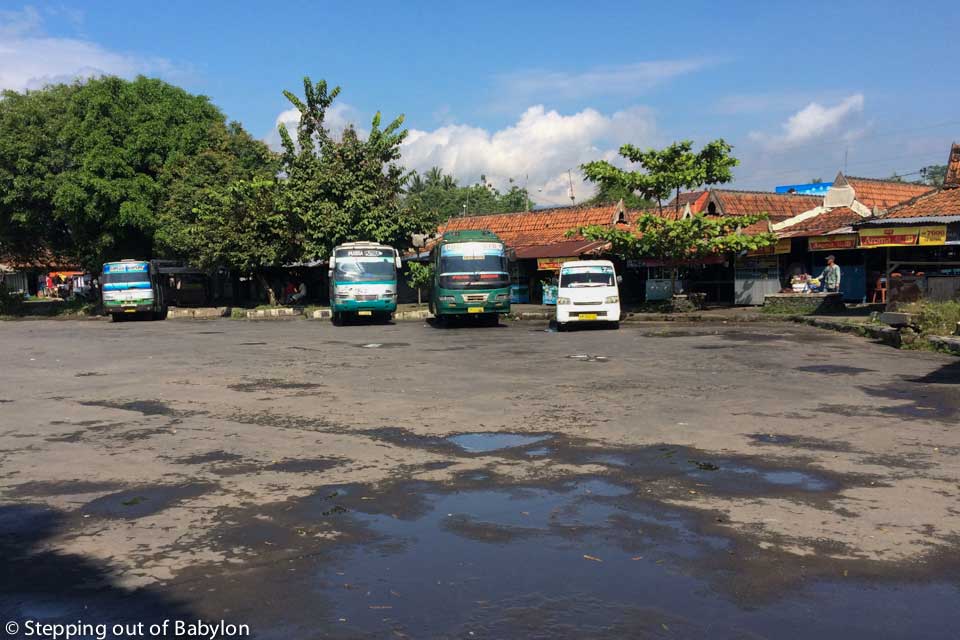
The bus terminates in a ground which is the Dalhousie bus terminal which is the center of the village.

Dalhousie Bus stand
Dalhousie Bus stand

_Hatton_Bus to Delhousie_DSC_7235

Hatton Train Station. Bus ticket to Dalhousie


There are no ATM in Dalhousie; the closest one is at Hatton.

Nasi Campur… so simple and so delicious!!

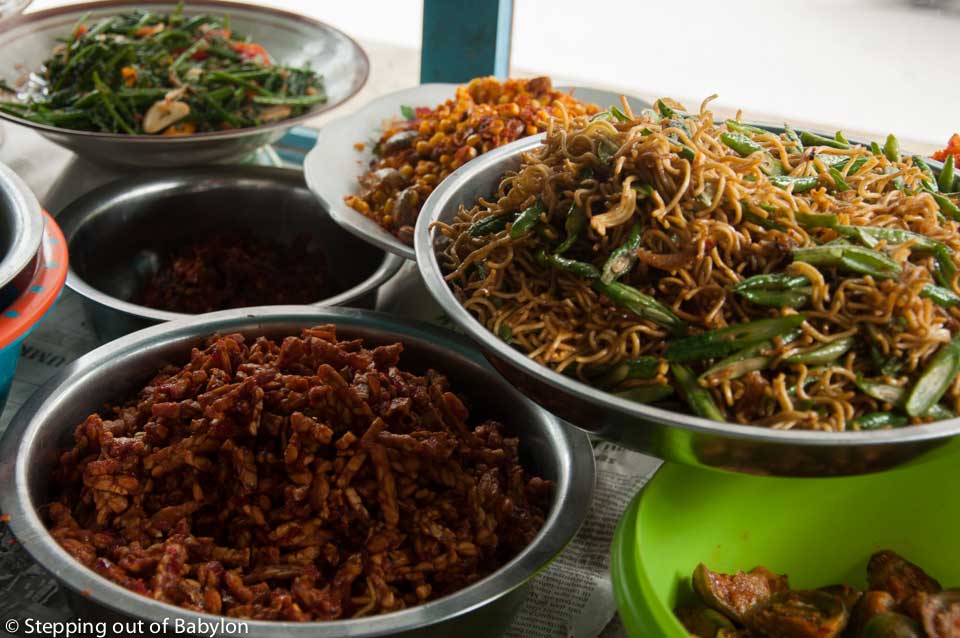
In the Indonesian language “nasi” means rice and “campur” means mixture, and nasi campur is basically a dish that mix steamed rice with other dishes: meat, fish, vegetables or egg, seasoned with sambal (see below).

In Java, the nasi campur is usually served with a portion of fried noodles, a style that hardly be found in other Indonesian Islands, which probably is an old influence from Chinese gastronomy, as also the tofu that is a regular presence in the Javanese cuisine.

In a certain way, nasi campur (pronounce as “champoor”) is quite similar to what can be found in Sumatra Island, called nasi kapau or nasi padang, but with different ingredientes and recipes, with the Javanese food being cooked with less gravy, less spicy and more sweetness than the neighbouring island. The presence of noodles, tofu and tempeh also makes a difference from this rice dish served in Java and in other islands.

nasi campur
nasi campur served in the traditional way in banana leaf and cooked on Javanese style with fry noodles, sweet tempeh and some vegetables… with a bit of a grind coconut, fried, sweet and seasoned with spices
nasi campur
The Javanese “nasi campur” in a vegetarian version, just with sit fry vegetables, fry noodles and sweet tempeh over a scoop of rice… the “sambal” stands up in the plate by it’s bright red colour

Thanks to the usual presence of vegetables (sayur in Indonesian language) like green beans, papaya and cassava leaf, bean sprouts, cabbage, spinach and other green leaf vegetables… the Indonesian cuisine, despite not being vegetarian (not even in Bali that is an island dominated by Hinduism) has a lot of options for vegetarians. And the frequent presence of tofu and tempeh especially in Java, Bali and Lombok create a wider range of options, even for the ones that want to avoid eggs.

But watch out if you are a “purist” about vegetarianism as there are a few animal products hidden in some of the Indonesian dishes, like the shrimp past that is used in the sambal… some super-small fishes mix in tempeh and vegetable dishes… and also in some crackers served with gado-gado and other salads that are flavoured with peanuts or shrimp past.

the most popular places to eat the "nasi campur" are small informal eateries that are easily identify by the window where the food is exposed in tray os plates... the noodles are an influence of the Chinese gastronomy but the "tempeh" is a traditional Indonesian food made from fermented soy beans, which can be cooked in different ways
the most popular places to eat the “nasi campur” are small informal eateries that are easily identify by the window where the food is exposed in tray os plates… the noodles are an influence of the Chinese gastronomy but the “tempeh” is a traditional Indonesian food made from fermented soy beans, which can be cooked in different ways

Something about tempeh…

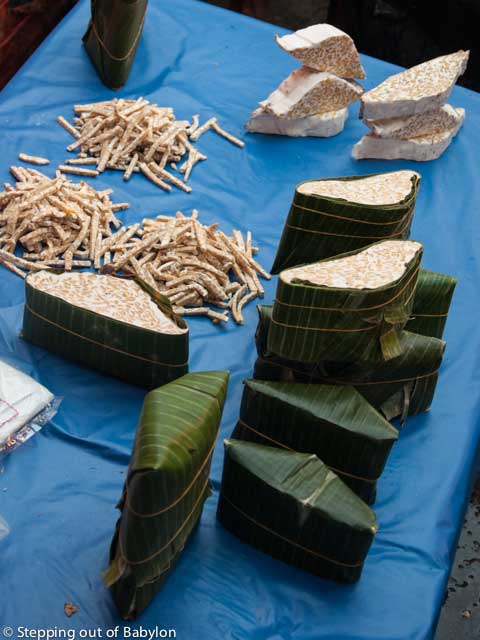
But the Javanese cuisine as something unique to offer: the tempeh!! Tempeh is made from fermented soybean, that gets aggregated forming a soft but compressed block, sometimes warped in banana leaf, which is sold fresh in local markets all over Java but that can also be found in nearby islands of Sumatra, Bali and Lombok.

Due to its compact consistency, the tempeh can be cut in slices or chopped in small pieces. Unlike most of the soy products, the tempeh isn’t an influence from China, but an Indonesian product that is present almost in every restaurant that serves rice dishes.

Is difficult to identify the taste of the tempeh as it isn’t something that stands up in a dish despite being a fermented product, but it can be described as something between beans and mushrooms, resulting from the fermentation of the soybeans that creates a thin layer of mould. It has a heavy and thick consistency but smooth on the month, giving a feeling sensation in the stomach.

The same way as the tofu, the tempeh can be simply deep-fried (goreng) or simply fried in a pan, but can also be cooked with fry peanuts in a sweet and red sauce made from spices and sugar… that is one on the reason why the Javanese food is famous for the sweetness.

[columns] [span6]

tempeh
The tempeh is usually sold in blocks that can be cut in slices or chopped in small pieces.. according to the time of the fermentation the tempeh may look different and have distinctive smells

[/span6][span6]

tempeh
Tempeh packed sold in markets

[/span6][/columns]

tempeh
tempeh sold in a street stall and wrapped in banana leaf… where is visible the layer of mould between the soybeans
fry tempeh... one of the most popular way to cook the tempeh
fry tempeh… one of the most popular way to cook the tempeh… delicious and crunchy

Sambal?!?!

Sambal (don’t mistake with “sambol” a Sri Lankan dish made from coconut) is a spicy condiment made from chilies, usually with a bright red colour but that can also be found in green. The sambal is a must in any nasi campur plate and gives a special touch to any meal. Sometimes a meal can just be some fried tempeh seasoned with sambal and served with a portion of steamed rice!

The sambals in Indonesia are hot but not extremely spicy and the recipe also includes tomato, garlic, shrimp paste and lime juice… but can have more other ingredients, with each restaurant having its own recipe.

The Indonesian sambal change from island to island, from market to market, from restaurant to restaurant… but are a mandatory presence at any rice dish served in Indonesia.

Sambal
Different kinds of “sambal” sold in a Market in Bukittinggi (Sumatra). The “sambal” is a condiment that can be find everywhere in Indonesia that is always added to a rice dish
Tempeh served with sambal and rice


Where to eat nasi campur?

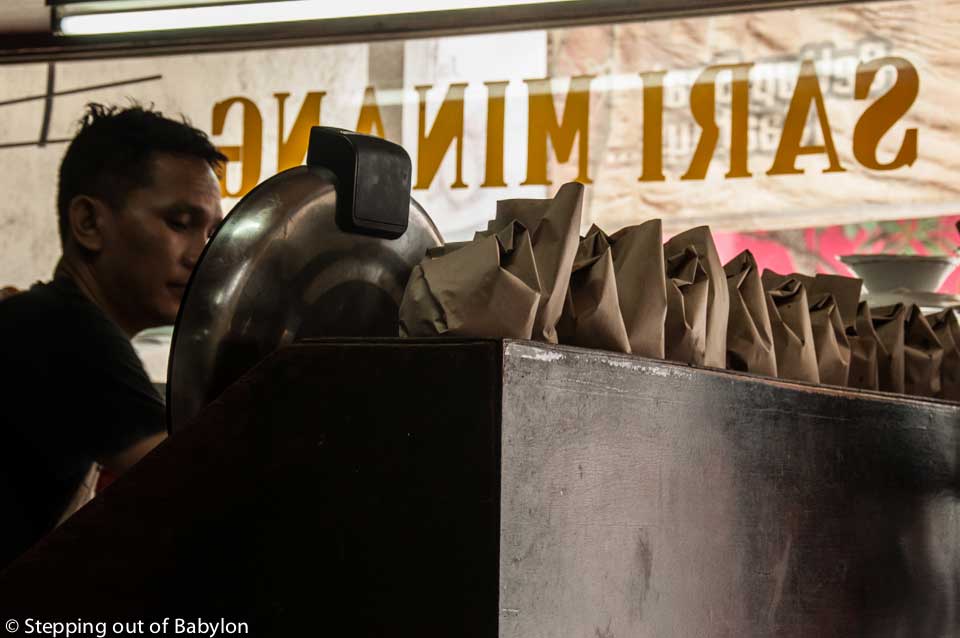
Basically, you can find nasi campur everywhere! It is served in a la carte restaurants, in informal eateries where the food is exposed in trays at the window, in a improvised stall set up in front of a house, in a hidden back street kiosk or inside the markets in a kind of food courts. The nasi campur can also be found in street hawkers that usually hang around the food markets, caring a basket loaded with the familiar paper cones that wraps the food.

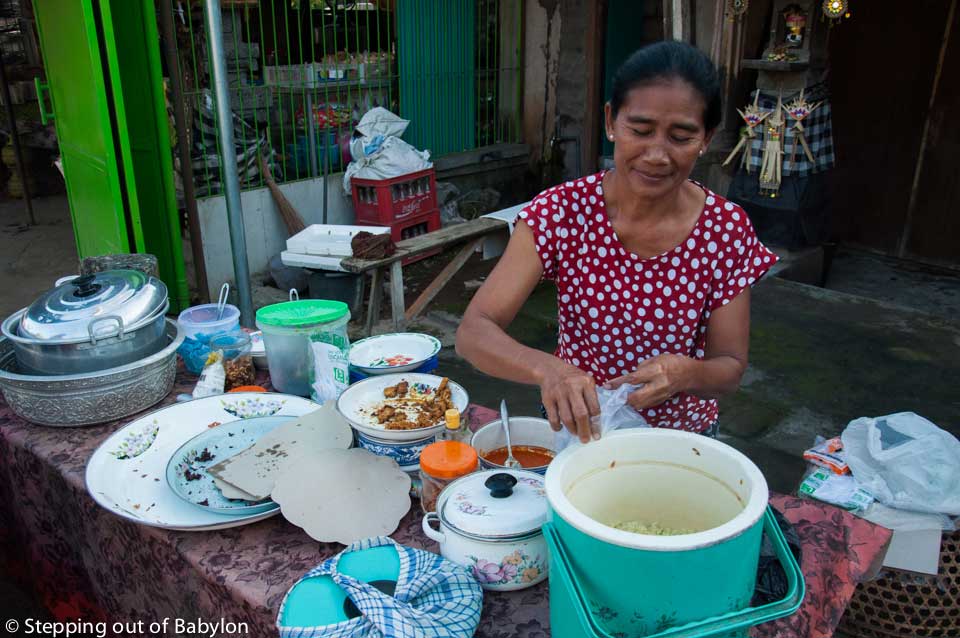
Early morning is the best time to find this informal way to eat the nasi campur, as many housewives set up a table on the street selling food, most of the times for take-away by people on the way to the work, but where is always possible to ask for a plate and seat on the side walk, interacting with other customers and enjoying the movement of the street.

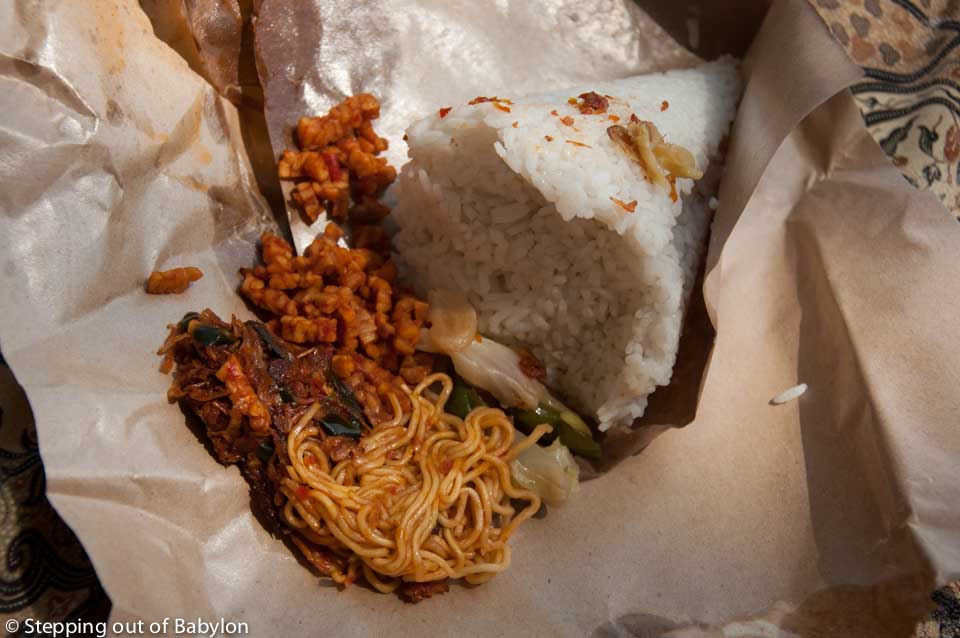
small eateries that are a bit everywhere in Indonesia that serve nasi campur, where the take away sytem is very popular, with the food wraped in paper sheets forming a cone
small eateries that are a bit everywhere in Indonesia that serve nasi campur, where the take away sytem is very popular, with the food wrapped in paper sheets forming a cone
Nasi campur can also be found in improvised food stall that pop up in the mornings along the streets
nasi campur for take away: rice, fry noodles, sweet fry tempeh

Despite the fried rice being the dish easiest to find in Indonesia, mostly due to the easy and quick way to prepare, the nasi campur can be considered the most popular Indonesian food staples, including here all the variations resulting from the different cultures, traditions and climates that characterise this huge country!

Borobudur… without visiting the temple!

Borobudur raises a mix of conflict feelings. In one side this structure is the biggest Buddhist temple in the world. In the other hand, the price of the ticket raised recently to 20$ for foreigners, more than any museum and monument in Europe. So what to do?!?!… blow up the budget to get the ticket or see the temple from a far distance?

For a while that the issue of price discrimination between national and foreigners is popping up in my mind but with the time I kind of get used to this, as usually, the price is not substantial if your currency is euros or dollars. But sometimes, in places that are classified as World Heritage by UNESCO, this difference is significant, excluding many people that are traveling but don’t have a big budget, making the so-called “world heritage” accessible only for a few. (See my text about Lions Rock in Sri Lanka). So as also a way to stand my point of view I decide not condone with this strategy that I consider discriminatory.


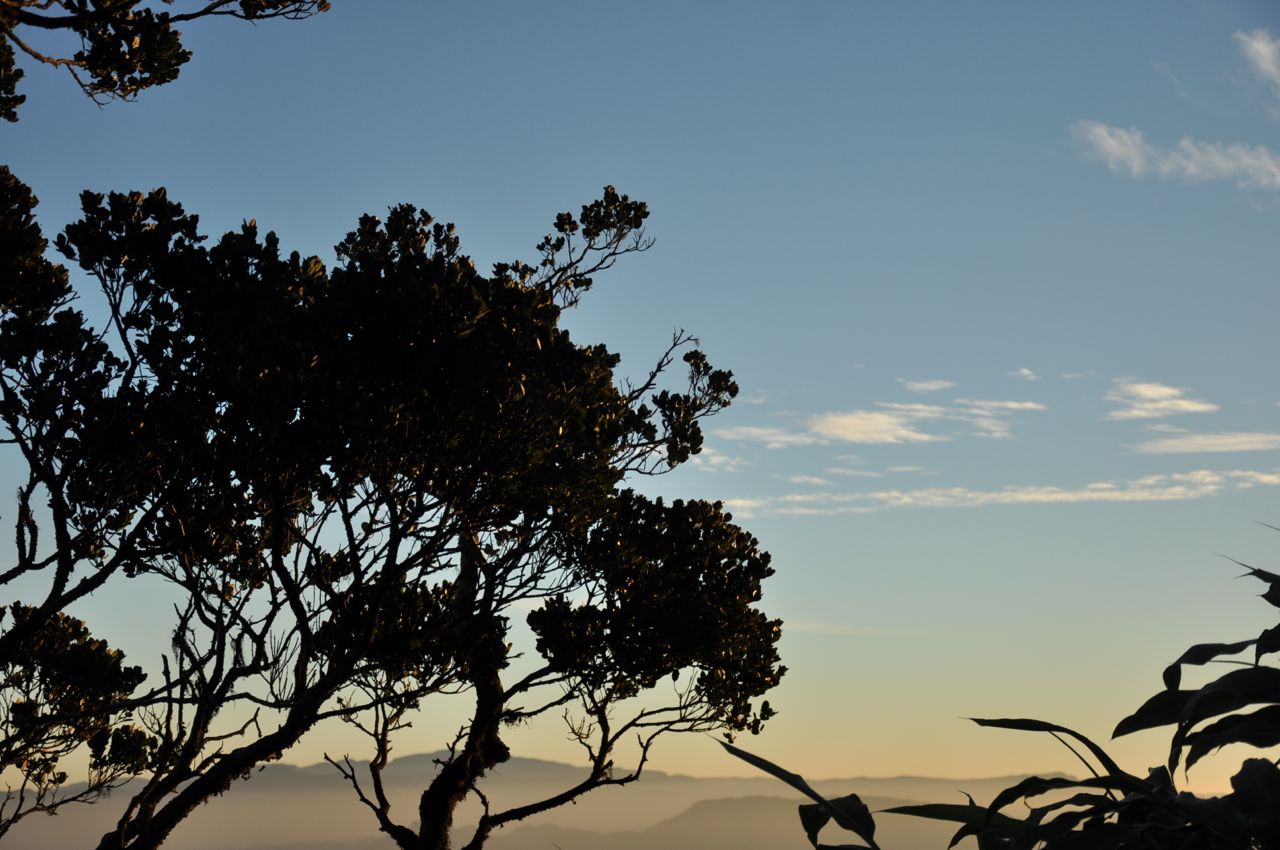
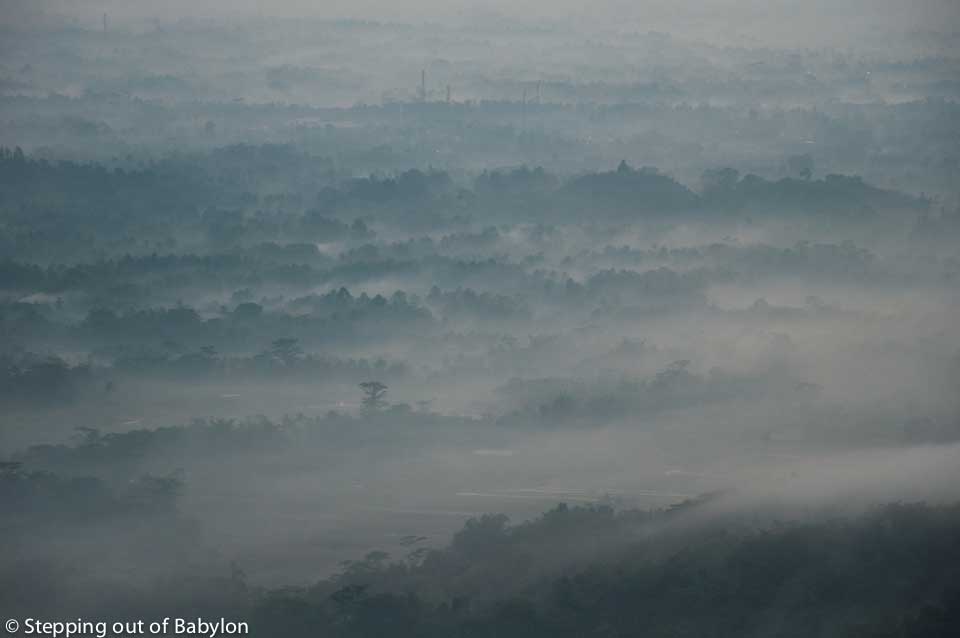
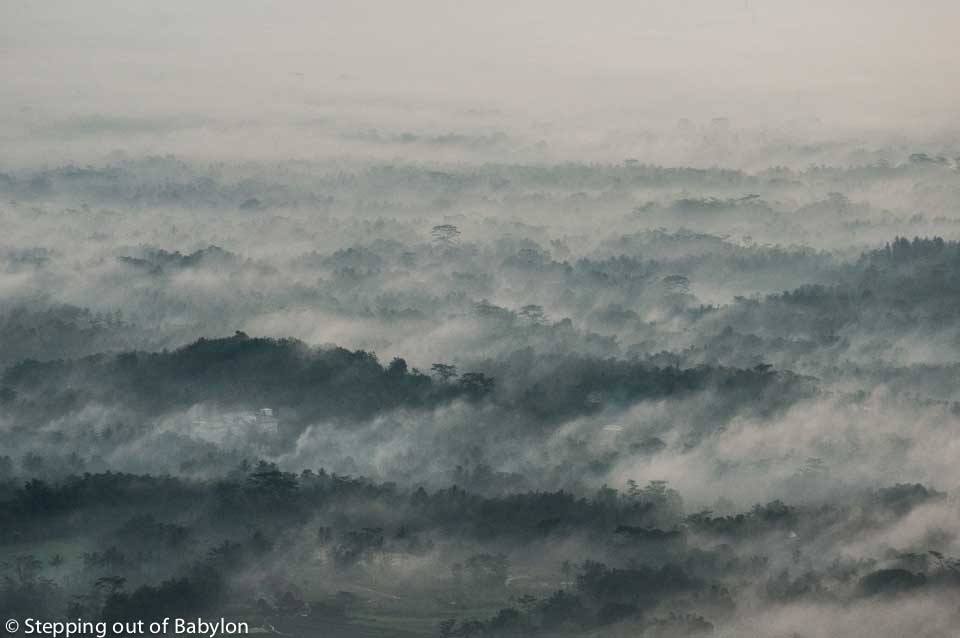
So I choose the backpacker option of seeing the Borobudur temple from a far distance… the most popular is the Setumbu Hill, but I went a bit far up in the mountain to Sukmojoyo viewpoint where you have better views to the mounts that surround the valley: Yup, Merapi and Merbabu volcano. But… there’s many times a “but” in the stories and the clouds hide the sunrise wrapping the volcanoes. But this cloudy sunrise left a thick layer of mist that took a long time to raise from the ground, creating a magic and enchanted landscape.

sunrise from Sukmojoyo hill, nearby Borobudur

So from my experience, the conclusion is: or you spend the 20 dollars and join the crown to visit the Borobudur temple… or if not it doesn’t worth much to move there just to see the sunrise and the silhouette of the temple at a far distance.

So basically, in my opinion going to Borobudur without get in the temple is like going to Rome and don’t see the Pope!!! 😉

sunrise from Sukmojoyo hill
sunrise from Sukmojoyo hill, nearby Borobudur
Around Borobudur, on the Sukmojoyo hill

About the village of Borobudur, we can say that is not much more that a stop over in the tourists tour that visit the temple, with nothing specially characteristic that worth to visit. The local market, nearby the bus terminal has the typical lively atmosphere but with the vendors, exploited by the tourism, become a bit pushy.

[columns] [span6]

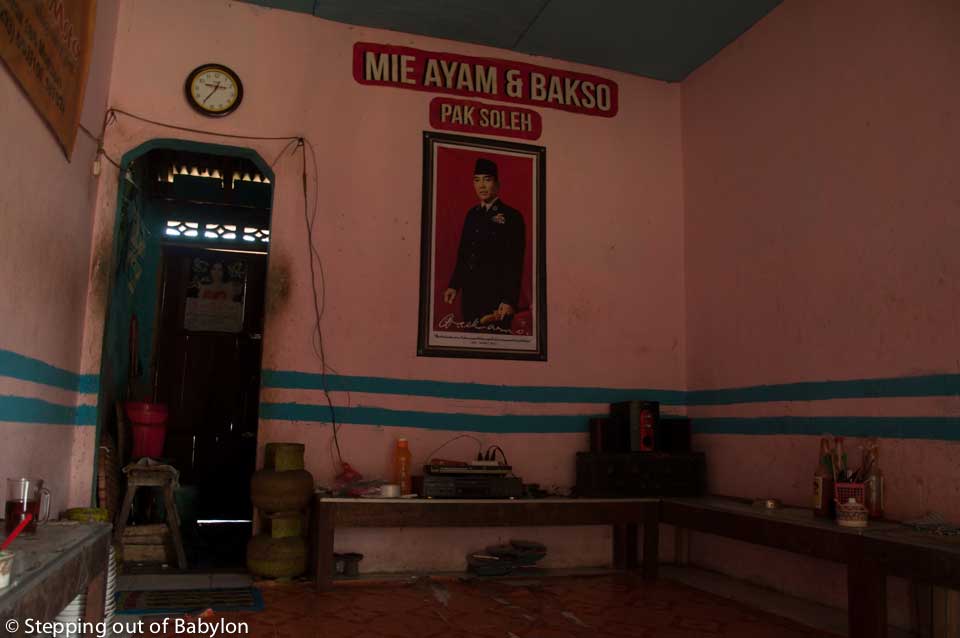
a local eatery at Candirejo

[/span6][span6]

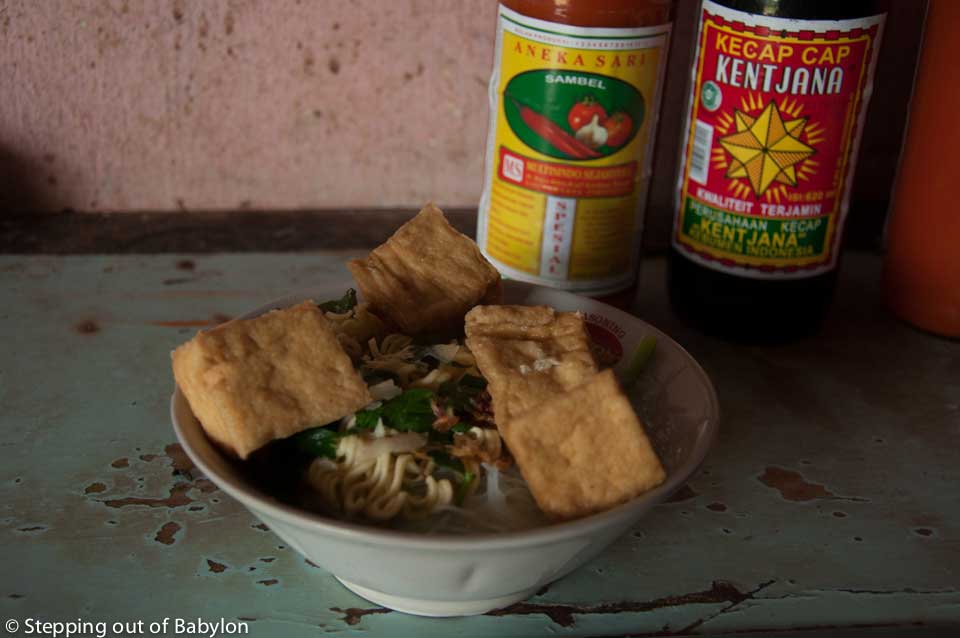
bakso soup in  a vegetarian option with tofu instead of meatballs, Candirejo
bakso soup in a vegetarian option with tofu instead of meatballs, Candirejo

[/span6][/columns]

Where to sleep in Borobudur:

There are some accommodations in Borobudur, but the prices are a bit inflated due to the proximity to the temple, so I choose the Casa Java Homestay, located in the village of Candirejo, about 3 km from Borobudur. The owner, Dino is a very friendly host making all possible for you to feel comfortable in his homestay.

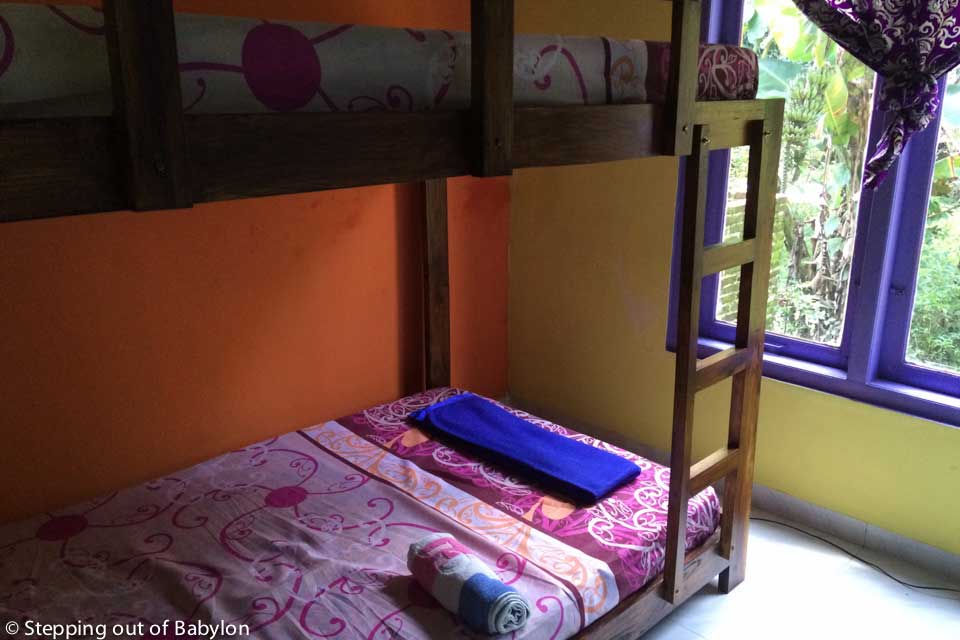
There are rooms, with and without toilet and a dorm that cost 80.000 Rp per person.

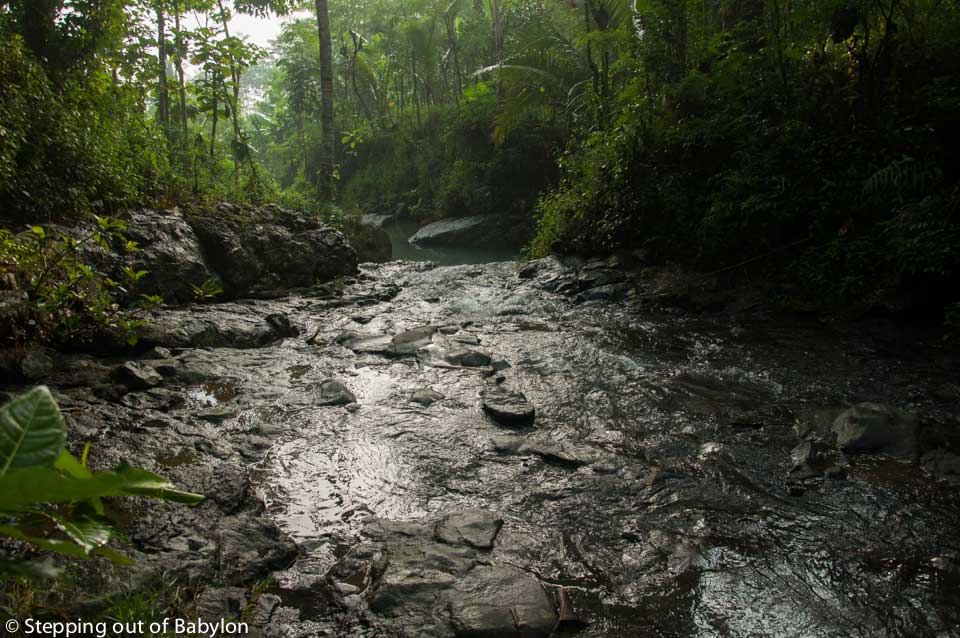
It really worth to stay here, in a quiet and peaceful rural area, full of nature, a river and bamboo forest… a nice place to make short walks. Here you can rent a scooter or hire the service of a tour guide (the cost is slightly the same) and move around.

Address: Candirejo, Brangkal, Borobudur, Candirejo, Borobudur

Phone: 0815-4814-3051

[columns] [span6]

Casa Java Homestay, located in the village of Candirejo, about 3 km from Borobudur

[/span6][span6]

Casa Java Homestay, located in the village of Candirejo, about 3 km from Borobudur

[/span6][/columns]

How to visit Borobudur:

  • If you are in Yogyakarta you can rent a motorbike and start the trip to Borobudur around 3 a.m. The scooter costs 50.000 Rp/day. At Borobudur, you can decide if you just see the sunrise from the Setumbu Hill (need a 30.000 Rp ticket) or visit the temple.
  • If you cannot manage to ride a motorbike you can join one of many tours available in Yogyakarta, that cost around 100.000 Rp to 140.000 Rp but that only include transportation and sometimes a breakfast.
  • You can spend one night in Borobudur and wake up early to see the sunrise from Setumbu Hill and visit the temple after that, as it opens at 6 a.m. and the sunrise is around 5.30 a.m.
  • There are lots and lots of people visiting the temple, arriving on big buses during all day, most of them Indonesians, as the ticket id very cheap for local people. So don’t expect to be alone.
sunrise from Sukmojoyo hill, nearby Borobudur
the borobudur temple wrapped by clouds from the Sukmojoyo hill view point, nearby Borobudur
The temple saw from a far distance. Borobudur

How to go from Yogyakarta do Borobudur:

There are buses leaving every 15 minutes from Terminal Jombor, located in the north of Yogyakarta. It’s a small terminal and is easy to spot the bus to Borobudur.

The trip takes 1 hours and the ticket cost 20.000 Rp.

Terminal Jombor at Yogyakrta from the buses to Borobudur departure
Borobudur bus terminal

About me

Hey there!

I’m Catarina, a wanderer from Lisbon, Portugal… or a backpack traveller with a camera!

My journey as a traveller started in 2013 and led me towards the Asian continent, after a few short trips to Vietnam, India, and Peru.

The first six months were spent in India which gave me the experience, knowledge, and strength to explore the diversity of Southeast Asia, including Thailand, Laos, Myanmar (Burma), Cambodia, the southwestern region of China, Malaysia, Singapore, and Indonesia. 

But it was India where I found myself visiting often and sticking around longer, exploring more remote areas like Ladakh, Kashmir, Nagaland, Rann of Kutch, Thar Desert and Cherrapunji.

In North Africa and the Middle East, I travelled through Iran, Morocco and Turkey.

Later, Sri Lanka and Nepal complemented the first four years of my journey.

Japan and Taiwan are the farthest East places that I have been so far.

After a two-year break during the pandemic, I hit the road again. This time, I focused on shorter trips and closer destinations. East Turkey and Lebanon are my recent passions with their rich history, cultural diversity, and delicious food.

But my recent biggest surprise was Bangladesh, a lesser-visited country without flashy sights, but which truly captured my heart through the kindness and friendliness of its people.

This blog is my travel notebook: here I share information and tips about accommodation, border crossings, visa arrangements, local transportation… all to help you travel safer, cheaper, and explore behind the beaten path.

I’m not exactly sure what keeps me travelling, but definitely photography keeps me pushing forward, food keeps me excited, and people keep me inspired.

Thanks for stopping by. I hope something here inspires you and inspires your next adventure!

Catarina

Love and Respect

How to go from Colombo to the Airport (Negombo)

Basically there are 3 ways to go to reach the Sri Lankan international airport, Bandaranaike International Airport, that is located 30 kilometers north from the center of the city: by taxi, by train and by bus.

  • By taxi is the most confortable, fast and expensive. Takes around 30 minutes and at least 2500 LKR.
  • By train is far the cheapest but as the trains usually don’t run on time, are frequently full and don’t have much frequency, this isn’t a very attractive option. Although the train station is not far form the Airport, about 100 LKR tuk-tuk ride.
  • By bus, is the balanced option between time and cost… and here there are two alternatives.

Sri Lanka_Colombo_Fort_Train Station_DSC_8486
Colombo-Fort Train station

Option 1:

Bus a/c (expressway), number 187: 100 LKR

This bus takes 1 hour, and as go by the expressway; don’t have many stops and don’t get much traffic on the way. It drops you in the entrance of the airport, from where is a walking distance to the building.

As it goes by the express-way, instead of the national road, the duration of the trip is more or less the same along the day, although if you need to catch the plain have in mind that all kind of transportation take more time than expected. Sometimes the buses delay the departure waiting for a few more passengers.

These buses run 24 hours, everyday of the week, every 15 minutes, but during the night the frequency decrease of 1 each hour.

Airport bus (expressway)

Option 2:

Normal Bus (national road): 60 LKR

The drive may ask for extra money for the luggage… but you don’t need to pay nothing, not in this bus or in any other in Sri Lanka.

At 5 o’clock in the morning it took 1.10h. Later it will take much more time, as it stops every time there’s a passenger on the road side, no mater if it is a bus stand or not. If you ask about how long is the trip until the airport, the driver always gonna say one hour, but during rush hour, it can take two hours.

But these buses don’t drop at the airport, but in a bus terminal of the closest village of Katunayake. From Katunayake Bus Terminal you need to walk about 1.6 km or take a tuk-tuk that cost around 100 LKR and take 5 minutes.

Pettah Bus Station, opp Colombo-Fort Train Staion

Both these buses start from the same place: Pettah Bus Station, located at the opposite side of Colombo-Fort Train Station, at Olcott Mawatha Road (A1), not far from a foot bridge over the road.

There’s nothing that indicates that there is a bus stand there, not a sign or a shelter, but during the day many buses line waiting for passengers.

The buses that go by the expressway are smaller, a bit more modern and have air-conditioner, witch means that the windows are blocked. The buses that go to Katunayake Bus Terminal are the usual private buses, big and with a white or blue colour

Sri Lanka_Colombo_bus to Airport_DSC_8410
Pettah Bus Station, where stop the buses that go to the airport

.

Colombo… the bazar and the sea

Colombo, Sri Lanka’s capital was the last stop on a route that lasted a month in the island of Sri Lanka, formerly called Ceylon.
The city shows little attractive to visitors without significant tourist, historical or cultural attractions, and given it’s large and highly congested traffic that create a noisy and polluted atmosphere, that mixed with the hot and humid climate, don’t produce much enthusiasm to make city tours.
The oldest part of the city is called Colombo Fort, which once was really limited by walls, of which nothing remains. Survive some imposing buildings attesting to the power of British colonialism, where the between were modern buildings grow, with offices, hotels, and luxury housing, making this neighborhood, where is also located the official residence of the president, in a quiet, sophisticated and well-policed ​​area.

Near Colombo Train Station

Colombo Fort
Colombo Fort

Not far away, at a distance that can easily be done on foot, is the Galle Face, a promenade that stretches along the sea for about a kilometer. During the day, under the burning sun, few venture in these place, but after five o’clock, with the end of the working day and as the sun is going down, Galle Face starts attracting much of the local population that occurs here relishing the fresh sea breeze.
While watching the sunset, is time for a walk, chatting, dating, play with the kids and to enjoy a snack, sold in more than ten stalls that line up along Galle Face. For an unknown reason, all the stall sell the same kind of snacks: pol roti, ulundhu vadai and parippu vada, which does not offer great choice to those who want to eat something other than fried.

Galle Face. Colombo
Galle Face. Colombo

Galle Face. Colombo
Galle Face. Colombo

But what aroused most interesting was the walk through the neighborhood located next to Colombo Fort, Pettah, one of the oldest neighborhoods in the Sri Lankan capital, which is currently occupied by an extensive bazaar where you can find a bit of everything from food, textiles, electronic goods, jewelery, clothing, etc… in a cluttered and busy environment, which seems dominate by chaos, but in Pettah the trade is organised by streets where each one is sold a specific type of products.

Pettah. Colombo
Pettah. Colombo

Pettah. Colombo
Pettah. Colombo

Along the streets of Pettah that due to traffic, the large number of people, the street vendors and lots of goods piled along the sidewalks, seem too narrow, porter move hastily transporting goods on the back or pushing hand-cars in an effort increased by the tropical warmth felt from the beginning of the day.

Pettah. Colombo
Pettah. Colombo

Pettah. Colombo
Pettah. Colombo

So the stay in Colombo was marked by the bustling bazaar of Pettah and the walks by the sea, along the Galle Face, savoring the warm breeze coming from the sea.

Galle Face. Colombo
Galle Face. Colombo


Where to stay in Colombo:
In Colombo, the cheapest options for accommodation are located further south of the city, so for those who want to stay in Colombo only for one or two nights, on arrival or at the end of the trip, the best option is to stay in Colombo-Fort. At Colombo-Fort is located the train station and two bus terminals, as well the bus stand for the bus to Negombo Airport, officially called Bandaranaike International Airport.
However, Colombo-Fort is a very expensive area in terms of accommodation, without many options. In a hostel, a bed in a dorm costs around € 18 (Cityrest Fort Hostel) so the cheapest option was the YMCA, a century-old institution that occupies an equally ancient building.
Not being very well referenced in the touristic guides, YMCA Colombo offers reasonable conditions, with a diverse range of rooms, from dorms, to double. The toilets and bathrooms are shared. The rooms along with the bathrooms need some repairs, but the basic is assured. The rooms are decorated with classic and heavy furniture that matches with the austere and sober style of the place, that together contribute to creating a captivating atmosphere that makes you forget the little flaws. YMCA is a good place to stay in Colombo, but a bit overpriced
YMCA Colombo
Address: 39, Bristol Street, Colombo 01
Tel: 011-2325252 / 3
Email: ymcacbo@sitnet.lk
Dorm (male or female): 1500 LKR
Single room: 2050 LKR, shared toilet
Another alternative for those who do not intend to spend much time in Sri Lankan capital, or must stay for only a few hours, between a train, a plane or bus trips, is to stay in the Pettah area. Directly opposite the railway station in Colombo-Fort, across the street, are several “hotels” and guest houses that rent rooms, usually above restaurants (in Sri Lanka commonly called by “hotel”) or shops. The area is busy and noisy, but for a short stay can be a good option.


Where to eat in Colombo:
After the short stay in Colombo, two places pop up, that are recommended sites:
One of the options was in Pettah to taste a delicious rice and curry in the local atmosphere: a restaurant frequented predominantly by Muslims, but where easily find vegetarian food:
Hotel Bankshall
Address: 57, Bankshall Street. Petah, Colombo 11
This “hotel” that has nothing to do with rent rooms, serving among other things, a tasty rice and curry for 110 rupees, with the right to “refill” and many smiles among the prying eyes of other unaccustomed customers the foreigners in this place.

Colombo Fort, two blocks behind the YMCA, is the Ruhunu Food Center, a big restaurant serving a bit of everything: rice and curry, snacks, sandwiches, hoopers, roti, kottu… very busy and a bit crowded, but with very good food, and a lot of smiles. Even at dinner, you can find here rice and curry, which unusual in Sri Lanka, where this dish is reserved for lunch.
Food Center Ruhunu
Address: Lotus Road, Colombo 01 (near the Sri Lanka Telecom and Sir Baron Jayathilaka Mawatha Road


Transportation in Colombo:
Colombo distances are great with the city to extend for several kilometers south along the sea, so the tuk-tuk is a good choice, although the traffic is intense, noisy and the air polluted.
Buses are by far the cheapest solution, and given the large amount, for sure that there is a bus to any part of the city.
However, my experience was limited to walking, hiking between Pettah, Fort and Galle Face, easily made on foot.
At Colombo-Fort are concentrated the main public transport services, serving the city as also other parts of the country: train station (Colombo-Fort), and two bus terminals, Colombo Central Bus Stand and Bastian Mawatha Bus Station, all located within 500 meters.


How to go to Colombo Airport (Negombo):


how to go to Colombo airport


Colombo Population: 650,000
Columbus elevation: 9 meters

Sigiriya and the climb to the Lion Rock

Sigiriya was not on “the list”… too expensive and too touristy, being the most visited site in Sri Lanka. But not everything happens as planned, and the fact that in Dambulla have found a comfortable place to stay made that the planned one-night stay was extended for two. And the fact that the entrance to the Cave Temples of Dambulla is free, created a kind of necessity to use the money and time in a “useful” way. Thus, the proximity from Dambulla, that make it possible for a day trip, imposed almost naturally visiting Sigiriya, that joined a certain challenge to climb the 200 meters that separate the top of the rock from the surrounding ground.

Lion rock. Sigiriya
Lion rock. Sigiriya

Sigiriya
Sigiriya

Sigiriya
Sigiriya

Lion rock. Sigiriya
Lion rock. Sigiriya

Sigiriya
Sigiriya

The balance was unsatisfactory, mainly due to the high number of visitors, which allowed not enjoy the space, but mainly by the behavior of some people, who disregard the fact of being a sacred place for Buddhists, as here was a monastery until XIV century, not deprive from smoking or drinking beer, practices which are prohibited on site.

The climb is subject to some tension with the jerks and the disregard for the order of the line while waiting to climb the narrow stairs; on the top of the atmosphere is euphoric with visitors trying to find the best place to take the selfies… but not everything was negative. The arrival at the top, which slid a gentle breeze can cool the sweaty body of the climb, which is not at all difficult but where the tropical heat makes the body heavy.

Lion rock. Sigiriya
Lion rock. Sigiriya

Lion rock. Sigiriya
Lion rock. Sigiriya

Lion rock. Sigiriya
Lion rock. Sigiriya

Lion rock. Sigiriya
Lion rock. Sigiriya

Lion rock. Sigiriya
Lion rock. Sigiriya

Resting under the protective shade of a tree, he saw the gentle climb of fog that blur the horizon, bringing definition to the contours of the mountains and the lakes nearby. Looking in the other direction the landscape of tropical green vegetation, torn here and there by the ferrous red soil, extends in an endless plain.

View from Lion rock. Sigiriya

View from Lion rock. Sigiriya

View from Lion rock. Sigiriya

View from Lion rock. Sigiriya

With the advance of the morning, which brought a blue sky and a bright sun, away from the morning mist, making the temperature rises, the Lion Rock watched calm the stampede of most visitors, provided a quiet stroll through the place where you can enjoy the ruins of what was once the palace of King Kasyapa that in the mid-first century AD here founded the capital of the Kingdom.

Palace ruins at the top of Lion Rock. Sigiriya

Palace ruins at the top of Lion Rock. Sigiriya

Palace ruins at the top of Lion Rock. Sigiriya

Lion rock. Sigiriya
Lion rock. Sigiriya

Palace ruins at the top of Lion Rock. Sigiriya

Sigiriya Ticket:

Like any Classified Patrimony by UNESCO in Sri Lanka, Sigiriya also has a high fee, 4200 LKR, around 27€, much more expensive than a ticket to visit the Louvre Museum (15€) or the Museum Vatican (16€). What makes the visit to the historical/tourist sites in Sri Lanka, for example, Sigirya, Polonnaruwa and Anuradhapura, more expensive than the most famous places in Europe.

Local people paid a derisory amount to visit Sigiriya of 50 LKR, equivalent to 0.30€) or is sometimes entitled to free entrance, as is the case of the Buddha Tooth Relic Temple in Kandy.

The high value is to preserve the sites, yet there is not available relevant information is displayed, not being distributed any brochure or map that allows a better interpretation of the site.

Beyond the issue of discrimination in the ticket price, among locals and foreigners, who can be acceptable, the amounts charged to visitors are indeed too high, sometimes 90 times more expensive!!!!!… and all supported by UNESCO, which is funded by dozens of countries, including the countries of the “foreigners” who visit Sri Lanka!

Sigiriya Ticket: 4200 LKR ($30)

Sigiriya Fee
Sigiriya Fee

Sigiriya Ticket
Sigiriya Ticket

For those who are on a budget it makes no sense to climb the Lion Rock, is preferable to climb and visit the Pidurangala which costs 500 LKR, and from where you have a good observation point of the landscape and a privileged view of the Lion Rock.

To achieve Pidurangala, facing the Lion Rock entrance, you must turn left (there are a few signs) and walk along the road until you reach a place were some tuk-tuk are waiting. It takes more than 15 minutes to do all the walk.

Way to Pidurangala. Sigiriya

Way to Pidurangala. Sigiriya

Best time of day to visit Sigiriya:

According to the tour guides the best time to visit the Lion Rock is early morning, and as this is an advice followed by almost everybody, that makes the “early morning” period is the busiest time of day, with the peak of affluence between 9 am and 10 am … at 11 am is visible a significant decrease in visitors, with many going down and returning to tour buses, so at this time there is no line to enter or to climb the stairs of access the Lion Rock top.

The alternative is to arrive before the big tour groups, which usually come from Kandy and arrive close to 9 am, which means to reach the site at the time of opening. This option has the disadvantage of sometimes mornings are a bit cloudy that does not allow a clear view of the surrounding landscape.

As for the heat, argument pointed to go early, is somewhat indifferent given that even the morning temperatures are high enough to make anyone sweat dripping with the walk to reach the top of the rock.

For all this, the best is to arrive around 11 o’clock … and anyone interested can start early by visiting Pidurangala and then heading for the Lion Rock … it is an easy climb by stairs and ramps.

Entrance. Sigiriya
Entrance. Sigiriya

Lion Rock. Sigiriya
Lion Rock. Sigiriya

Where to stay in Sigiriya

Around the archeological zone, there are many options from hotels, resorts, boutique hotel, guest houses, etc …

The best option was to stay in Dambulla, where prices are lower, and where you can easily access the Cave Temple, staying at the familiar and pleasant Gold Rock Guest House. From Dambulla Bus Terminal, about 1.5 kilometers, buses run directly to Sigiriya, every 30 minutes. Opposite of the main entrance to the Cave Temples pass buses that stop at Dambulla Bus Terminal, that for 10 LKR, make easy to reach the bus terminal.

Gold Rock Guest House

Address: 45, Kandy Road, Dambulla

Contact: 066 2248 114, 71 118 8958

Email: guestgoldrock@gmail.com

Room for one person with bathroom: 1000 LKR

In Wi-Fi

(Link)


Where to eat in Sigiriya:

Next to the ticket office there is a cafeteria. There is no hawkers food in Sigiriya. Leaving Sigiriya, walked toward the national road (Anuradhapura Road) there are some restaurants serving local and international food at inflated prices.

So the best option was to buy food before starting the tour and savor it at the top of Lion Rock. Inside the bus terminal Dambulla, there are several stalls selling rotis, samosas and other snacks that can be easily packaged for takeaway making a tasty meal. At Kandy Road between the bus terminal and the Clocktower, there are some restaurants that offer a little more variety, with hoppers and string hoppers filled with a mixture of coconut and sugar…. delicious breakfast!

sweet string hoppers (lavariya). Dambulla

How to go from Dambulla to Sigiriya:

From Dambulla bus terminal departing every 30 minutes, from 6 a.m. to 6 p.m., buses to Sigiriya.

Bus Ticket Dambulla – Sigiriya: 40 LKR

The bus trip takes 1 hour to make the 18 kilometers that separate the two sites.

The bus drops passengers a short distance from the entrance, about 10 minutes of a quiet pleasant walk, where you nice views of the Lion Rock.

This bus has a stop on the National Highway (Trincomalee – Dambulla) so if you come by bus don’t not necessarily to go to Dambulla, can catch this bus at the entrance of Sigiriya Road (Inamaluwa Junction).

Dambulla Bus Terminal

Bus from Dambulla to Sigiriya
Bus Terminal. Sigiriya Bus stop

Bus from Dambulla to Sigiriya

How to go from Sigiriya to Dambulla:

Leaving the Lion Rock, and walked back to the main road, ie first walked south and then east.

On the main road there is any bus stand or sign but just wait by the roadside for the bus back to Dambulla.

Bus from Dambulla to Sigiriya

Dambulla … the city and the market

The city of Dambulla is strategically located in the “center” of the so-called “cultural triangle” passing by Kandy-Anuradhapura-Polonnaruwa, being necessary passage point and often “basis” for those visiting Sigiriya, the sacred place for Buddhists and unavoidable site in history and Sinhalese culture.

School girls at Kandy Road. Dambulla

But by itself Dambulla has enough interesting features here if you stay at least for a day, and the city itself despite not having great attractions besides Cave Temples, and being crossed by two national roads, has a cheerful wholesale fruit and vegetable market that provides a lively and colorful spectacle, with the intense movement of people and goods.

Dambulla Market
Dambulla Market

Dambulla Market
Dambulla Market

Dambulla Market
Dambulla Market

Dambulla Market
Dambulla Market

Dambulla Market
Dambulla Market

Appearing at first glance a local unimportant when visiting Dambulla, being out of the tourist routes, the market located between the bus Terminal and the Cave Temples, provides an intense and lively atmosphere. It is clearly a male territory, divided between drivers, porters, traders and sellers, who in a constant bustle buy and sell goods. The market occupies a wide area but is totally packed with trucks, vans, hand-cars… and between porters, transporting the products on the back or on the shoulders, in an intense effort that leaves dry and muscular bodies.

No one walks around here and everyone seems absorbed in his task, with a routine made from mechanical gestures. However, a strange, yet for most women and foreign, it always causes curiosity, able to stop some conversations. But an exchange of glances, always returned with a smile that is contagious and is spread by groups of men, which often compete to appear in a photograph, leaving them proud and sure with a topic of conversation for the next few minutes…

Dambulla Market
Dambulla Market

Dambulla Market
Dambulla Market

Dambulla Market
Dambulla Market

Dambulla Market
Dambulla Market

Where to stay in Dambulla:

The best option is to stay close to the Dambulla Caves Temples, which are within a reasonable distance to be made on foot from the bus terminal.

Just opposite to the temple entrance, on the other side of the road (Kandy Road), gets a yard along which are aligned parallel to the road several houses, with some of them renting rooms.


It is recommended to Gold Rock Guest House, next to the “Oasis Tourist Welfare Center” that is mentioned in tourist guides and is usually full. The Gold Rock Guest House is located in a family house where the family, occupies the top floor, with rooms for rent available on the ground floor, surrounded by a pleasant garden. The atmosphere is very nice and comfortable with family to show up very friendly and helpful, providing all the information. The rooms are good, clean and well cared. The location is great within a 2-minute walk from Temple Cave and less than 10 minutes from Dambulla Bus Terminal.

In addition to all this, the stay of two nights in Dambulla provided nice chatting with the owner of the house, an English teacher, and her daughter that was a great opportunity to learns and understand more about the culture, habits and Sinhalese traditions, which are otherwise difficult to grasp. The generosity extended to a delicious rice and curry prepared by the owner, where the delicate flavor of coconut oil marked the difference between the many “rice and curry” tasted along the stay in Sri Lanka.

Gold Rock Guest House

Address: 45, Kandy Road, Dambulla

Contact: 066 2248 114, 71 118 8958

Email: guestgoldrock@gmail.com

Room for one person with bathroom: 1000 LKR

no Wi-Fi

Gold Rock Guest House. Dambulla

Gold Rock Guest House. Dambulla

Gold Rock Guest House. Dambulla

Family from Gold Rock Guest House. Dambulla

Contacts. Gold Rock Guest House. Dambulla

Where to eat in Dambulla:

Near Dambulla Bus Terminal (Kandy Road) there are several options, with some restaurants opening early in the morning, with delicious coconut hopper, sweet string hoppers (lavariya) and the usual rotis, samosas and other deep-fried snacks that can also find throughout the day. In the evening, it is time for kotu and rotis. At lunchtime is not difficult to find a rice and curry, but that runs out soon, so it is not recommended to delay lunch.

sweet string hoppers (lavariya). Dambulla
sweet string hoppers (lavariya)… filled with coconut and sugar. Dambulla

Opposite the stop of private buses (Anuradhapura road) is a very recommendable restaurant with Sri Lankan food, which also provides food for takeaway.

… but the best meal was, without a doubt, a delicious homemade rice and curry at Gold Rock Guest House, that was a good example of the Sri Lanka generosity.

home made rice and curry

Internet and wi-fi:

At Kurunegala Road, close to the clock Tower, on the first floor, above an electronic shop.

Clock Tower. Dambulla

Transports from Dambulla:

The Dambulla Bus Terminal is located at Kandy Road, about 10 minutes from Dambulla Cave Temples, and hence buses to Sigiriya and Kandy, among others destinations.

Dambulla Bus Terminal

But if you want to go from Dambulla to Trincomalee or Colombo, you must browse to the location where private buses stop. There are many buses linking regularly the east coast and the capital and which must stop at Dambulla. This buses stop at Anuradhapura road, next to a mango tree… yes! mango tree! It seems strange but this is the reference point used by the local people. The concentration of tuk-tuk also helps to locate the place, that has no signs or shelter, but where usually are some buses stopped waiting for passengers, before continuing the trip… or some people waiting for the buses.

Private bus stop at Anuradhapura Road. Dambulla

This private bus stop is about 700 meters from Dambulla Bus Terminal, walking north from the terminal to the Clock Tower, and then turn right and walk about 200 meters more.

For how is lodge near the Cave Temples, and wants to go to the private buses stop (Trincomalee and Colombo directions), have to walk more than 2 kilometers, which can be done on foot. But to make it easy you can catch one of the many buses that stop in front of the main entrance to the Cave Temples (no bus stand… just wait along the road) and ask for one that stops at “Clock Tower” or “private bus”. The bus ticket costs 10 LKR. A tuk-tuk costs 100 LKR.

Kandy Road. Dambulla

Dambulla Temple Caves. Entrance near Kandy road


Dambulla Population: 70,000

Dambulla elevation: 168 meters

  • « Go to Previous Page
  • Page 1
  • Page 2
  • Page 3
  • Page 4
  • Go to Next Page »

Footer

search

Tags

accommodation Assam Bagan Bali Border Crossing Borneo Colombo Dalí Dambulla Dao Cheng Esfahan Fes Food Gilis Hiking hokkaido Istanbul Itinerary Jakarta Java Kashan Kuala Lumpur Kumano Kodo Lombok Majuli Meghalaya Meknes Mekong Nagaland Natural Park Nongriat Northeast States Ouarzazate Sarawak Shiraz Sichuan Province Sumatra Tabriz Tehran transportation Visa Yangon Yazd Yogyakarta Yunnan Province

I’m Catarina, a wanderer from Lisbon, Portugal… or a backpack traveller with a camera!

Every word and photo here comes from my own journey — the places I’ve stayed, the meals I’ve enjoyed, and the routes I’ve taken. I travel independently and share it all without sponsors or ads, so what you read is real and unfiltered.

If you’ve found my blog helpful or inspiring, consider supporting it with a small contribution. Every donation helps me keep this project alive and free for everyone who loves exploring the world.

Thank you for helping me keep the journey going!

BUY ME A COFFEE

Categories

Recent Posts:

  • How to go from Hualien to Dulan Beach
  • Taroko Gorge: between marble cliffs and emerald rivers
  • Hualien: a dull gateway to Taroko Gorge
  • Taiwan: Itinerary for an 16 day trip
  • Vietnam: Itinerary
  • 3 months in India: Kolkata, Tamil Nadu, Karnataka, Goa and Kerala
  • Backpacking Turkey in 24 Days: itinerary & costs
  • English
  • Português

© Copyright 2026 Stepping out of Babylon · All Rights Reserved · Designed by OnVa Online · Login