• Skip to main content
  • Skip to footer

Stepping Out Of Babylon

Travel & Photography

  • About me
    • Contact
  • Destinations
    • Africa and Middle East
      • Iran
      • Lebanon
      • Morocco
      • Turkey
    • East Asia
      • China
      • Japan
      • Taiwan (Formosa)
    • South Asia
      • Bangladesh
      • India
      • Nepal
      • Sri Lanka
    • Southeast Asia
      • Cambodia
      • Indonesia
      • Lao
      • Malaysia
      • Myanmar
      • Singapore
      • Thailand
      • Vietnam
  • Itineraries
  • Travel tips
    • Border crossing
    • Hiking and Natural parks
    • Food Journey
    • Visa
  • Photography

Search Results for: sri lanka

Galle and the Fort

Galle is one of the cities with the greatest heritage and history of the southwest coast of Sri Lanka, with its fort built originally by the Portuguese and later taken over and expanded by the Dutch, preserves within its walls many examples of colonial architecture, whether in public buildings, religious or habitation.

With the growth of tourism Galle has turned much of the heritage in upscale hotels, boutique hotels, cafes and restaurants that contribute to keeping most of the buildings in excellent condition. However perceives a certain lack of authenticity, as if we face a postcard rather than a city with its own life and personality.

Through the streets groups tourists wandering attracted by sophisticated shops of souvenirs and crafts, Sinhalese visitors gathering here in family enjoying the bay still water near the fort and school children coming in with their spotless white uniforms. We hear the bells of a church when it passes near a Buddhist stupa, breaking the stillness of the place.

Surrounding the compact stone fortress comes the sea of ​​light tones of a translucent blue, which contrasts with the intense green of the tropical vegetation and the white that covers most of the buildings in Galle Fort. The breeze blowing from the sea has a cooling effect but intensifies the humidity that sticks to the skin.

Galle Fort
Galle Fort
Galle Fort
Galle Fort
Tenis scholl at Galle Fort
Galle Fort
Galle Fort
Galle Fort
Galle Fort
Galle Fort
Galle Fort

Outside the fort lies a city that lives at a completely different pace, with the usually disorganized traffic, the beeping of buses and tuk-tuks, the accelerated movement of the people that know where they are going. A few meters from Fort is the Dutch market, a picturesque building that brings together sellers of fruit and vegetables, but where prices are clearly inflated for tourists.

Galle although picturesque and well preserved not aroused great enthusiasm but provided a pleasant walk along the ramparts overlooking the sea.

Galle
Galle
bread stall
bread stall
Galle
Galle

Where to stay in Galle:

Most accommodations are located inside the Fort walls, but all focused on a top budget tourism and groups that come in organized tours, that makes Galle not an inviting place for a “backpacker” budget.

As the city of Galle, the “new town” shows unattractive the best option is to visit Galle Fort a day-trip. For those who are lodge in one of the southwest coast beaches, like Bentota, Hikkaduwa, Narigama or Mirrisa, Gale is located within a reasonable distance to be made by bus, visited and come back in the same day.


Where to eat in Galle:

Inside the fort, the offer points to sophisticated restaurants and cafes, far more expensive that you can find outside the wall, but of course with other comfort and refinement.

So the best alternative to find a rice and curry is in one of the “new-town” restaurants, with several options lying right next to the bus station or in the side streets, and it isn’t necessary to walk more than 500 meters to find a good rice and curry per 200 LKR.

Right next to the bus terminal are several small shops and stalls selling rotis and the usual variety of deep-fried patties that always serve as a meal if you arrive too late and the rice and curry had already finished.

Go to Dutch Market in search of fruit at local prices does not appear feasible, with sellers accustomed to tourists charging twice the price. Also, near the bus terminal, there are a few fruit sellers where the prices are displayed… usually, the price is not per kilogram, but by the number of pieces of fruit that you can get for 100 LKR, i.e.

Street near Galle Bus Terminal where you can find restaurants, snack stall and fruit vendors
rice and curry in Galle

5 apples for 100 rupees but if they are big apples you can only get 3 apples for that price… this is the fruit of sale system in Sri Lanka!


Transport in Galle:

Galle has a railway station and is one of the most important stops on the Colombo-Matara line. However the frequency of trains and the difficulty of reserve a seat, especially on weekends and holidays, makes the train a less attractive option. But despite these disadvantages, the train offers a more calm and relaxing trips, away from pollution, traffic and the constant noise of horns, which all drivers used intensively, including bus drivers. Often trains make tracks away from urban areas and provide the best views of the natural landscape, but do not cover the entire island.

Right across from the train station is the bus terminal, both for long-distance services (for Colombo and other cities) as local nearby villages. The terminal looks at first too confuse by a large number of people, but is quite well organized with signs indicating the destination of each bus. There is also a information desck in the middle of the terminal on the lower level, which provides accurate information about destinations, prices, and schedules.

Bus Galle – Mirrisa: 1 hour, 50 LKR

Bus Galle – (Narigama) Hikkaduwa: 30 minutes, 35 LRK


How to get from Galle to Colombo:

For those on Hikkaduwa, Narigama, Mirissa and other beaches scattered around the southwest coast and plan to go to Colombo, you have several alternatives:

  1. Take one of the many buses that make the journey along the national road A2 Galle-Colombo, but these buses are not “express” ie make multiple stops often picking up passengers outside stops “official”.

The journey takes more than four hours, between dangerous overtaking and infernal honks. It is not guaranteed seating position not sure if she ate the trip at the beginning of the route, for example, Matara and Galle.


  1. There’s also a/c buses (small vehicles with air-conditioning) that also make the journey by the national road A2 as the “normal” buses but do not carry out as many stops; the fact that the windows go always closed eliminates pollution and noise, making the journey less tiring. They departure from Galle Bus Terminal every 30 minutes.

Officially the trip takes three hours, but it is most likely take close to four hours, depending on traffic in the city of Colombo, since the bus has to cross the whole city to get to Colombo-Fort where the terminal and which is at the north end of town.

The bus route starts in Galle Bus Terminal, platform number 2.

Ticket Galle-Colombo-Fort: 275 LKR (3 hours)


  1. There are a modern and comfortable bus with a/c, Galle to Maharagama, and that is the route the expressway which takes 1.45 hours and departs every 30 minutes from the top left side of Galle Bus Terminal.

Reaching Maharagama, a town 15 km south of Colombo, it is necessary to change to a city bus bound for Colombo-Fort who has to cross the entire city, because the bus station is at the north end of town, which reveals a long 1 hour trip.

Galle ticket to Maharagama: 375 LKR (1.45 hour)

Ticket Maharagama to Colombo-Fort: 50 LKR (1 hour)


  1. Use the train, but as not all trains stop at all stations, it is best to head to Galle and then start the journey to Colombo. The question of the train is always the same: get a seat since tickets for 1st class (the one with seating) are usually sold out in advance.

Travel between Galle and Colombo-Fort takes about 3 hours.

Ticket Galle to Colombo Fort: 180 LKR (in 2nd class)

Gale Train Station
Gale Train Station
Train Schedule from Galle
Gale Train Station
Gale Train Station
Train Schedule from Colombo
Train fares from Galle


Galle population: 99.000

Galle elevation: 1 meter

Narigama Beach in Hikkaduwa

Hikkaduwa, located on the southwest coast of Sri Lanka, became popular by the waves that provide good conditions for surfing, presenting itself as a cheaper and more popular alternative among backpackers than other beaches like Bentota, dominate by resorts and that attract more people… but as everything changes, Hikkaduwa also changed and also became popular and part of the itineraries of the “package” holiday, giving rise to hotels and resorts, leaving behind a quiet fishing village atmosphere to turn out hectic and touristic.

As a consequence, the most southern beaches were becoming more popular and also, the previously living from fishing was mostly replaced by tourism business.

Hikkaduwa beach
Hikkaduwa beach still a popular place for surfers

So the place to enjoy the famous Sri Lanka beaches was Narigama Beach, a mere 5 kilometers from Hikkaduwa, who heads towards the south by the infernal national road, that link Colombo to Galle (known as Galle Road). In fact, it is hard to say when it’s over a village and starts another, as along the national road, line up t houses and more houses, restaurants, shops, guest houses, hotels, grocery stores, travel agencies, souvenir shops, etc… in an endless succession that don’t allow to see the dense green patch of palm trees from the tropical landscape of this region of ​​Sri Lanka.

While Hikkaduwa continues to attract surfers, who also had already found new spots further south along the coast, Narigama Beach attracts more couples and older tourists, mainly Russians and Germans who fled the turmoil of restaurants and bars that animate the Hikkaduwa beach, seeking for quiet of a nearly empty beach.

Sri Lanka_Narigama beach_DSC_6988
Narigama beach
Narigama Beach
Narigama Beach before one of the heavy storms that sometimes arrive in the afternoon
Narigama Beach
Narigama Beach
road Hikkaduwa-Galle
road Hikkaduwa-Galle that despite the intense and noisy traffic still keep the laid-back local atmosphere
road Hikkaduwa-Galle
road Hikkaduwa-Galle, that despite this signs many people walk along the national road in swim wear, disrespecting Sri Lanka traditions

Sri Lanka advertises itself as one of the destinations with beautiful beaches but its geographical position of the island in the Indian Ocean between the Arabian Sea and the Bay of Bengal causes strong currents and powerful waves. Here, the sea is reputed to be dangerous, and a short swim it turns out that in fact is not very safe, with many strong currents and cross waves which make animated baths but at the same time risky. To compensate this, the temperature of the sea is perfect: warm but not too hot.

Narigama beach extends for 3 kilometers long towards the south, in a broad and continuous sand, that as you walk will have a less occupation, that means fewer hotels and houses since in terms of tourists these beaches can not be considered crowded.

This extensive beach offers pleasant walks at the end of the afternoon when the sun softens intensity, hiding behind a blanket of clouds even before reaching the horizon line. Is at this time of day that the sky gets fantastic colors, contrasting with the dawn, bright and delicate, the sunset leaves a surreal track where nature gets bizarre colors, creating moments of a strange atmosphere.

Narigama Beach
Narigama Beach… early in the norning
Narigama Beach
Narigama Beach
Narigama Beach
Narigama Beach… one of the magic sun sets
Narigama Beach
Narigama Beach

Where to stay in Narigama Beach:

Along the national road, as also along the beach and a little to the inside (with the inconvenience of having to cross the main road to reach the beach) are dozens of accommodation including resorts, hotels, boutique hotels, guest houses and many houses that rent rooms (homestays). Prices vary widely, but you can be a room for 1000 LKR, and if you choose a guest house (or homestay) the prices can be bargained in low season or for long term stays.

Along the beach are the most expensive accommodation, but walking a bit along the coconut trees and asking locals you end up finding more modest and modest places that provide good rooms at reasonable prices.

Hector’s Place is one of those places, which brings together a few small houses and rooms of various types and sizes. This place is very quiet, far enough from the road to not hear the car noise, and at less than 100 meters from the sea, which provides a constant background sound of the strong waves.

A double room, living room, balcony, and bathroom costs 2000 LKR.

For those traveling on the main road, the entrance to the Hector’s Place is located just after the Ranmal Beach Hotel, for who go towards Hikkaduwa for Galle. For who walks the road the place is not easy to find because it has not sign or identified, but walking by the sand there is a discreet sign “rooms available” near one of the observation posts, a kind of “lifeguard” that run in mixed trade selling clothes and coconut while seem to watch who bathe in the sea.

Narigama Beach
Narigama Beach view from Hecto’s Place a few steps from the sea
Hector’s Place . Narigama Beach
Hector’s Place. Narigama Beach
Hector’s Place . Narigama Beach
Hector’s Place. Narigama Beach

Where to eat in Narigama Beach:

Find local food at reasonable prices is not easy in these areas by the sea, where the food prices are extremely inflated, where some rice and curry can cost 500 LKR, instead of the usual 150 LKR.

Most restaurants offer a mix of local food with international food stands the fish and shellfish.

Along the road linking Hikkaduwa to Narigama there are plenty of choice in terms of restaurants, but only after an exhaustive search, was possible to find a place that serves a proper rice and curry for 200 LKR… cheaper just taking the bus and going to the village of Hikkaduwa. The site is very popular among the locals, that early starts to flock to buy a meal and takeaway, which makes that around two o’clock the food finish. The rice, instead of the usual white rice is the called “red-rice”, a little more tasty; but the focus is on the curries, which varied every day, sometimes using the jack-fruit or its seeds as an ingredient, but always accompanied by traditional sambol, a spicy condiment made from freshly grated coconut. The place has no name or any indication in English, and can be easily unnoticed. The food is delicious and spicy, as the tradition in Sri Lankan cuisine, and can be vegetarian or not.

Rice and curry restaurant
Rice and curry restaurant, without any sign that shows that here is served one of the best “rice and curry”… delicious and with a reasonable price
Rice and curry
Rice and curry served in the small and family style restaurant near the national road… discreet but very popular between locals


The No Name restaurant, also located on the roadside serves kotu in generous and delicious doses, as well as vegetarian rotis in variants with meat, fish or even with banana and chocolate, a variation according to the Western taste.

In fact, the easiest and cheapest meal is undoubtedly the rotis and the kotus, which are popular as evening meal, packing several restaurants that specialize in this kind of food.

All this type of inexpensive places, as also some more expensive restaurants are located along the national road and suffering from the same problem: the discomfort caused by the constant traffic of trucks, buses, cars, motorcycles and tuk-tuks almost always running at excessive speed, adding to the discomfort caused by constant honking and pollution.


But the village of Hikkaduwa remains the “center” of activity with the train station, bus station, banks and local businesses, is a good option to find meals at reasonable prices, as well a fruit and vegetables market.

And it is certainly the right place for lovers of the traditional Sinhalese snacks, the deep fry patties, filled with delicious and very spicy curries.

snack stall. Hikkaduwa
snack stall with rotis and deep fry patties in front of Hikkaduwa Bus Terminal


Next to the bus station the milk bar sells traditional curd, a thicker yogurt from buffalo milk, more fat than what we are used to, and that comes in clay pots. The price is displayed so there is no doubt that the smaller “pot”, half a kilo costs 150 LKR.

Milk Bar. Hikkaduwa
Milk Bar. Hikkaduwa bus terminal
Curd from buffalo milk. Hikkaduwa


How to get to Hikkaduwa:

Hikkaduwa can be reached by train or bus, with direct links to the city of Colombo. South of there, there are also buses and trains from Matara and Galle.

The train ride from Colombo-Fort to Hikkaduwa takes about 3 hours and the route is always done by the coast so it is preferable to choose a place on the right side of the wagon… if you can find a seat! Leaving the Hikkaduwa railway station you’ll see a small Hikkaduwa bus terminal bound for Matara, Mirissa, Galle stopping in small villages in between.

Hikkaduwa Bus Terminal

How to go from Narigama to Hikkaduwa:

The best option is to use one of the many buses that constantly pass on the national road bound for Hikkaduwa and other northern villages.

There is also a train station that is closer to the Narigama beach: Thiranagama. But given the low frequency of trains the best option is to use the bus whose high frequency don’t make you wait more than five minutes for the next bus.

The Narigama trip to Hikkaduwa takes 10 minutes and costs 8 LKR.


How to go from Narigama to Galle:

From Narigama to Galle as the frequency of the buses is high, you never waiting more than 5 minutes. If you want to go further to Mirissa ou Matara, you’ll need to change buses in Galle Terminal.

Find a bus stand can be a little difficult because many times there isn’t   a shelter or sign that identifies a bus stand, however, just follow the markings on the floor in yellow, in which the local stop is defined as a rectangle…. os simply ask to the local people.

The Narigama trip to Galle takes 30 minutes and costs 35 LKR.

Bus from Hikkaduwa to Galle that stops in Narigama

From the hill to the beach… Kandy to Hikkaduwa by train

Go from Kandy on the hills to the plains of the southwest coast, near Hikkaduwa, by train proved to be a long and arduous trip that lasted over 9 hours, to cover the 250 kilometers that separate the two sites, involving three trains and two short bus journeys trips… but “zero” tuk-tuks!!!!

Kandy is located at the so-called “Hill Country” a mountain area with lakes, forests and tea plantations that dominate the central-south part of the country. Around, in whatever direction is extend the tropical plains ending at the sea. But given the topography of the country, the inefficient road network and the structure of the transport system, to go to Kandy to the beaches located on the southwest coast is inevitable to go to Colombo, either to change trains or bus.

Although looking disorganised and be very slow the buses are a good mean of transport in Sri Lanka, with services covering the entire territory with high frequency, where is not necessary to wait more than 15 minutes for the “next bus”. The bus terminals are continently located in the city center, and never far from the Train Stations. The drawback of the bus is that there aren’t express services, i.e. direct buses, so the trips become long and tiring with multiple stops to pick up passengers, not only in the “official” bus stands but in any place where someone is waiting.

Buses of the state-owned company (SLBT identifiable by the red color of the buses) do not have this problem, but also don’t offer direct connections between major cities.

Roads linking the major cities are in good condition, but having only two lanes show up most often insufficient for the intense traffic, essentially dominated by buses, trucks, motorbikes and tuk-tuks, that constantly takeover each other in risky maneuvers that require quick accelerations and constant braking making any journey tiring and uncomfortable.

The busiest roads, such as Colombo to Kandy are flanked on both sides by houses, workshops, buildings, shops and stalls that cause a constant busyness of people and vehicles that often occupy the road slowing, even more, the traffic flow.

The train is a relic left by British colonialism and kept almost intact, with only a few newer wagons “made in china”. Stations, information boards, tickets took us to charming old times, but worst is the totally archaic operating system, where all lines radiate from Colombo, with trains to start and finish the service in the capital, always being necessary to change to another train if you wish to go to another line.

Keeping the same strategy doesn’t exist an “extra” service in the busiest section of a line, that makes the train arrive at a busy station already totally packed. The same applies to weekends and holidays, when the number of passenger increases, to visit relatives or religious sites, making the train runs always crowded in the 2nd and 3rd class.

Buy train tickets for 1st class, the only ones with reserved seats, have to be done over a month in advance what pushes tourists to travel agencies that book lots of tickets in advance and resell then charging high commissions. This means that for those who travel without an organised tour has no chance to have a reserved seat in Sri Lankan trains, make you strive for a seat or often just to get into the train.

Yet the price of a train ticket is extremely cheap, for a 250 km trip you pay 600 LKR (approximately 3.7 €) and with the train to do more interesting and charming routes than the buses, away from the noisy and polluted roads, and providing nice view especially in mountainous areas.

For train schedule and more detail information: http://www.seat61.com/SriLanka.htm


3rd Class train. Sri Lanka
Train departure time @ Galle Train Station
Hatton Train Station
Train Schedule @ Galle Train Station
Haputale Train Station Staff

Sri Lanka_Train ticket_DSC_7084

How to go from Kandy to Colombo by Train:

For those who are lodged on the southern side of the lake along the Saranankara Road, just go down until reaching the main road that runs along the lake and waits for one of the many buses passing by. The ticket until the Bus Terminal costs 8 LKR, and bus stops within a walking distance from the train station. The alternative is the tuk-tuk, but they don’t charge less than 100 LKR.

Tickets for 2nd and 3rd class start to be sold one hour before the train departure. The early morning trains have always more demand, so if you want to start your trip early you better get prepared to face a big queue at the ticket counter.

Since there are no reserved seats it is convenient to arrive early to get a seat if the train is beginning in Kandy station, otherwise, it is most likely you need to stand most of the trip.

The train trip between Kandy and Colombo is quite nice, with much of the route between mountainous areas full of green, with superb views of valleys, lakes and highest peaks, if you are lucky to get a seat by the window, on the left side of the train, for who is traveling in Colombo direction.

Kandy Train station is small, easy guidance and without significant movement… and have toilets for foreigners?!?!?! Even if you don’t have time for a meal, you’ll find something to eat in one of the many hawkers sealing rotis, steamed corn, fruits and deep fry snacks.

From Kandy to Colombo the train takes close to four hours, arriving a little later than the scheduled.

Train ticket: 600 LKR (include travel to Kandy to Colombo-Fort and from Colombo-Fort to Hikkaduwa).


Kandy Train Station
Kandy Train Station
Kandy Train Station
Kandy Train Station
Kandy Train Station
Kandy Train Station
Kandy Train Station
Kandy Train Station
Train trip from Kandy to Colombo

How to go from Colombo to Hikkaduwa by train:

Arriving at Colombo Fort, the main train station of the capital (and the most central) is necessary to find out which line pass the next train in direction to Matara, that stops in Hikkaduwa, and since there is no proper signals and it is difficult to find the station staff, there is no other option than to ask to other passengers, who will do everything to help.

As the first train that arrived at Matara was completely full, which is usual on weekends, the solution was to rely on the help of one of the passengers that were traveling in the same direction. So we take first a train in the opposite direction to Maradana Station (about 10 minutes away) where the train to Matara begins. There we just wait for the next train that stops in Hikkaduwa.

The journey until Hikkaduwa, after leave Colombo, is quite pleasant with the train making the most of the way along the coast overlooking the sea.

Reaching Hikkaduwa, exiting the small station, you’ll see in the other side of the road a small bus Terminal. To go to the beaches of Narigama or Trianagama, a little south of the busy Hikkaduwa, just catch one of the buses that pass on the main road next to the terminal bound for Galle.

bus Hikkaduwa -Narigama ticket: 8 LKR

Colombo-fort Train Station. Sri Lanka
Hikkaduwa bus terminal, on the road Colombo-Galle
Bus from Hikkaduwa to Galle that stops in Narigama

Kandy: the lake and the tooth

For no apparent reason, some places don’t attract, don’t stimulate, drain our energy… yet nothing rationally seems negative there. Kandy is one of those places that has everything to be enjoyable: a central lake, densely vegetated slopes, a lively city center in terms of commerce, authentic local life, many historical sites, heritage… but still the stay in Kandy left a set of negative sensations.

From this negative image saved up the lake that provides more or less pleasant walks, if you are able to ignore the noise of the traffic and the continuously beeping that comes from the road that surrounds the lake, and the colors that dye the landscape after sunset.

Kandy Lake
Kandy Lake
Kandy Lake
Kandy Lake

Kandy is reputed to be the cultural capital of Sri Lanka, but a visit a few days revealed no significant cultural events despite being evident the presence of British colonialism in public buildings and houses converted into sophisticated hotels and shopping areas. However Kandy keeps its importance on the national scene for being the capital of one of the greatest kingdoms that ruled Sri Lanka, having resisted for a long time the attacks of the invaders: first the Portuguese, followed by the Dutch and culminating with the British who only left the territory in 1948.

But what stands out in Kandy is the religion, as this is considered one of the sacred places of Sri Lanka for the Buddhist religion, as it is here that is kept the famous relic of Buddha, a tooth saved in the cremation process and that through many ventures were brought to the island and stored in so-called Buddha Tooth Relic Temple, in the heart of the city near the Kandy Lake.

Despite the proximity to neighboring India, the dominant religion in Sri Lanka is Buddhism followed by 70% of the population; seconded by Hinduism with 8%, Muslim with 7%, and the remainder population divided by the various currents of Christianity left by the Portuguese, Dutch and British presence.

Kandy_DSC_6940
Kandy Lake
Buddha Tooth Relic Temple

Kandy with its location in the middle of the hill where the low altitude provides a mild climate that contrasts with the constant high temperatures of the capital, Colombo, situated only 115 kilometers away. Even the winters are not too cold compared to other parts of the “Hill Country”, a name given to the mountain area that occupies the center of the island.

Since the city’s main attraction is the Buddha Tooth Relic Temple, whose entry for foreigners cost 1500 LKR ($ 10) that makes it out the itinerary “backpacker”, remaining the walks through city streets, watching the trading goods bustle, visit the fresh food market, the observation of the local way of life.

Time for tasting delicious Sri Lanka snacks, the rotis, samosas, vadai, parippuvada, etc… most of them deep fry stuff, that are eaten at breakfast, between meals or even as a meal itself. A cheap and very popular food that is easily found everywhere, both as street vendors, in restaurants or cafes… and Kandy proved to have the best quality and supply.

Kandy Lake
Kandy Lake
Kandy
Kandy
Kandy_DSC_7086
Kandy
Kandy
Kandy
Kandy Market
Kandy Market
Market. Kandy
Dry fish. Market. Kandy
Market. Kandy
Market. Kandy
Street Food. Kandy
Street Food. Kandy
South Kandy Lake Road

Where to stay in Kandy:

Kandy has many options in terms of accommodation. In the center of the city within 2 kilometers radius from the Clock Tower Bus Terminal, there are few hostels with dorms, starting from 900 LKR. Moreover, in the center, the other accommodations are top range hotels and boutique hotel with the exception of Olde Empire, which charges too much for the conditions offered.

The best option is the homestays with most of them located on the south side of the lake, along the Saranankara Road, with prices vary greatly according to the rooms and the fact of whether or not a view of the lake, but where can be found a double room for 1000 LKR. They have the disadvantage of being a bit away from the center of Kandy, around 10 minutes walk, or more if situated on the top of the hill. To stay in a homestay, it is appropriate to make a reservation during peak season, as these places usually don’t have more than three or four rooms.


Pink House (homestay)

Address: 15 Saranankara Road, South Lake Kandy, 20000 Kandy

Phone: +94 77 961 8552

Good location at the beginning of the hill from the south side of the lake, not far from the road but far enough to save you from traffic and horns noise. From the bus terminal (Goods Shed Bus Terminal) as from the Train Station is a walking distance, but buses run on the main road and the ticket costs 8 LKR. To get to the town center, the nearest place with restaurants, ATMs and shops do not take more than 10 minutes on foot, a journey made along the lake.

The atmosphere is familiar in a relax and friendly atmosphere, ideal for those who like to participate in everyday family and learn more about the local way of life.

The rooms vary in size and comfort, but they are all with shared bathroom. The rooms at the entrance of the house are the nicest, whereas those located on the back of the house, after the courtyard, are small and uncomfortable. Meals can be provided if ordered in advance to the owner.

Double room: 1200 LKR

Shared toilet; hot water shower.

wi-fi available but extremely slow.

Pink House homestay. Kandy
Pink House room. Kandy


Olde Empire Hotel

Address: 21 Temple St, 20000 Kandy

Phone: +94 77 632 1867

Great location in the city center, opposite the Buddha Tooth Relic Temple. However quite noisy due to proximity to one of the main avenues of the city.

The best rooms are located on the top floor, some overlooking the entrance to the temple, keeping the old colonial style given by the heavy furniture and the wooden floors where stands the smell of wax. The room located on the ground floor have no windows, but some holes on the wall near the ceiling, eliminating any chance of privacy between rooms as well as allow the mosquito entry, the cold of the nights (in December and January the nights are still chill in Kandy) and street noise, voices, engines, tuk-tuks, beeps…

The staff is not friendly at all and far from be useful in terms of information.

Double Room (upstairs): 3000 (attached toilet)

Double room (upstairs): 1800 (shared toilet)

Double room (ground floor): 2000 (attached toilet)

No hot shower, in any room or shared bathroom.

No Wi-Fi

Please note: some rooms have bed-bugs, but during the stay (January 2016) a big cleaning with replacement mattresses was taking place.

Olde Empire. Kandy
Olde Empire. Kandy
Olde Empire. Ground floor corridor. Kandy


Where to eat in Kandy

Also, in terms of restaurants Kandy offers many options, from fine dining, international chains of fast food, indian food as also of local restaurants with a menu to suit all budgets. Given the influence of Buddhism as well as Hinduism is very easy to find vegetarian food.

By the newness and the atmosphere the highlight goes to Kandy Muslim Hotel (in Sri Lanka as well as in South India the word “hotel” refers to simple, unpretentious and cheap restaurants), where you can find throughout the day the popular roti in their many variants with different shapes and fillings and the not less popular kottu, whose preparation is always shrouded in a lot of noise with the cook offering a small show.

As the name indicates the place is run by Muslims with a long beard and joyful attitude, which together with the patina and restaurant decor create a good atmosphere, accompanying appetizing dishes, which are not recommended to one sensitive to spicy or not comfortable with “oily” food!


Kandy Muslim Hotel

Address: Dalada Vidiya (in central Kandy within walking distance of Clock Tower)

Great for rotis and kottus, but where you can also find other meals such as fried rice, curries, lentils, vegetables… and meat or this were not a Muslim restaurant!

Popular between locals, informal, cheap but noisy.

_Kandy_Muslim Restaurant_Roti_Kottu_DSC_6937
Roti and Kottu at Kandy Muslim Restaurant


_Kandy_Muslim Hotel_DSC_7072
Kandy Muslim Hotel. Kandy


Devon Restaurant & Bakery

Address: 11, Dalada Vidiya (in central Kandy within walking distance of Clock Tower and opposite the Muslim Hotel)

The restaurant is on the first floor, but the best is located at street level where is a cafe selling delicious snacks (vegetarian, with meat or fish). In the morning, people line up for take-away. As it open at 6 a.m. is a good option to supply food for those long bus or train journeys that are part of the Sri Lanka traveling experience.

Devon Restaurant. Kandy


The stay in Kandy also provided time to savor several variations of the popular rice and curry, which can be considered the national dish of Sri Lanka, and is served in all restaurants, whatever the category.

As the name implies this is rice accompanied by one, two or more varieties of curry, pol sambol in (a spicy flavor based on coconut oil) or gotukola sambol (one crude mixture of a green leaf vegetable with coconut and chili).

Served in the morning as breakfast, the rice and curry is more popular as lunch, but rarely find at dinner time in the restaurants.

Rice and curry
Rice and curry

Transportation in Kandy:

Kandy is served by rail, a direct connection with Columbo and halfway to the call Hill Country. Despite the short distance from the capital to Kandy, the train journey takes over 4 hours. The alternative is the “normal” buses, that depending on traffic may even take even longer. From Columbo-Fort departing bus with a/c that makes fewer stops along the way and takes between 3.5 to 4 hours.


There are 3 bus terminals in Kandy, all located in the city center and near the train station. The “Goods Shed Bus Terminal” and the terminal of private buses (Private Bus Terminal) work for long-distance services. The bus station 500 meters further north, near the Clock Tower – Clock Tower Bus Stop – is intended for urban service.

From both bus terminals as from the railway station is relatively easy to reach the city center on foot. As you reach the lakeside, you’ll have on your left the busiest area of Kandy, or you can walk to the right side to access the hill where are located most of the homestays and guest houses.

Kandy train Station
Kandy train Station
A/C bus Colombo-Kandy


Population: 112,000

Altitude: 500 m

How to apply for Indian Visa in Malaysia and Thailand

At least since December 2015 that is not possible to get an Indian Tourist visa is Malaysia, as also in Thailand.

At the IVS /Indian visa Services) in Kuala Lumpur you can apply for visa, give all the documentation, fill a form as non-resident, make the payment and anyone will tell you that the India Embassy in Malaysia in not longer giving tourist visa to non-Malaysia Resident for more than two years. The only things that they ask is you to sign a paper that you agree to the submission of your application to the High Commission, don’t tell nothing about the meaning of this.

Later you’ll find that there is 99% of chances that you application is refused, and no way to have you money back.

The IVS staff in Kuala Lumpur is extremely impolite and totally incompetent to provide proper and clear information.

The only option if you are in one of this countries (Malaysia or Thailand), is to apply for 1 month e-visa if you are citizen of one of the 133 eligible counties:

Andorra, Anguilla, Antigua & Barbuda, Argentina, Armenia, Aruba, Australia, Bahamas, Barbados, Belgium, Belize, Bolivia, Brazil, Cambodia, Canada, Cayman Island, Chile, China, China- SAR Hongkong, China- SAR Macau, Colombia, Cook Islands, Costa Rica, Cuba, Djibouti, Dominica, Dominican Republic, East Timor, Ecuador, El Salvador, Estonia, Fiji, Finland, France, Georgia, Germany, Grenada, Guatemala, Guyana, Haiti, Honduras, Hungary, Indonesia, Ireland, Israel, Jamaica, Japan, Jordan, Kenya, Kiribati, Laos, Latvia, Liechtenstein, Lithuania, Luxembourg, Malta, Malaysia, Marshall Islands, Mauritius, Mexico, Micronesia, Monaco, Mongolia, Montenegro, Montserrat, Mozambique, Myanmar, Nauru, Netherlands, New Zealand, Nicaragua, Niue Island, Norway, Oman, Palau, Palestine, Panama, Papua New Guinea, Paraguay, Peru, Philippines, Poland, Portugal, Republic of Korea, Republic of Macedonia, Russia, Saint Christopher and Nevis, Saint Lucia, Saint Vincent & the Grenadines, Samoa, Seychelles, Singapore, Slovenia, Solomon Islands, Spain, Sri Lanka, Suriname, Sweden, Taiwan, Tanzania, Thailand, Tonga, Turks & Caicos Island, Tuvalu, UAE, Ukraine, United Kingdom, USA, Uruguay, Vanuatu, Vatican City-Holy See, Venezuela, Vietnam.

https://indianvisaonline.gov.in/visa/tvoa.html


Indian Visa Services (IVS) in Kuala Lumpur


Indian Visa Services (IVS) in Kuala Lumpur

Apply for Indian Visa in Thailand

Since October 2015, it is no longer possible for a non-Thailand residents to get a Indian Tourist visas in Bangkok or any other city.

Indian Tourist Visa is only given to Thai residents.

Check update info at: http://www.travelfish.org/orientation_detail/thailand/bangkok_and_surrounds/bangkok/bangkok/138


The only option is to apply for 1 month e-visa if you are citizen of one of the 133 eligible counties:

Andorra, Anguilla, Antigua & Barbuda, Argentina, Armenia, Aruba, Australia, Bahamas, Barbados, Belgium, Belize, Bolivia, Brazil, Cambodia, Canada, Cayman Island, Chile, China, China- SAR Hongkong, China- SAR Macau, Colombia, Cook Islands, Costa Rica, Cuba, Djibouti, Dominica, Dominican Republic, East Timor, Ecuador, El Salvador, Estonia, Fiji, Finland, France, Georgia, Germany, Grenada, Guatemala, Guyana, Haiti, Honduras, Hungary, Indonesia, Ireland, Israel, Jamaica, Japan, Jordan, Kenya, Kiribati, Laos, Latvia, Liechtenstein, Lithuania, Luxembourg, Malta, Malaysia, Marshall Islands, Mauritius, Mexico, Micronesia, Monaco, Mongolia, Montenegro, Montserrat, Mozambique, Myanmar, Nauru, Netherlands, New Zealand, Nicaragua, Niue Island, Norway, Oman, Palau, Palestine, Panama, Papua New Guinea, Paraguay, Peru, Philippines, Poland, Portugal, Republic of Korea, Republic of Macedonia, Russia, Saint Christopher and Nevis, Saint Lucia, Saint Vincent & the Grenadines, Samoa, Seychelles, Singapore, Slovenia, Solomon Islands, Spain, Sri Lanka, Suriname, Sweden, Taiwan, Tanzania, Thailand, Tonga, Turks & Caicos Island, Tuvalu, UAE, Ukraine, United Kingdom, USA, Uruguay, Vanuatu, Vatican City-Holy See, Venezuela, Vietnam.

https://indianvisaonline.gov.in/visa/tvoa.html


Food in Singapore… so may vegetarian options!!

Singapore is proud to be the culinary capital of Asia, receiving influences of Chinese Malaysian, Indian and Indonesia cuisines, as also Sri Lanka and Thailand. Arise even traces of Portuguese and English presence in the region, were the “portuguese egg tart” which is no more than the famous pastel-de-nata.

Singapore like any big city offers a wide range of choice in terms of restaurants, not only in terms of cuisine, where Asian food dominates but also with many Western and World option, but also in terms of cost of a meal.

And through the city, we are faced with the simplest and informal restaurants, whose space is open to the street, to the most sophisticated places, passing through many restaurants “a la carte” that feature a wide range of prices. In between is a myriad of choices, showing that food plays an important role in the social live of Singaporeans, that given the high purchasing power fill up restaurants, especially on Fridays and Saturdays.

And here we are faced with the question what really is the typical Singaporean food… the answer is: that’s a bit of everything, not a mixture of influences from which resulted an own cuisine that reflects the geographical position, climate, fauna and flora of the region, but an offer of diversity in terms of gastronomy that reflects the ethnic and religious diversity is what best defines this country-city-state.

10 local dishes to try in Singapore
Rochor Beancurd House: soy-milk, beancurd e “portuguese egg tart”!

The areas of Little India, Kampong Glam and Chinatown are the most attractive in terms of food, with any of them with options for all pockets. The shopping centers also have many options in terms of restaurants apart from fast food and big international food chains.

In Singapore the food although more expensive than in neighboring Asian countries is affordable, as you stick to food-courts and markets, as there isn’t in Singapore “street food”. These sites provide meals from 4 S$, which corresponds to € 2.5.

A bit all over the city, with the exception of the most sophisticated and wealthy areas (Wafles Place, Marina Bay, etc…) there are food-courts that comprised several kiosks, stall or small restaurants grouped in the same space sharing a common area consisting of tables and chairs, were people have meals or drinks. Each of these places has it own type of food that usually is served in take-away system. These food-courts could be huge to the point where a person almost get lost in there or of more modest dimensions, but they are always the cheapest and quickest option and the one that attracts most of the local people.

Usually these places offer several options in terms of food, Chinese, Malay, India … but some are more targeted to Chinese food, where it is sometimes difficult to find vegetarian food. The fried-rice and fried-noodles are easy to find and are a good vegetarian options, as the food is made in the moment and is possible to ask to replace the meat or seafood, for vegetables and sometimes tofu. Also very popular is the so called fast food or simply rice or rice plate, where food is exposed on trays in buffet style with many vegetarian options, and each person make his own plate, based on rice, paying for the number of varieties that are served. This type of meal can cost around 4 to 5 S$ and have a lot of choices for vegetarians, with lots of legumes, tofu and soy product dishes.

Chinatown Complex
Chinatown Complex
Chinatown Peoples Park Complex.
Chinatown. food court

With so much diversity is not difficult to find vegetarian or even vegan restaurants, but these usually in more sophisticated areas of the city, and not so affordable. But Singapore brings together different types of cuisines and almost everywhere have at least one vegetarian option, with the Chinese food the most difficult in this field, and the Indiana the easiest since in Singapore there are a big Hindu community. The Malaysian food also has some traditional dishes, that depending on the restaurant may have or not animal products, but you can try to ask to replaced meat, fish or shellfish by tofu, which due to Chinese influence is quite popular.

But attention because sometimes the pastes that seasoning the food are often made with fish-source or other animal condiments. For vegans is more difficult as the eggs are a constant presence in many of the dishes.

Tooth Relic Temple
Tooth Relic Temple

Kampong Glam, the so-called Arab Quarter featuring up around the mosque Masjid Sultan, one can find food from Morocco, Tunisia, Turkey and Iran, as also many more options being an ideal place to enjoy traditional Malaysian dishes: laksa, lontong, nasi lemak, nasi goreng … where “nasi” means rice, that could be steamed or stir-fry in various forms and flavors, with vegetables, egg, chicken, beef or seafood… pork is excluded from Malay gastronomy as this is Muslim country.

The nasi lemak can be considered one of the most popular dishes from Malaysia and is usually consumed at breakfast, simple and very easy to prepare is based on rice with fried anchovies, fried peanuts, cucumber slices and egg (boiled or fried) at the side. The nasi lemak can be served on the plate or wrapped in banana leaf to take-away. But what makes this special dish is the sambal, a red paste resulting from a mix of chilies, onions, garlic, ginger and a few more spices, resulting in a spicy mixture, but very tasty.

Laksa is another popular Malaysian dishes easily found in Singapore, comprising a curry based on coconut milk, sweet and spice with ginger and lemongrass, which involves rice noodles and some vegetables. It may also served with shellfish.

Lontong is a traditional Indonesian dish that was built in Malaysian cuisine, and also popular in Singapore. Made with pressed rice forming a roll which is then cut into pieces seasoning with a vegetable curry cooked on coconut milk, to which joins tofu, tempeh and boiled egg. Like the nasi lemak, it adds a fish-based sambal.

Laksa
Laksa
Nasi Lemak
Nasi Lemak
lontong
lontong

Kampong Glam is one of the best places to try the biryani, an Indian dish made of rice, traditional in Muslim areas, but with a Malay “twist” with a strong meat presence. Here you can also appreciate the roti prata, or simply roti, or paratta, which is traditional South Indian specialty but that was incorporated in Malaysian cuisine being also very popular in Singapore. It is a flat bread, unleavened, but whose dough is extended to be very thin, with the help of much oil and then worked and flattened, in order to create rough layers, which later sintered in metallic surface until becomes slightly crispy. It is served with a small dish of curry, were pieces of the roti are soaked. We can find many versions of this dish, with the roti stuffed with egg, banana, sweetened milk…

roti @ Singapore Zam Zam Restaurant

For those who like Indian food, Little India is the place that offers best variety, especially focus traditional food of South India, as most of the Indian community resident here has his origins the state of Tamil Nadu. In addition to all the most popular type of snacks are the thalis with many restaurants serving this meal, vegetarian or non-vegetarian, in a banana leaf. Here are also the popular rotis, the dosa, uttapam, vada, puri, etc … Little India is also the best place to buy Indian origin products such as spices and condiments, lying in grocery stores a large variety of vegetables .

veg thali @ Famous Indian Curry Food Restaurant. Little India

In Chinatown, even more than in other parts of the city, buzzing with activity around the food, dominating the food-courts, where you can meet hundreds of food stalls and find a bit of everything in terms of Asian cuisine, attracting thousands of people and open from morning until the evening, with food being served throughout the day. One of the most popular is the Chinatown Complex, where the environment is noisy and busy but it provides an interesting insight into the way of life, culture and way of being of the population. A meal in these food-courts can cost between 4 to 5 S$, with the meat and seafood dishes higher-priced.

One of Chinese specialties is the popiah, a very thin dough roll involving a mix of lettuce, soy sprouts, peanuts, cooked carrots and a spicy sauce. They are delicious, and a great vegetarian option for a snack.

Chinatown Complex. Popiah

Also in Chinatown, the Buddha Tooth Relic Temple, there is a canteen in the basement where only vegetarian food is served, but according to Chinese recipes, where the meat is replaced by derivatives from vegetable origin that resemble meat in appearance and consistency. A ideal way to explore the rich Chinese cuisine for vegetarians. Each meal, which consists of a rice dish with two dishes cost 3 $S. Only open till 3 pm. The food is good, the atmosphere is calm and has charitable purposes.

Tooth Relic Temple
Tooth Relic Temple

In terms of drinks tea is very popular among the Chinese community, being seen for medicinal purposes; but it is the milk-tea that gained in popularity, which is tea with sweetened milk that can be served hot or with ice. A sweet and refreshing drink that goes well with the hot and humid climate of Singapore. Addictive.

The coffee is also very popular and can be found at sophisticated coffee shops, coping the western style with espresso, cappuccino, latte, etc… or alternatively you can taste the Singaporean coffee, kopi, a filtered coffee extremely dense and very strong in terms of caffeine, which is served in different ways:

  • Kopi: coffee with condensed milk, served hot
  • Kopi C: hot coffee served with milk and sugar
  • Kopi: with sugar
  • Kopi Kosong: without sugar and without milk
Kopi, Singaporean coffee, served with green tea cake

Where to eat in China Town:

  • Tooth Relic Temple: canteen with Chinese Vegetarian Food: 3 S$.

Address: 288 S Bridge Rd, Singapore 058840

Tooth Relic Temple. Schedule
  • Chinatown Complex: the fresh market in the basement, laundry on the ground floor and food on the first floor where the options are so many it’s hard to choose with different types of cuisines and specialty stalls in specific dishes; meals from 3 S$.
Chinatown Complex
Chinatown Complex. Maret, food market and food-court

Where to eat in Little India:

  • Komala Villas: Typical South Indian food at affordable prices; thali served in a banana leaf.

Address: 76 Serangoon Road, Singapore 217981

Komala Vila Restaurante. Little India
  • Famous Indian Curry Food Restaurant: serving delicious thali in banana leaf, in a informal and quiet restaurant in with vegetarian options. 6 S$

Address: 30/32 Upper Dickson Road, Singapore 207489

Famous Indian Curry Food Restaurant. Little India

Where to eat in Kampong Glam (Arab Quarter):

  • Kampong Glam Cafe: good food with a wide variety of Malaysian dishes (lontong, laksa, nasi lemak, nasi goreng and many more), rotis and also with the self-service option where based on rice can compose the dish with various side dishes to choose from a big range of option, and where you can also find vegetarian Optimal location for a meal or just for a drink (no alcohol) and watching the local way of life. Meals from 3.5 S$.

Address: 17 Bussorah St, Singapore 199438

Kampong Glam Café
Kampong Glam Café
  • Singapore Zam Zam Restaurant: very popular for byriani (only meat) and the rotis

Address: 697-699 N Bridge Rd, Singapore 198675

Singapore Zam Zam Restaurant

Where to eat in Geyland:

  • Rice House (Wang Da Zhou): This casual restaurant confeciona the recipes of Chinese cuisine but using derived from vegetable products, mainly soybeans, which are similar in texture to the meat, and we can thus enjoy “hainanese chicken rice” without sacrificing animals ☺

Address: Blk 129 # 01-102 Geylang East Avenue 2, Singapore380129, Singapore

  • Rochor Beancurd House: here are produced and serve to soy-based products, for example soy-milk and beancurd (also called soybean pudding) a pudding made of very soft and smooth tofu that is served as a dessert or snack, washed down with sugarcane syrup, a typical product of Chinese cuisine. In addition, there is the “portuguese egg tart”!

Address: 745 Geyland Road (Lor 39), Singapore 389653

Rochor Beancurd House:soy-milk, beancurd e “portuguese egg tart”!

How to apply for Indian visa in Kathmandu

(this post is from June 2015. Please, always check the mentioned website for more update information)

India recently introduced the system ‘visa on arrival’ to the following countries:

Andorra, Anguilla, Antigua & Barbuda, Argentina, Armenia, Aruba, Australia, Bahamas, Barbados, Belgium, Belize, Bolivia, Brazil, Cambodia, Canada, Cayman Island,Chile, China, China- SAR Hongkong, China- SAR Macau, Colombia, Cook Islands, Costa Rica, Cuba, Djibouti, Dominica, Dominican Republic, East Timor, Ecuador, El Salvador, Estonia, Fiji, Finland, France, Georgia, Germany, Grenada, Guatemala, Guyana, Haiti, Honduras, Hungary, Indonesia, Ireland, Israel, Jamaica, Japan, Jordan, Kenya, Kiribati, Laos, Latvia, Liechtenstein, Lithuania, Luxembourg, Malta, Malaysia, Marshall Islands, Mauritius, Mexico, Micronesia, Monaco, Mongolia, Montenegro, Montserrat, Mozambique, Myanmar, Nauru, Netherlands, New Zealand, Nicaragua, Niue Island, Norway, Oman, Palau, Palestine, Panama, Papua New Guinea, Paraguay, Peru, Philippines, Poland, Portugal, Republic of Korea, Republic of Macedonia, Russia, Saint Christopher and Nevis, Saint Lucia, Saint Vincent & the Grenadines, Samoa, Seychelles, Singapore, Slovenia, Solomon Islands, Spain, Sri Lanka, Suriname, Sweden, Taiwan, Tanzania, Thailand, Tonga, Turks & Caicos Island, Tuvalu, UAE, Ukraine, United Kingdom, USA, Uruguay, Vanuatu, Vatican City-Holy See, Venezuela, Vietnam.

  • the “visa on arrival” is valid only for 30 days; with a single entry;
  • “visa on arrival’ is only available in the following airports: Bangalore, Chennai, Cochin, Delhi, Goa, Hyderabad, Kolkata, Mumbai and Trivandrum;
  • at land borders need to apply visa before entering the country;
  • this “visa on arrival” can not be extended;
  • this is valid only for Tourist Visa!

If your country is not in the list above (witch probably isn’t) you must have to apply your visa in an diplomatic service (embassy or consulate) in your country or in any other Indian diplomatic representation that more or less are all over the world.

Note that if you apply the visa in your country, you’ll probably get a 6 months visa… in other counties many times just give 3 months visa. Anyway, if in your passport you still don’t have any Indian visa, probably you’ll get the 6 months, even if you ask it in other country.

The proximity and geographical position that allows access by land (not a easy journey!) or a an hour by plane, Nepal is a country often chosen for those who are in India and plans to extend their stay, what commonly is called “to extend the visa”

This requires use of the services of the Embassy of India in Kathmandu: a process that is not difficult but requires some patience, documentation and take about five working days.

Necessary documents:

  • application form that you can find on the website of the immigration service, which must be filled online and submitted to the immigration services; do this at least one day before going to the embassy;
  • 1 photography with 2 x 2 cm size, in color, with white background; other formats will not be accepted;
  • copy of passport (identification page);
  • copy of the last Indian visa (if applicable) including pages with entry and exit stamps;
  • copy Nepalese visa;
  • note that in the online form the ‘current address’ field must be filled with the address of the hotel or guesthouse in Kathmandu.

The visa application is processed in three steps:

  1. Go to the embassy with all this documents on mentioned schedule (9 am – 12 pm). Once inside, grab a ticket from the machine and wait until your number is called; after present your documents and pay the fee you’ll get a receipt with a date and time stamp to submit your passport.
  2. On the second visit (usually 5 business days after the delivery of documents), the passport must be delivered in the services, accompanied by the proof of payment;
  3. On the third visit, usually one working day after, the passport is returned in the afternoon hours (5 pm to 5:30 pm) with your visa.

Duration:

The duration of the visa depends on the number of previous visits:

  • in the case of the first visa application (or at least the first of this passport) the visa is 6 months with multiple entries;
  • people with other Indian visas in their passports only got 3 months, regardless of what they applied for, and valid only for a single entry.
  • However there are situations where, for no apparent reason, only one or two months of visa


Costs:

  • Whatever the visa issued, 3 or 6 months, the fee is always the same: 4990 NPR (Nepali rupees). Visa fees.

It should reach the embassy early morning, even before the opening of doors, for by 9 am there is already a considerable line of people. If you arrive about 7am you have a good chance to be one of the first of the line. After the door open, by a friendly Nepali guard, take a ticket from the machine and just wait…. depending on the number of people but may take about 2 hours.

This is a good opportunity to interact with other foreigners and share experiences… there’s lot’s of peoples here with a long and vast experience in Indian visas.

After the delivery of the documents in the first counter, left side window, move to the next window immediately to the right to make the payment, where we are given a receipt of payment where is stamped the date and time of the second visit to submit your passport.

If for some reason the visa is not refused, the amount paid will not be refunded.

In the absence of any of the documents required visa application will not be accepted. If you need a last minute copy or printing, there’ s a shop that also take photos, just before the embassy that practice reasonable prices.

It is advisable not to buy bus or plane tickets before you overtake this bureaucratic process: is unpredictable and may take longer than expected without apparent reasons.

Previously there was a rule that was necessary to wait two months to apply for a new Indian visa, but now this already changed and now you can ask new visa just after arrival in Nepal.

Address of Indian Embassy in Kathmandu

336, Kapurdhara Marg, Lainchaur

Kathmandu, Nepal

Near British Embassy – British Council. It’s a reasonable walking distance from Thamel and not that far from Basantapur Square.

Telephone: 977-1-4410900 / 4414990/4411699

(24×7, Emergency Contact Number) – 977-1-4423702

Mob. no. 9851107021 (24×7)

Fax No: 977-1-4428279

Site: www.indianembassy.org.np

email: visa.india@nsbi.com.np

Working hours (for visa):

For visa: Monday – Friday – 9:30 to 12:00

For general info: Monday – Friday – 9:00 to 17:30

Close on Saturday, Sunday and Public Holidays

Online visa application form:

https://indianvisaonline.gov.in/visa/index.html

Lista dos feriados em que a Embaixada da Índia em Kathamandu se encontra encerrada
List of holidays when the Indian Embassy in Kathmandu will be closed during 2015
Horário da Embaixada da Índia em Kathmandu
Front gate of  Indina Embasy in Kathmandu with the schedule for apply the visa

The “paan” chewers

"paan" chewer in the streets of Guwahati, Assam, India

“paan” chewer in the streets of Guwahati, Assam, India


From the experience of traveling in the Northeast states of India, there was one thing that caused a strong impression in the memory of the sensations: the paan… the smell, the color, the gestures, the sound of spit and red trace left on the ground.

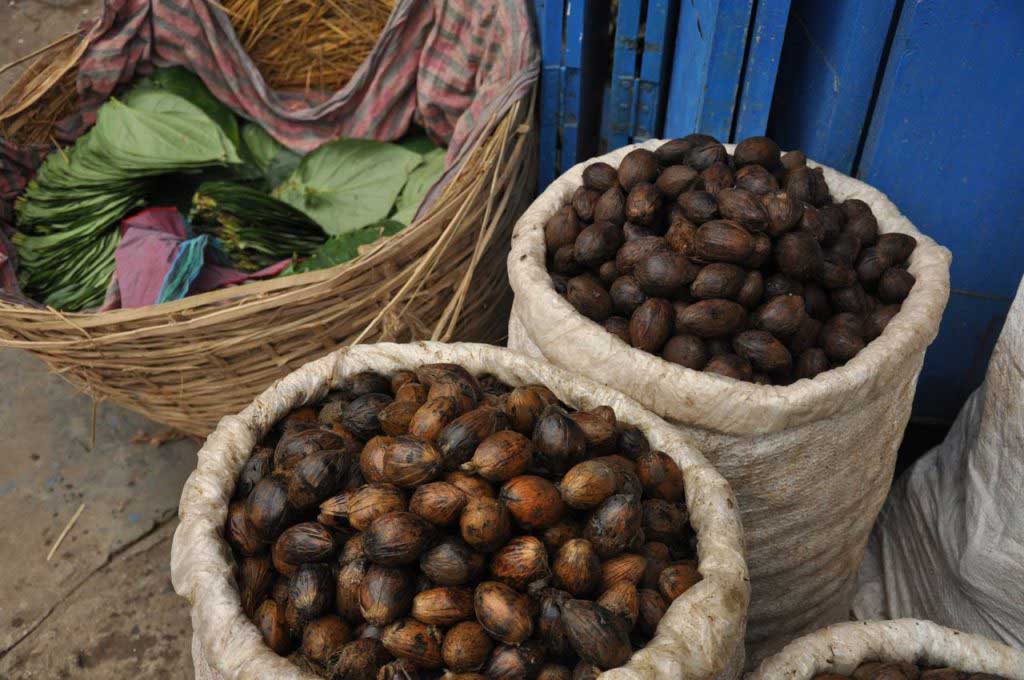
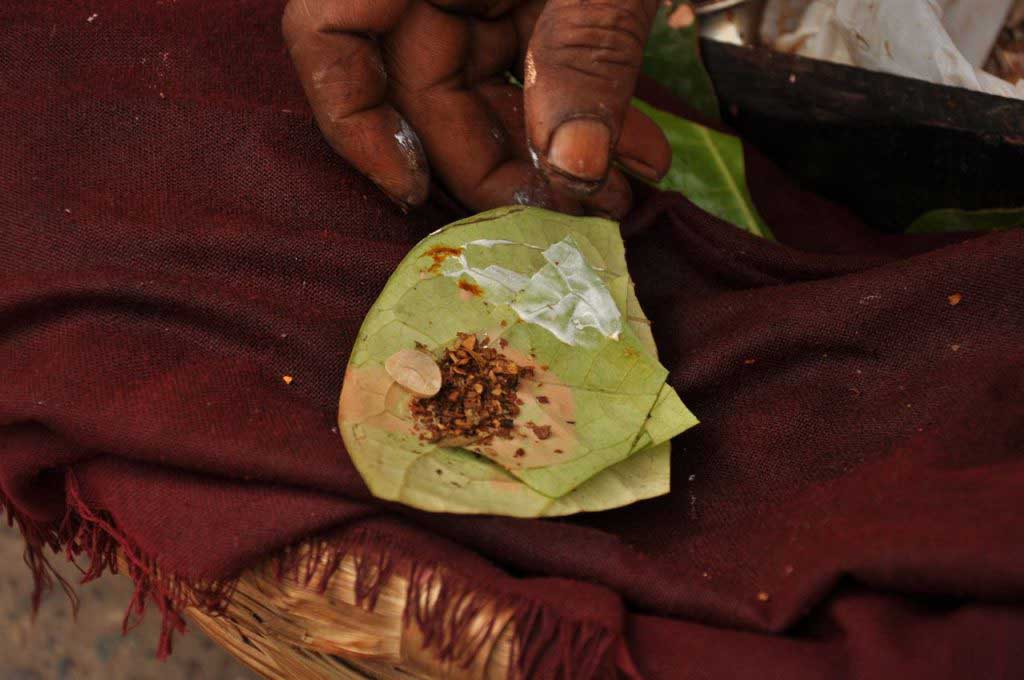
But what is the paan!?! Basically, paan is areca nut, whose appearance resembles a nutmeg, cut into small pieces and wrapped in betel leaf, a green vine leaf that has stimulant effects. To this mixture, is often added tobacco (chewing tobacco) and lime (calcium hydroxide … yes, the same as the lime which is used to cover walls.

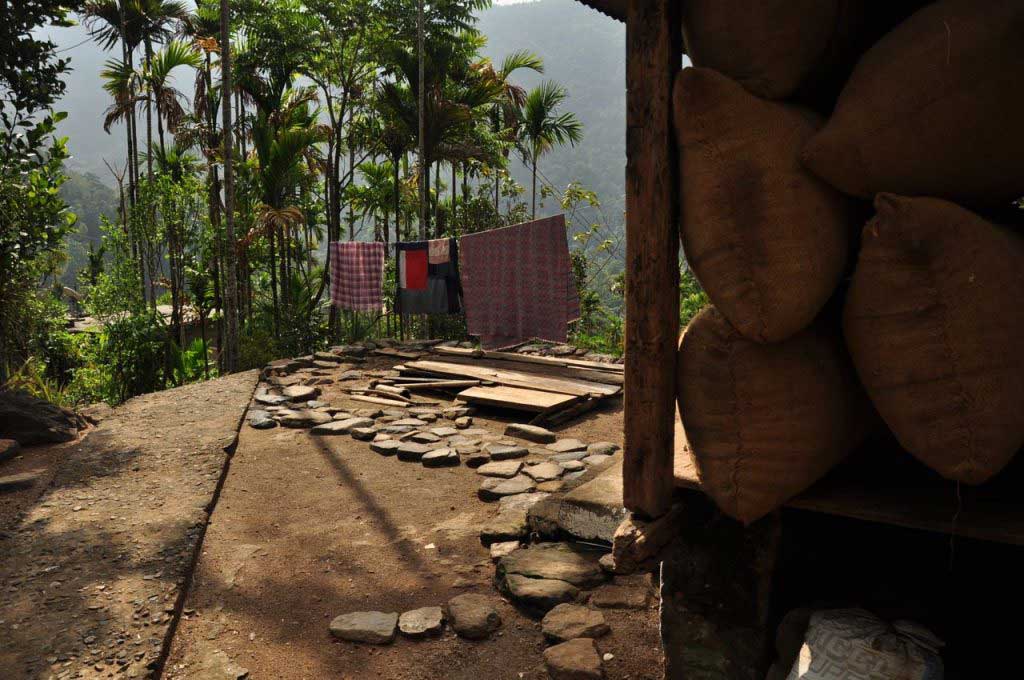
The areca nut, resembles much the nutmeg, both in size and in the appearance of the fruit, but rather born of a tree is the fruit of a palm tree, whose nuts grow in clusters at the top of a thin, high trunk.

Areca nut still with the skin of the fruit
Betel Leaf sold in markets (folha de Betel à venda nos mercados)
Areca nut without skin
Areca nut without skin at a market in Burma (Myanmar)
Areca nut tree. Megahlaya. India

The betel leaf is carefully folded in the form of a small rectangle or triangle shape, keeping the areca nut mix inside, and placed in the mouth between the cheek and the teeth. This “pack” is slightly chewed so slowly release the juice that gives gradually a reddish color to the saliva, which extends to the corners of the mouth and lips. After a few years of use, it results, in the decayed teeth and stained red, as well as a certain addition, due to the stimulation property of betel leaf. Mixed with tobacco, it increases the carcinogenic effects of the areca nut.

paan street stall. Burma
paan street stall. Burma (Myanmar)
"paan" before being fold in the betel leaf. "paan" uma mistura de nós de areca, cal e tabaco de mascar, enbrulhada numa folha de betel)
“paan” before being fold in the betel leaf. (“paan” uma mistura de nós de areca, cal e tabaco de mascar, embrulhada numa folha de betel)

The paan produces a strong salivation, which makes their consumers have frequent need to spit, which is often made in a showy way, a jet of red saliva, which leaves a trail through the streets, sidewalks and even on the walls!

Being very popular in India, the habit of consuming paan lies spread by all Asian countries, being more evident in India, Nepal, Bangladesh, Sri Lanka and Burma, with this last country being the place where the presence of paan is a constant being also chewed by women and the children.

But weeks spent through some of the northeastern states of India, like Assam, Nagaland and Meghalaya, left a stronger mark of this phenomenon. Here, perhaps more than in any other regions of India, areca nut “rules”, being even chewed without betel leaf or any other mixture.

Being predominantly a male habit, common among the poorest, it is a mark image among bus and tuk-tuks drivers; but in Northeast India the paan is also quite popular among women, and its cross-consumption to the various social classes, not being surprising to find a shepherd in Majuli Island spiting paan or the receptionist of a hotel in Mokokchung with corners of the mouth marked in red by the areca nut.

The chewing tobacco consumption is also very popular, being mixed with lime in order to moist the tobacco dry leaves, forming a paste which is placed near the gums. The tobacco preparation, rubbing the mixture in the hand palm with the index finger, being in the end slightly beaten to become flat and compact, are one of the most preset gestures… in the cities or in the villages, on the streets or in shops, on buses and trains… everywhere!!!

Despite the chew of tobacco be unpleasant, as it produces the frequent need of spit, the paan with its sweetish smell created, after three weeks of traveling through northeastern India, a certain distaste and aversion, for the combination of the spitting sound with the jet red saliva discharged, which doesn’t strive to be discreet or delicate, making the act of spitting an art, where the trajectory and distance of the red track left on the ground, is a matter of pride.

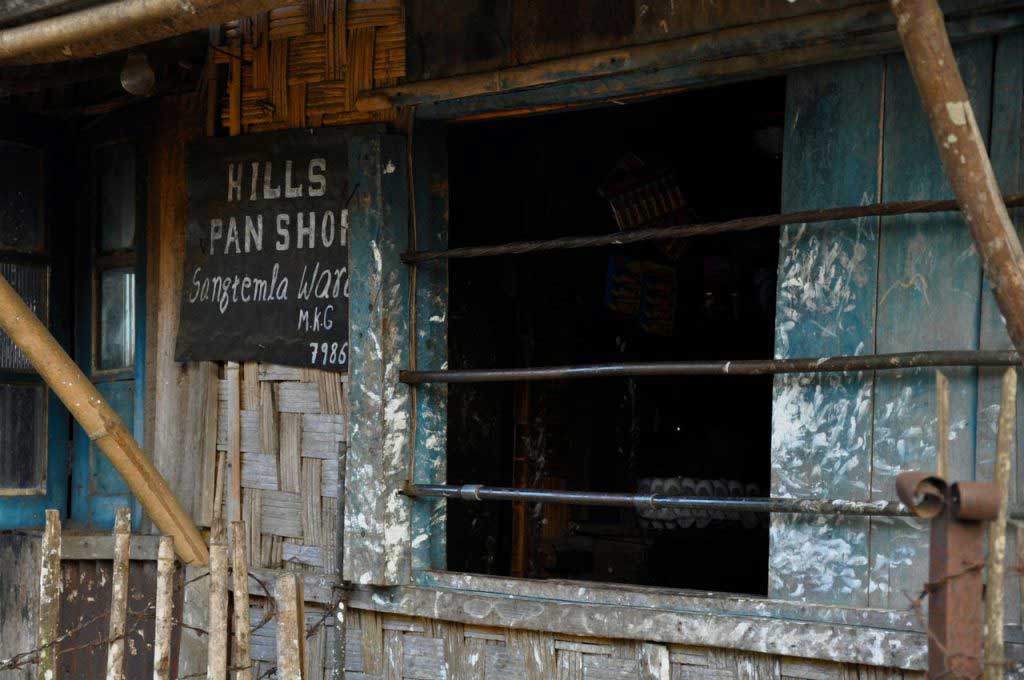
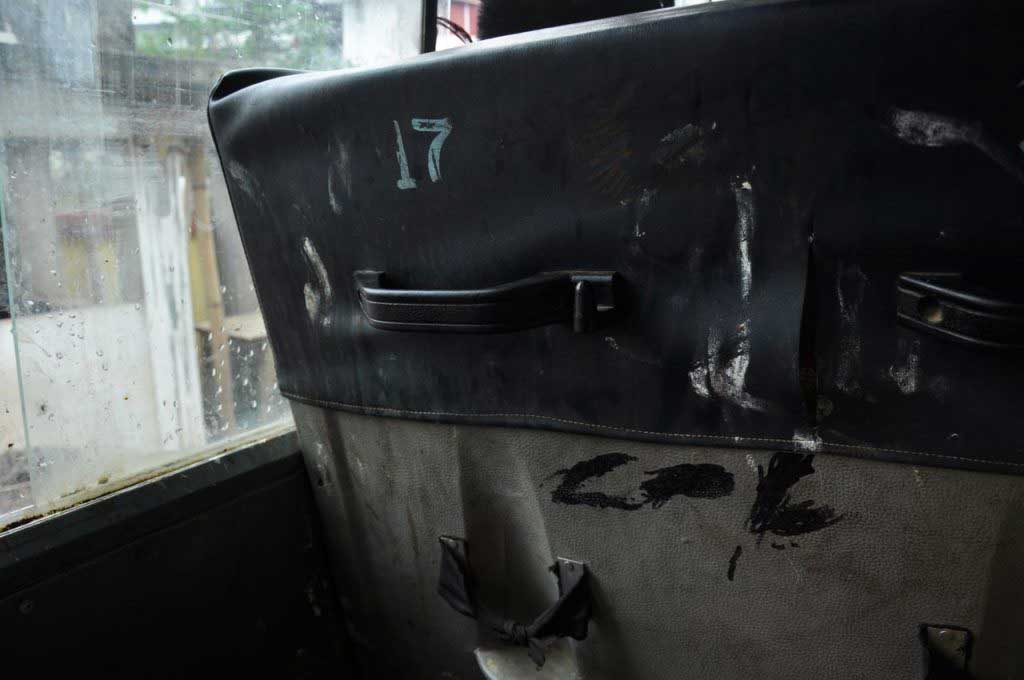
And a little everywhere, always come up white marks left by lime stuck to the fingers, that is rubbed on doorposts of the paan shops, or on the seats of a bus or a train…

paan shop, that are small stall where the paan is prepared and sold, usually in pack of six. Mokokchung, Nagaland. India
marks left by the fingers with lime that is used to mix with the tobacco and the areca nut (marcas deixadas pela cal usada para misturar o tabaco de mascar com o noz de areca).


And the smell also left a strong mark on my memory, with hotel rooms with paan presence, and long trips made by bus or the sumo, in the company of enthusiastic paan chewers, whose sweet smell pervades the space, and my field of vision regularly crossed by someone that need to spit out by the window.

A negative but strong memory that created in me a disgust of the paan, which my senses can not remain indifferent.

tuk-tuk driver spiting the paan, leaving a red trace on the streets (condutor de tuk-tuk
  • « Go to Previous Page
  • Page 1
  • Page 2
  • Page 3
  • Page 4

Footer

search

Tags

accommodation Assam Bali Border Crossing Borneo Cappadocia Colombo Dalí Dambulla Esfahan Fes Food Gilis Hiking hokkaido Istanbul Itinerary Jakarta Java Kandy Kashan Kataragama Kathmandu Kumano Kodo Lombok Meghalaya Meknes Mekong Nagaland Natural Park Nongriat Northeast States Ouarzazate Sarawak Shiraz Sichuan Province Sumatra Tabriz Tehran transportation Visa Yangon Yazd Yogyakarta Yunnan Province

I’m Catarina, a wanderer from Lisbon, Portugal… or a backpack traveller with a camera!

Every word and photo here comes from my own journey — the places I’ve stayed, the meals I’ve enjoyed, and the routes I’ve taken. I travel independently and share it all without sponsors or ads, so what you read is real and unfiltered.

If you’ve found my blog helpful or inspiring, consider supporting it with a small contribution. Every donation helps me keep this project alive and free for everyone who loves exploring the world.

Thank you for helping me keep the journey going!

BUY ME A COFFEE

Categories

Recent Posts:

  • How to go from Hualien to Dulan Beach
  • Taroko Gorge: between marble cliffs and emerald rivers
  • Hualien: a dull gateway to Taroko Gorge
  • Taiwan: Itinerary for an 16 day trip
  • Vietnam: Itinerary
  • 3 months in India: Kolkata, Tamil Nadu, Karnataka, Goa and Kerala
  • Backpacking Turkey in 24 Days: itinerary & costs
  • English
  • Português

© Copyright 2026 Stepping out of Babylon · All Rights Reserved · Designed by OnVa Online · Login