• Skip to main content
  • Skip to footer

Stepping Out Of Babylon

Travel & Photography

  • About me
    • Contact
  • Destinations
    • Africa and Middle East
      • Iran
      • Lebanon
      • Morocco
      • Turkey
    • East Asia
      • China
      • Japan
      • Taiwan (Formosa)
    • South Asia
      • Bangladesh
      • India
      • Nepal
      • Sri Lanka
    • Southeast Asia
      • Cambodia
      • Indonesia
      • Lao
      • Malaysia
      • Myanmar
      • Singapore
      • Thailand
      • Vietnam
  • Itineraries
  • Travel tips
    • Border crossing
    • Hiking and Natural parks
    • Food Journey
    • Visa
  • Photography

Stepping out of Babylon

Tehran… from bazaars to secret parties

Tehran with more than 16 million inhabitants (including suburbs), and heavy and polluted air resulting from the vehicles that clog the main arteries of the city appears to be unattractive to most visitors who only here are the minimum time required on arrival and departure from the country.

In fact the size and dispersion, the city of Tehran is not friendly to wandering, and the main places of interest are far from each other. However the Metro network covers much of the city, proving to be effective and cheap way and easy way to move around.

The stay was in the northern part of Tehran, near Tajrish, where the city begins to climb the slopes of the surrounding hills, enjoying a more ventilated atmosphere and less polluted air, compared to the zone further south, where lies the Grand Bazaar. The north of the city, wealthier and more modern, the black chador is less popular and scarves covering the hair, reveal more than they hide.

In Tajrish Square begins the longest street in the Middle East, Valiasr Street, with over 17 kilometers in length, developing the north-south direction to Rahahan Square, dividing the city in half. Built by Shah Reza Pahlavi, and renamed after the 1979 Islamic revolution, is now one of the main shopping locations in the city, attracting many shops of international brands. Here, not far from Tajrish Square is the Cinema Museum, that presents a selection of more alternative circuit movies, that surrounded by a pleasant garden makes you forget the incessant car movement passing in front of the gates.

The Grand Bazaar of Tehran presented itself, as the name implies “great”, too big in fact, dispersed and difficult to orientation; a succession of modern and uncharacteristic buildings, where most of the area is occupied by clothing shops “Made in China” style, not very attractive and with a certain lack of character.

However, not far is another type of trade in a succession of small shops aligned along the Marvi Street, where you can find a wide variety of imported products, from groceries, clothing, sunglasses, cosmetics, perfumes, etc… showing another facet of local businesses.

Along the street that leads to the main entrance of the bazaar, a 15 Khordad Avenue (Metro Sation: Panzdah-e Khordad), back-filling with movement and excitement that grows throughout the morning, with street vendors hawking their products, leading shippers and bringing goods and hundreds of people shopping, creating a lively atmosphere, where there is always time to take a break to enjoy an ice cream.

But a visit to this capital had the adventure with the unexpected opportunity to get in one of the famous secret parties that make this famous city; in a country where alcohol, nightclubs and many more things are forbidden, these parties organised in apartments are free of all these rules. An paradox to what is lived in public: here the alcohol flows freely, the atmosphere is euphoric party and women, leaving aside the Islamic heavy “dress code”, wear fashion clothing, exhibit hairstyles and heavy make-up.

Tehran, a city full of contrasts between the muslim tradition and modernity of a capital, deserve a more detailed visit, because like any big city, it keeps its hidden charms of who here does not linger.

Tajrish Bazaar
Tajrish Bazaar
Tehran Grand Bazaar
Tehran Grand Bazaar
Tehran Grand Bazaar
Tehran Grand Bazaar
Tehran Grand Bazaar
Tehran Grand Bazaar
Tehran Grand Bazaar
Tehran Grand Bazaar
Tehran Grand Bazaar
Tehran Grand Bazaar
Tehran Grand Bazaar
Tehran Grand Bazaar
Valiasr Street
Valiasr Street
Tehran
Tehran
Esculturas nos jardins do Cinema Museum de Tehran

Transport:

Coming from Tabriz, the arrival in Tehran is in Terminal-e Qarb (near Azadi Square easy to identify by the giant arc), with connection to Metro network (Meydan-e Azadi – Yellow Line).

For destinations to the south, as Kashan, Esfahan, Yazd … buses leave from Terminal-e Jonub, located in the southern part of the city, also accessible by Metro (Terminal-e Jonoob – Red Line)


But beware, Tehran disposes of 4 terminals of long-haul buses, targeting different regions of the country, so it is necessary to obtain accurate information about what the appropriate terminal:

  • Terminal-e Qarb

Address: Qarb passenger terminal, Azadi Sq.

  • Terminal-e Jonoob

Address: Jonub passenger terminal, Mohammad Bokharaie St., St. Shoosh

  • Terminal-e Shargh

Address: Shargh passenger terminal, Damavand St., Tehranpars

  • Beihaghi Terminal

Address: Beyhaghi passenger terminal, Arjantine Sq.


For arrivals by plane or part, the Metro network also has access to Mehrabad Airport but not at Imam Khomeini International Airport, the main airport of the city.

Theran Metro
Theran Metro
Bus Terminal-e Qarb; entrada da estação de Metro
Bus Terminal-e Qarb; entrance to Metro


Tehran Metro Map
Tehran Metro Map

Accommodation:

In the cozy home of a friend, savoring the generous hospitality of an Iranian family … couldn’t be better!


Where to eat:

Like any big city, in Tehran is a bit of everything in terms of restaurants, which in addition to traditional kebaks, has much more to offer not missing the international food options.

In the visit to the Grand Bazaar, cannot miss one of the most popular places to eat falafel in Tehran: na Naser Khosvo Street, near the corner with Marvi Street, were around lunchtime customers line up. The site has no tables, only serving falafel in long bread, on take-away system, so the small square in front serves as a location to seat and taste the Iranian version of this typical Arabic snack.

Tehran_Naser Khosvo_Falafel_DSC_1725
popular falafel place at Never Khosvo Street, close to the Grand Bazaar

Another option is the traditional Iranian soup, ash, made in the base grain, beans, lentils and some vegetables, and forming a thick aromatic broth. One of the best of these soups is in Valiasr Street at Tajrish zone where fried onion flakes and a taste of sour cream …

Ash at Valiasr Street


Ash, sopa iraniana à base de logominosas e legumes
Ash, iranian soup with beans and vegetables

Between Tabriz and Tehran… on the road again!

“Everything happens for a reason”… and so it happened! After Tabriz the next destination was the village of Masuleh, located in the foothills of Mount Talesh where the humid climate turns dry landscape in a green forest.

For over four hours, they were passing by the bus window desert landscapes almost with out vegetation, where the flat straight road is the only trace of human presence. Untouched plains intercepted by dry river beds, interrupted by small, gentle hills, which when approaching exhibit different textures, soft colors ranging from beige to brown, from gray to reddish shades. Occasionally arises a village of brick built houses whose color is difficult to distinguish from the surrounding landscape, which maintains the same look desert.

But “destiny” would change the turns to plans drawn by “man”, making the driver of the bus between Tabriz and Tehran, forget to leave me in an intermediate stop, Qazvin where it would change bus to reach Masuleh. The mistake was only detected upon arrival to the outskirts of big capital, where there was no way to return to Qazvin.

I found myself unexpectedly in the gigantic bus station in a city with over 15 million inhabitants, a few days ahead of schedule, without preparation, without plans, without a map or even route.

But believing that everything happens for a reason, this was the way to meet with a friend, with later shared with me the trip to Masuleh, making this a special itinerary in the trip by Iran. An inspected situation on the course of the events that reveals to be a balm to the lonely, grey and lonely days spent in Tabriz.

Tabriz - Tehran
Tabriz – Tehran
Tabriz - Tehran
Tabriz – Tehran
Tabriz - Tehran
Tabriz – Tehran
Tabriz - Tehran
Tabriz – Tehran
Tabriz - Tehran
Tabriz – Tehran
Tabriz - Tehran
Tabriz – Tehran

Transport:

The trip Tabriz – Tehran takes about 4 hours but maybe take more time if the arrival in Tehran coincides with the rush-hour, with road congestion.

From Tabriz Bus Terminal (the only one in town for long distance buses) buses depart roughly every hour, with several companies doing this connection. The first buses leave by 6 am and last for 24 hours.

Bus ticket costs 155,000 rials.

VIP Bus Tabriz - Tehran
VIP Bus Tabriz – Tehran
Normal Bus Esfahan - Shiraz
Normal Bus Esfahan – Shiraz
VIP bus Yazd - Kerman
VIP bus Yazd – Kerman
Normal Bus Maku - Tabriz
Normal Bus Maku – Tabriz

Buses in Iran are a great choice for long-distance travel, and there are regular services, with good frequency between major cities: Tabriz, Tehran, Esfahan, Shiraz, Yazd, Mashad, Kerman, Bandar Abbas… as we move away from this itinerary, the offer is less in terms of schedules and sometimes the quality of buses decrease.

The main roads are good, flat and with few curves, often with two lanes, making a comfortable ride; however existing speed brakes can often be quite disturbing during sleep. In mountainous areas, such as Kurdistan, or near the Caspian Sea roads become more sinuous, but usually with good pavement.

The prices are very attractive, with travel between major cities to costing between 100,000 and 200,000 rials (approximately 3:05 €; Out.2015 values).

The price varies depending on the kilometers and the type of service: normal or VIP and did not differ significantly depending on the transport company.

In the VIP service is provided a small snack (biscuits, cake, chocolate and packaged juice); in normal service sometimes tea and water.

When the trip coincides with mealtime and frequent stop for meals.

VIP buses have only 3 passengers per row, with wide and comfortable sets that look more like sofas, with armrest, reclining chairs and some with support that allows elevate your feet. Recommended for overnight trips because the price is not significantly higher.

Normal buses have 4 passengers per row, usually without armrest between seats.

In either option the space between seats is generous, allowing stretch your legs without problems, even for taller people.

All have air-conditioner, which not being too strong can offer enough comfort.

If we are to make a night of long-distance travel (5 or more hours in length) is recommended to confirm the departure time of the last bus, and if possible buy the ticket in advance, at least one day.

Festive seasons such as Nowruz – New Year’s Eve according to the Persian calendar – which coincides with the beginning of spring, are times when the bus, train and plane tickers and difficult to get, so traveling in Iran during is time implies careful planning.

When the number of passengers is not enough to fill a bus, is often different companies join efforts and move all the passengers a single bus, which may delay somewhat the departure and consequently the arrival, although the delay are not usually more than half hour.

Stops right outside the cities to collect passengers (and occasionally goods) are also common in day trips, but virtually nonexistent in night trips.

Tabriz: the carpets and the bazaar

Tabriz was the first stop on a month trip in Iran, and had the heavy responsibility to create a first impression of a vast and diverse country, stretching from the Caspian Sea to the Persian Gulf, from Turkey to Afghanistan, from Iraq to Pakistan, also bordering Turkmenistan, Armenia and Azerbaijan.

The city of Tabriz, that was capital of Iran, but because of its geographical position that formed very vulnerable to the attack of the Ottoman Empire, is now the capital of Azerbaijan province, where a significant part of the population is Azevi, constituting the largest ethnic group of Iran.

Tabriz an obligatory stopping point on the Silk Road, is today one of the oldest bazaars in the Middle East and the largest covered bazaar in the world, continuing to play a key role in commercial activity in the country, especially the trade of carpets … the legendary Persian carpets!!

The bazaar is clearly dominated by carpet business, which can be found in wool or silk, with geometric or floral motifs, with portraits or with religious inscriptions… business whereby Tabriz has worldwide fame. In parallel to the carpet business exist a great variety of stores that are associated with its production, selling raw materials, both the cotton yarns serving as weft as wool that are woven most carpets.

Dispite much of the area is dedicated to carpets, the Bazaar of Tabriz has much more to offer: areas dedicated to the sale of fabrics and clothing, specially the scarves to cover the head, who are here in an endless number of variations. Sometimes we are attracted by the smell of spices, the shinny honey pots, the brightness of dates, raisins, prunes and other dried fruits, the piles of walnuts, almonds and pistachios… a generous and endless variety.

The visit to Kabud Mosque, called the Blue Mosque (100,000 rials), despite the weight of seniority involving the building built in 1465, proved to be uninteresting. Ark-e Alishah, a huge and massive arch that is imposed in the city center has also little to offer. Lost in the intricate maze of streets that make up the bazaar is the Jameh Mosque, whose interior offers silence and comfort, in opposition to the feverish agitation made by porters, pushing cars by hand, bringing and taking good, in a movement that only slows at lunch time.

A city with a long history, where the bazaar was the center off all attentions, deserving more than a view, in different times of day, showing different light, different rhythms, different pulsars as the bazaar were a living organism.

Bazaar de Tabriz
Tabriz Bazaar
Bazaar de Tabriz
Tabriz bazaar
Bazaar de Tabriz
Tabriz bazaar
Tabriz_Bazaar_DSC_1198
Tabriz Bazaar
Bazaar de Tabriz
Porter at Tabriz Bazaar
Bazaar de Tabriz
Tabriz Bazaar
Bazaar de Tabriz
Tabriz Bazaar
Bazaar de Tabriz
Tabriz Bazaar
Tabriz_Bazaar_DSC_1233
Tabriz Bazaar
Bazaar de Tabriz
Bazaar de Tabriz
Tabriz_Bazaar_DSC_1257
Tabriz Bazaar
Bazaar de Tabriz
Tabriz Bazaar
Tabriz bazaar_DSC_1188
Tabriz Bazaar
Bazaar de Tabriz
Tabriz Bazaar

Leaving the city center, a visit to the surrounding area of Valiasr Square, revealed another facet of Tabriz, more modern and cosmopolitan, with sophisticated shops, cafes, restaurants and bakeries. A wealthier Tabriz where the way of dressing, more relaxed and colourful, reveals a less conservative and traditional mindset.

Zona junto à Valiasr Square
Near Valiasr Square

The four days spent in Tabriz served as adapting to a different culture, to understand the rules of social behaviour, where segregation between sexes in buses and other public places is strictly respected, where the scarf used to cover the head, is not only required at streets, but as well inside the guest houses. The dress code also requires some attention, especially for women and is not limited to the head scarf, including long sleeves, loose clothing and covered legs… yet the rules are always more flexible for foreigners. Also time for the necessary adaptation to food, where meat dominates most of the meals served in restaurants. It was also time to adapt to the money, where the “zeros” dominate the value of banknotes, where almost nothing is bought with less than 1000 rials and where to return for a 50€ bill makes us holding more than a million rials… basically millionaires.

Tabriz. Ferdowsi St.

Tourism Office:

The Tabriz touristm office, located on the first floor of one of the buildings in the pedestrian zone that serves as the main entrance to the bazaar, is a required stop for those visiting the city, where the friendly and helpful staff provide all kinds information, whether from excursions (organized by the tourist office), the local money exchange, public buses to different places to visit (including for the Bus Terminal Tabriz), restaurants, etc …

Tabriz may be the base for day visits to neighboring regions, with Kodovan, a town whose houses are built on the rock, one of the most popular; given the similarity with the recently visited Cappadocia was not selected in this itinerary.

Posto de Turismo de Tabriz
Tabriz Tourism Office
Posto de Turismo de Tabriz. Horário
Tabriz Tourism Office. Schedule

Accommodation:

The center of Tabriz, between the main entrance of the bazaar and the Imam Khomeini Street is located the Ferdowsi Street, which concentrates a large number of guesthouses, with cheaper prices. There are single, double or shared room, usually with shared toilets. Prices vary widely, depending on the conditions offered in terms of ventilation (with rooms without windows) and cleaning, so it is worth seeing a few rooms and check prices before making a decision.

The choice went to the Mashhad Guest House that wasn’t the best price but show up clean and fresh, despite the minimum dimensions of the room.

Mashhad Guest House

Ferdowsi Street

Single room: 250,000 Rials  + 60,000 rials shower

Free wi-fi… slow, very slow… and just at the reception room

Almost no English is spoken by receptionist and staff

Mashhad Guest House
Mashhad Guest House
Mashhad Guest House
Mashhad Guest House

Where to eat:

One of the very popular choices in terms of street food found in Tabriz was made with baked potatoes, crumbled on a piece of bread, adding boiled egg, tomato and some fresh herbs, form a roll… that fills you up as a proper meal.

Along the streets of the bazaar, some sellers of sweet potatoes and other roots cooked in sugar syrup, spread the sweet aroma wrapped in a steam cloud.

Inside the bazaar there are also a few restaurants, but given the labyrinthine nature of the space where the guidance is not easy, find these sites is a little to chance or delivered to the olfactory sensitivity.

Snack de rua em frente à entrada principal do bazaar
Street food at the entrance of Tabriz Bazaar

Transport:

Bus to Valiasr Square: number 159; the stop is street outside the bazaar Jomhuriye Eslami Street.

Bus to Tabriz Bus Terminal (long distance buses): number 104; the stop is on Amir St., a street perpendicular to Ferdowsi St.

Apparently you need a card for travel on city buses, which is validated electronically on every trip to the entrance of the bus. But you can pay directly to the driver, between 500-1000 rials; in the case of women the situation is more complicated because after entering through the front door and pay the tickets, you must exit and re-enter through the back door to the area reserved for women. Often the driver did not charge ticket … maybe to make things easier, perhaps because I’m a foreigner …?!?!?

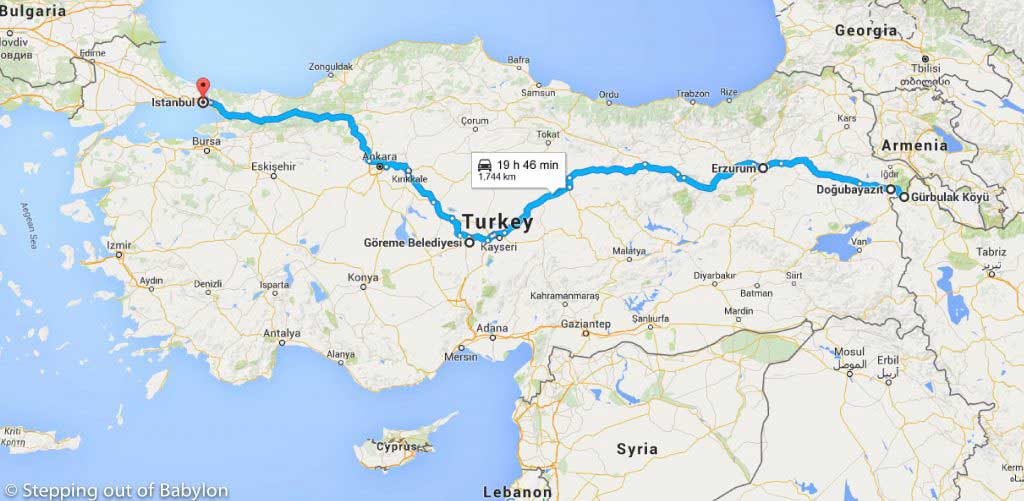
15 days in Turkey: itinerary & costs

Distance travel in Turkey from Istanbul to Iranian Border: 1750 km

5 days

September 2015

Itinerary:

  • Istanbul: 8 days
  • Goreme and Cappadocia: 4 days
  • Erzurum: 2 days
  • Doğubayazıt: 1 day
  • Gurbulak (Iran Border)

Average costs based on solo travel, with a focus on keeping things budget-friendly:

17 €/dia

… considering travel always by public transport, bus and train, no flights… sleep in dorm or share a room, using the couchsurfing sometimes… rent a scooter a couple of days… eating just local (vegetarian) food, no a/c rooms, sometimes dorms, travel by public transport, no alcohol and no soft drinks, making my own laundry and walking a lot on foot avoiding taxis… Shopping and souvenirs are also not included, as well health expenses and communications (SIM card, mobile, telephone, internet…).

doesn’t include visa fee

see more in How to get a Turkish visa

Turkey: Itinerary
Turkey: Itinerary

How to cross the border Gurbulak–Bazargan (Turkey-Iran)

Due to problem in the east part of Turkey, resulting from conflicts to Kurdish community the train that usually runs from Ankara to Tehran, Trans-Asia Express, was canceled. Check for more update information about Trans-Asia Express at: http://www.seat61.com/Iran.htm#train

According to the few information that I could get, the border Kapikoy– Razi, in Van district is open and the bus connection to border towns don’t have any problem.

Other popular and easy border is the Gurbulak – Bazargan, a bit north, closer to Armenia, and this was the chosen one to enter Iran.

Erzurum – Doğubayazıt

The city of Erzurum doesn’t show much attractive, except the beautiful naked mountain that are visible from many places in the city. Anyway, from here there are buses to Doğubayazıt.

There are buses several times a day, but is recommended to leave early in the morning, as the trip until Doğubayazıt takes ore than 3.5 hours, and arrive with time to visit the Ishak Pasha Palace, that closes at 5pm.

The bus ticket should be bought in advance, in the bus terminal (a few kilometers far from the city) on in one of the bus companies and bus agents in the center of Erzurum, at Nazik Çarsisi Caddesi, close to the main shopping street.

The ticket cost 30 TL.

Doğubayazıt – Gurbulak

Doğubayazıt is the last town in Turkish side before the border.

Here is definitively recommend to spend the night, to start the trip to Iran in the morning and avoid to arrive to Tabriz too late. I leave from Doğubayazıt at 9.30 am and arrive to Tabriz at 8 pm.

The city is small, and easy to orientate. The buses from Erzurum stop in the main street. From there is 5 minutes walking until the office where the mini-vans (dolmus) to the border.

Mini-vans start at 7 am, and leave Doğubayazıt as soon they are full, and take 35 minutes until the border.

The ticket cost 7 TL.

Doğubayazıt
Doğubayazıt. Office of the bus company that makes the service to Gurbulak… at front of the office there’s a few mii-vans parked

Doğubayazıt
Doğubayazıt, in fronto fo the mini-van company that make the trip until the border

Border Turkey-Iran (Gurbulak- Bazargan)

Despite the long queue of trucks, there are only a few people crossing the border, not much more that the people that arrive in your mini-van.

After showing your passport and Turkish visa (the printed paper visa), and have your passport stamped, just follow to the next building were are situated the Iranian Immigration Office.

For women this is the time to put the scarf over the head.

In the Iranian side it takes more time to the foreigners, I mean, the non-Iranian or Turkish, because it is asked a few question about the reason of the trip and places to visit… just give the classic itinerary (Tabriz, Tehran, Esfahan, Yazd…) and make the life easier to you and to the border officer.

After this you are in Iran, where a friendly group of men, interrupt theirs chatting to ask same friendly questions and invite for tea. Here, according to some Internet infos, there are two guys that are good resource of information about the country.

Several friendly guys that want to exchange money will intercept you, both in Turkish as at the Iranian side, just outside the imitation buildings. Despite they insisting that is no possible to exchange Turkish Lira after the border, don’t believe, you can do it later… is up to you! Here in the street you can also exchange dollars and euros. If you are confortable with the Iranian currency and rates maybe is a good option, otherwise just wait 5 minutes until reach Barzagan.

Watch out that the time zone change in Iran, 1.5 hours late.

Turkey-Iran border (Gurbulak–Bazargan)

Bazargan – Maku

From the border you need to walk about 3 km or take a taxi to the next town of Bazargan, that is not much more than road with some shops, restaurants and small offices were you can exchange money. There are not much signs but just ask about “exchange” and suddenly you are surrounded by people trying to push you to an office of a friend. The rates are more or less the same. Here you can also exchange dollars and euros. Just get what you need to reach your next destiny… for sure there you’ll get a better rate.

Shared taxi cost 20.000 Rial per person.

You can change the last Turkish Liras at Gurbulak or Bazargan, but the taxi drivers accept TL until Maku.

Bazargan – Maku

From Bazargan you need a taxi to the next town that takes not more than 20 minutes, Maku where you find a bus terminal, and from here another bus to Tabriz, Tehran, etc…

Shared taxi cost 20.000 Rial per person.

There’s nothing in Maku that make you stay there, so you can go straight to the small and quiet bus terminal. There you find different bus companies offices. Is difficult to get information about schedules… so just arrive and ask about the next bus to the city that you want to go.

The Maku bus terminal, is a bit far from the center Maku, but has some small restaurants and acceptable toilets.

To Tabriz there is a bus departing at 3 p.m. Watch out that the time zone change in Iran, 1.5h plus.

The trip to Tabriz takes 6h… because the bus stops many times to pick and drop passenger on the way. Maybe a night bus is faster.

Bus ticket Maku-Tabriz: 110.000 Rials

Maku
Maku
Maku Bus Terminal
Maku Bus Terminal

How to get the Turkish visa

Get a visa to visit Turkey is easy and fast.

Since the computer system was introduced for the visa Turkish, e-visa, it is not possible to obtain visas on arrival at the airport or at any land border.

Simply fill out the form found on the website of emigration Turks services (https://www.evisa.gov.tr/en/) and after pay by credit card, following the instructions, the electronic visa is sent by e-mail the same day.

To facilitate the migration of service passages in this document (an A4 sheet) to be printed and maintained until the exit of the country, when it is requested again.

  • Cost: 20 €
  • Valid for 6 months after first entry
  • Multiple entries
... miss the old style visa stamp!
… miss the old-style visa stamps!

About Turkey and Turkish people

After a short stay of two-week, few conclusions can be drawn from a country so vast and with so much history and cultural diversity. However impressions, feelings and ideas, were experienced, the realities observed as also information exchanged with the population.


Language and Writing

Although Turkish is a completely different language where there are few common words, appear here and there same familiar French sounds like “pardon” to ask say “excuse me”.

The greeting is given by “merhaba” and thank you by “texekkur”

Having the Turkish links with the Arabic language, the writing system was for centuries in Arabic characters, but thanks to Mustafa Kemal Atatürk, in the year 1928, the Turkish language was converted to the western alphabet, which makes it much easier in terms of orientation and location learning and even more basic words, such as food.

In Istanbul and in areas with more tourists, like Goreme, you will find someone who speaks English, sometimes fluently, others just the enough for basic communication about directions, information about buses and schedules, destinations, prices, etc… But outside these areas the situation seems to be more difficult, although the local people, who despite this limitation is sparing no efforts to help us, using the sign language as calling someone younger that can speak a bit of English.

The contact with the younger population, from urban areas and with a higher level of education show another reality, were is easy to have a more deep conversation about society, religion, etc…


Buses

Turkey has an efficient and modern transport system, with a network that covers the whole country, and with many passenger transportation companies. The bus terminals are generally large, modern, clean and organized, with toilets, seating areas and restaurant/shops zones. In smaller cities this terminal become more modest, but still with the comfortable conditions to wait a few hours between bus connections.

Kamil Koç and the Metro are two of the best and more reliable companies used during this trip in Turkey, the wide range of connections between major cities, an effective service of information and ticket sales, as also in the quality of buses, with both offering different kinds of service, from the normal 4 seats raw until the more spacious VIP buses, were tea and water are served.

The good quality of the roads and buses, even the most modest companies makes buses a good option for long trips.

There are many night services.

Reserve ticket by web pages is not possible because you must enter the “TC” the number of Turkish identity, and passport number or any other identification document works.

Istanbul offers an effective and reliable transportation network that relies on buses, boats and Metro.

Metro e Kamil Koç destacam-se nas viagens de bus

Train

There was no opportunity to try this mode of transport during this short trip.

The connection Ankara-Tehran, the famous Trans-Asia Express, was canceled due to problems in Eastern Turkey, with conflicts with the Kurdish population. There’s no information about possible reopening (Sep 2015). Although for more updated information http://www.seat61.com/Iran.htm#train

Tickets must be booked in advance especially if travel at weekends and upcoming religious holiday, like Kurban Bayrami, where many people are heading to visit family; this also applies to bus and plane tickets.

In train travel, as well as on long-distance buses, it is not customary for men stay sitting next to women unless they are couples, relatives or friends; this system can become a issue at the time of buying tickets during of peak demand, where sometimes there are eats available, but not always next to a person of the same sex as you.

http://www.seat61.com/Turkey2.htm


Religion

Despite all the efforts of Ataturk to bring Turkey closer to western standards, reducing the power of Islamic religion and transform the country in a secular society, Turkey has become in recent years more conservative, with a greater presence of the Muslim religion in daily life of the population.

Officially more than 95% of the population is Muslim, mostly Sunni, but there still Alevis, Sufis and Shias.

Since social and political reforms introduced by Ataturk from 1926, the society was modernized as well the dress code, which has become more Western, leading to gradual abandon of Islamic tradition that forces women to cover their hair, starting to be a choice of each one.

But recently, with the increasing power of Islamic groups and religious fervor, the use of the headscarf, which was previously only a tradition, become more often. Is quiet frequent to see women and teenagers using the hijab, a scarf that covers the entire hair, ears and neck. The use of chador, black mantle surrounding body, is more common in conservative areas, for example in Erzurum, but is not unusual to find it in Istanbul, at Fatih and near bazaar.

Blue Mosque, Istanbul


Cash

There are ATMs everywhere, accepting most Visa and Master Card, but a commission is charge for each movement. You can also make payments by credit card and even some bus companies accept payment by credit card for long journey trips.

To save the exaggerated costs of bank fees charged outside the Euro zone, the option was to bring money and exchange locally by Turkish Liras.

In Istanbul, and in the most tourist areas is easy to find exchange shop, that usually don’t charge commission. Still is recommender to check the rates in a few shops because the difference could be noticeable.

Another option are the ATMs machines/banks that are prepared to exchange money, introducing dollar, euros or pounds bills, and return Turks Liras, no commission and a very reasonably good exchange rate.

By my experience, the best option was to go directly to the bank… may take a while, depending on the number of people. It is necessary to ask first about the rates and the commission… in some places like Goreme, with just one bank the deals wasn’t good, not even in the exchange shops. The best option found was the Ziraat Bankasi, easily identifiable by the red logo, where I found the best exchange rate without commissions.

Ziraat Bankasi
Ziraat Bankasi

Generosity and hospitality

There is no doubt that these two words make a stay in Turkey.

Usually, everywhere people show friendly and curious, always available to help, whether giving directions, helping them find sites, providing information, offering food to try, a tea…

This sympathy was even more evident with the couchsurfing experience in Istanbul, Erzurum and Doğubayazıt, where hospitality word was brought “to the letter”, having shared the house with people who did not know, who helped me, providing information and guidance, showing the city, searching for transport, and specially by making and sharing meals and life experiences.


Kurds

With the long history of empires and civilizations that passed through here, Turkey is currently home to diverse ethnic and religious minorities such as Armenians, Jews, Greeks, Kurds and many other groups belonging to neighboring countries or countries that belonged to the Ottoman Empire. However these groups, the largest in terms of population are the Kurds, who account for about 15%, and still not recognized as ethnic group.

Holders of their own culture and language, but being Sunni Muslims, as well as the Turks were never officially recognized. The areas where they predominately live, mainly in the east and the southeast of Turkey, were not supported and developed in parallel with other parts of the country, which led to a greater sense of exclusion that continues today causing conflicts, and perhaps a desire for a Kurdistan “the land of the Kurds.”

Recently (September 2015) there were some conflicts in the east of Turkey, which led to the temporary closure of the rail link Trans-Asia Express that crosses the province of Van, near the border of Iran.


Atatürk

The “Father of the Turks” is all over the place. It cannot be said to be a revered figure, but no doubt it is a respected figure whose image is present in many public places such as shops, restaurants, cafes, hotels, railway station, official departments… and in the Turks Lira bills.

Mustafa Kemal, nickname Atatürk, having ruled the country for eighteen years, represents a turning point in the history of Turkey, creating rules and reforms that radically changed the political, justice, economy and society, transformed Turkey into a secular country, more close to European standards. He developed the industry, gave priority to education, gave women equal political and social rights, banned polygamy, and abolished the political system based on Caliphates, where political power was reserved to Islamic religious.

His name is in avenues and squares and the International Airport of Istanbul, and is undoubtedly the main responsible for the modern and developed society that is now Turkey.


Atatürk
Atatürk

The brief spell in Turkey was the impression of a modern country, proud of its past, which persists the weight of religion and traditions.

Erzurum

Erzurum is a city that attracts few foreign visitors, not offering much more than ski resorts.

However the University here existing attracts a lot of young people, giving some life to a gray, cold city, even at a time of year when the autumn is come and we are still far from cold temperatures that cover the mountains surrounding the city of snow which lasts until April.

This is a conservative area in religious terms, perhaps due to the proximity to neighbor Iran, in Erzurum is no alcohol sold in supermarkets and restaurants, but there are a few bars and liquor stores selling it.

The stay in Erzurum was short, but necessary on the route to the border with Iran.

Erzurum
Erzurum
Yakutiye Madrash, Erzurum
Erzurum
Erzurum
Erzurum
Traditional home Erzurum Evleri that works as restaurant and a tea house, while maintaining an atmosphere of museum

Where to stay:

As there are few hotels and many houses shared by the student population, the option in Erzurum went to Couchsurfing, where we were greeted by a group of students from different regions of Turkey, which were excellent hosts, showing the city, sharing views on society, culture and Turkish traditions … and above all sharing delicious home cooking. A very special generosity and hospitality.

Couchsurfing Crew
Couchsurfing Crew

Where to eat:

No doubt that the best meals were served at home, prepared by our hosts, and were good examples of traditional Turkish food. However the city center there are the usual restaurants and fast food places like borek and pide.

The excelled pastry Luks Pastanesi, with delicious breakfast, as well as the variety in terms of bread and pastries, served in a sophisticated atmosphere.

Lüks Pastanesi, Erzurum

Transports:

The bus station is quite far from the city. Major transport companies offer shuttles from the terminal to the center.

Bus tickets can be purchased in various offices of transport companies at Nazik Çarsisi Caddesi, one of the streets perpendicular to the main avenue, Kongre Cd.

For those who want to cross the land border with Iran (Gurbulak-Bazargan) need to find a bus from Erzurum to Doğubayazıt, the last town before the border.

It is difficult to find information on schedules this connection. But around 10 am a bus leave daily from Erzurum Bus Terminal. You can also buy the ticket in one of the existing agencies in the city center that provide transportation to the terminal up to certain parts of the city where the bus passes on the way out of the city.

It is recommended to book the bus ticket, at least one day in advance, because the bus is usually full.

The journey takes about 3 to 4 hours. It costs 30 TL.

Nazik Çarsisi Cd.
Nazik Çarsisi Cadessi
  • « Go to Previous Page
  • Page 1
  • Interim pages omitted …
  • Page 27
  • Page 28
  • Page 29
  • Page 30
  • Page 31
  • Go to Next Page »

Footer

search

Tags

Amed Arugam Bay Assam Bali Bogor Border Crossing Borneo Colombo Esfahan Fes Food Gilis Hiking Hikkaduwa hokkaido Istanbul Itinerary Jakarta Java Kashan Kohima Kumano Kodo Lombok Marrakesh Meghalaya Meknes Mekong Nagaland Natural Park Northeast States Ouarzazate Sarawak Shan State Shiraz Sichuan Province Sumatra Tabriz Tehran transportation Varanasi Visa Yangon Yazd Yogyakarta Yunnan Province

I’m Catarina, a wanderer from Lisbon, Portugal… or a backpack traveller with a camera!

Every word and photo here comes from my own journey — the places I’ve stayed, the meals I’ve enjoyed, and the routes I’ve taken. I travel independently and share it all without sponsors or ads, so what you read is real and unfiltered.

If you’ve found my blog helpful or inspiring, consider supporting it with a small contribution. Every donation helps me keep this project alive and free for everyone who loves exploring the world.

Thank you for helping me keep the journey going!

BUY ME A COFFEE

Categories

Recent Posts:

  • How to go from Hualien to Dulan Beach
  • Taroko Gorge: between marble cliffs and emerald rivers
  • Hualien: a dull gateway to Taroko Gorge
  • Taiwan: Itinerary for an 16 day trip
  • Vietnam: Itinerary
  • 3 months in India: Kolkata, Tamil Nadu, Karnataka, Goa and Kerala
  • Backpacking Turkey in 24 Days: itinerary & costs
  • English
  • Português

© Copyright 2026 Stepping out of Babylon · All Rights Reserved · Designed by OnVa Online · Login