• Skip to main content
  • Skip to footer

Stepping Out Of Babylon

Travel & Photography

  • About me
    • Contact
  • Destinations
    • Africa and Middle East
      • Iran
      • Lebanon
      • Morocco
      • Turkey
    • East Asia
      • China
      • Japan
      • Taiwan (Formosa)
    • South Asia
      • Bangladesh
      • India
      • Nepal
      • Sri Lanka
    • Southeast Asia
      • Cambodia
      • Indonesia
      • Lao
      • Malaysia
      • Myanmar
      • Singapore
      • Thailand
      • Vietnam
  • Itineraries
  • Travel tips
    • Border crossing
    • Hiking and Natural parks
    • Food Journey
    • Visa
  • Photography

Indonesia

Bromo… the breath of the earth

Feeling blessed fro this experience and pound of overcome some hard parts of the path, the dark cold of the night and the tiredness of a long-long hike, without giving up.

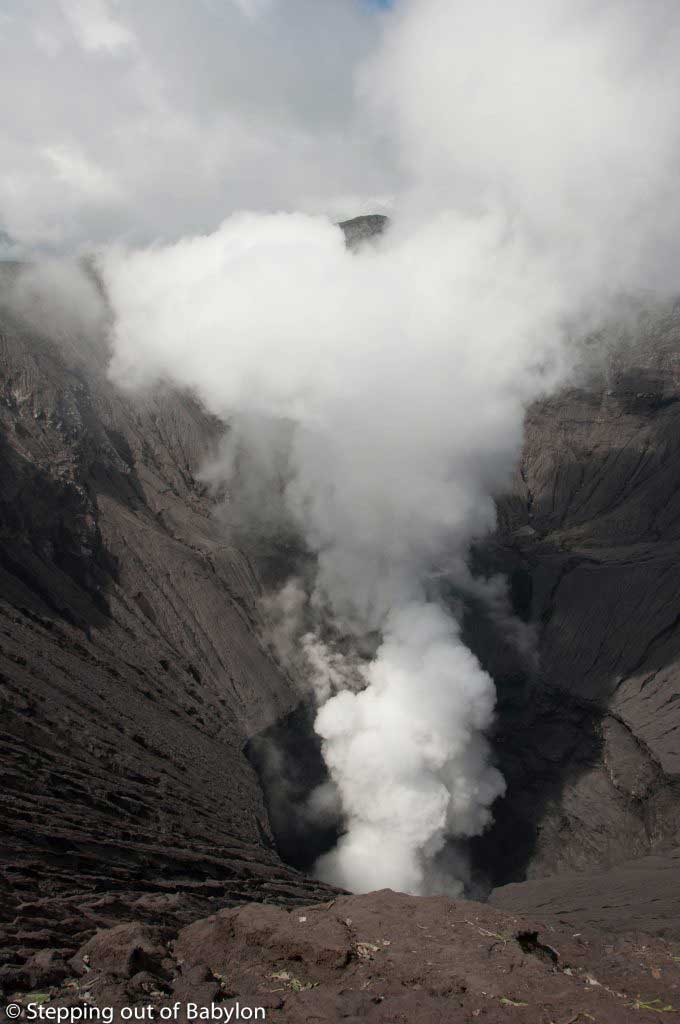
Arriving at Bromo, listening to the sound that comes from the center of the crater, a mix of boiling water with the sound from an earthquake… the breading of the earth. Such a power… such a memorable experience.

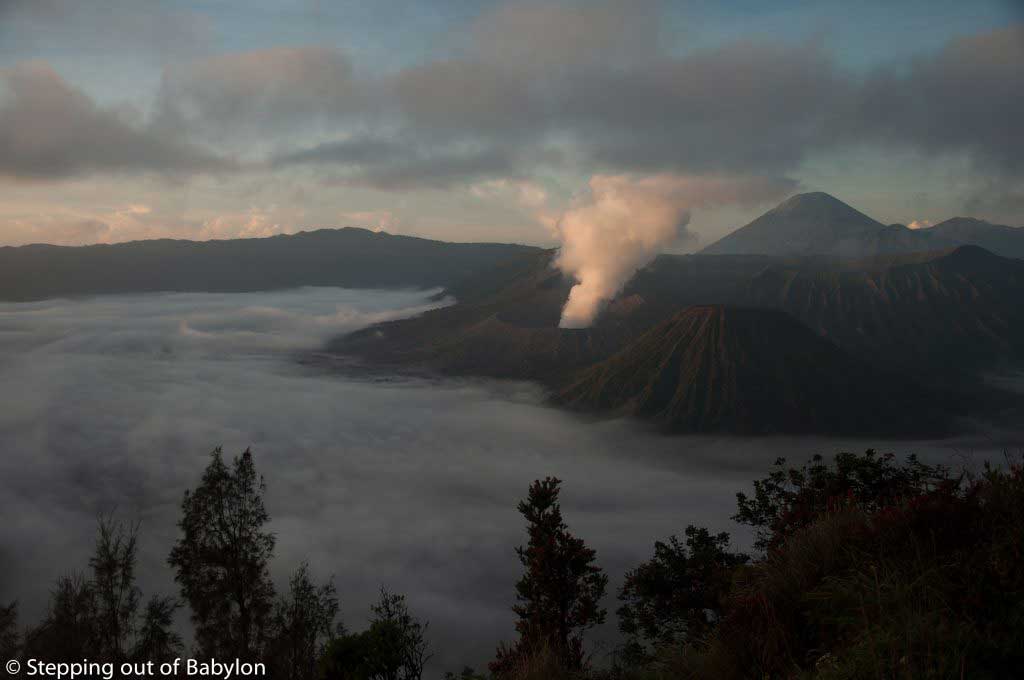
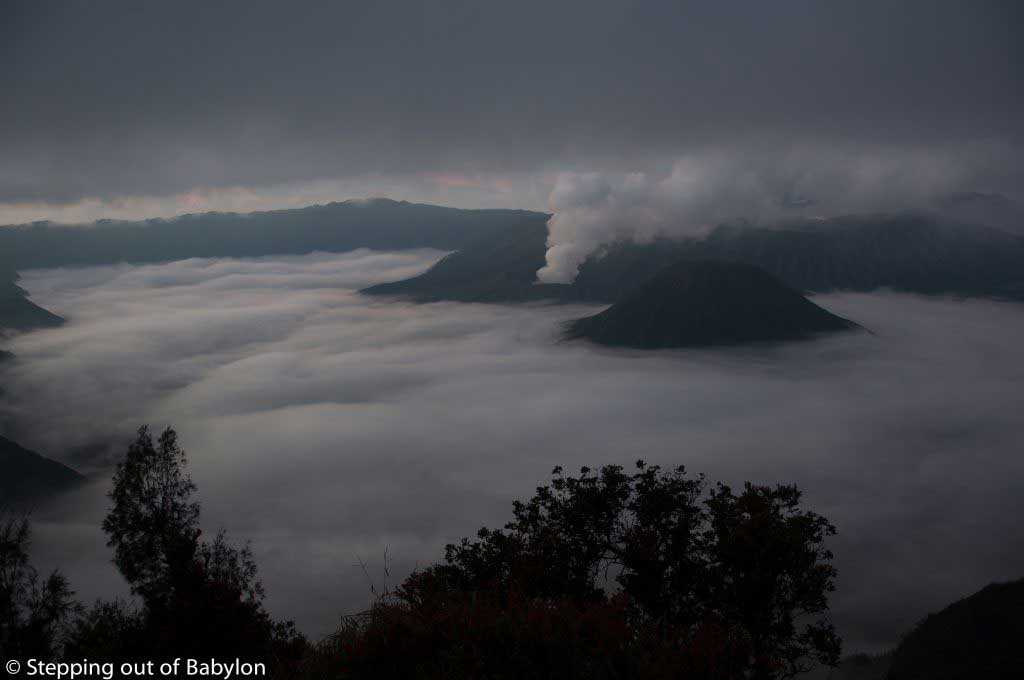
But the extraordinary moments lived in this visit to the Bromo-Tengger-Semeru National Park started early in the morning, when before the first sun rays climb up the mountains, with the dawn light revealing a unreal landscape where the base of the three mountains – Bromo, Kursi and Batok – emerge from a thick layer of white clouds, giving the impression that these mountains are float in a cotton candy mattress.

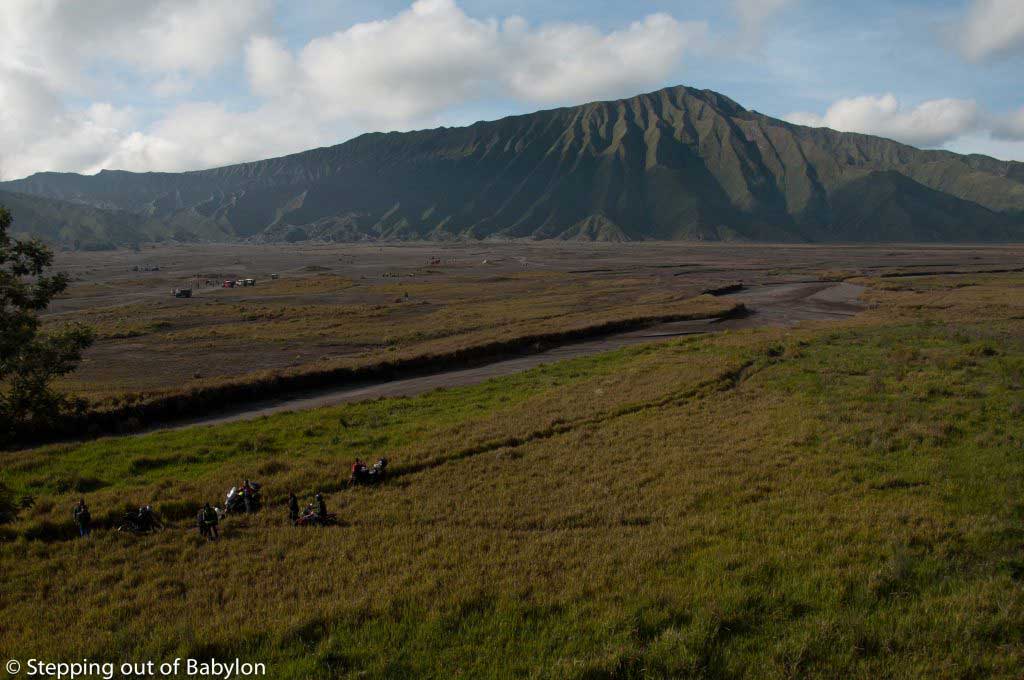
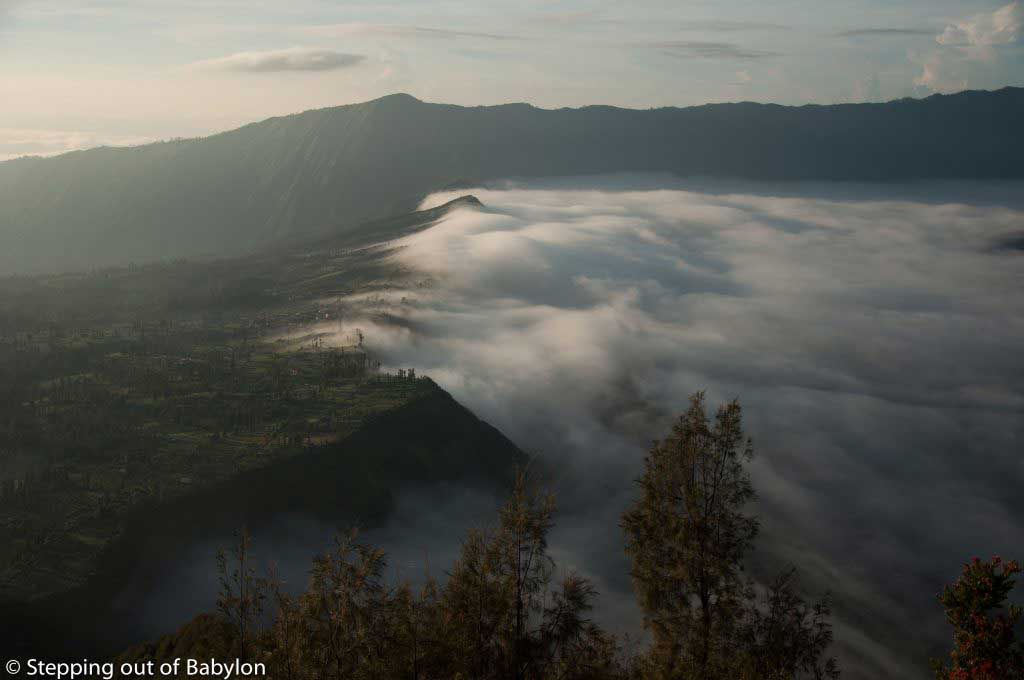
But with the daylight the mantle of clouds slowly vanish, exposing a flat green plain, that is itself a center of an old volcano, which walls were almost all erased by erosion, but the one that is clearly visible is the location of Cemoro Lawang village.

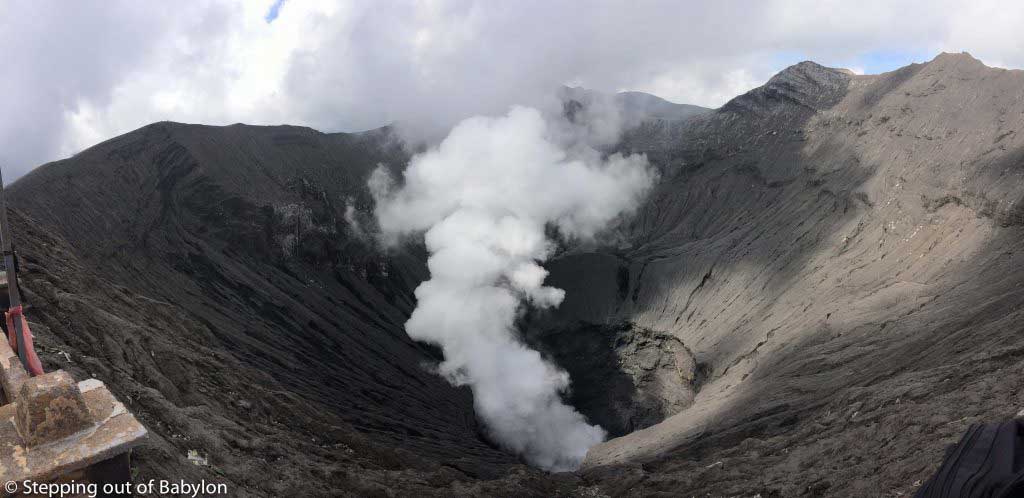
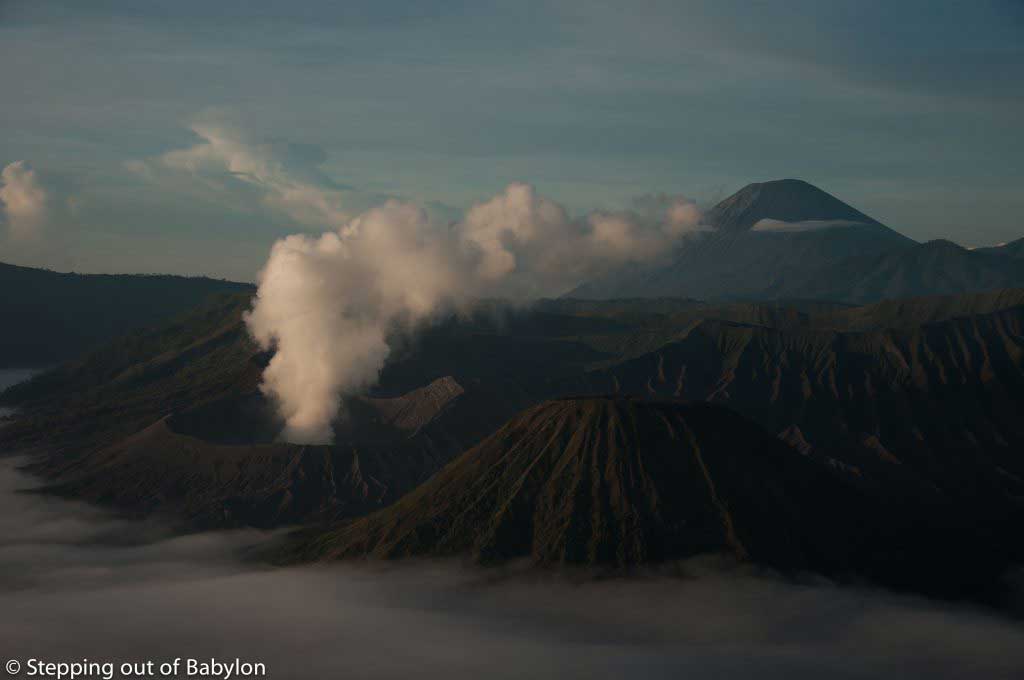
The lava naked cone of Bromo volcano, emerge majestic and powerful in the lunar landscape, and the white dense smoke that comes from the crater reminds us this volcano is alive and can show is power at any moment!

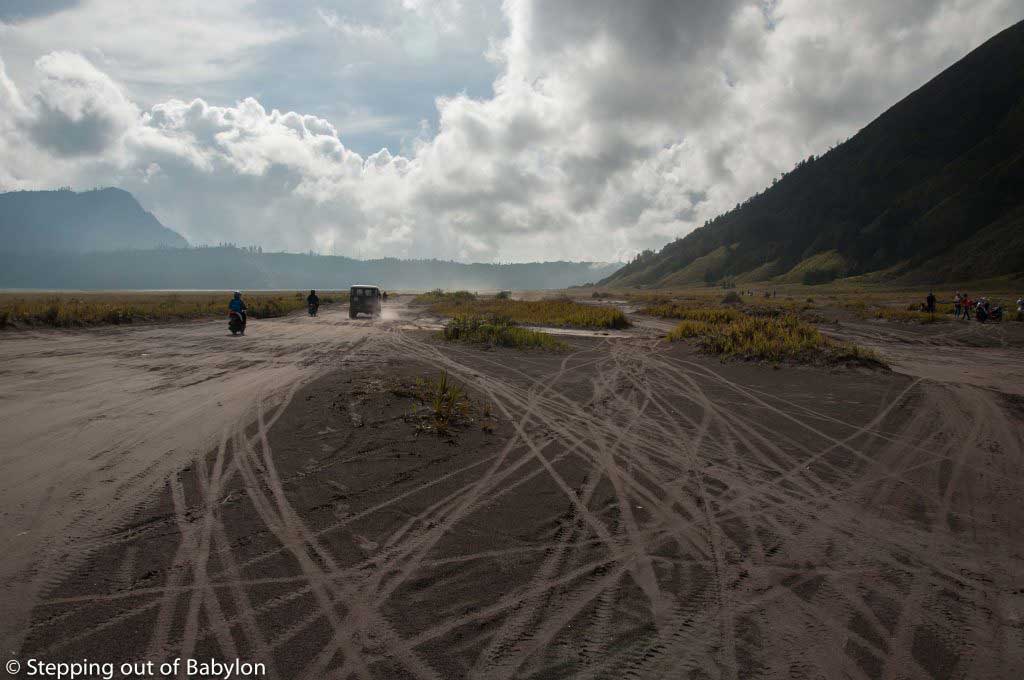
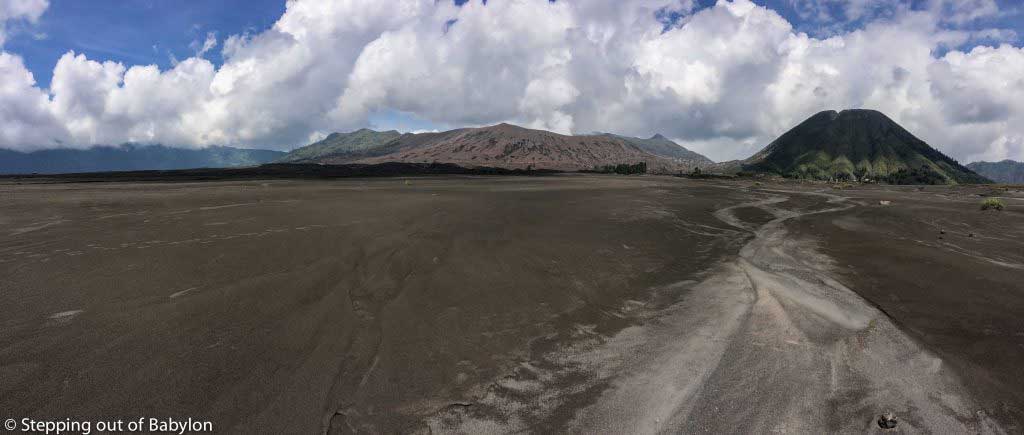
Around there’s a wide and desert plain of black volcanic sand were a few plants try to survive… walking in this emptiness brings the feeling of total freedom, no boundaries, no limits… not even a footpath to follow!!!
Bromo volcano
Bromo volcano just before the sunrise

Bromo volcano
the village of Cemoro lawang at the first light of the day, swallowed by the fog that comes from the valley

Bromo volcano
Bromo volcano

Bromo volcano
Bromo volcano

Bromo volcano
Bromo volcano

Bromo volcano
Bromo volcano

Bromo volcano
Bromo volcano

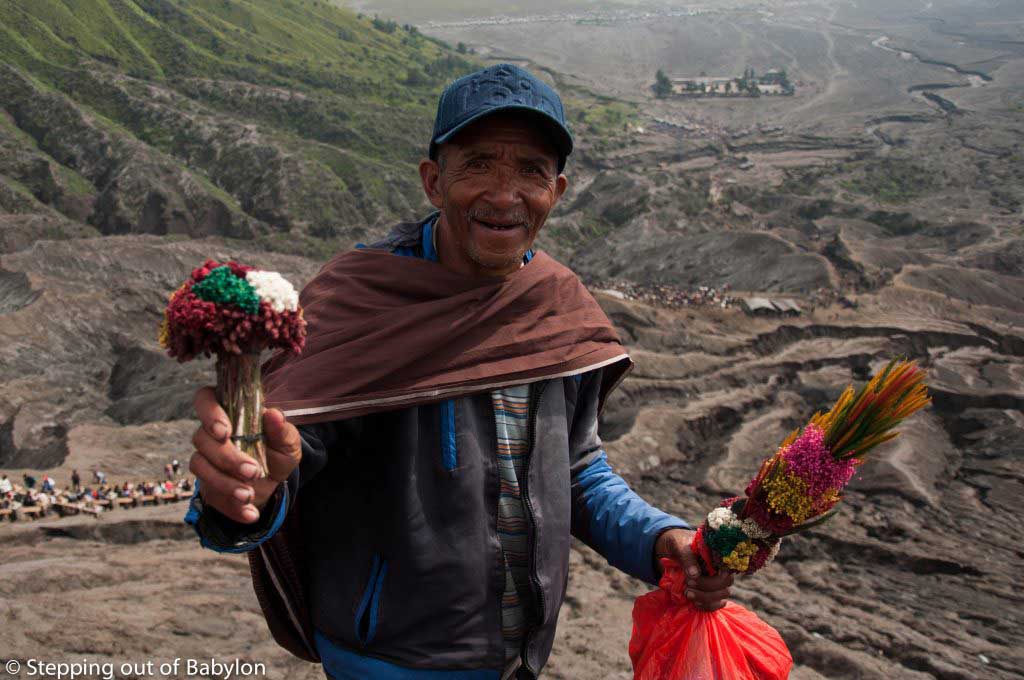
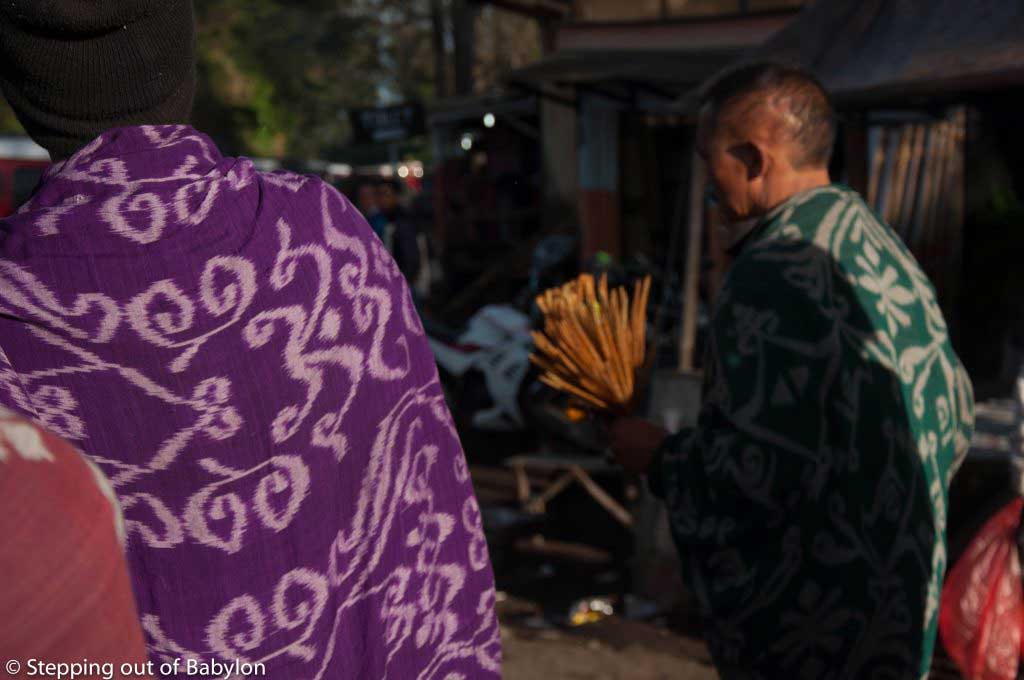
Selling flowers to trow to the Bromo crater to pacify the volcano

Bromo volcano
Bromo volcano view from the crater rim, with the Pura Luhur Poten Gunung Bromo

Bromo volcano
Bromo volcano crater where the sound that comes from the center of the crater, a mix of boiling water with the sound from an earthquake


Bromo volcano
Bromo volcano
Bromo volcano
Bromo volcano


Visit Bromo Volcano… DIY:

To visit Bromo National Park you don’t need a guide or a tour, but you need to walk a lot!!!!!… let’s say around 20 kilometers if you want to see the sun rise at the viewpoint and then go down to visit the volcano in the same day… is doable! I start at 4 a.m. and finish at 10.30 a.m. But don’t worry, ojeks (moto-taxi) are available everywhere, so if you start on foot and you feel that this hike is too hard you can get one ojek to save you some kilometers from your legs.

Jeep tours can be arranged at the guesthouses in Cemoro Lawang, but most of the people arrive here in tours from Malang and some from Probolindo (don’t recommend Probolingo as the city is famous for scams).

  • You don’t need special gear, just comfortable sneakers and warm clothes. It’s better to dress several layers that you can take off as the day warm’s up. Also, be prepared for the rain if you are visiting Bromo around April.
  • You need a ticket that cost 10.000 Rp. I couldn’t find the ticket counter and the guys also didn’t found me…
  • I start at 4 a.m. but need to walk fast to reach the summit of the hill nearby Cemoro Lawang, where you have the top view point… so is better leave the village around 3:30 a.m.
  • Walk along the road until the last viewpoint where you find some stalls (Mount Pananjakan). The road can be busy with traffic because almost everybody goes up by jeep. Most of the people stop here, on the end of the road, but you can keep walking up along a staircase. After, the path is not clear and the first part is a bit difficult, where I need the help of my hands to climb up, but after the hike get’s easier, always up in a kind of zigzag until you reach the top
  • On the top of the hill, there’s a viewpoint with a kind of cement fence. Here is an amazing spot to watch the sunrise, Bromo and the nearby hills, as you probably arrive already with some daylight.
  • After the sunrise, I could see clearly the volcano and the valley but just for a few minutes, because the fog starts to close the view. But when I was almost ready to leave, suddenly the all the fog vanish and the sunrays light the landscape. The view was perfect.
  • I weather is very unpredictable here and the conditions change quickly. In April the mornings were mostly sunny but around noon the rain starts, sometimes with thunders… other times is just a thick fog.
  • When you are done with the views of Bromo, is time to come down and walk to the crater. There are two options:
    • the shortest one is to go back to Cemoro Lawang and from there cross the plain to reach the volcano.
    • The other option is to go down along the road on the other side of the hill, a pavement road that ends in the plain area. Is a long walk, around 7.2 km but always downhill, with some parts very steep.

Anyway, at this road there are several ojeks waiting to help if you feel that is too much walk. There are several viewpoints where you can grab a coffee, instant noodle soup or some food, and have some rest.

  • Crossing the plain is the easiest part. Here you’ll also find a few basic food stalls.
  • When you arrive close to the Bromo, you’ll pass by the temple (Pura Luhur Poten Gunung Bromo) nothing special if you already have been in Bali.
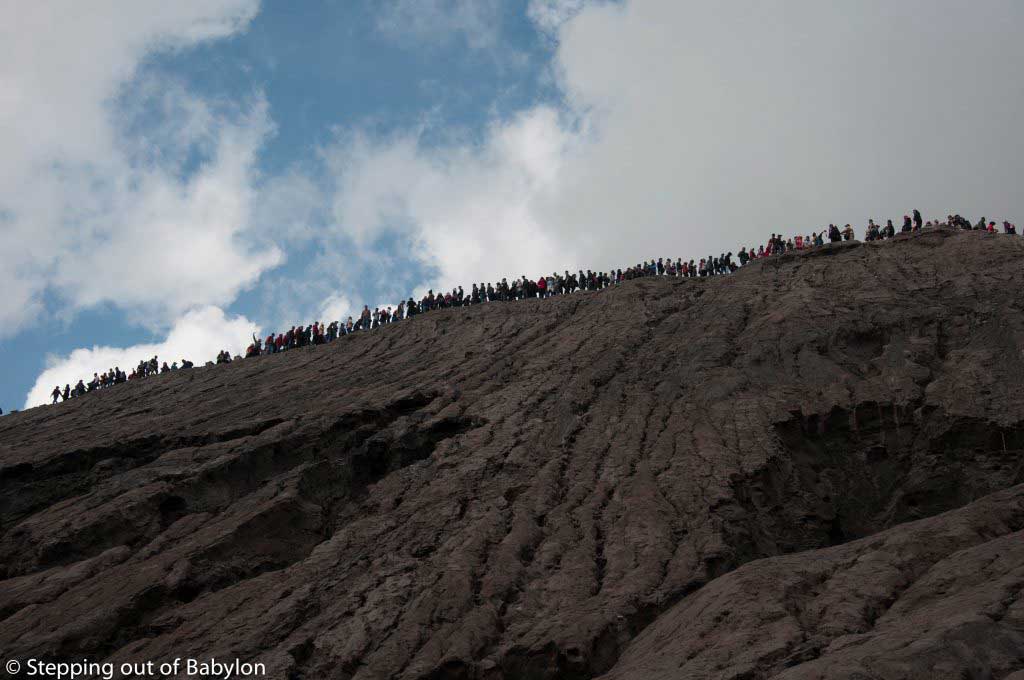
  • From here you need to climb a bit to reach the staircase to the top of the crater. There are horses to help you to reach until the stairs.
  • You can walk along the crater rim, but a certain point the path gets narrow…. didn’t walk further because I found it danger as there is no protection on the active crater side.
  • Now is time to go down… walk along the plain but now in the direction to Cemoro Lawang… is a very nice walk and you don’t even need to follow the path of the cars.
  • The last part is the worst, as you need to climb a steep road back to Cemoro Lawang… it doesn’t have more than 800 m, but look steeper for my tired legs.

So all this takes more than 6.5h, but cost you nothing and you can enjoy the view as long as you want.
Bromo volcano
Bromo volcano

Bromo volcano
Bromo volcano

ojek (moto-taxi) drivers wait for people along the way that goes from the sunrise viewpoint to the Bromo volcano

Bromo volcano
Bromo volcano

Bromo volcano
Bromo volcano

About Cemoro Lawang:

Cemoro Lawang (pronounces chemoro) could be just one more rural small village at the end of the road, but due to the proximity to the Bromo-Tengger-Semeru National Park, which entrance starts in the village, become a tourist destination, particularly for visitors that want to visit Bromo independently, without a tour.

And Cemoro Lawang doesn’t have much than a few houses, some homestays, hotel and guesthouses, a few eateries and a couple of groceries shops. Around, away from the tropical climate from the lower lands, all the fields were planted with onions and cabbages!!!

Cemoro Lawang
Cemoro Lawang… field of onions and cabbages

Where to sleep in Cemoro Lawang:

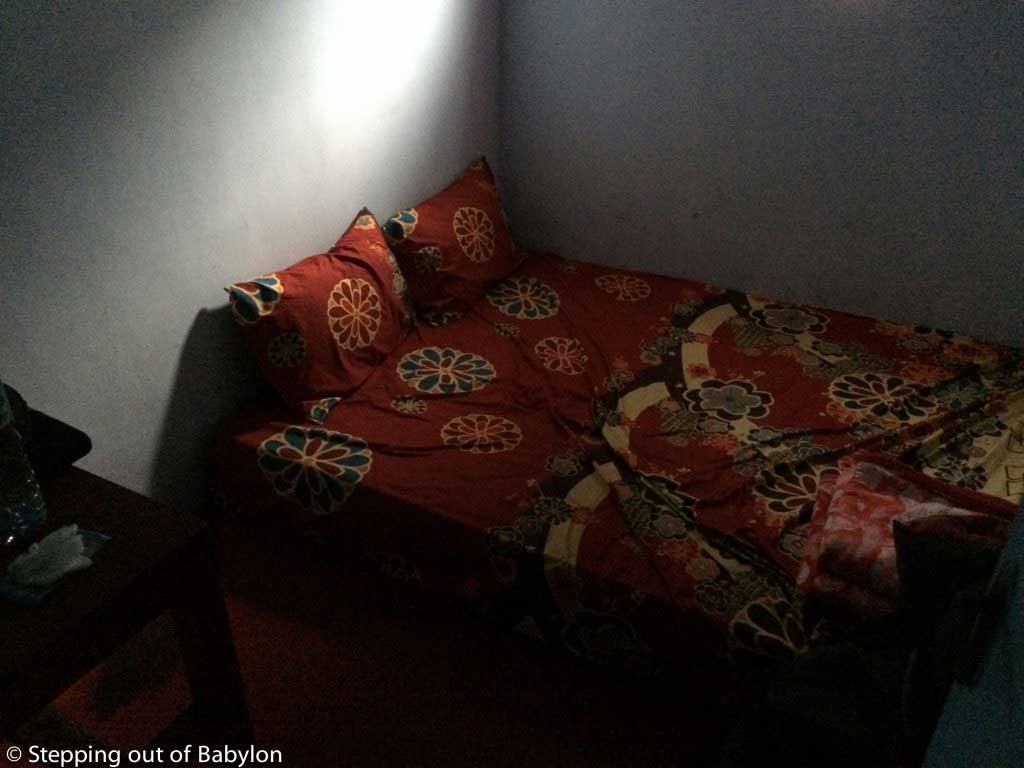
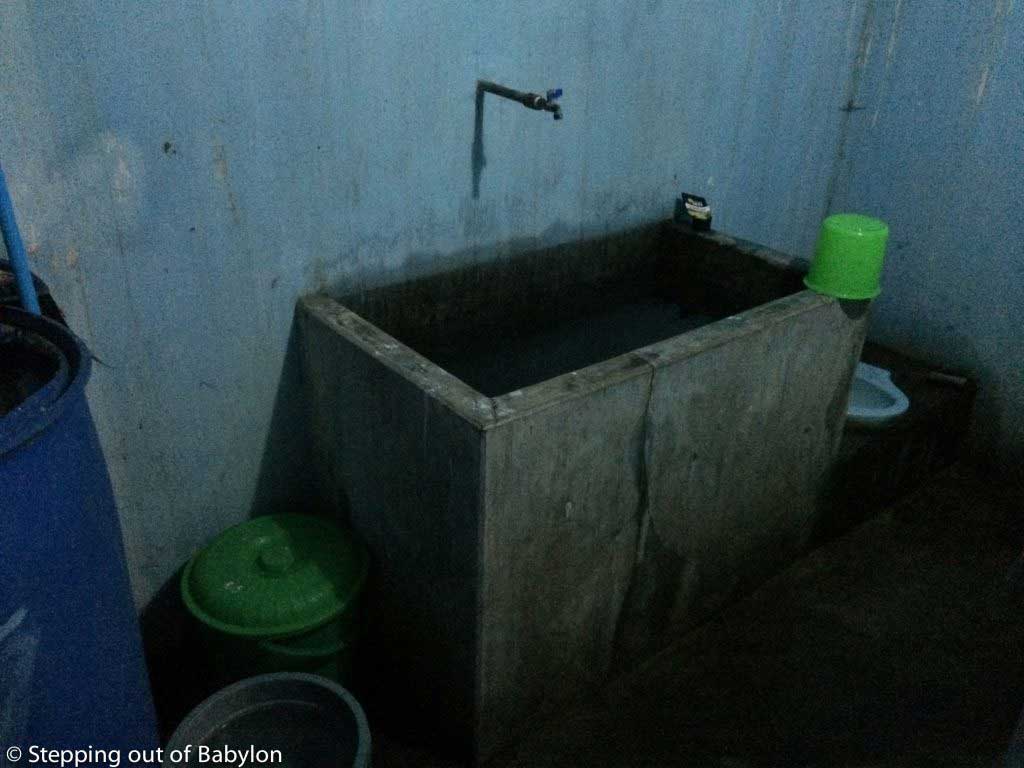
There are many guesthouses and homestays everywhere… also many people renting rooms and houses that don’t even have a sign. Just start to ask, that someone will show you a place. You can bargain the price, but the local people don’t speak much English. The conditions are basic, no hot water and no heating, but you can get a room for 75.000 Rp in one of these homestays.

For a more comfortable stay there are many options in Cemoro Lawang that cost more than 200.000 Rp.
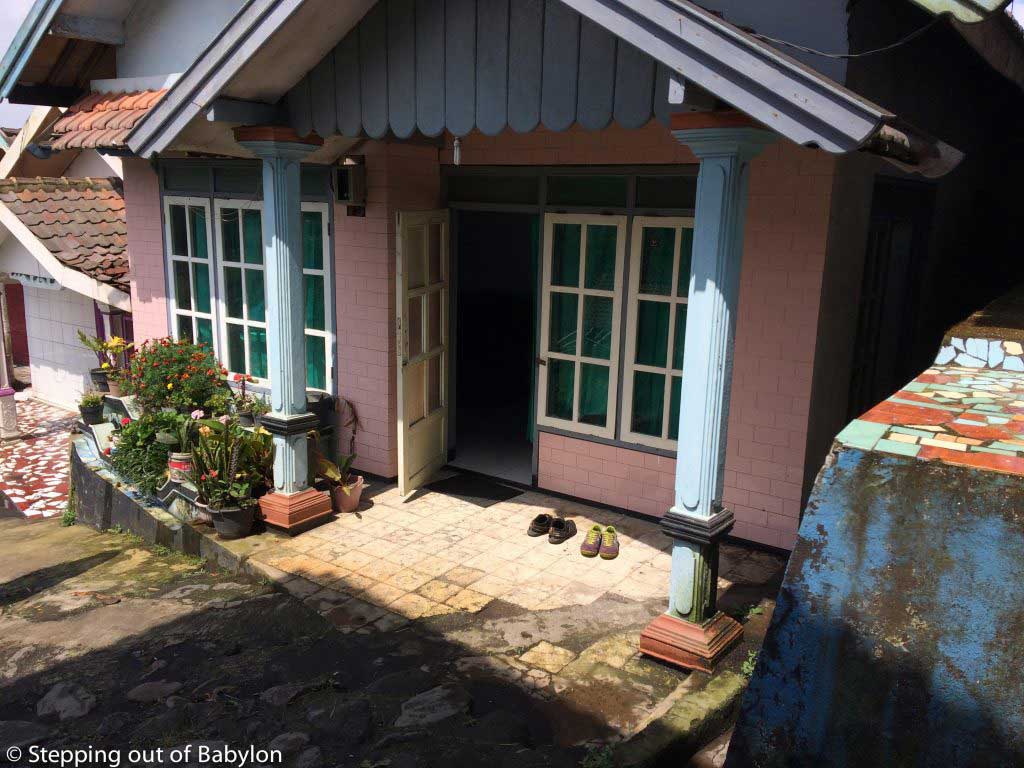
Cemoro Lawang... one of the local houses that are rented to the tourist
Cemoro Lawang… one of the local houses that are rented to the tourist

[columns] [span6]

Cemoro Lawang... one of the local houses that are rented to the tourist
Cemoro Lawang… one of the local houses that are rented to the tourist

[/span6][span6]

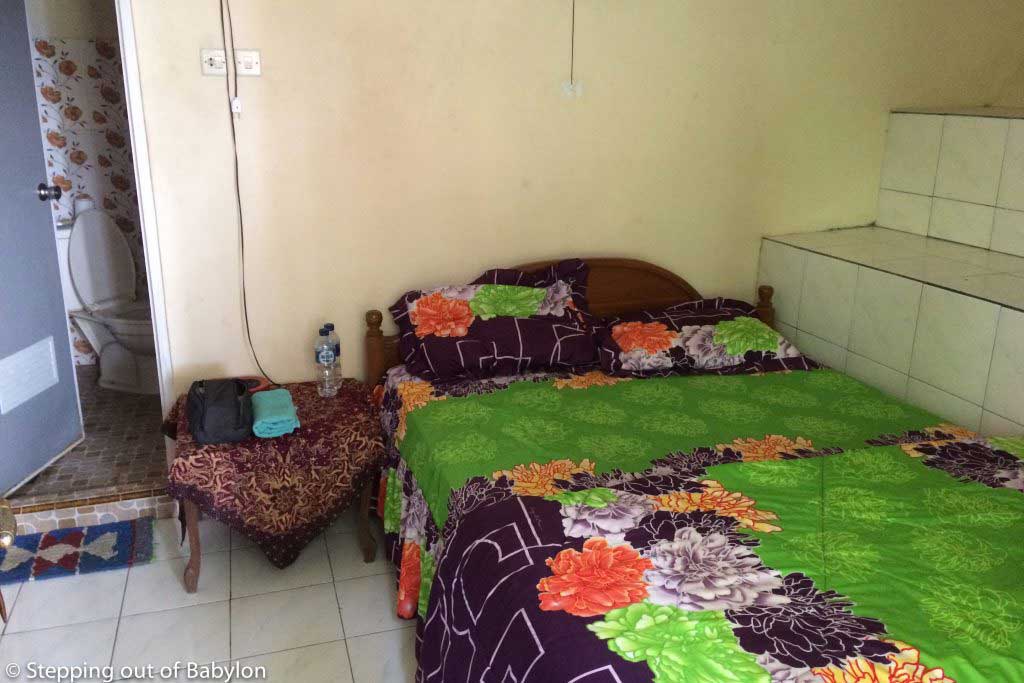
Cemoro Lawang homestay with very basic condition

[/span6][/columns]

Where to eat in Cemoro Lawang:

There are many warungs along the main road that leads to the entrance of the Bromo Park. Despite being a touristic area, the prices are quite fair and the food follows the Indonesian standards.

Nearby the place where the buses wait for passengers there’s a restaurant with tasty food… a good option while you wait for the bus to be full.

ATMs and Money exchange in Cemoro Lawang:

There aren’t ATMs in Cemoro Lawang, but on the way from Probolingo the bus will stop at an ATM, and wait for you.

How to go from Probolingo to Cemoro Lawang (Bromo Volcano)

  • If you arrive at Probolingo by train, you need to catch a bemo to the Bus Terminal Bayu Angga. If you travel by bus probably you’ll end your trip at the terminal and you just need to walk 500 m to reach the bus stop where the buses to Cemoro Lawang are waiting. Watch out: Probolingo is famous for scams!
  • In front of the Probolingo Train Station, you’ll see a yellow bemo waiting that goes to the Bus Terminal Bayu Angga. You need to wait until it get’s full and the trip costs 10.000 Rp and takes 15 minutes. Along the way, the driver stopped several times trying to push the foreigners out of the bemo, saying that is the place to catch the bus to Cemoro Lawang, but these are the private buses or private cars. The public buses (very old and in bad condition) are waiting a bit south from the Bayu Angga Terminal, in front of some warungs. The driver will spot you as everybody that arrives here go to “Bromo”. The ticket costs 35.000 Rp and you need to wait until the bus is full, that means 15 people. If after a while there are not enough people, the total cost of 525.000 Rp will be divided by the number of passengers
  • The 37 km until Cemoro Lawang are made along a bumpy road with nice views passing along rural areas. The bus drops you at the end of the road, or before if you ask, as there is not exactly a center of the village.
bemo from the train station to the Bus Terminal Bayu Angga
Place where the bus to Cemoro Lawang wait for passangers... there's nothing written but the bus helper will spot you as you arrive
Place where the bus to Cemoro Lawang wait for passangers… there’s nothing written but the bus helper will spot you as you arrive
bus from Probolingo to Cemoro Lawang


Ijen Volcano and Banyuwangi

Emptiness, desolation, silence, void… some words that are not enough to describe totally the feeling inspired by the landscape that surrounds the Ijen Volcano, which activity contributes to producing high quantities of sulphur, a mineral that is collected from the bottom of the crater by men.

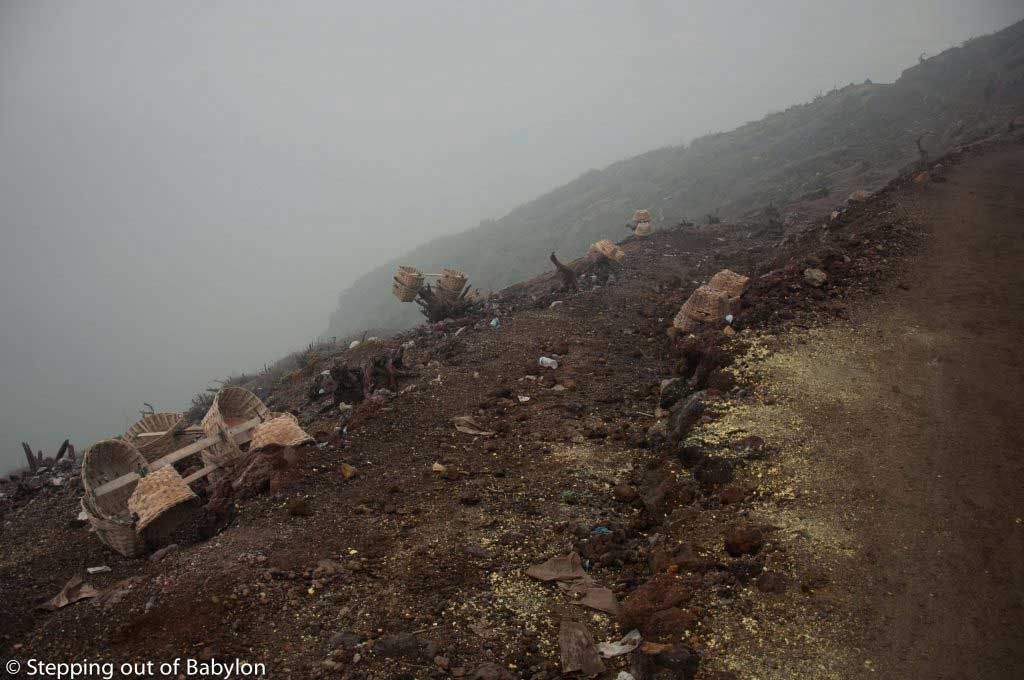
Since early morning these miners, carry baskets on their shoulder with the big blocks of sulphur, which shiny yellow color contrast with the monochrome landscape. This concentration of sulphur is also responsible for a phenomenon called the “blue fire” only visible during the night, that is the combustion of the gas released by the volcano. Due to the recent eruption (March 2017) the crater is filled with smoke and the visitors are not allowed to go down, so the “blue fire” is not really visible.

The fire is not visible but the smoke that comes out from the crater, slowly start to irritate the throat and the eyes, making the breath heavy and leaving an intoxication sensation, that increase at dawn, when the air starts warming up. It’s strong enough to force anyone to use the gas mask, making your breath an audible experience that reminds Darth Vader, where the almost desert landscape creates a hash scenario.

Workers don’t use a gas mask but I think is more an option, maybe due to the lack of awareness of the impact of sulphur in health, than by economical reasons, as the same miners hang around selling mask to the visitors. But these miners suffer from the sulphur expose that reduces their life expectancy to less than 50 years.

Kawah Ijen... the most acidic lake in the world
Kawah Ijen… the most acidic lake in the world
Kawah Ijen
Kawah Ijen
Kawah Ijen
Kawah Ijen
sulfur rocks carried by the miners
sulphur rocks carried by the miners
Ijen Volcano
Ijen Volcano

But the Ijen has much more to offer: Kawah Ijen, another crater filled with water that due to the concentration of sulphur results on the most acidic lake in the world.

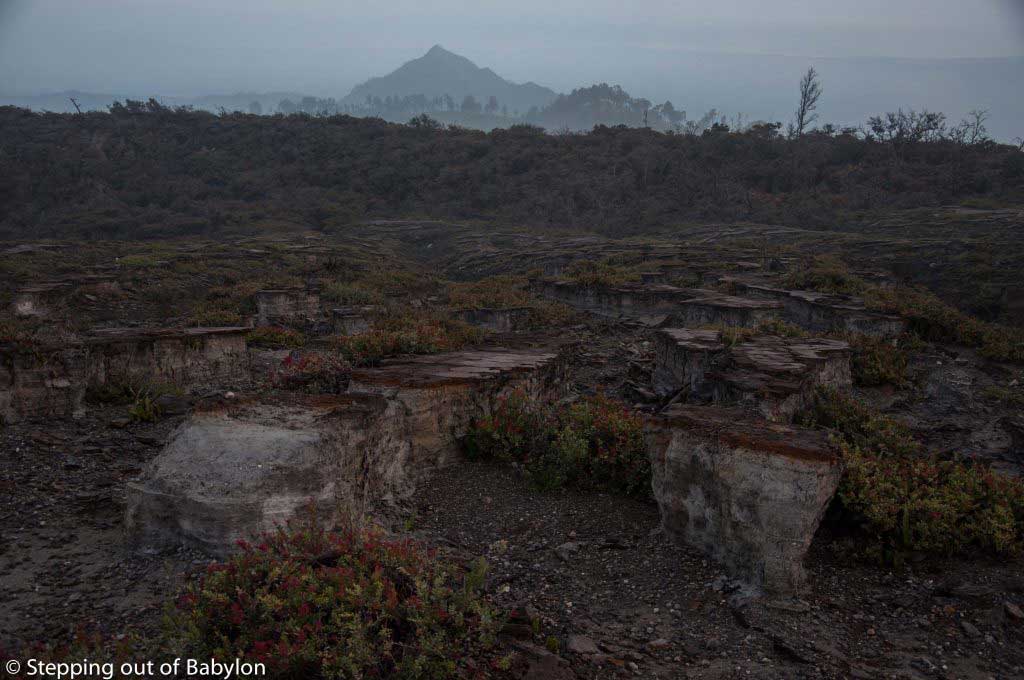
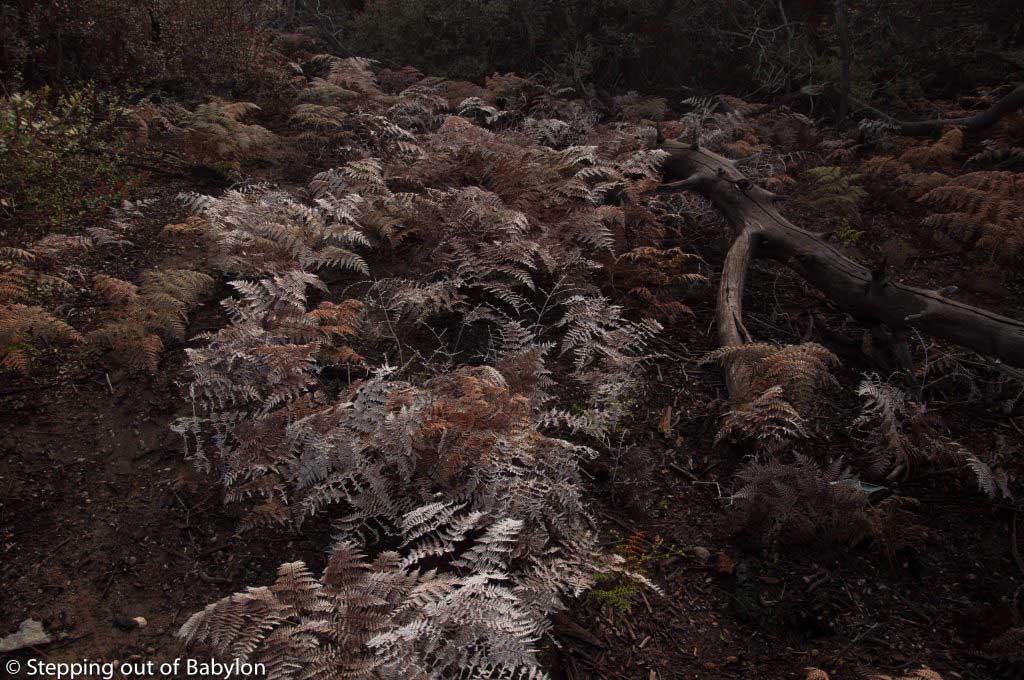
As the sun comes out behind the mountains that surround Ijen, the mist that fills the crater starts to slowly dissipate, revealing the fantastic colours of the lake, that goes from the greenish to a bluish color, with a milky appearance. Something hard to describe as everything looks unreal and illusory. And is not just the lake… as the soft first light of the day illuminates the sky, a fantastic landscape starts to show up, revealing a scarce almost all burned by the acid steam that comes from the lake, and a soil where the erosion of the acid waters brought by the rain leaves deep marks like ditches made by a gigantic claw.

The soil on the top of the Kawah Ijen also gets unusual colours with yellowish traces resulting from the acidic lake waters.

Ijen Volcano
Ijen Volcano
Ijen Volcano
Ijen Volcano
Ijen Volcano
Ijen Volcano
Ijen Volcano
Ijen Volcano
Ijen Volcano
Ijen Volcano

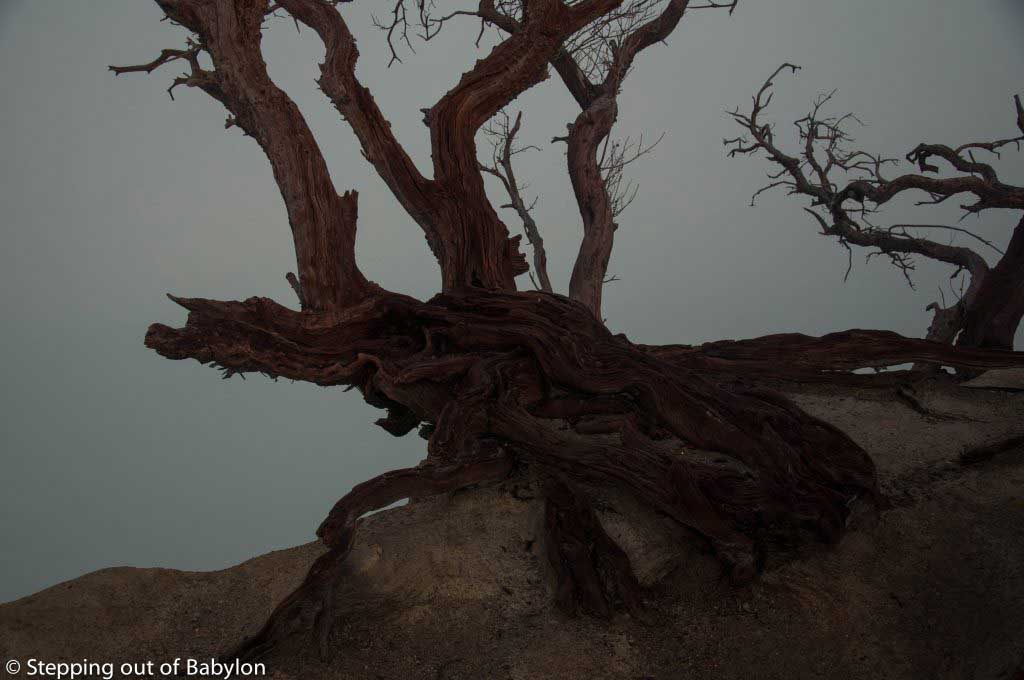
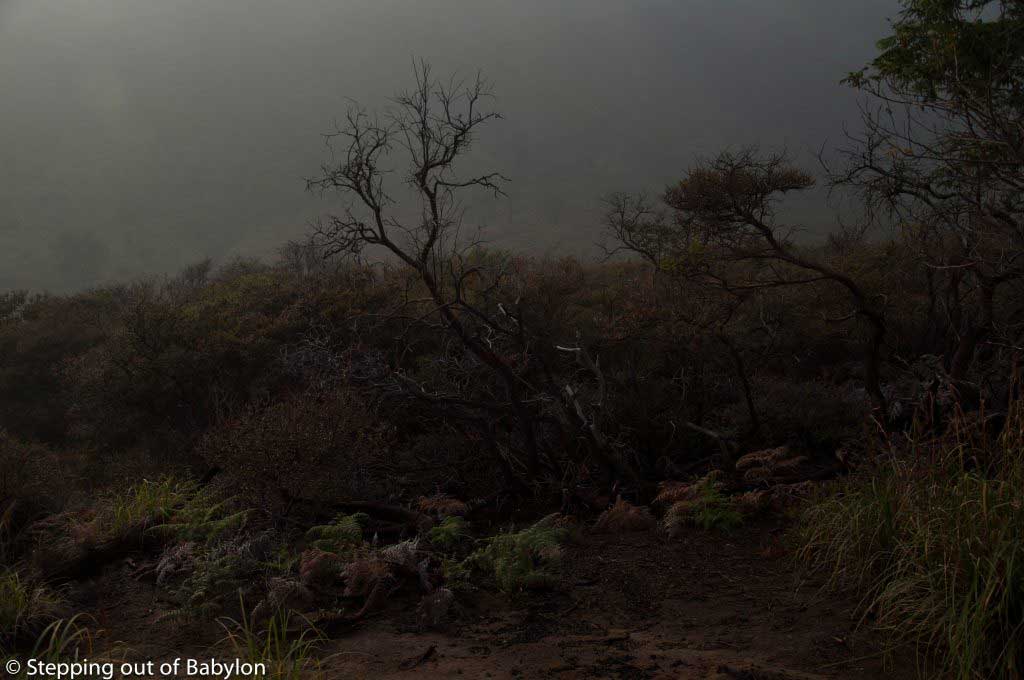
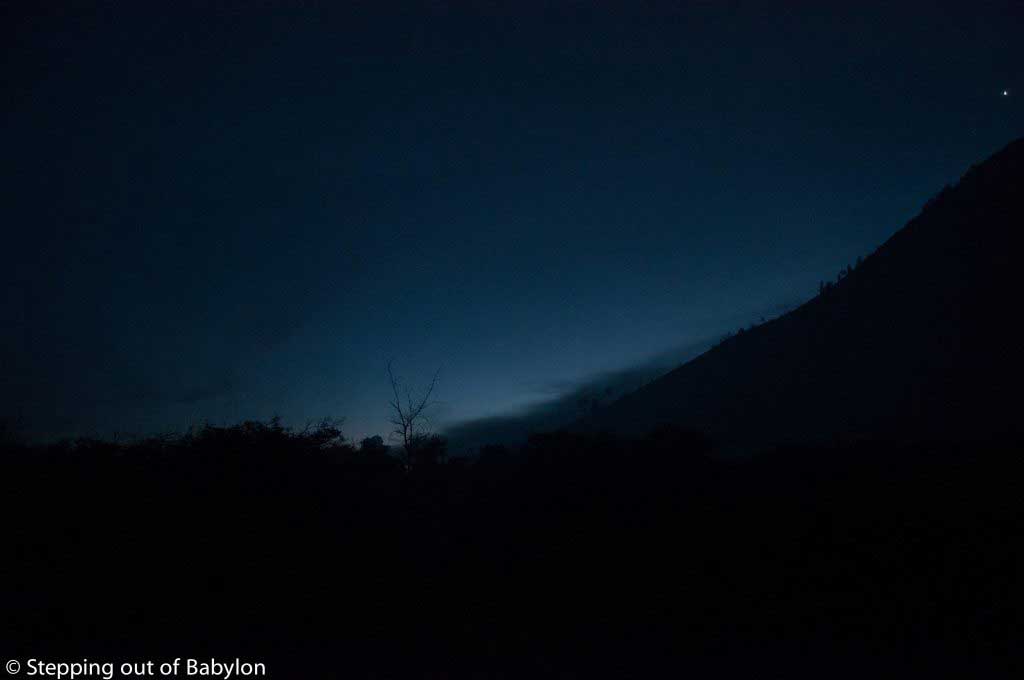
But the most remarkable moment from this visit, was the hike just before the sun rises up, where the dawn light, still dim to light the path I was walking, but strong enough to cut out the shape of trees and bushes which naked branches create phantasmagoric black figures against the dark blue sky. The absence of sounds, the immobility of the air and the fantastic landscape wrap us in a surreal reality… like a dream coming from another dimension.

the way to Kawah Ijen at dawn


How to visit Ijen Volcano:

  • You gonna need transport from Banyuwangi to Pos Paltuding the entrance of the Ijen Park: rent a motorbike or get an ojek (200.000 Rp return). If you want to see the sunrise and reach Ijen by ojek you need warm clothes as the trip is made around 2 a.m. and is really cold, even if at Banyuwangi is a warm night. If you drive a motorbike, go with plenty of time, as a few parts of the road are in bad condition… is a long way to the top made in darkness, so you must feel confident as a scooter driver. The way down is steep and a bit danger!
  • You gonna need a gas mask… really!!! It will cost 40.000 Rp at the entrance. The sulphur gas can be strong, depending on the winds, irritating the throat, lungs and eyes, making the hiking more difficult… although you just feel it nearby the crater and on the way to the lake. Around the lake, thesulphur is not significant.
  • You need to buy the entrance ticket: 100.000 Rp. At the weekends and public holidays, the ticket costs 150.000 Rp.
  • You do not need a guide!!!!! The doors open at 3:00 a.m. and everybody that arrive by a tour start hiking at the same time, so you just need to follow the crowd… and anyway the path is wide and very clear, as it used by the miners to transport the sulphur stones in hand cart. This hike takes about 90 minutes to reach the “blue fire” crater.
  • You gonna need a flashlight!!! The stretch between the blue fire crater and the Ijen Lake is not so clear and probably you’ll do it still before dawn, and at this point the tour groups will split a bit and there’s not a crowd to follow. If you don’t travel with one ask at your guesthouse.
  • Warm clothes. When you reach Pos Paltuding the temperatures are low during the night is even more on the top around the crater, maybe 10 degrees C. But with the hike quickly you’ll be sweating and need to get rid of some layers of clothes to put them on again when you reach the top. But on the top, around 8 a.m. is still very cold, and at that time my hands were almost without sensitivity.

If you choose a tour, they all stat from Banyuwangi around 1:00 a.m., moving around to pick others tourists and arriving at the Ijen park entrance (Pos Paltuding) around 2:30 a.m. There you find eateries with snacks, food and drinks… and some warm clothes.

The gates open at 3:00 a.m. with all the groups moving at the same time.

The visit usually ends around 7 or 8 a.m., depending on the guide and the speed of the group… I arrive at Banyuwangi around 9.30 h.

miners selling sulfur souvenires to the tourists
miners selling sulphur souvenires to the tourists

Due to the recent eruption (March 2017) the crater is filled with smoke and the visitors are not allowed to go down, so the “blue fire” is not really visible, and doesn’t make much sense the tours start so early (1 a.m. from Banyuwangi)…. but this information is not released by the people that are organizing or selling the tour and not even by the guides.

Note: since March 2017, after an eruption of the Ijen volcano, the way down to the crater is closed for visitors, that makes almost impossible to see the so-called “blue fire” as the smoke result from the volcano activity fills the entire crater.


Banyuwangi:

This city, at the most eastern point of Java, doesn’t offer much to see or to do and basically serves as a base point to visit the Ijen Volcano. Most of the people arrive here during the day, sleep a few hours and after visiting Ijen leave to Bali or Bromo.

Banyuwangi is also a waypoint for those traveling from Bali to Java, by ferryboat, that means from the Gilimanuk to Ketapang (Java) located a few kilometers from Banyuwangi.

I walk a bit around but couldn’t find anything that catches my attention, but the people are very friendly and smiley, making this uncharacteristic place a warm welcome to Java!

Banyuwangi
Banyuwangi
Banyuwangi
Banyuwangi
Banyuwangi
Banyuwangi

Where to sleep in Banyuwangi:

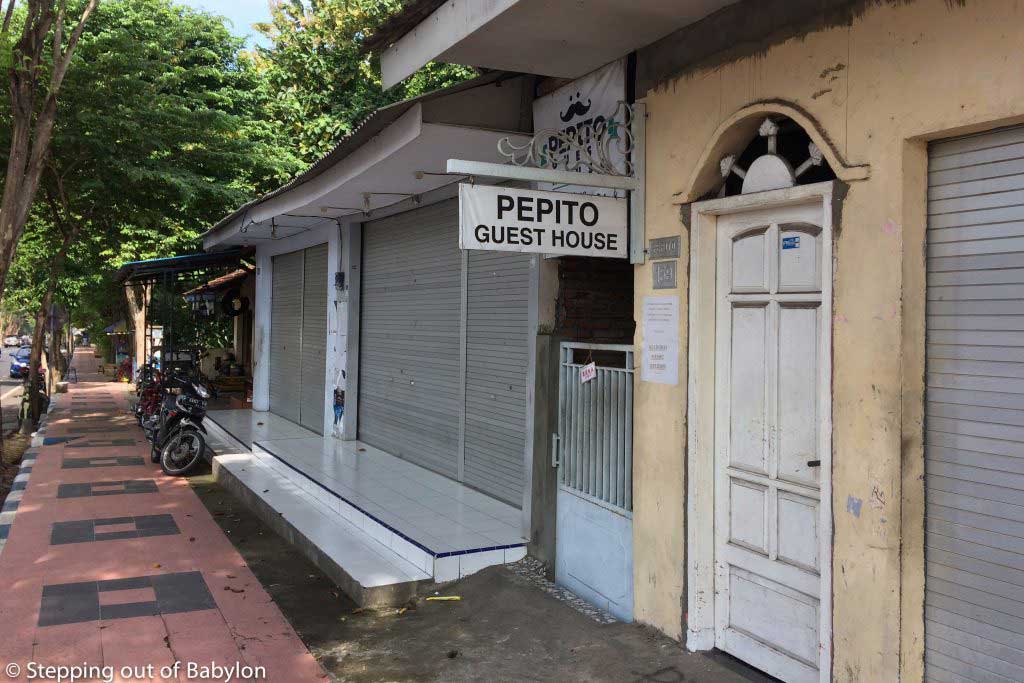
I stay at Pepito Guest House, that isn’t a remarkable place but has a good price, with a room with toilet costing 100.000 Rp, and with a delicious breakfast (Javanese style) made by the “auntie” that lives next door (maybe the best memory from Banyuwangi). Friendly staff that will help you to move by local transportation and that can also arrange a tour for a “not-so-expensive” price… 300.000 Rp, including transport, ticket and mask…. and a guide that you don’t need!

Pepito Guest house

Address: Jalan Jaksa Agung Suprapto No.159, Banyuwangi

Phone: 0813-3627-8367

Some rooms can be a bit noisy, and others without windows, so check the options available… and don’t trust much when the reservation sites say that there is “just one more room free”… if you arrive after noon probably all the rooms will be free, as most of the people just check out on the same day that visited the Ijen. You can call them if you want to book!

[columns] [span6]

Pepito Guest house. Banyuwangi

[/span6][span6]

Pepito Guest house. Banyuwangi

[/span6][/columns]

Where to eat in Banyuwangi:

Along the Jalan Jaksa Agung Suprapto, there are many eateries that sell food, the usual variation of nasi. Just next door of Pepito Guest House there is also one shop that opens after 5 p.m. selling food packed in paper cones.

A meal in one of these places costs around 10.000 Rp and is usually tasty and spicy.

ATMs and Money exchange in Banyuwangi:

I couldn’t find moneychanger at Banyuwangi.

But during my search, one helpful and friendly man drove me to the BCA Bank, at Jalan Jenderal Achmad Ysani. Usually, the banks don’t offer an attractive rate but the BCA at Banyuwangi, gave me a good deal and doesn’t charge commission. It takes more time, as you need to fill a form, show the passport and wait for your turn, but the friendly staff made all this very smooth.

Money changer at BCA bank,

How to go from Banyuwangi to Cemoro Lawang (Bromo Volcano)

  • Bemo number 8 (yellow bemos that pass by Jalan Jaksa Agung Suprato) from Banyuwangi to the Karangasem Train Station, the trip takes about 5 minutes and cost 5.000 Rp
  • Train from Karangasem to Probolindo. Is better by the ticket in advance otherwise, you probably will not find economic ticket. I got mine one hour before the train departure and only found a seat in business class (120.000 Rp). There’s one train departing from Karangasem at 9:15 a.m. that arrive at Probolingo at 13:15. Watch out: Probolingo is famous for scams!
  • In front of the Probolingo Train Station, you’ll see a yellow bemo waiting that goes to the Bus Terminal Bayu Angga. You need to wait until it get’s full and the trip costs 10.000 Rp and takes 15 minutes. Along the way, the driver stopped several times trying to push the forigners out of the bemo, saying that in that place we’ll catch the bus to Cemoro Lawang, but these are the private buses or private cars. The public buses (very old and in bad condition) are waiting a bit south from the Bayu Angga Terminal, in front of some warungs. The driver will spot you as everybody that arrives here go to “Bromo”. The ticket costs 35.000 Rp and you need to wait until the bus is full, that means 15 people. If after a while there are not enough people, the total cost of 525.000 Rp will be divided by the number of passengers
  • The 37 km until Cemoro Lawang are made along a bumpy road with nice views passing along rural areas. It takes 1.5 hours.
  • The bus drops you at the end of the road, or before if you ask, as there is not exactly a center of the village, very close from the starting point of the hiking to reach the sunrise viewpoint.

How to go from Bali to Java by ferry boat

This is an easy and short trip between islands:

  • If you start in Singaraja you need to go to the Banyuasri Terminal to Gilimanuk during the day…. more than 50.000 Rp, I think, as no one gave me precise information.
  • I was in Pemuteran and took the same bus that passes on the main road. Didn’t need to wait more than 10 minutes. The trip to Gilimanuk cost 30.000 Rp and takes around 35 minutes.
  • The bus drops you about 300 meters from the terminal, and after you just need to walk straight.
  • When you arrive at the ferry terminal, you need to find the passenger area that is in a building after the vehicle’s entrance.
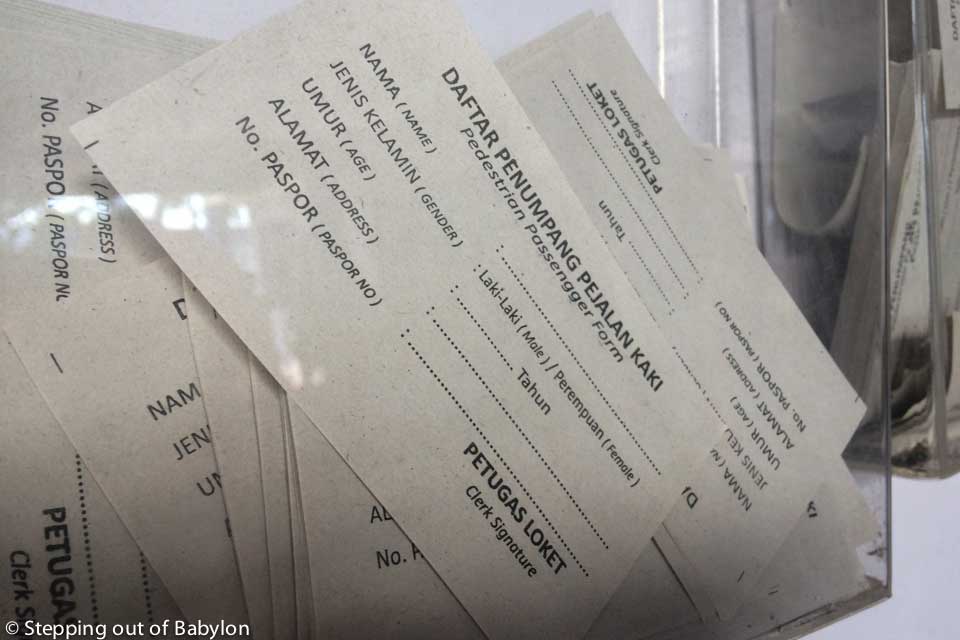
  • To buy the ticket you need to fill a form. The forms are at a board on the left side before the ticket counter.
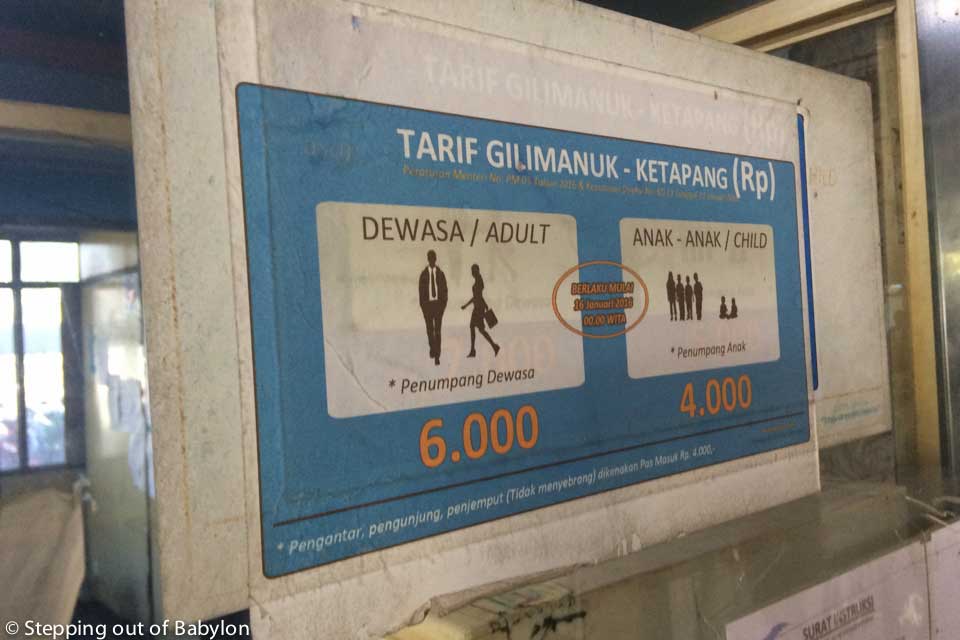
  • The ticket is 6.000 Rp, for a passenger without vehicles. If you have a motorbike or a car you need to go to another entrance.
  • There is no fixed schedule for the departure, but I just wait 15 minutes. The ferry works 24 hours a day.
  • The berry boat trip takes about 30 minutes and drops you at Ketapang, Java.
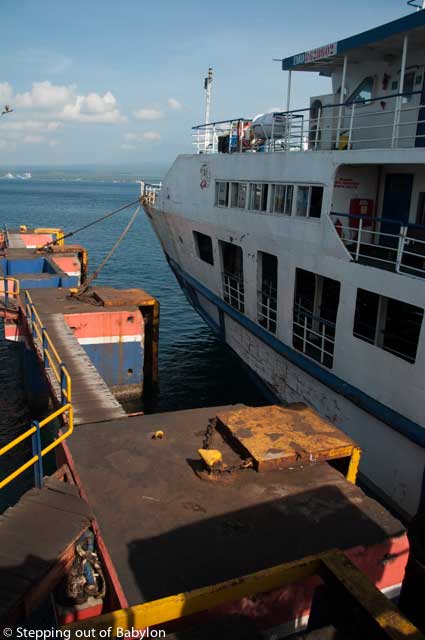
Ferry boat Bali-Java
form that needs to be fill to buy the ferry ticket
Ferry boat Bali-Java: ticket
Ferry boat Bali-Java
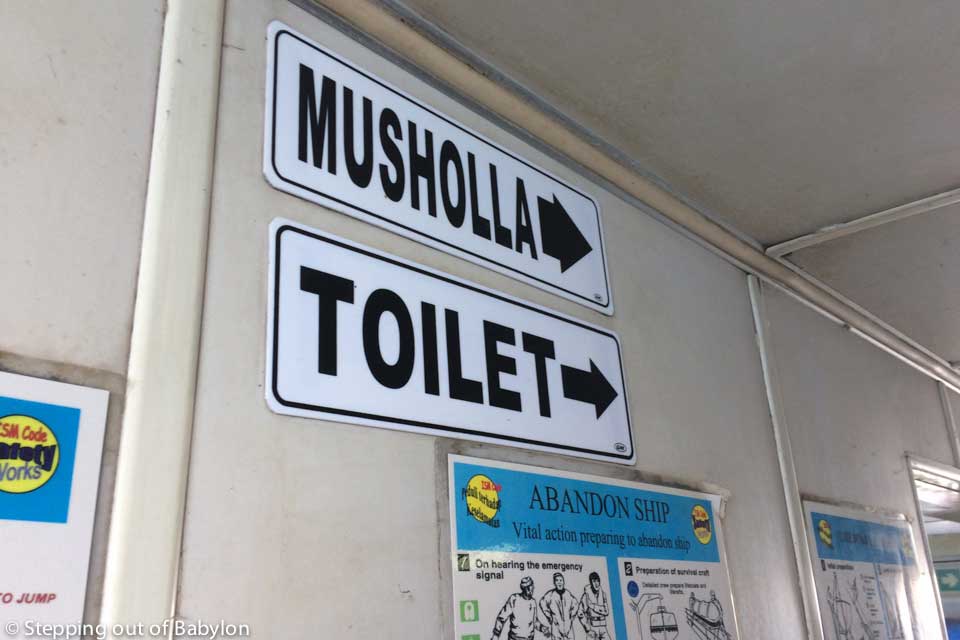
there's always a place for prayers... even inside the boat
there’s always a place for prayers… even inside the boat

How to go from Ketapanga (ferry terminal) to Banyuwangi:

If you travel by public transportation from Bali to Java you gonna arrive at Ketapang Terminal.

If your plan is to visit the Ijen Volcano you’ll probably need to spend one night at Banyuwangi. As you exit the terminal by the pedestrian exit, you’ll be surrounded by touts trying to push you to a bemo. You can deal with them a ride to the center of Banyuwangi for 10.000 Rp… and from there walk to your accommodation or get other bemo, that costs 5.000 Rp.

If you can’t get a fair price just walk away a bit, turn left on the main road and after 200 meters you’ll see the yellow bemos. From the center (there is not really a center) you can walk to your hotel or guesthouse of get an ojek.

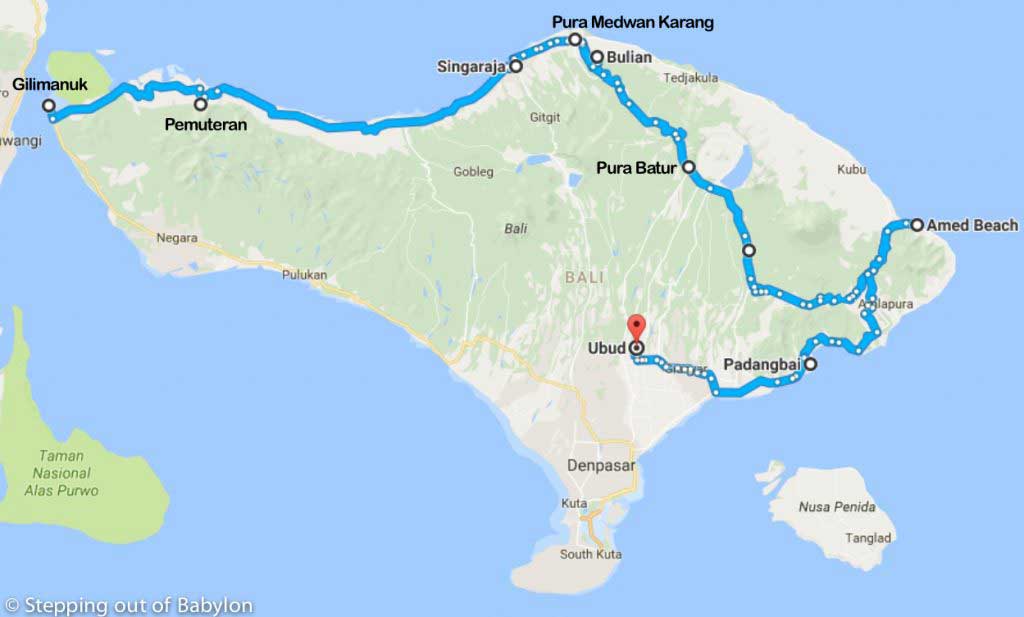
14 days in Bali: itinerary & costs

Itinerary:

  • Ubud: 6 days

(14 days break to visit Lombok, leaving and return to Bali by Padangbai, using public ferry)

  • Amed: 3 days
  • Batur and Pura Ulun Danu Batur: 1 day
  • Bulian (Singaraja): 2 days
  • Pemuteran: 2 days
  • Gilimanuk (ferry from Bali to Java)

Costs:

15 €/day

… considering traveling solo, eating just local food, no a/c rooms, sometimes dorms, travel by public transport as far as possible, no alcohol and no soft drinks, making my own laundry and walking a lot on foot… Shopping and souvenirs are also not included, as well health expenses and communications (SIM card, mobile, telephone, internet…).


Costs in Bali:

  • room (fan): minimum 100.000 Rp up to 150.000 Rp (one person); sometimes dorms.
  • meal: less than 20.000 Rp (local food, street-food, vegetarian meals, the breakfast is almost always included)
  • rent a scooter: 50.000 Rp/day or 60.000 Rp/day
  • a liter of petrol: 10.000 Rp (at the pump station is 8.000 Rp/l)
  • snorkeling: 50.000 Rp/day (just gear)
  • bemos: around 1.000 Rp per kilometer
  • ojek: 10 km cost around 15.000 Rp (but the price of the ojek depends on your bargain skills and the needs of the driver, weather, time of the day…)… but once I need to pay 50.000 Rp for a 15 km ride!!!
  • As Bali, was the beginning of my trip, and I didn’t know yet how to move around, I took some tourist shuttle bus as also taxis, which increase the cost of transport.

Note: this trip was made in March/April 2017, which still is considered the low season, when the prices of the accommodation could be bargain.


Bali. costs. itenirery
Bali. costs. itinerary

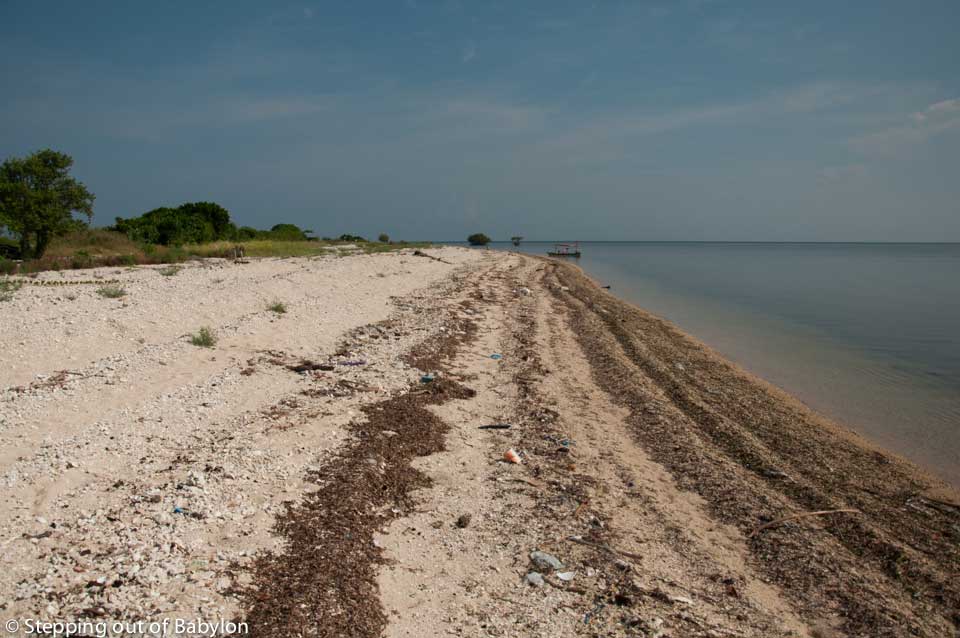
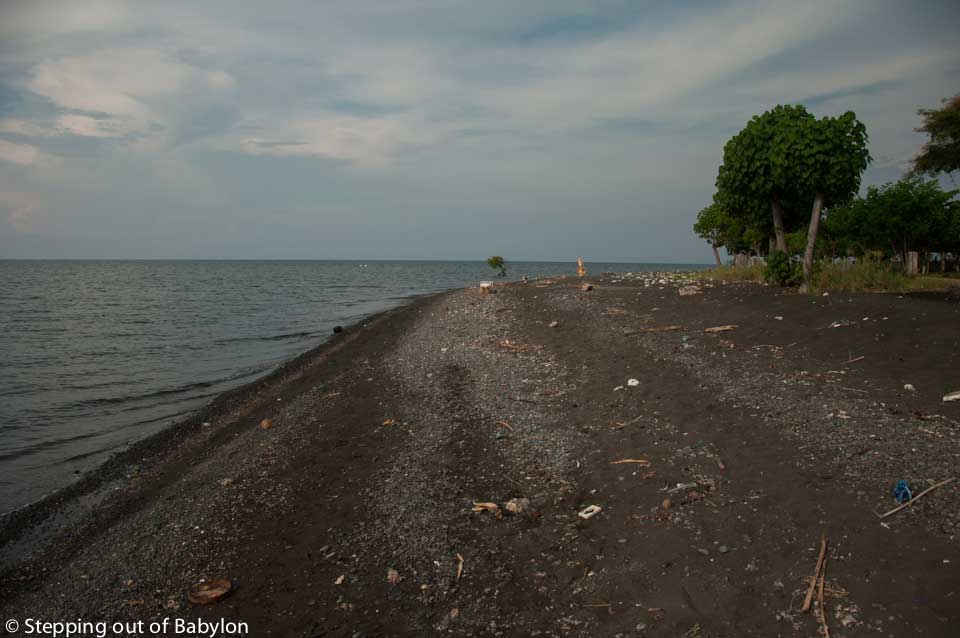
Pemuteran… white sand vs black sand beaches

Permuteran, as most of the beaches on the north coast of Bali, has black sand… a soft back sand reminding the volcanic origins of the island, where the mountains that frame the area are a strong evidence. But… there’s a small area where the sand is white! The whiteness of the coral reef located a few kilometers west from Permuteran, before the Taman Bali Barat Park.

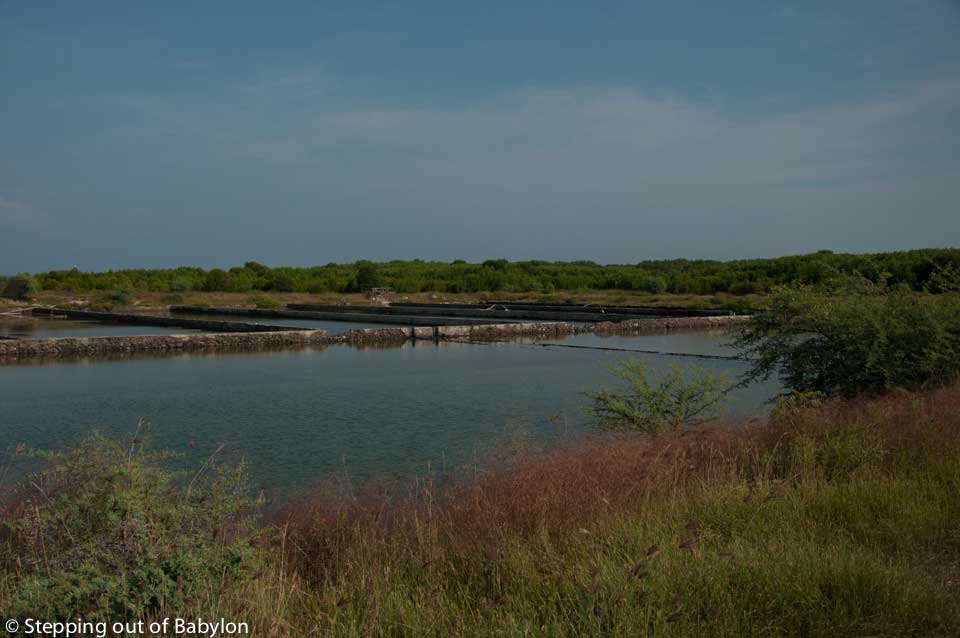
This area creates a kind of peninsula with the north coast dominated by the mangroves, where you can get a nice view of the mountains but no protection from the sun. But to reach this white sand you need to cross a wide fishery area, that creates a kind of labyrinthic network of roads, able to mistake anyone.

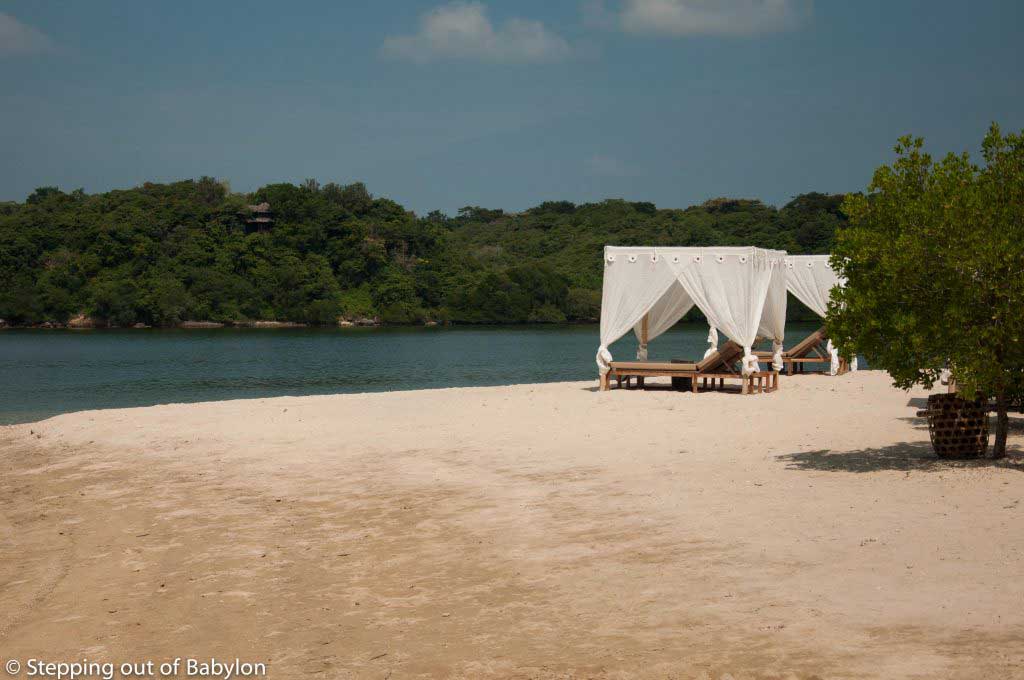
But hidden in this area, there is a small bay with the perfect conditions to swim, the Banyuwedang Bay… transparent and still water, shade, lots of nature around, in an almost empty white sand… a contrast with the busy and dark beaches nearby Pemuteran village, located only eleven kilometers away!!!

DSC_4933_Pemuteran beach
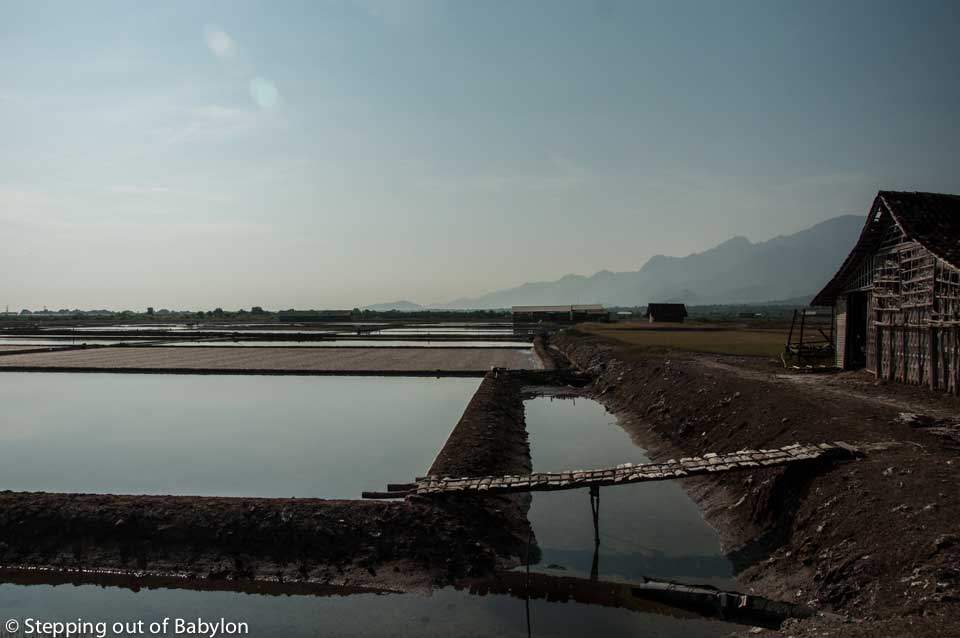
Pemuteran beach… were the finishing area is slowly taking over by resorts close to the sea line

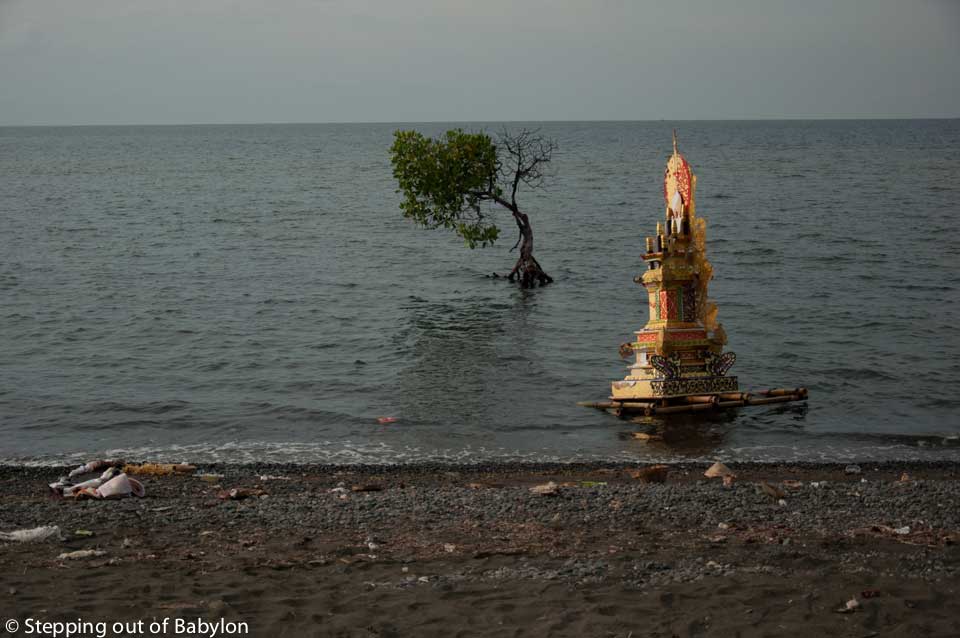
DSC_4929_Pemuteran beachPemuteran beach… nearby the fishing village there is some garbage on the beach… and some traces of a religious ceremony

DSC_4936_Pemuteran beach
Pemuteran beach

DSC_4894_Pemuteranfisheries on the way to Mangrove beach

DSC_4895_Pemuteran
on the way to the Mangrove beach were many men work on the fisheries

DSC_4876_Pemuteran
fisheries on the way to Mangrove beach

DSC_4866_Pemuteran
fisheries on the way to Mangrove beach

Banyuwedang Bay... white sand and nature... just this almost empty resort breaks the perfection of the place
Banyuwedang Bay… white sand and nature… just this almost empty resort breaks the perfection of the place

Banyuwedang Bay surrounded by nature this strip of white sand is perfect compared with the beaches around Pemuteran, that is not more than 11 kilometers distante


Where to sleep in Pemuteran:

Many options for many budgets but don’t expect to find anything less that 100.000 Rp. According to information from a guesthouse owner, the dorms are not allowed anymore in Pemuteran, as result of the pressure of some owners

If you are looking for a budget option you need to search on the land side of the road, as the coat line accommodation are all above 200.000 Rp. There are a few accommodations before the “gate” that marks the beginning of Pemuteran, but if are not planning to rent a scooter, maybe this area is a bit far from restaurants.

I found in a nice place in one of the small alleys that you find on the left side of the road Singaraja-Gilimanuk

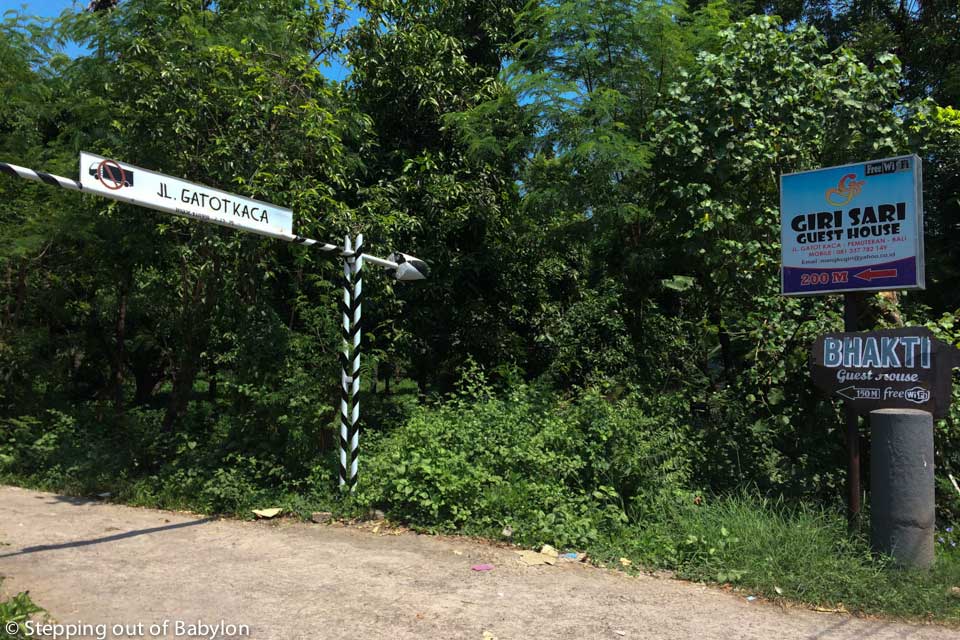
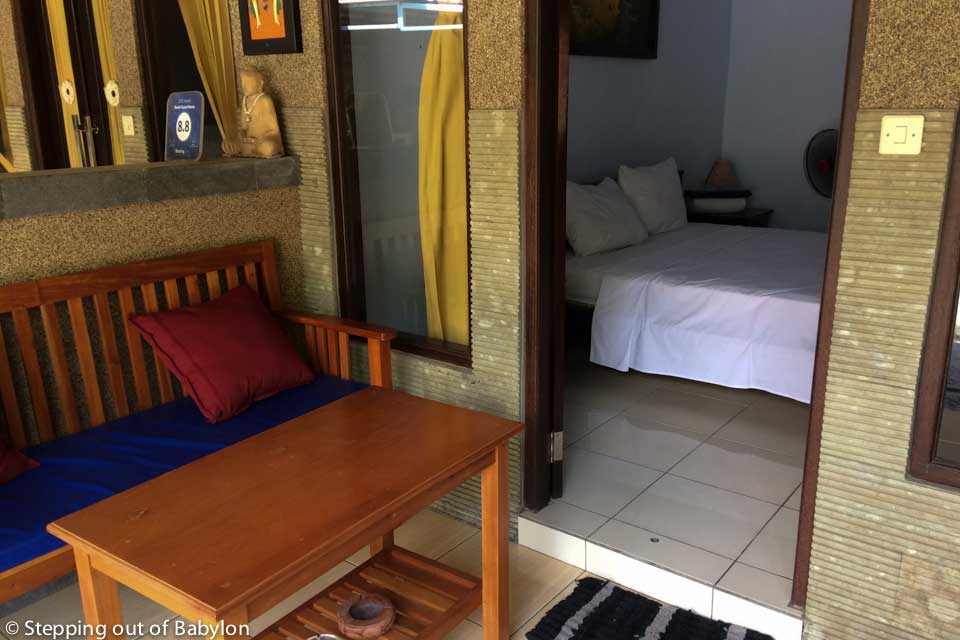
  • Bhakti Guest House. A quiet and very clean place, only with two rooms… so if you are looking for social life this is not your place! The family is not very talkative but is nice and available to help. The breakfast is the usual banana pancake but is served in a very generous portion with fruit and coffee. A room cost 150.000 Rp but could get it for 000 Rp, with the fact that if I had booked by a reservation website he would receive less money as these companies charge a commission of 15%.

[columns] [span6]

Bhakti Guest House. Permuteran

[/span6][span6]

Bhakti Guest House. Permuteran

[/span6][/columns]

Bhakti Guest House. Permuteran

Where to eat in Pemuteran:

Along the road, there are many restaurants, from the more fancy ones to the local warungs, where you can find a nasi campur from 10.000 Rp to 20.000 Rp.

One small stall stands up, that at the first look doesn’t have anything to offer but where I found a delicious gado-gado, made by a super friendly couple, that costs 7.000 Rp!!! … difficult to explain the place as there is no name, but is located on the opposite side of the road of the T junction that goes to Doubleyou Homestay.

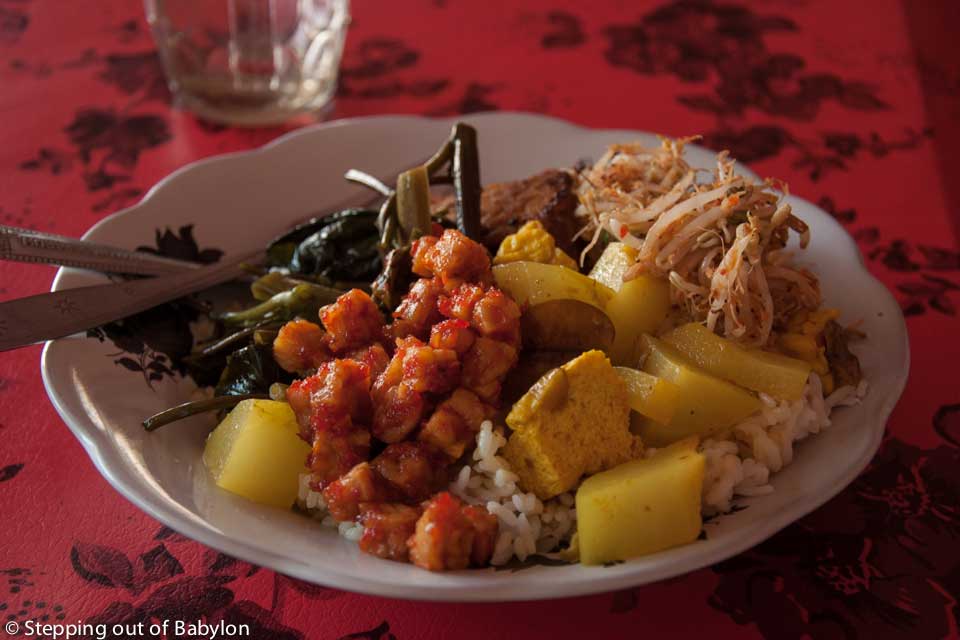
gado-gado.. a classic from the Indonesia gastronomy, basically a salad with compressed rice, vegetables and peanut sauce

How to move around in Pemuteran:

On foot ,you can reach restaurants and groceries shops but cannot go much further that the main beach nearby the Pondok Sari Resort, but is very busy and not that clean…. everywhere else you need a scooter. A scooter costs 60.000 Rp to 70.000 Rp a day. I rent mine at Bhakti Guest House.

There are also many buses running along the main road, as also a few bemos.

to reach the Banyuwedang Bay just follow the signs to the resort White Sandy Beach Menjangan

Best beaches in Pemuteran:

  • At Banyuwedang Bay, you find an almost empty beach with white sand, surrounded by vegetation and with nice views of the hills. The water is very quiet and transparent and with shade from the trees. The reference point to reach Banyuwedang Bay beach is the “White Sandy Beach Menjangan”. The last part of the road is very bumpy but doable by scooter.
  • Mangrove beach: close by Banyuwedang Bay, this beach is peaty tricky to find, because you need to cross a big area of fisheries that create a kind of labyrinth. The place is empty but no shade.
  • If you don’t have your own transport, you can find a clean area to swim in front of Matahari resort.
Banyuwedang Bay
Banyuwedang Bay
Mangrove beach
Mangrove beach
Penuteran Beach nearby Matahari Resort

ATMs and Money exchange in Pemuteran:

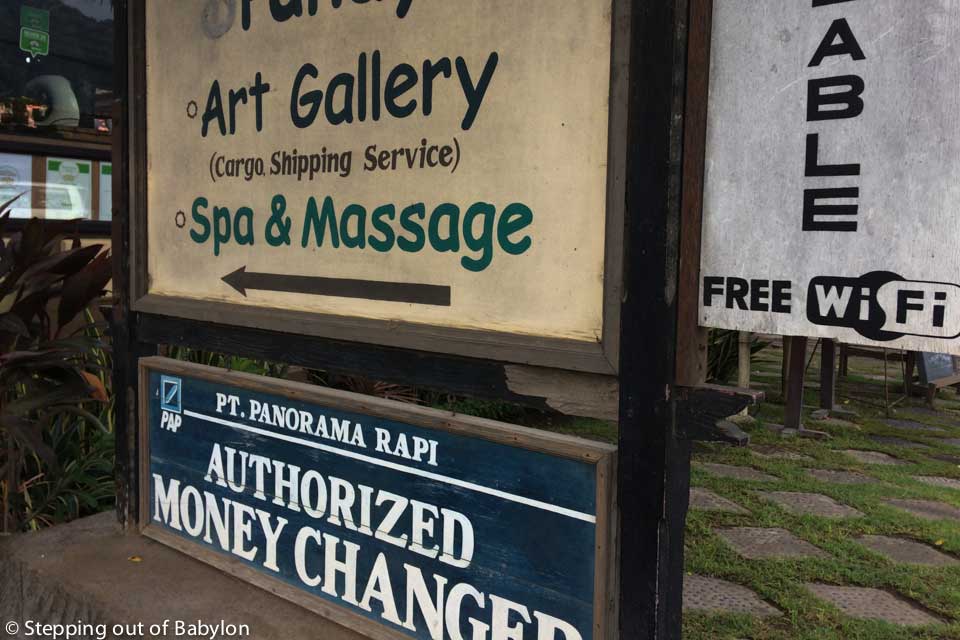
There’s a moneychanger at the Taruna Homestay. No commission and a better rate than the banks…. but not so good as in other places in Bali.

There are several ATMs along the road that cross Pemuteran.

Many changer at Pemuteran

How to go from Singaraja to Pemuteran:

  • At Singaraja, you need to go to the Banyuasri Terminal. From there departure regular services on the way to Gilimanuk that stop in Pemuteran.
  • The trip takes 2 hours and costs 50.000 Rp.
  • Doesn’t exist a “center” in Pemuteran or a bus terminal, so just ask the driver to drop you nearby your accommodation… the cheapest accommodation are located at the entrance of Pemuteran, nearby the gate, and on the left side of the road.


How to go from Bali to Java by public ferry:

How to go from Pemuteran to Gilimanuk:

Just walk from your guesthouse, hotel or homestay to the main road that crosses Pemuteran, and wait for the bus, a dark red van.

The trip takes 35 minutes and costs 30.000 Rp.

The bus will drop you at 300 meters from the ferry terminal.

The way to Gilimanuk is very beautiful, as you leave Pemuteran and reach a more natural area where the West Bali Natural Park is located.


Singaraja and the hidden Bulian Homestay

From the visit to Singaraja, the second biggest city of Bali didn’t remain a significant memory. The center is not impressive but the streets around the market, the Pasar Anyar, deserve a walk to see the local lifestyle, being an opportunity to buy a traditional Balinese sarong made with batik technic or the ikat, where the patterns result from dyeing the yarns before weaving the fabric.

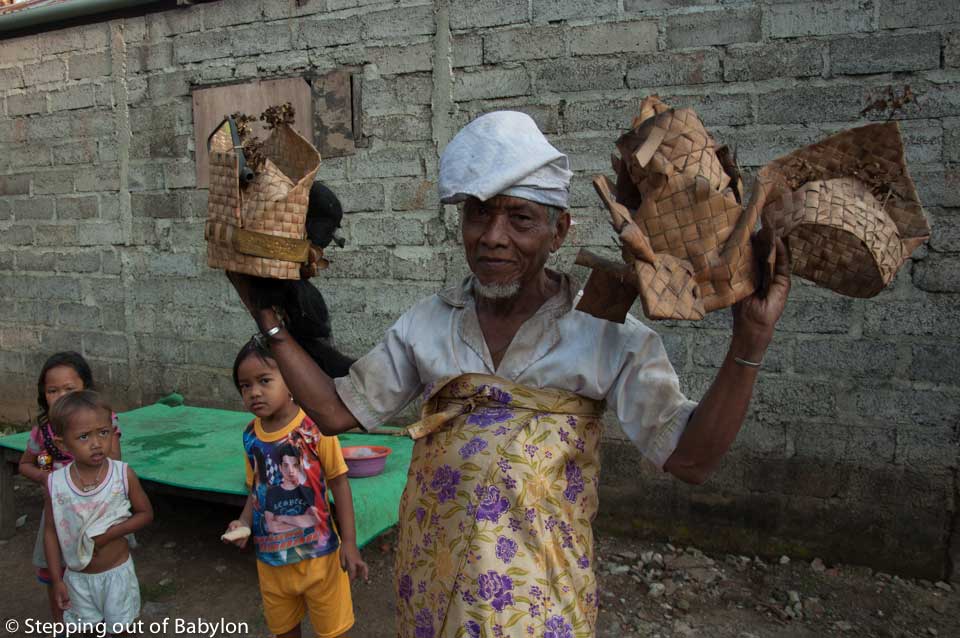
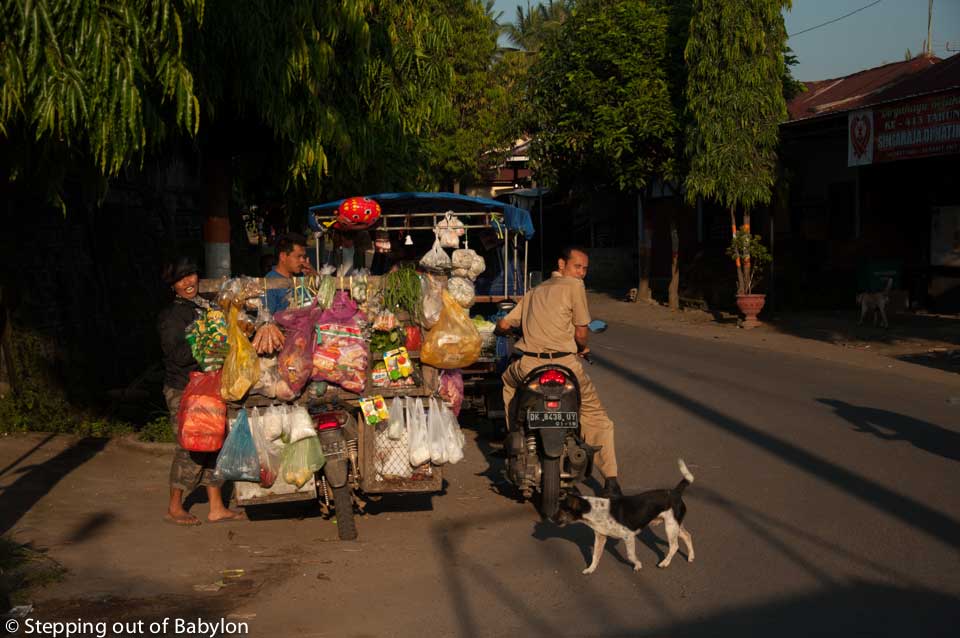
But the very small village of Bulian, that is more like a few houses gathering along a road, where people live at the slow pace of the rural life, but where everybody welcome me with a warm “hallo”, a happy smile, and with the will help me all the time… showing me where to find food on a Sunday, giving me a ride in a truck or motorbike to make the six kilometers to the main road, and pose for a photo in an special costume.

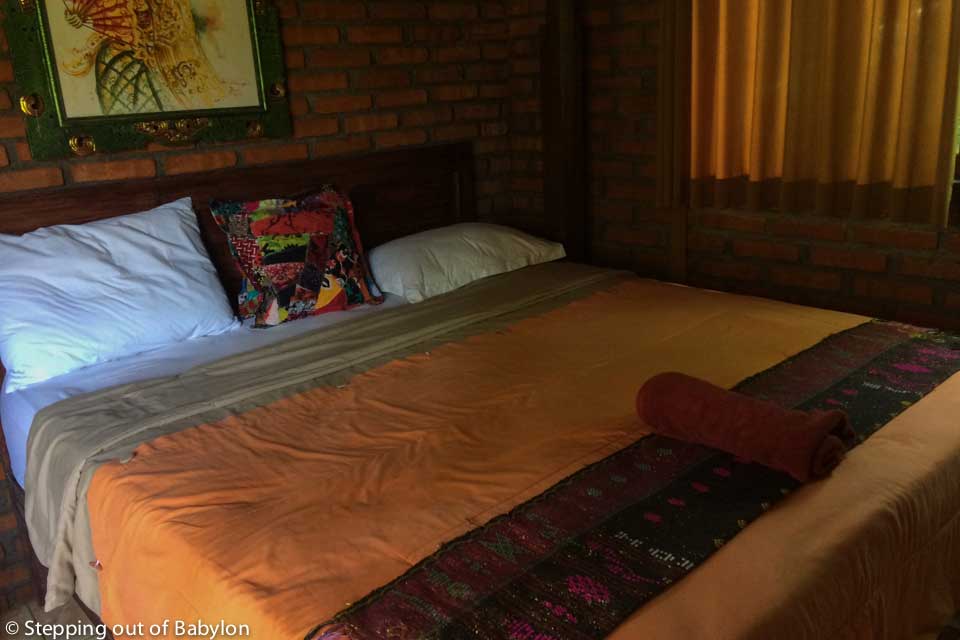
But Bulian hid also a precious place, a lovely homestay surrounded by a forest of trees and bamboos, where the room faces a beautiful garden where the water run all the time to a pool, creating the perfect soundtrack. Cats, dogs and a friendly family complete the scenery, which makes me stay here longer than I planned.

Nearby, on the busy main road that runs from east to west along the north coast of Bali, and at 6 km from Bulian, is the Pura Meduwe Karang, a lovely temple, with interesting stone carving and statues that don’t receive many visitors but worth a visit if you pass by.

Pura Medwan Karang. Singaraj. Bali

Bulian village. Singaraja, Bali
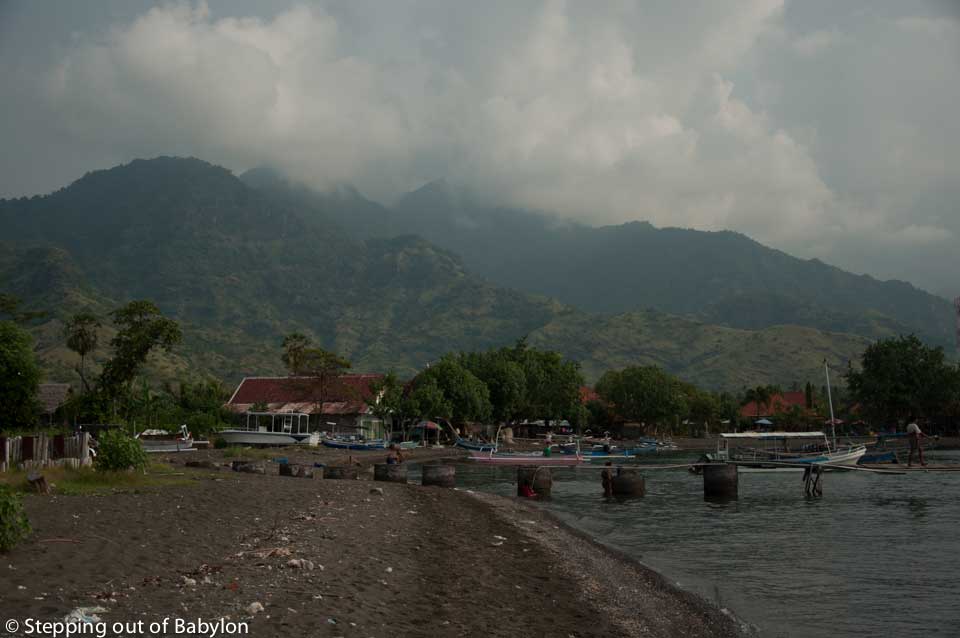
Pasar Anyar, Sinagaraja

Where to sleep in Singaraja:

Apparently, no one stays in the city of Singaraja, as the Lovina beach is very close by and attracts all the tourists. I was tired of the tourist trap of Batur and was looking for a less popular place than Lovina, and also didn’t what to end up in a lack of atmosphere hotel in Singaraja… what shows up in the map was Yeh Sanih, but there all the accommodation were too expensive.

So, by chance (or fate) I found a homestay about 18 km from Singaraja, away from the beach resorts, located in a small-small village called Bulian… what a paradise here, at Bulian Homestay! Really a home stay, a kind of a treat after the bad experience at Batur.

The Bulian Homestay has 4 rooms, different styles. The cheaper one (standard) has a fan and shared toilet, on an open-air bathroom (200.000 Rp but got it for 150.000 Rp without breakfast). They’re a lovely garden. Forest, trees and bamboos are all around and the music of the water coming from a fountain fills the air. The decoration shows a good taste and the place has a kind of relax atmosphere, perfect to chill away from everything.

The only inconvenient is the distance to the main road (6 km), from where you can get a bemo or bus to Singaraja. There is no public transport to Bulian, so the only option is to hitchhike from a motorbike or a truck, and give 10.000 Rp as a donation. You can hire a motorbike at Bulian Homestay, for 70.000 Rp. A car with driver and laundry are also available, but expensive.

There are also meals available at Bulian Homestay, but nearby, 500 meters down the road is possible to find some stalls along the road during the morning serving nasi campur for take-away that costs 10.000 Rp. There are also a couple of small eateries and groceries with basic stuff and some fruit and vegetables stalls.

[columns] [span6]

Bulian Homestay. Bilian, Singaraja, Bali

[/span6][span6]

Bulian Homestay. Bilian, Singaraja, Bali

[/span6][/columns]

Bulian Homestay contacts. Bilian, Singaraja, Bali

Where to eat in Singaraja:

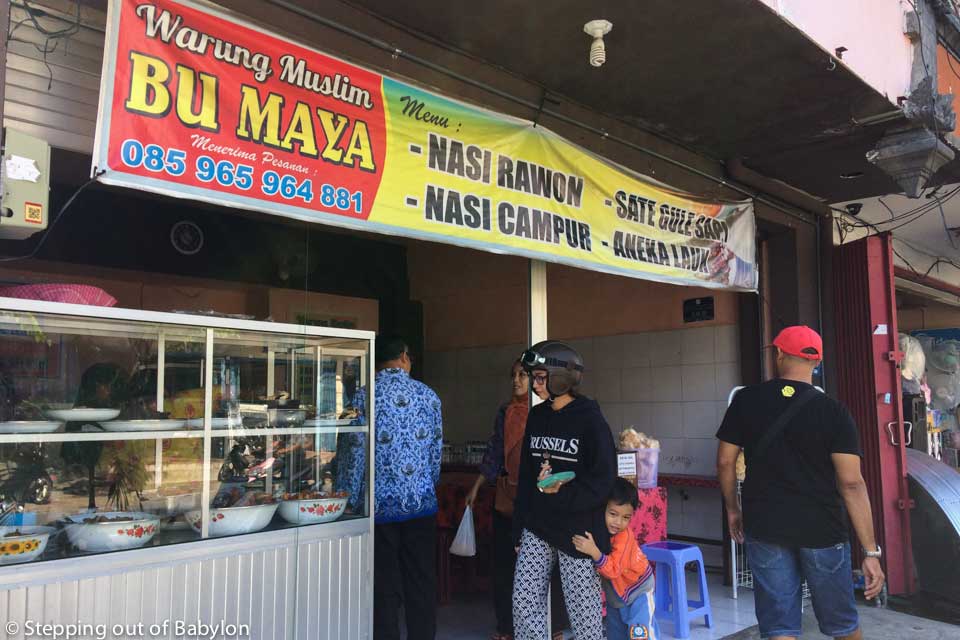
Warung Muslim Bu Maya… don’t need to go anywhere else. The food is delicious and with a lot of options!!! At Jalan Diponegoro, north from the Pasar Anyar.

Depending on your greediness for food, a meal cost around 15.000 Rp.

[columns] [span6]

Warung Muslim... delicious food on the center of singaraja
Warung Muslim… delicious food on the center of singaraja

[/span6][span6]

Nasi Campur at Warung Muslim

[/span6][/columns]

What to do in Singaraja:

  • A 12 km east from Singaraja, and at 6 km from Bulian Homestay, you can find the Pura Meduwe Karang…. on the road to Singaraja, here are many temples showing interesting statues and decoration, but don’t know about his historical values. There’s not a fee to visit the temple but is expected a donation… 10.000 Rp is ok.
  • Pasar Anyar… a big covered market at the center of Singaraja…. didn’t like it, as I found it too dirty and smelly and nothing really interesting to see, but apparently is more interesting around 5 a.m.
  • But Singaraja, away from the tourist route is a good opportunity to buy the traditional Balinese sarongs, batik or ikat… around the market nearby the Jalan Diponegoro and Jalan A. Yani you can find a few shops… a handmade ikat sarong can cost from 100.000 Rp to 300.000 Rp, depending oo the length, the pattern and the quality of the fabric. The industrial ones, made by printing process are cheaper, around 50.000 Rp.
one of the shops around Pasar Anyar where you can find hand made ikat sarongs

How to go from Batur to Singaraja:

  • From Penelokan junction, nearby the market building, stops a bus to Singaraja; it arrived before 9 am, but is better to arrive earlier to the bus stand as this service is not frequent and probably just run during the mornings. It’s a nice journey trough the hills that took 1:40h to reach the Kerobokan terminal and cost 000 Rp.
  • From here you need to take a bemo to Singaraja or any other destination… don’t deal with the guys inside the terminal, as there are many bemos waiting outside on the main road, leading both east and west.
  • A private car can be arranged, from Batur to Singaraja or Lovina, by 300.000 Rp.
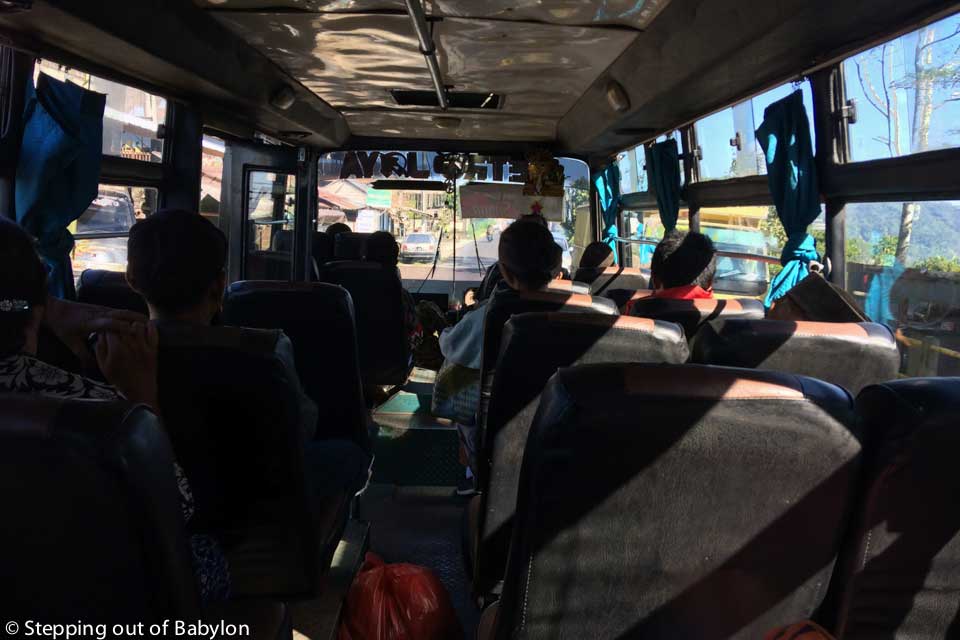
bus from Penelokan (Batur) to SIngaraja

see also:

How to go from Singaraja to Pemuteran:

How to go from Pemuteran to Gilimanuk:

Pura Ulun Danu Batur… a holy place in a holy day

So what was to be a trip to have an impressive view of the lake and mountains of Batur region, result in an even more exciting and memorable visit to the temple, due to the celebration of the Kuningan day that marks the day when the ancestors return to heaven after visiting the earth during Galungan celebration that lasts for ten days.

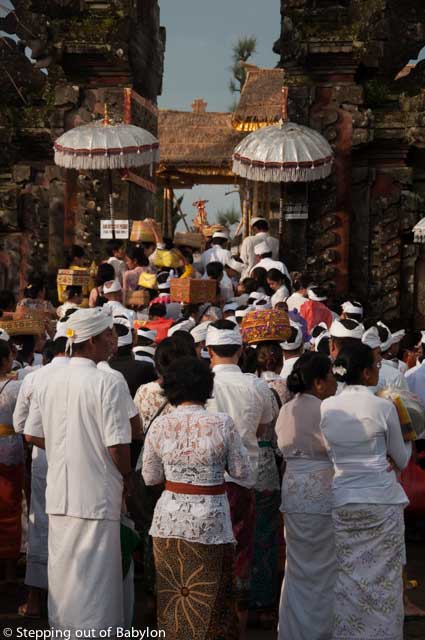
Visiting the Pura Ulun Danu Batur (also known as Pura Batur) during this celebration result in a memorable experience, with thousands of pilgrims arriving during all day, dressing the Balinese traditional clothes and bringing offerings like rice, fruits, cakes, money, meat, fish, flowers and incense that leave a trace of a sweet smell in the air.

From the original Pura Ulun Danu Batur, dedicated to the goddess of lakes and rivers, only one temple survive after one of the eruptions of the Batur volcano that also destroyed the village, forcing the population to move away from the lakeside and rebuild the temple there.

The stay in Batur area left a bitter taste on my memory, but the opportunity to visit Pura Ulun Danu Batur, the second most important temple in Bali, during the celebration of the Kuningan Hindu festival, was a gift from the “gods”!!!

Pura Ulun Danu Batur on the celebration of the Kuningan day
Pura Ulun Danu Batur
Pura Ulun Danu Batur. Bali
The frangipani flowers is the symbol of Bali, and is frequently used during the ceremonies and for decoration the offerings to the temples. Pura Ulun Danu Batur. Bali
Pura Ulun Danu Batur. Bali
Elaborated decoration for temples and houses, according to the Balinese Hindu traditions. Pura Ulun Danu Batur. Bali
Pura Ulun Danu Batur. Bali


How to visit Pura Ulun Danu Batur:

At Penelokan you can get a bemo… the price until the temple is 20.000 Rp, too much for just 5 kilometers, but think that the drivers were taking advantage of the festival, as the local people were paying the same.

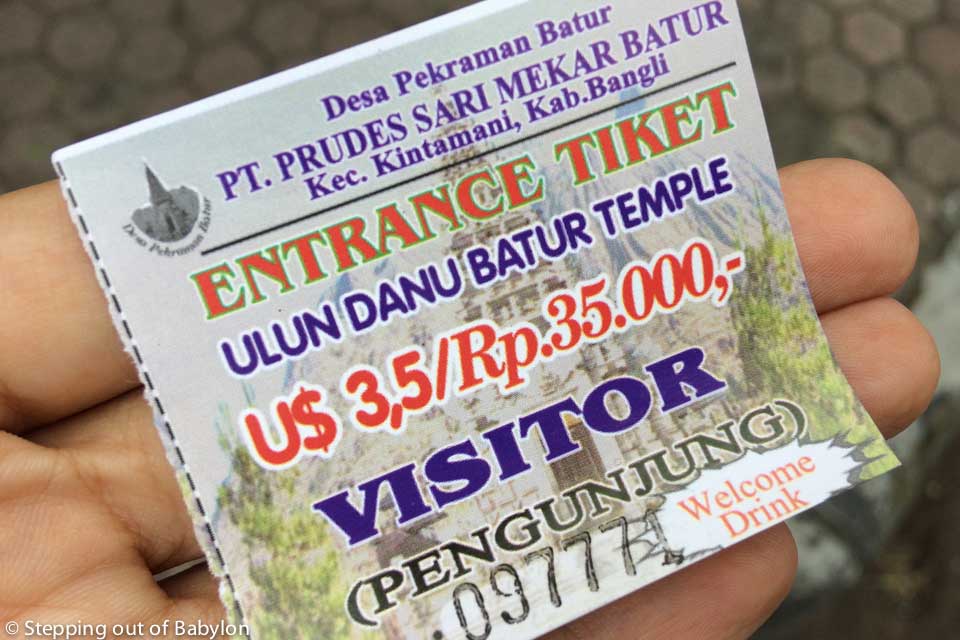
Ticket to visit the Pura Ulun Danu Batur is 35.000 Rp… and you get a bottle of water for free!

Both men and women must wear a sarong.

Nearby there are many food stalls and eateries.

[columns] [span6]

entrance ticket for Pura Ulun Danu Batur

[/span6][span6]

Ticket counter for foreigners at Pura Ulun Danu Batur

[/span6][/columns]


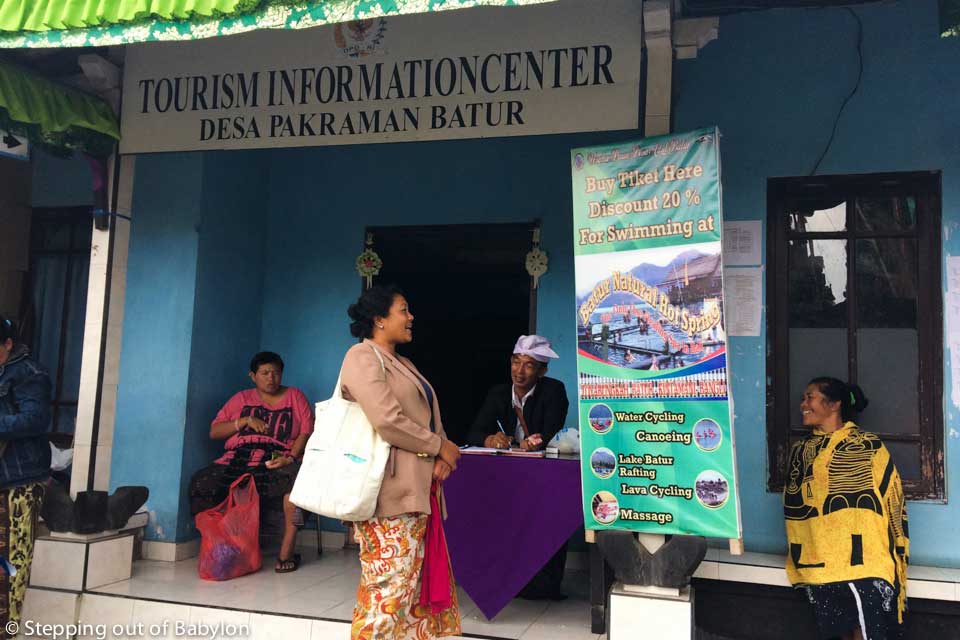
Batur… the lake or the volcano?!

Leaving behind the beach and the seashore that are letting my skin with a strong tan, it time to move to the Bali countryside and visit the area of Batur, famous for the volcano (Gurung Batur) and the lake below (Danau Batur).
This is a very touristic attraction, with people coming for climbing the Mount Batur to see the sunrise and others just come here as a day trip to enjoy the views. So what to do?! Lake or mountain?!?!

The answer came naturally… neither of them!!! By change I arrive at Batur on a special Hindu day: the end of the Galungan festival…. and also by chance (or maybe not!) one of the second most important temples in Bali, the Pura Ulun Danu Batur (also known as Pura Batur) is located nearby.

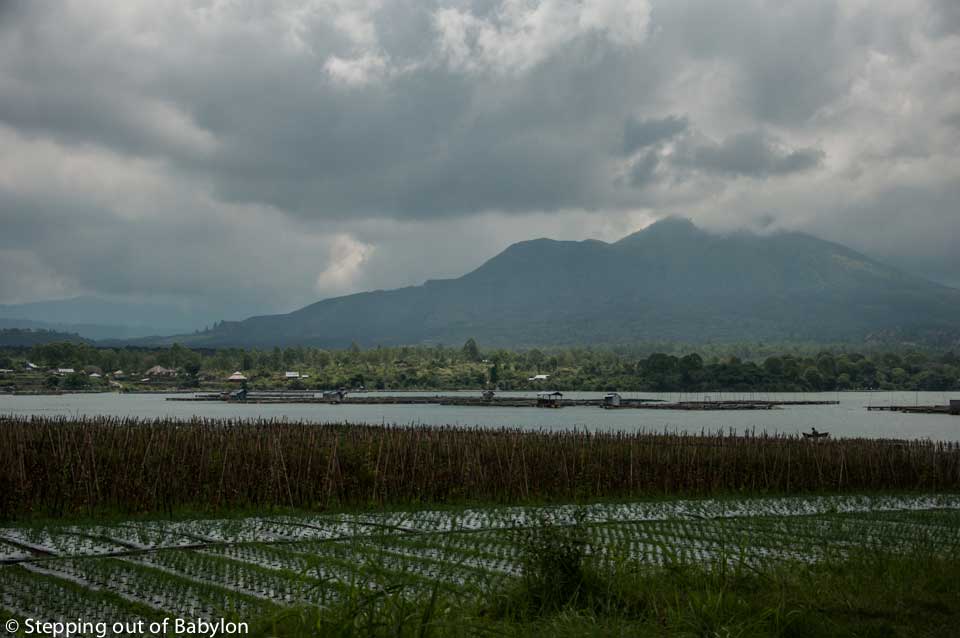
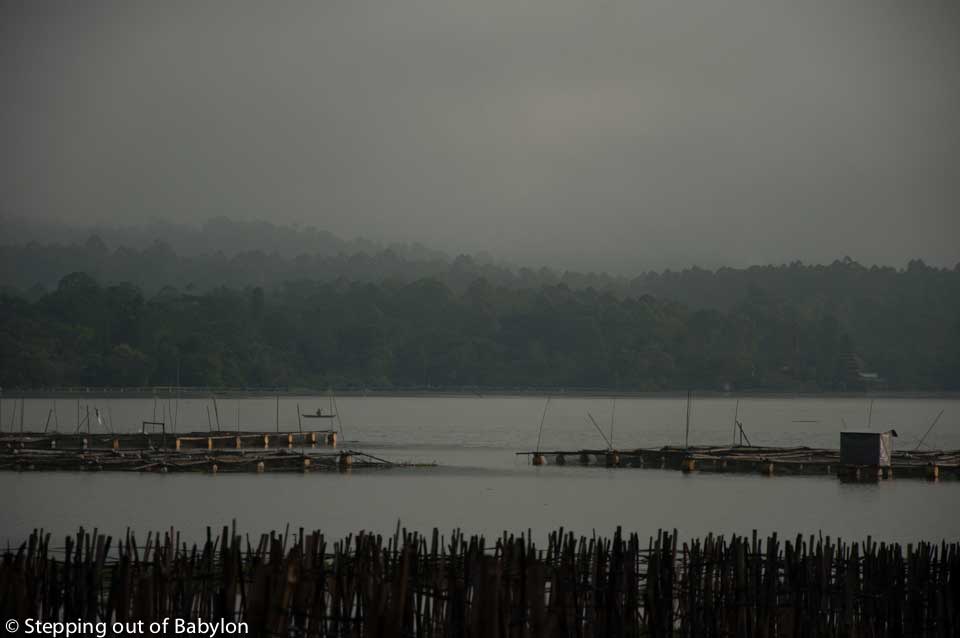
But despite the festival that brought a meaning to visit this place, the mount Batur didn’t impressed, as the top was most of the time cloudy, except early morning, and the lake was most of the time wrapped by a layer of mist that painted the landscape with sad colors. This gloomy feeling spread to the lethargic Kedisan and to the characterless Penelokan, and was able to change also my mood!

Lake Batur and the Volcano
Lake Batur and the Volcano wrapped in clouds view from Kedisan village
Kedisan, nearby the Batur lake
Gurung Batur early Morning. Bali

But Kedisan, look like woke up from the sleepy mood to celebrate the last day of the Galungan festival, and the temple nearby was the center of all the activity.

Women caring heavy offerings made form fruits at their head walking in the quiet streets of Kedisan… while the men in groups, play music, grill satay (meat sticks) and drink rice wine, away from the religiosity of the day. But later everybody goes to the temples as the religion has a big importance on the Balinese daylife.

Women caring heavy offerings made form fruits at their head walking in the quiet streets of Kedisan
Offering at a temple nearby Kedisan
gongs form the "gamelan" orquestra that plays during the Hindu celebrations
gongs form the “gamelan” orquestra that plays during the Hindu celebrations
Temple nearby Kedisan during the Kuningan celebration
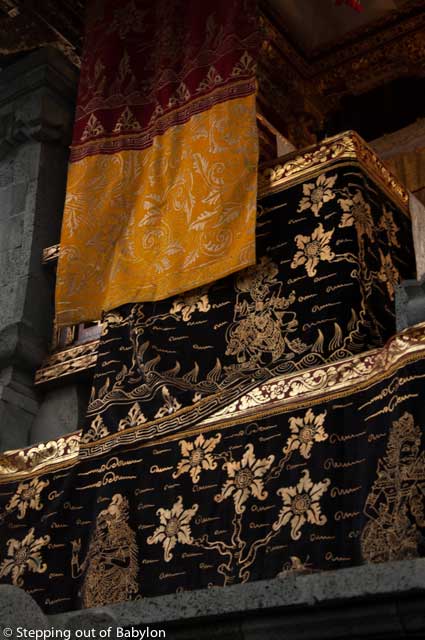
the Balinese Hindu temples have always complex and elaborate decorations, full of significance according to the religious traditions
Hindu temple in Kesidan. Batur. Bali

Where to sleep at Batur area:

There are basically 4 different areas around Gurung Batur:

  • Penelokan: this is the best viewpoint of the lake and to Gurung Batur, but isn’t much more than an intersection on the road, with a parking area, a market with souvenirs… a place without character.
  • Kintamani: this village spreads along the road and is nearby some significant temples, as Pura Ulun Danu Batur, with a lot of eateries and a local vibe but didn’t spot much accommodations… and is about 5 km from Penelokan and 10 km from the lake Danu Batur, that makes this place away from the nice views of Batur.
  • Kedisan: located on the west side of the lake, at water level, offer a nice view to the volcano and the mountains surrounding the lake, is very quiet and has a local vibe with a few warungs, but not much more is going on here.
  • Toya Bungkah: located nearby the north shore of the lake is the base point to start the hiking to Gurung Batur.

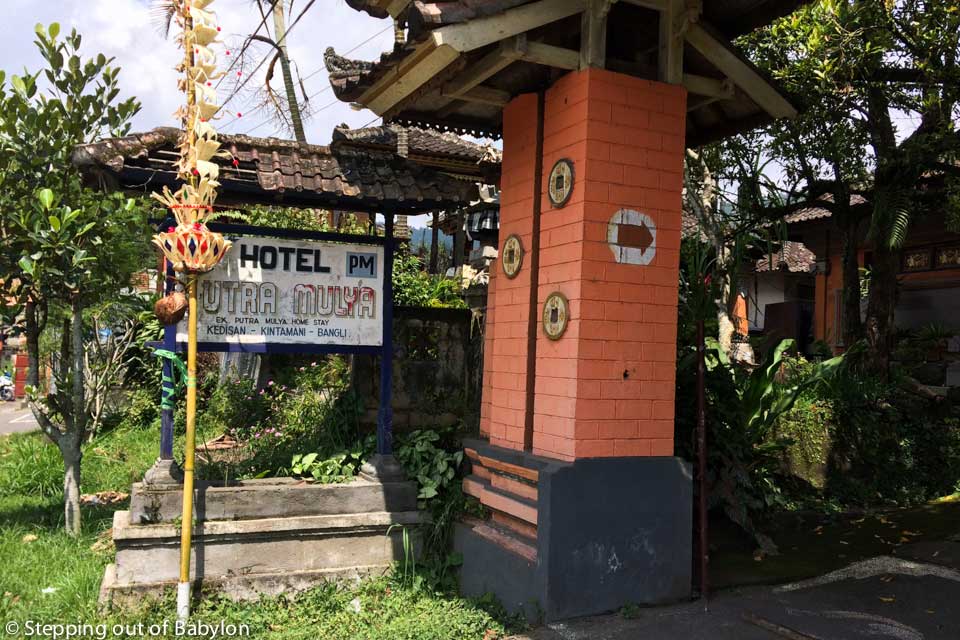
As the prices are higher that usual in Bali, as Batur is one important tourist destination on the island, the areas that offer cheap option are Toya Bungkah and Kedisan. As I was here more for the views than for the hike, I choose the last option and stay in one of the three options around Kedisan, Putra Mulya Hotel, that is more a homestay.

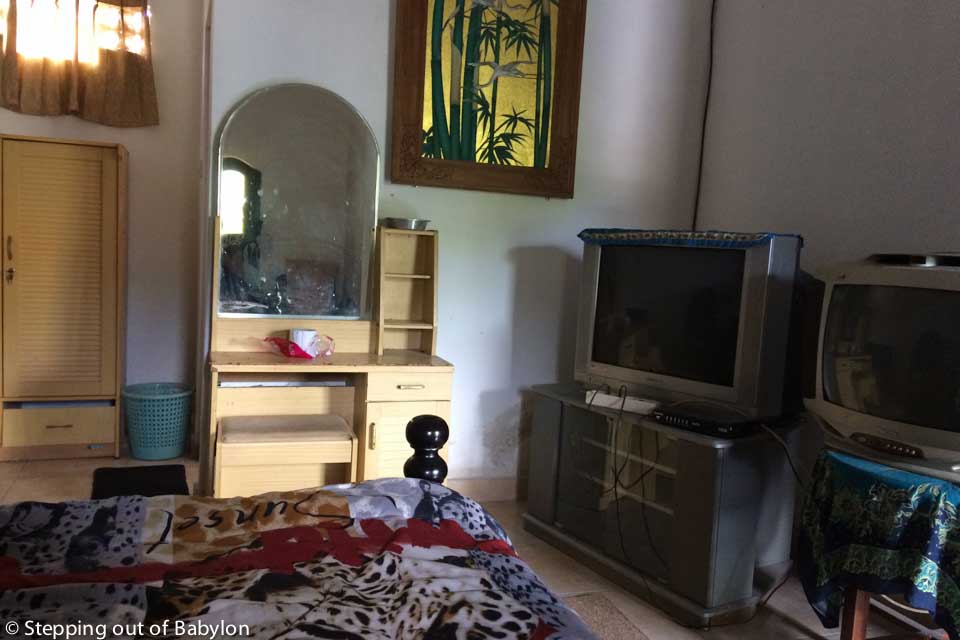
A super nice lady runs Putra Mulya Hotel, but the rooms accuse many years without maintenance, decadent and dirty, with a strong mold smell. Room for 100.000 Rp that include a horrible breakfast… not even the coffee was good.

[columns] [span6]

Putra Mulya Hotel em Kedisan, Batur

[/span6][span6]

Look much better in the photo than it rally is... Putra Mulya Hotel em Kedisan, Batur.
Look much better in the photo than it rally is… Putra Mulya Hotel em Kedisan, Batur.

[/span6][/columns]

Where to eat in Batur area:

Along the road that cross Kedisai you can find a few sleeping warungs, any of them looking attractive.

At Penelokan I didn’t spot any restaurant or eatery, just a stall of bakso (meatballs soup) but is a good place to buy fruits.

Kintamani has many eateries along the road, nearby the Nusa Ulun Danu Batur; basic and humble places, serving goregan (deep fry tofu, banana, corn, etc…), bakso and the usual rice dishes, mainly orientated to local visitors. A nasi campur (pronounce champur) cost 20.000 Rp.

many warungs nearby Pura Batur

How to go from Amed to Batur area:

  • By Shuttle bus:

Everywhere in Amed, you can find agencies offering this service for 200.000 Rp (minimum 2 people). If you are traveling along you can try to arrange a car for a cheaper price at your homestay.

Definitively this is the faster and the more comfortable way to travel…. but I was alone!

  • By public transport:

There is a route along the north coast, from Amed to Tedjakula, where you can find an ojek to Kintamani. But this road crosses dry areas and don’t offer nice views of the volcano.

So the other option is to go first to Almapura, and then to Besakih, and from here to Kintamani; this entire trip is possible to be made by bemo and bus. This was my choice as the road pass by rice fields and a more pleasant landscape, as people in Amed told me it. But… but there are always something unpredictable, and by chance I travel on the Kuningan day, an important Balinese religious celebration, that means that most of the public transport wasn’t working, what make this trip to Batur a very difficult task, forcing me to find another route.

  • Bemo from Culik to Amlapura: 20.000 Rp… just wait on the road for a red old mini-van… it will take around 30 minutes to Amlapura. On the way, you can see the beautiful rice fields landscape of Tirtaganga.
  • bus Amlapura to Gianyar: 30.000 Rp… this bus is not much different from a bemo, just a bit bigger, and also drives very slow. It was difficult to communicate with the driver but he dropped me in a junction near Gianyar, from where there’s a direct road to Batur, passing by Bangli. It took around 1.5 hours.
  • Ojek from Gianyar to Batur (Kedisan): 50.000 Rp… after one hour waiting for a bemo didn´t have other option than getting a moto-taxi. It’s a pretty nice trip along rural areas, and the last part is particularly winding and steep.

How to go from Batur to Singaraja:

  • From Kedisan to Penelokan: bemo 10.000 Rp or just try to hitchhike and give the same amount of money to the driver if he want.
  • At Penelokan junction, nearby the market building, wait for the bus to Singaraja: it arrived before 9 am, but is better to arrive earlier to the bus stand as this service is not frequent and probably just during the mornings. It’s a nice journey trough the hills that took 1:40h to reach the Kerobokan terminal and cost 50.000 Rp. From here you need to take a bemo to Singaraja or any other destination… don’t deal with the guys inside the terminal, as there are many bemos waiting outside on the main road
  • A private car can be arranged by 300.000 Rp to Singaraja… good if you travel in a group!

How to visit Pura Ulun Danu Batur:

At Penelokan you can get a bemo… the price until the temple is 20.000 Rp, too much for just 5 kilometers, but think that the drivers were taking advantage of the festival, as the local people were paying the same.

Ticket to visit the Pura Ulun Danu Batur is 35.000 Rp… and you get a bottle of water for free!

Both men and women must wear a sarong.

Nearby there are many food stalls and eateries.


  • « Go to Previous Page
  • Page 1
  • Page 2
  • Page 3
  • Page 4
  • Page 5
  • Page 6
  • Go to Next Page »

Footer

search

Tags

Amed Arugam Bay Assam Bali Border Crossing Borneo Colombo Esfahan Fes Food Gilis Hiking hokkaido Istanbul Itinerary Jakarta Java Kashan Kohima Kumano Kodo Litang Lombok Meghalaya Meknes Mekong Mulay Idriss Nagaland Natural Park Northeast States Ouarzazate Sarawak Shangri-lá (Zhongdian) Shan State Shiraz Sichuan Province Sishuan Sumatra Tabriz Tehran transportation Visa Yangon Yazd Yogyakarta Yunnan Province

I’m Catarina, a wanderer from Lisbon, Portugal… or a backpack traveller with a camera!

Every word and photo here comes from my own journey — the places I’ve stayed, the meals I’ve enjoyed, and the routes I’ve taken. I travel independently and share it all without sponsors or ads, so what you read is real and unfiltered.

If you’ve found my blog helpful or inspiring, consider supporting it with a small contribution. Every donation helps me keep this project alive and free for everyone who loves exploring the world.

Thank you for helping me keep the journey going!

BUY ME A COFFEE

Categories

Recent Posts:

  • How to go from Hualien to Dulan Beach
  • Taroko Gorge: between marble cliffs and emerald rivers
  • Hualien: a dull gateway to Taroko Gorge
  • Taiwan: Itinerary for an 16 day trip
  • Vietnam: Itinerary
  • 3 months in India: Kolkata, Tamil Nadu, Karnataka, Goa and Kerala
  • Backpacking Turkey in 24 Days: itinerary & costs
  • English
  • Português

© Copyright 2026 Stepping out of Babylon · All Rights Reserved · Designed by OnVa Online · Login